Quick answer
Desert animals are animals that live in dry habitats with low rainfall, intense sunlight, limited shade, and often large temperature swings between day and night. They survive through special adaptations such as water conservation, heat avoidance, nocturnal behavior, burrowing, pale coloration, efficient kidneys, large ears, tough skin, and specialized diets.
Not all deserts are hot. Some deserts are cold, high-altitude, or coastal. This means desert animals do not all look or behave the same way. A camel in the Sahara, a kangaroo rat in North America, a thorny devil in Australia, and a snow leopard near cold desert regions all face dryness, but their survival strategies are very different.
Summary table
| Desert Animal | Type | Where It Lives | Key Adaptation |
|---|---|---|---|
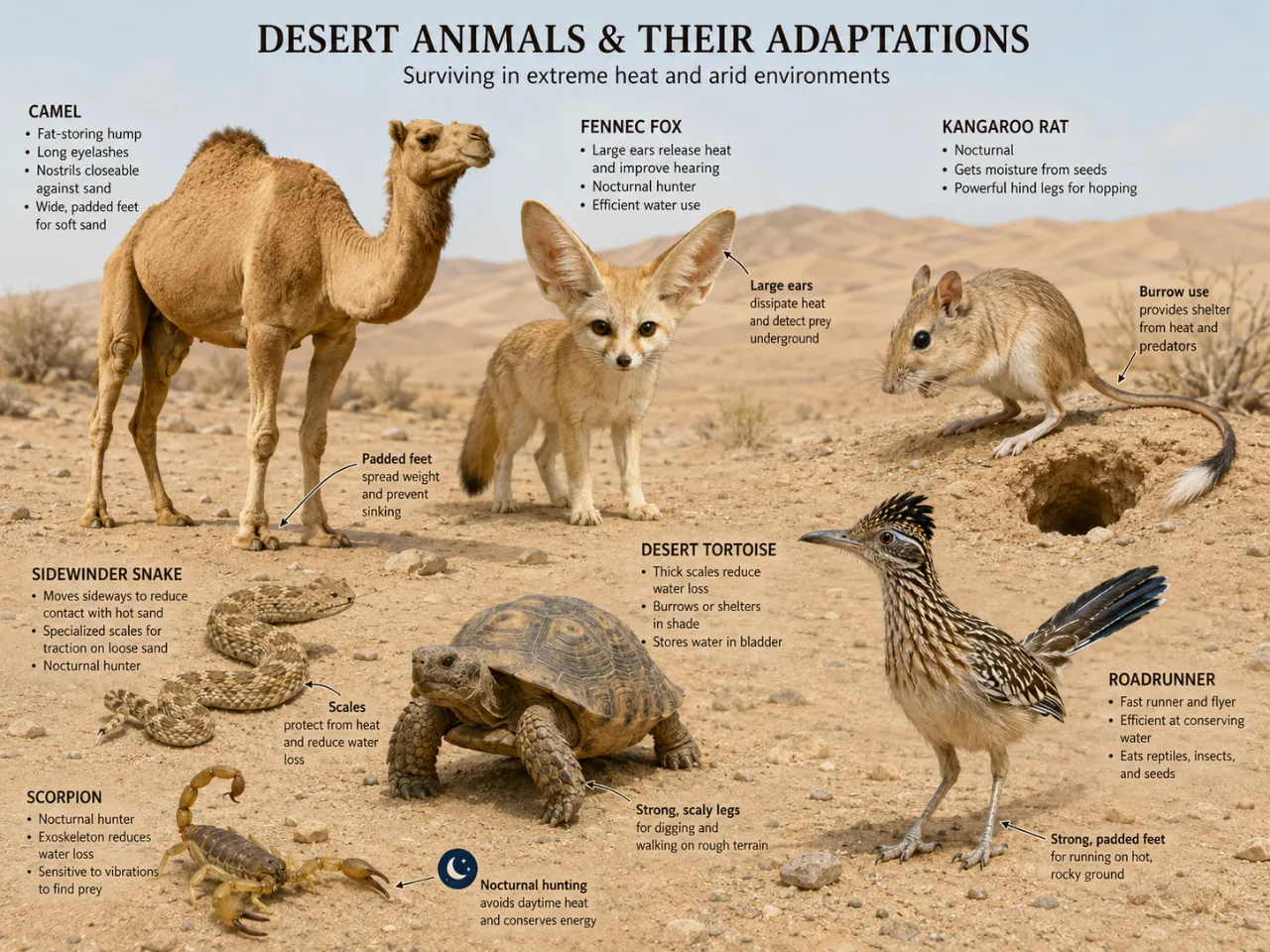
| Camel | Mammal | Africa, Asia, and domesticated desert regions | Stores fat in humps and tolerates dehydration well |
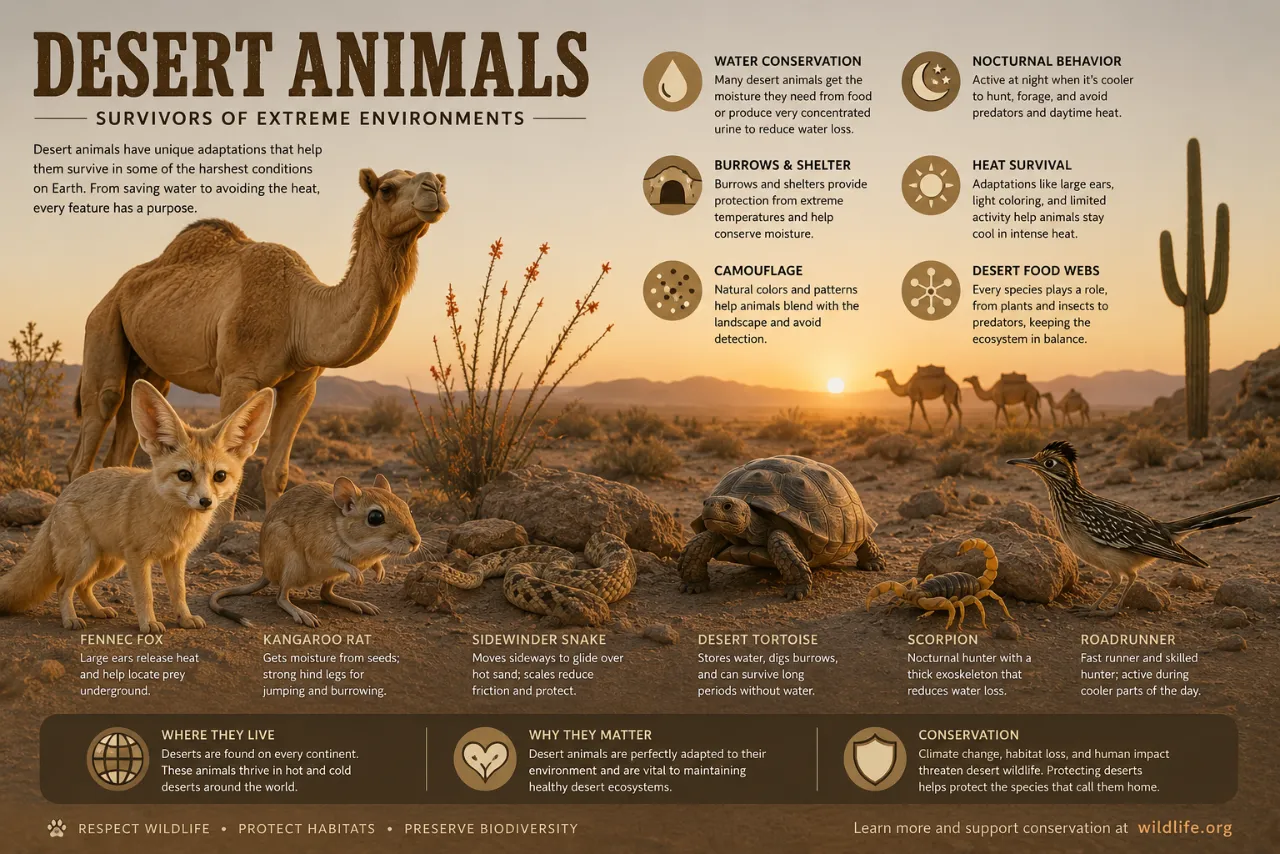
| Fennec fox | Mammal | Sahara and North African deserts | Large ears help release heat and detect prey |
| Kangaroo rat | Mammal | North American deserts | Can survive largely on water from seeds |
| Sidewinder rattlesnake | Reptile | Sandy deserts of North America | Sidewinding movement reduces contact with hot sand |
| Desert tortoise | Reptile | Southwestern United States and northern Mexico | Uses burrows and stores water in the body |
| Thorny devil | Reptile | Australian deserts | Grooved skin can help channel moisture toward the mouth |
| Scorpion | Arachnid | Many deserts worldwide | Nocturnal behavior and low water loss |
| Roadrunner | Bird | North American deserts and scrublands | Runs efficiently and eats many desert animals |
What makes an animal a desert animal?
A desert animal is not defined by one body shape or one group of species. Instead, it is defined by its ability to live in dry habitats. Deserts generally receive very little rainfall, and water may appear only seasonally, underground, in plants, or after rare storms.
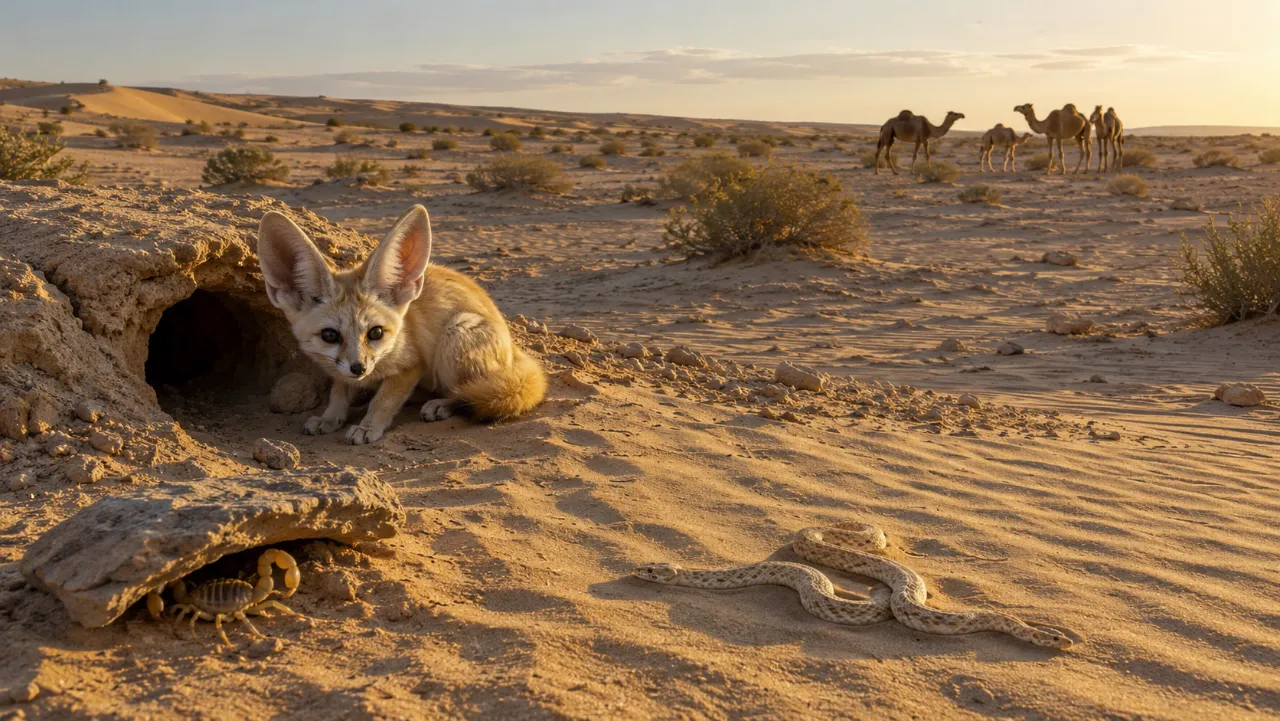
Desert animals must solve several problems at once. They need to avoid overheating, reduce water loss, find enough food, escape predators, and reproduce successfully in a harsh landscape. These challenges shape their bodies and behavior over many generations.
Some desert animals live almost entirely in open sand. Others live in rocky canyons, dry grasslands, salt flats, thorn scrub, dry riverbeds, or desert mountains. Because deserts are diverse, desert animals are also highly diverse.
How desert animals survive heat
Heat is one of the most obvious challenges in many deserts. During the day, sand and rocks can become extremely hot. Many animals avoid this danger by being nocturnal, meaning they are most active at night. Others are crepuscular, meaning they are active mainly around dawn and dusk.
Burrows are another important heat defense. A burrow can be much cooler than the surface during the day and warmer than the surface at night. Desert tortoises, kangaroo rats, foxes, spiders, snakes, and many insects use underground shelters to avoid extreme temperatures.
Some animals use body shape to manage heat. Fennec foxes have very large ears that help release heat. Many desert reptiles raise parts of the body off hot ground, move between shade patches, or bask only during safer parts of the day.
How desert animals find and conserve water
Water is often the most important limiting resource in deserts. Some animals drink when water is available, but others may go long periods without drinking. Kangaroo rats are famous for getting much of their water from the seeds they eat. This water is produced during metabolism as the body breaks down food.
Camels are often misunderstood. Their humps do not store water directly; they store fat. This fat can be used as an energy reserve and may indirectly help with survival when food and water are scarce. Camels can also tolerate dehydration better than many mammals and can drink large amounts when water becomes available.
Many desert animals have efficient kidneys, dry droppings, waterproof skin, or behaviors that reduce sweating and evaporation. Reptiles and insects often lose less water than mammals because of their body coverings and waste systems. In many species, survival depends as much on saving water as finding it.
How desert animals sense danger and find food
Desert animals often rely on sharp senses because food, mates, shelter, and predators may be spread across large areas. Smell is important for many mammals, reptiles, insects, and arachnids. A fox may smell prey under sand, while a snake may use chemical cues to track small animals.
Hearing is also useful, especially at night. Large-eared desert mammals can detect insects, rodents, or predators in the dark. Owls and foxes may locate prey by sound, even when the prey is hidden under vegetation or soil.
Vision varies by species. Some desert animals have excellent night vision, while others are adapted to bright daylight. Many birds of prey can scan open desert terrain from above. Lizards may use quick visual detection to spot insects, rivals, or predators.
How desert animals move across sand and rock
Movement in the desert can be difficult. Loose sand, sharp rocks, steep dunes, and hot surfaces all create challenges. Some animals have wide feet that spread their weight and prevent sinking. Camels, for example, have broad padded feet that help them walk over soft ground.
The sidewinder rattlesnake uses a specialized movement pattern that leaves only small parts of the body touching the hot sand at one time. This helps the snake move efficiently across loose dunes while reducing heat contact.
Small rodents often hop or bound quickly between cover. Lizards may lift their feet rapidly from hot ground. Insects may use long legs to keep the body away from the hottest surface. In the desert, efficient movement can save both energy and water.
Which desert adaptation is strongest?
There is no single strongest desert adaptation for every animal. For some species, water conservation is the most important. For others, heat avoidance, camouflage, venom, speed, burrowing, or social behavior may be more important.
For kangaroo rats, water-saving physiology is especially powerful. For camels, tolerance of dehydration and long-distance movement are key. For scorpions, nocturnal hunting and low water loss are essential. For desert tortoises, burrows and long-term water storage are vital.
The best desert survivors usually combine several adaptations. A nocturnal animal that also conserves water, hides well, and eats a flexible diet has a better chance of surviving unpredictable desert conditions.
Do all desert animals survive the same way?
No. Desert animals use many different survival strategies. A camel is a large grazing mammal that can travel long distances. A scorpion is a small nocturnal predator that hides by day and hunts at night. A cactus wren builds nests among thorny plants. A desert tortoise may spend much of its life in burrows.
Some desert animals are specialists, adapted to narrow diets or particular habitats. Others are generalists that eat many foods and use many shelters. Generalists may adapt better to change, while specialists may be more vulnerable if their habitat or food source declines.
Even within the same desert, animals may use different time schedules. Some are active at night, some at dawn, some after rain, and some only during cooler seasons. Desert life is often about timing.
Examples of desert mammals
Desert mammals include camels, fennec foxes, kangaroo rats, jerboas, jackrabbits, oryx, meerkats, coyotes, and many bats. Mammals face special challenges because they are warm-blooded and often need more water than reptiles or insects.
Many desert mammals avoid daytime heat. They rest in shade, burrows, dens, or rocky shelters, then become active when temperatures drop. Some have large ears, pale fur, long legs, or efficient kidneys.
Small mammals are especially important in desert food webs. Rodents eat seeds and plants, spread some seeds, dig burrows, and provide food for snakes, foxes, owls, coyotes, and other predators.
Examples of desert reptiles
Reptiles are often very successful in deserts because their bodies generally conserve water better than those of many mammals. Desert reptiles include snakes, lizards, geckos, tortoises, skinks, and monitors.
Lizards may bask in the morning to warm up, then retreat to shade when temperatures become too high. Snakes often hunt at night or during cooler hours. Desert tortoises spend long periods in burrows and may become less active during drought or extreme heat.
Reptiles still need careful temperature control. Too little heat can slow them down, while too much heat can be deadly. Their survival depends on moving between sun, shade, soil, rocks, and burrows at the right time.
Examples of desert birds
Desert birds include roadrunners, owls, hawks, vultures, sandgrouse, cactus wrens, larks, ravens, and many migratory species. Birds can escape some desert problems by flying long distances, but they still need food, nesting sites, and water or moisture from food.
Some desert birds are active early in the morning when temperatures are lower. Others use shade, panting, or special behaviors to cool themselves. Many nest in cactus, shrubs, cliffs, burrows, or hidden ground sites.
Birds also play important ecological roles. They eat insects, reptiles, seeds, carrion, and small mammals. Some spread seeds, pollinate plants, or clean up carcasses.
Examples of desert insects and arachnids
Desert insects and arachnids include ants, beetles, termites, grasshoppers, bees, flies, scorpions, spiders, mites, and solifuges. These animals are often small, but they are extremely important in desert ecosystems.
Many are active at night or after rain. Some beetles can collect moisture from fog or dew in certain deserts. Ants may forage quickly and return underground before the heat becomes dangerous. Scorpions often hide under rocks or in burrows during the day and hunt at night.
Because insects and arachnids are food for many larger animals, they help support desert birds, reptiles, mammals, and amphibians. Without small invertebrates, many desert food webs would collapse.
Why desert animals matter in ecosystems
Desert animals help keep dry ecosystems functioning. Herbivores graze plants and spread seeds. Predators control prey populations. Scavengers recycle nutrients. Burrowing animals loosen soil and create shelters that other species may use.
Even small animals can have large effects. Ants move soil and seeds. Termites break down dry plant material. Rodents store seeds underground. Lizards and birds reduce insect populations. Scavengers such as vultures and beetles help clean the landscape.
Deserts may look empty at first, but they are full of specialized relationships. Many animals depend on seasonal rain, flowering plants, insect outbreaks, or temporary pools. When one part of the system changes, many species can be affected.
Threats to desert animals
Desert animals face natural challenges, but human activity adds new pressures. Habitat loss, road construction, mining, livestock overgrazing, off-road vehicles, water extraction, pollution, invasive species, and climate change can all affect desert wildlife.
Climate change may increase heat stress, alter rainfall patterns, reduce plant growth, and make droughts more severe in some regions. Animals already living near their heat or water limits may struggle if conditions become more extreme.
Some desert animals are also harmed by illegal collection for the pet trade, hunting, poisoning, or conflict with humans. Protecting desert wildlife often means protecting large landscapes, water sources, migration routes, and fragile soil crusts.
Final takeaway
Desert animals are not simply animals that tolerate heat. They are highly adapted survivors that manage water carefully, avoid extreme temperatures, find scattered food, and use special behaviors to live in some of Earth’s driest habitats.
From camels and fennec foxes to kangaroo rats, sidewinder snakes, scorpions, tortoises, and roadrunners, desert animals show many different solutions to the same basic problem: how to live where water is scarce and conditions can change quickly. Their adaptations make deserts far more alive than they may appear at first glance.
FAQs
What are the most common desert animals?
Common desert animals include camels, foxes, rodents, snakes, lizards, tortoises, owls, hawks, vultures, scorpions, ants, beetles, and spiders. The exact species depend on the desert region.
How do desert animals survive without much water?
Many desert animals conserve water through efficient kidneys, dry waste, waterproof skin or scales, nocturnal behavior, burrows, and diets that provide moisture. Some get much of their water from food rather than drinking often.
Are all desert animals nocturnal?
No. Many desert animals are nocturnal, but not all. Some are active at dawn or dusk, some are active during cooler seasons, and some reptiles bask during safe daylight hours before retreating from extreme heat.