The yacare caiman is a medium-sized crocodilian that lives in South America. It is commonly associated with wetlands, rivers, marshes, and seasonally flooded grasslands, where it feeds on fish, snails, crustaceans, amphibians, birds, and other small animals.
At first glance, the yacare caiman may look similar to other caimans, especially the spectacled caiman. However, it has its own range, proportions, and ecological role. In places such as the Pantanal, it can be one of the most visible reptile predators in the landscape.
In this guide, you will learn the most important yacare caiman facts, including its size, habitat, diet, appearance, behavior, and range.
Quick facts
| Feature | Yacare Caiman |
|---|---|
| Scientific name | Caiman yacare |
| Group | Caiman in the alligator family |
| Range | Central South America |
| Habitat | Rivers, marshes, lagoons, swamps, flooded grasslands, wetlands |
| Diet | Carnivorous |
| Typical prey | Fish, snails, crustaceans, amphibians, birds, reptiles, small mammals |
| Typical size | Usually medium-sized; males are larger than females |
| Main trait | Wetland predator strongly associated with the Pantanal and nearby regions |
What is a yacare caiman?
The yacare caiman is a South American crocodilian in the caiman branch of the alligator family. That means it is more closely related to alligators and other caimans than to true crocodiles.
It is often described as a medium-sized caiman that is well adapted to life in freshwater wetlands. In some regions, especially broad floodplains and marsh systems, it can occur in high numbers and become one of the most noticeable reptiles in the habitat.
The yacare caiman is sometimes confused with the spectacled caiman because the two are similar in overall body shape and ecology. Even so, the yacare caiman is generally treated as its own distinct South American species.
How big is a yacare caiman?
The yacare caiman is usually considered a medium-sized crocodilian. Adult males are larger than females and can become impressively long and heavy, although they are much smaller than the largest black caimans or giant crocodile species.
Many adults fall into a moderate size range compared with the largest crocodilians. Big males can exceed 2 meters and may reach around 2.5 to 3 meters in some cases, while females are smaller on average.
Even though it is not one of the biggest crocodilians in the world, a large yacare caiman is still a powerful predator with strong jaws and a muscular tail.
What does a yacare caiman look like?
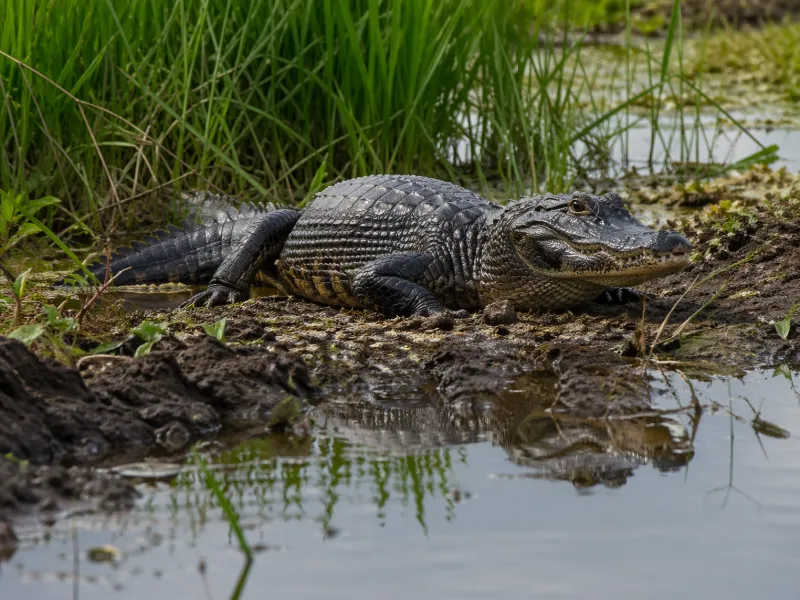
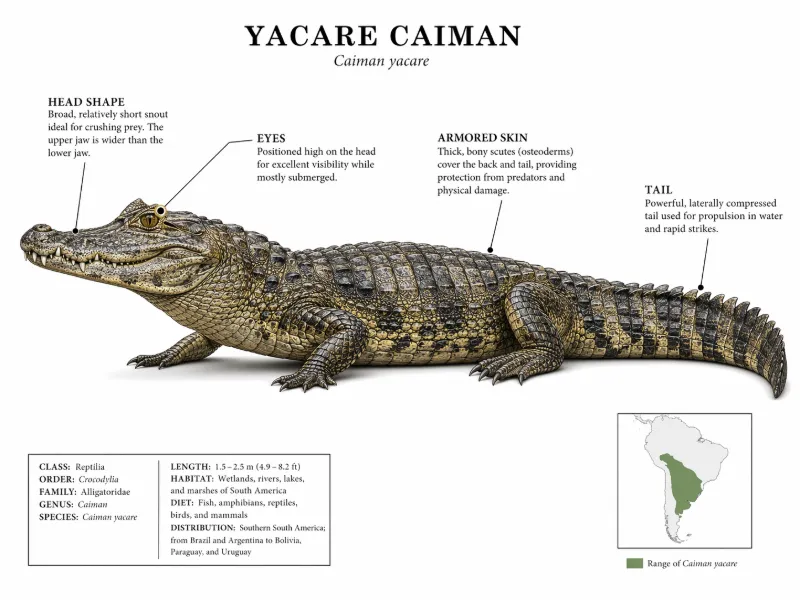
The yacare caiman has a long body, armored skin, a strong tail, and a relatively broad head. Its color is usually olive, brownish, gray, or dark greenish depending on the animal’s age, the water, and the surrounding habitat.
Like other caimans, it often shows darker bands or markings, especially when young. These markings can help break up the outline of the body in shallow water and wetland vegetation.
The head is not as sharply pointed as that of many crocodiles. Instead, it has the more compact, robust look typical of caimans. The eyes and nostrils sit high on the head so the animal can stay mostly submerged while watching prey.
In the right light, a yacare caiman can look rugged and heavily scaled, especially when basking on mud or resting at the water’s edge.
Where do yacare caimans live?
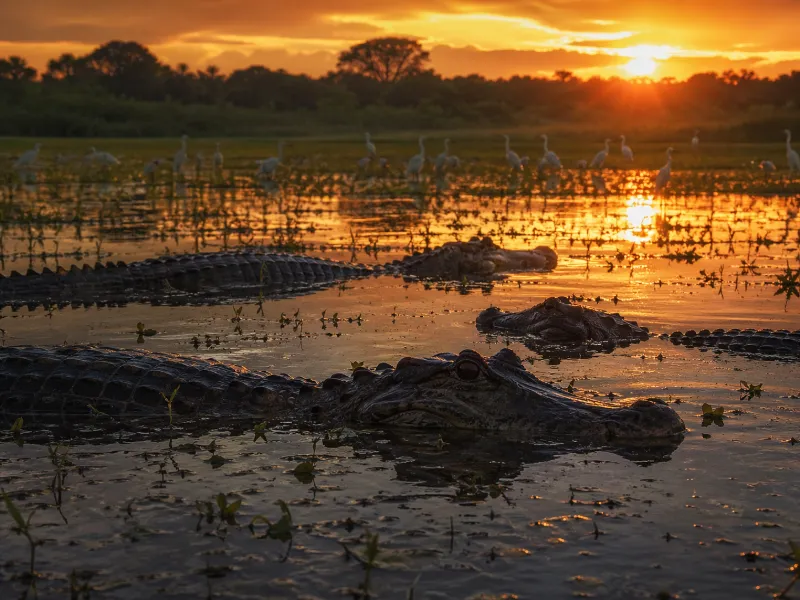
Yacare caimans live in central parts of South America. Their range includes countries such as Brazil, Bolivia, Paraguay, and Argentina, especially in major wetland systems and river basins.
They are strongly associated with freshwater habitats. Typical places include marshes, lagoons, swamps, oxbow lakes, flooded grasslands, shallow rivers, and seasonally inundated plains. They are especially well known from the Pantanal, one of the world’s largest tropical wetland regions.
Because wetlands expand and shrink with seasonal flooding, yacare caimans often use a changing patchwork of habitats through the year. During wet periods, they may spread into newly flooded areas. During drier periods, they may concentrate around deeper water.
What does a yacare caiman eat?
The yacare caiman is a carnivore and an opportunistic feeder. Its diet varies with age, size, season, and local prey availability.
Young individuals often eat aquatic insects, small crustaceans, snails, tadpoles, frogs, and small fish. These prey items are abundant in shallow wetland environments and are easier for smaller caimans to handle.
As they grow, yacare caimans take larger prey. Adults commonly eat fish, snails, crabs, amphibians, birds, reptiles, and small mammals. In some habitats, fish may make up a large part of the diet, while in others hard-shelled prey such as snails can be important.
Because it is flexible, the yacare caiman does not depend on just one kind of prey. That adaptability helps it survive in wetlands that change dramatically through the seasons.
How does a yacare caiman hunt?
Like other crocodilians, the yacare caiman is mainly an ambush predator. It often waits quietly in shallow water, near reeds, or along muddy banks until prey comes close enough for a fast strike.
Its eyes and nostrils stay above the water while the rest of the body remains hidden. When prey moves within range, the caiman lunges forward with its jaws and grabs the animal quickly.
Many yacare caimans are especially active at night, when cooler temperatures and darkness may improve hunting success. During the day, they may bask to regulate body temperature and conserve energy between feeding opportunities.
Is the yacare caiman dangerous?
The yacare caiman is a wild predator and should be treated with caution. Even though it is smaller than the biggest crocodiles or black caimans, it can still bite forcefully and defend itself if approached or cornered.
Most individuals are more likely to avoid people than to attack, but large adults, nesting females, or animals surprised at close range can be dangerous. The safest approach is always to observe from a distance and avoid entering water where caimans are known to occur.
As with other crocodilians, feeding them or getting too close can make encounters more risky for both people and the animals themselves.
How is the yacare caiman different from other caimans?
The yacare caiman is often compared with the spectacled caiman because the two are similar in size and general appearance. In practical terms, one of the biggest differences is range. The yacare caiman is strongly tied to central South American wetland systems such as the Pantanal and nearby river basins.
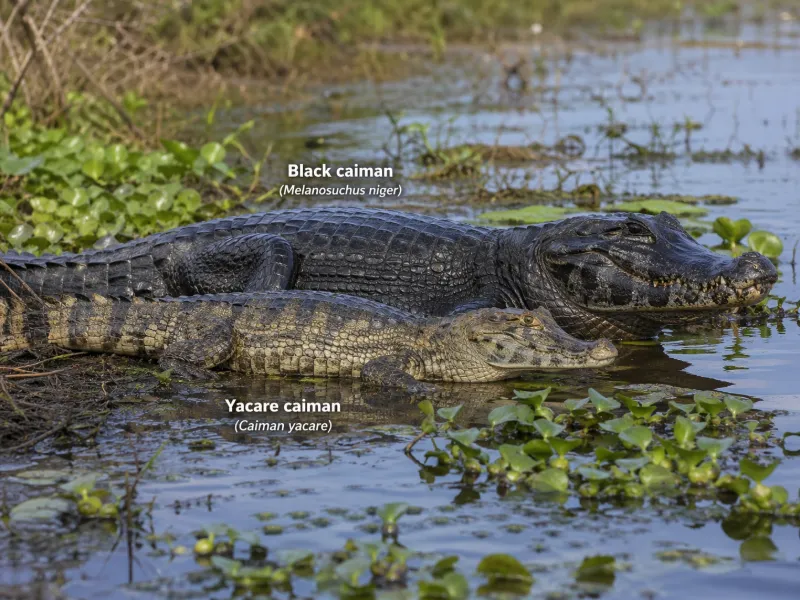
It is also usually much smaller and less imposing than the black caiman. A black caiman tends to look darker, bulkier, and far more powerful overall, especially at large adult size.
So if you are looking at a medium-sized caiman in a South American marsh or floodplain, especially in the Pantanal region, it may well be a yacare caiman rather than a black caiman.
Do yacare caimans live alone?
Yacare caimans may be seen alone or in loose concentrations, depending on habitat conditions. In productive wetlands with abundant prey and good basking sites, multiple individuals can often be found in the same general area.
This does not mean they are highly social in the way mammals such as wolves or primates are. Instead, it reflects the fact that suitable wetland habitat can support many animals at once, especially during certain seasons.
Water levels, food availability, breeding behavior, and local competition all influence how closely they occur together.
How do yacare caimans reproduce?
Like other crocodilians, yacare caimans reproduce by laying eggs. Females build nests, often using vegetation and mud, in places where warmth and cover help the eggs develop.
The female may guard the nest area, especially during the breeding season. After hatching, the young are vulnerable to many predators, including birds, fish, mammals, and larger reptiles.
Only a small fraction survive to adulthood, which is why healthy wetland habitat is important for maintaining strong populations.
What is the conservation status of the yacare caiman?
The yacare caiman has experienced hunting pressure in the past, especially where crocodilian skins were commercially valuable. However, in some major wetland areas it remains common and can recover well when habitat is protected and hunting is controlled.
Local pressures can still include habitat loss, wetland alteration, illegal killing, pollution, and conflict with people. Even a species that is doing fairly well overall can decline in places where wetlands are drained or heavily disturbed.
Its long-term future depends on maintaining healthy freshwater ecosystems across its range.
Why is the yacare caiman important?
The yacare caiman is an important predator in South American wetlands. It helps shape aquatic food webs by feeding on fish, amphibians, snails, and other animals, and it also serves as prey for larger predators when young.
Because it is common in some wetland systems, it is also an important part of ecotourism and wildlife observation. In places such as the Pantanal, seeing yacare caimans is one of the most familiar signs of a healthy reptile-rich wetland.
Protecting the yacare caiman also helps protect marshes, rivers, flooded plains, and the many other species that depend on them.
Final takeaway
The yacare caiman is a medium-sized South American crocodilian that lives in freshwater wetlands, rivers, marshes, and flooded grasslands. It feeds on fish, snails, crustaceans, amphibians, birds, and other small animals, using stealth and ambush hunting to survive in dynamic wetland habitats.
Although it is less famous than the black caiman, it is one of the most important and recognizable reptile predators in central South American wetlands.
FAQs
Where does the yacare caiman live?
The yacare caiman lives in central South America, especially in wetlands, marshes, rivers, and flooded plains in countries such as Brazil, Bolivia, Paraguay, and Argentina.
How big is a yacare caiman?
It is usually a medium-sized crocodilian. Large males can grow well over 2 meters, while females are smaller on average.
What does a yacare caiman eat?
It eats fish, snails, crustaceans, amphibians, birds, reptiles, and small mammals, depending on age and local habitat.
Is the yacare caiman dangerous?
Yes. It is a wild predator and can be dangerous if approached, cornered, or disturbed.