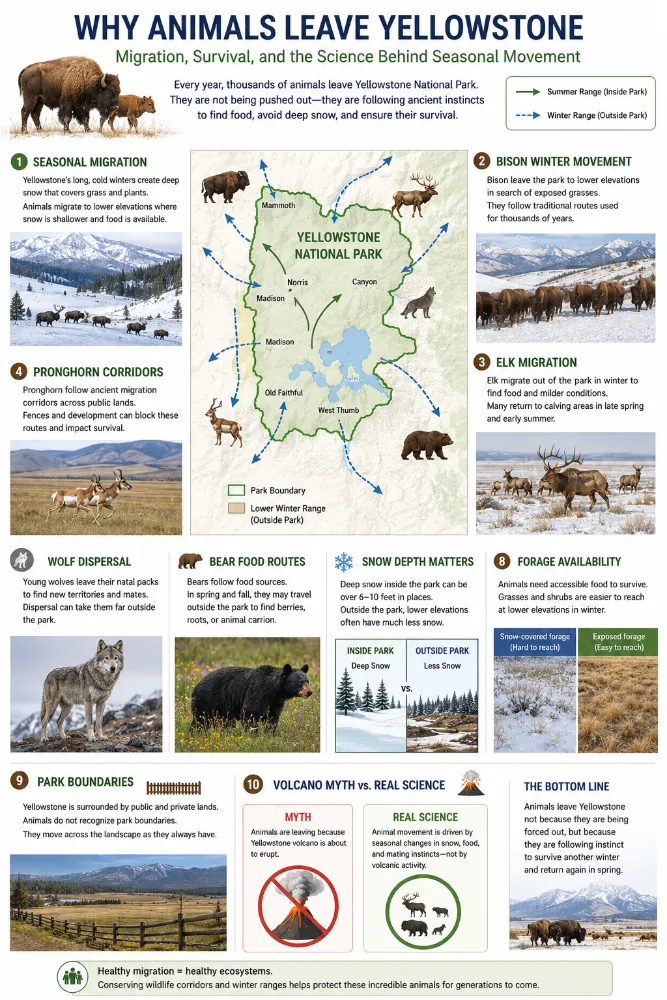
Animals leaving Yellowstone is usually normal seasonal movement, not a sign of a volcanic eruption. Yellowstone is not a fenced zoo; it is part of the larger Greater Yellowstone Ecosystem. Bison, elk, pronghorn, wolves, bears, and other animals may move across park boundaries for food, snow conditions, breeding, migration, or territory. Viral “mass exodus” claims are misleading and should not be treated as eruption warnings.
| Question | Short Answer | What It Really Means |
|---|---|---|
| Are animals leaving Yellowstone? | Some animals leave parts of the park seasonally. | This is normal wildlife movement, not a mysterious escape. |
| Does it mean Yellowstone is about to erupt? | No. | Viral eruption claims are not supported by wildlife biology or volcano monitoring. |
| Why do bison leave Yellowstone? | Mostly for winter forage, migration routes, and lower-elevation habitat. | Bison naturally move with snow depth, food access, and herd behavior. |
| Why do elk leave Yellowstone? | Many migrate between summer and winter ranges. | Elk often move to lower elevations in winter and higher areas in summer. |
| Do wolves leave Yellowstone? | Yes, sometimes. | Wolf packs follow prey, disperse, defend territories, and cross boundaries. |
| Do bears leave Yellowstone? | Yes, depending on season and food. | Grizzlies and black bears use large home ranges and food-rich habitats beyond the park. |
| Is Yellowstone fenced? | No. | Wild animals can move naturally across park edges, roads, forests, rivers, and public or private lands. |
| What should visitors do? | Observe from a safe distance. | Never approach, feed, chase, or interfere with wildlife. |
What Does “Animals Leaving Yellowstone” Really Mean?
When people say “animals are leaving Yellowstone,” they may mean several different things. Some are normal and scientifically expected. Others are online rumors or exaggerated videos with little connection to real Yellowstone wildlife behavior.
In a biological sense, animals “leaving Yellowstone” usually means wildlife are moving across the boundary of Yellowstone National Park into the larger Greater Yellowstone Ecosystem. This can happen during seasonal migration, winter movement, dispersal, breeding, feeding, or territory shifts.
Yellowstone is a national park, not an enclosure. Bison, elk, deer, pronghorn, wolves, bears, cougars, coyotes, birds, and smaller animals do not recognize human boundary lines. They follow food, safety, snow conditions, water, mating opportunities, and inherited movement routes.
The Most Important Answer: It Is Usually Normal
Animals moving out of Yellowstone is usually normal. In fact, movement is one of the most important signs of a functioning wild ecosystem. Many animals need access to different habitats at different times of year.
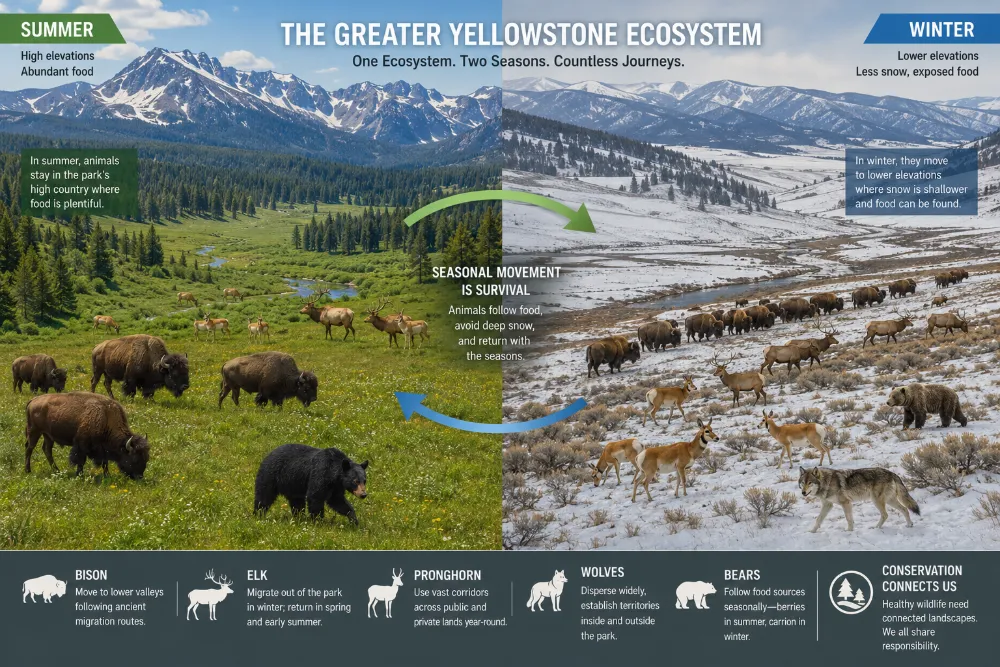
For example, an elk may spend summer in high-elevation meadows inside the park, then move to lower-elevation winter range outside the park when deep snow covers food. Bison may move toward lower valleys or boundary areas where grazing is easier. Wolves may follow elk or bison, and young wolves may disperse to find mates and territories.
These movements are not panic. They are survival strategies.
Why the Yellowstone Volcano Rumor Keeps Appearing
Every few years, online posts claim that animals are fleeing Yellowstone because they “sense” a coming volcanic eruption. These stories often use old clips, unrelated footage, misleading captions, or normal wildlife movement presented as something unusual.
The idea is dramatic because Yellowstone is famous for its volcanic history. People see bison running on a road or elk moving through snow and imagine the animals are escaping danger. In reality, bison run for many ordinary reasons: traffic, herd movement, breeding behavior, weather, insects, or simple travel between feeding areas.
Wild animals can respond to earthquakes, storms, fires, predators, and other immediate environmental changes. But there is no credible evidence that Yellowstone’s wildlife are staging a mass exodus before an eruption.
Yellowstone Is Part of a Larger Ecosystem
Yellowstone National Park sits within the Greater Yellowstone Ecosystem, one of the most important large temperate ecosystems in North America. This ecosystem includes national parks, national forests, wilderness areas, private lands, ranches, rivers, mountains, valleys, and migration routes.
Animals use the whole landscape. A park boundary may matter legally to people, but it does not function as a wall for wildlife.
Important movement zones include:
High summer meadows
Lower winter valleys
River corridors
Forest edges
Thermal areas with less snow cover
Mountain passes
Traditional migration routes
Public and private lands surrounding the park
Why Bison Leave Yellowstone
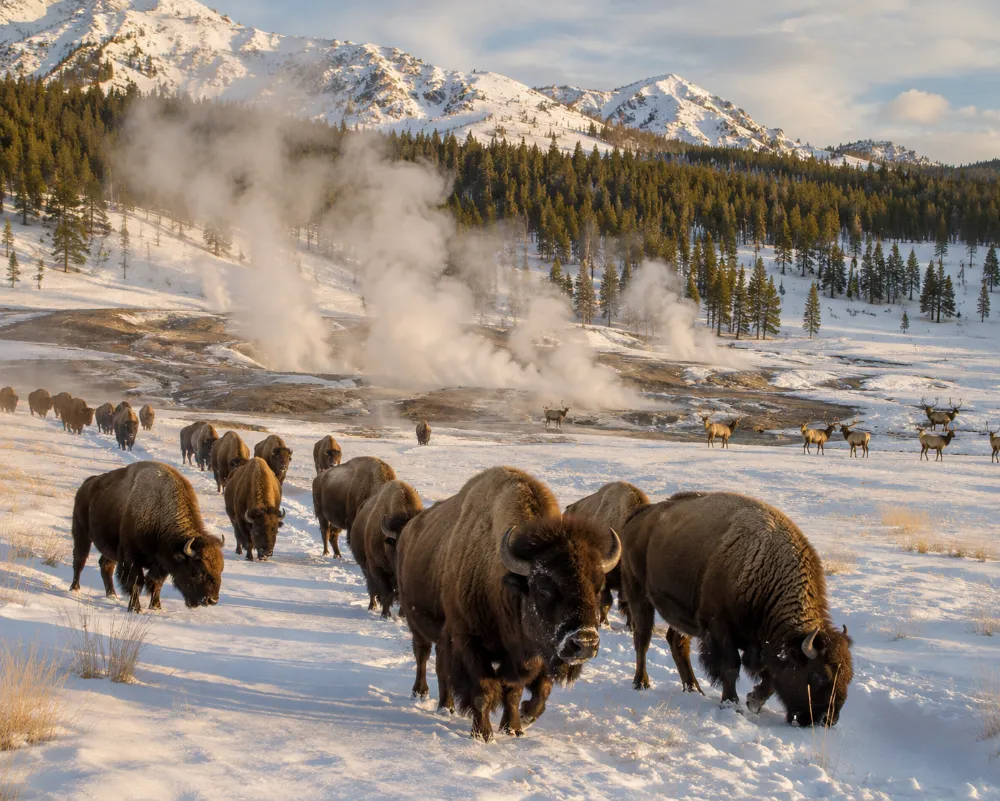
Bison are one of the most visible animals associated with “leaving Yellowstone” stories. In winter and early spring, some bison move toward lower elevations and boundary areas where snow may be shallower and forage easier to reach.
Bison are powerful animals adapted to harsh winters, but deep snow still affects movement and grazing. They use their massive heads and necks to sweep snow aside, but they also choose routes and habitats where feeding is less costly.
Reasons bison may leave parts of Yellowstone include:
Deep snow inside higher areas
Better winter forage at lower elevations
Traditional herd movement routes
Spring migration toward calving areas
Population pressure in certain ranges
Following other herd members
Access to grass near roads, rivers, or boundary zones
Bison Movement Is Not a Volcano Warning
Seeing bison move along roads, cross boundaries, or gather near park edges does not mean Yellowstone is about to erupt. Bison have moved across this landscape for thousands of years. They travel in herds, respond to weather, and shift with seasonal forage.
Videos of bison running can be misleading. Bison may run because vehicles are nearby, because the herd is moving quickly, because bulls are interacting during the rut, or because they are reacting to a short-term disturbance.
A moving bison herd is not an eruption forecast. It is usually just bison being bison.
Why Elk Leave Yellowstone
Elk are among Yellowstone’s most important migratory animals. Many elk herds use different seasonal ranges. In summer, they may move to higher elevations where fresh plants are available. In winter, they often move to lower elevations where snow is less deep and forage is easier to reach.
Elk migration is shaped by:
Snow depth
Plant growth
Predator pressure
Calving needs
Hunting pressure outside the park
Inherited migration routes
Human development along corridors
Elk leaving one part of Yellowstone may simply be moving to winter range or following a seasonal route used by generations of elk before them.
Why Pronghorn Leave Yellowstone
Pronghorn are famous for long-distance movement in the Greater Yellowstone region. They are fast, open-country animals that depend on connected migration corridors between seasonal ranges.
Pronghorn may leave Yellowstone or nearby protected lands to reach lower, more open winter habitats. Their movement can be affected by fences, roads, snow, predators, drought, and human development.
For pronghorn, leaving Yellowstone is not unusual. It is part of a broader survival strategy in a landscape where food and snow conditions change dramatically with the seasons.
Why Wolves Leave Yellowstone
Wolves are territorial predators with large home ranges. A wolf may leave Yellowstone because it is following prey, dispersing from its birth pack, searching for a mate, avoiding conflict, or exploring new territory.
Young wolves often disperse when they mature. This is natural and important for genetic exchange between packs. Some dispersing wolves travel long distances and may cross many human boundaries.
Wolves may move because of:
Prey movement
Pack territory changes
Dispersal by young adults
Mating opportunities
Competition with other packs
Seasonal elk and bison distribution
A wolf leaving Yellowstone is not evidence of panic. It is normal carnivore ecology.
Why Bears Leave Yellowstone
Grizzly bears and black bears use large home ranges. They move across forests, meadows, rivers, slopes, and valley bottoms in search of food. Depending on season, they may seek roots, berries, insects, carcasses, fish, moths, whitebark pine seeds, or other food sources.
Bears may cross park boundaries because food is not evenly distributed. A bear’s seasonal route may include both protected park land and surrounding public or private land.
Bear movement is shaped by:
Spring green-up
Carcass availability
Berry production
Denning sites
Mating season
Human food attractants
Drought and climate effects
Birds Leaving Yellowstone
Many birds leave Yellowstone seasonally because migration is part of their life cycle. Songbirds, waterfowl, raptors, cranes, and other birds may nest or feed in Yellowstone during warmer months and migrate south or to lower elevations when winter arrives.
Bird migration is triggered by day length, temperature, food supply, breeding cycles, and inherited navigation systems. It has nothing to do with a volcanic warning.
Birds may leave because insects disappear, lakes freeze, snow covers feeding sites, or breeding season ends. In this case, “leaving Yellowstone” is simply migration.
Small Mammals and Seasonal Movement
Small mammals also move, but usually over shorter distances. Ground squirrels may enter hibernation. Pikas may stay near rock piles and rely on stored vegetation. Beavers remain near water and food caches. Coyotes shift with prey. Foxes hunt where rodents are available.
These animals may not “leave Yellowstone” in dramatic herds, but they still adjust to winter, snow, predation, and food availability.
Important small-animal responses include:
Hibernation
Food caching
Burrow use
Moving to lower snow areas
Following prey availability
Using thermal or sheltered microhabitats
Seasonal Migration vs Mass Exodus
Seasonal migration is normal, repeated, and biologically meaningful. A mass exodus implies sudden panic, danger, or unexplained escape. These are very different ideas.
| Feature | Seasonal Migration | Mass Exodus Rumor |
|---|---|---|
| Pattern | Occurs regularly with seasons | Claimed as sudden and mysterious |
| Cause | Food, snow, breeding, migration routes | Often linked online to eruption fear |
| Species involved | Usually specific species moving in expected ways | Often claims “all animals” are fleeing |
| Scientific support | Well documented in wildlife biology | Not supported by credible evidence |
| Meaning | Healthy landscape connectivity | Usually misinformation or exaggeration |
How Snow Drives Animal Movement
Snow is one of the strongest forces shaping Yellowstone wildlife movement. Deep snow makes walking harder and hides grass, sedges, and other forage. Animals may move to places where wind, sun, elevation, or geothermal heat reduces snow cover.
Large ungulates such as bison and elk can handle winter better than many animals, but they still conserve energy. Moving to lower elevations or wind-swept slopes can make the difference between survival and starvation.
Snow affects:
Travel cost
Forage access
Predator-prey encounters
Calf and fawn survival
Use of roads and packed trails
Movement toward lower valleys
How Food Availability Shapes Movement
Animals move because food changes across the landscape. Spring green-up begins earlier at lower elevations, then moves upward as snow melts. Summer brings high-elevation meadows, insects, and plant growth. Autumn brings berries, seeds, rut behavior, and preparation for winter. Winter concentrates animals where food remains reachable.
Different species follow different food patterns:
Bison seek grasses and sedges.
Elk browse and graze depending on season.
Pronghorn need open forage and low snow.
Bears follow seasonal foods from carcasses to berries.
Wolves follow prey distribution.
Raptors follow small mammals, fish, or migrating birds.
Thermal Areas and Winter Wildlife
Yellowstone’s geothermal areas can influence winter animal distribution. Warm ground, steam, and thinner snow cover may make some areas easier for animals to use in winter. Bison are especially well known for using thermal-influenced landscapes and snow-free patches.
This can create the impression that animals are gathering in strange places. In reality, they are often using microhabitats where winter conditions are less severe.
However, thermal areas can be dangerous. Thin crusts, boiling water, and unstable ground can injure or kill animals and humans. Wildlife using these areas should be observed only from safe, legal boardwalks and distances.
Predators and Prey Move Together
When prey animals move, predators often respond. Wolves, cougars, coyotes, bears, eagles, and scavengers all pay attention to prey distribution. If elk shift to winter range outside the park, predators may also shift their hunting areas.
This does not mean predators are “fleeing.” It means they are following ecological opportunity.
Examples include:
Wolves following elk herds
Coyotes hunting rodents in open valleys
Bears using carcasses in spring
Eagles and ravens feeding on winter-killed animals
Cougars using forest edges near deer and elk movement routes
Breeding and Calving Movements
Reproduction also shapes animal movement. Some animals move to calving, fawning, nesting, or breeding areas. These sites may offer better food, lower predator risk, traditional herd use, or safer terrain.
In Yellowstone, bison calving, elk calving, wolf denning, bear mating, bird nesting, and fish spawning all involve seasonal shifts in behavior and location.
Animals may leave one area not because it is dangerous, but because another area is better for reproduction.
Dispersal: When Young Animals Leave
Dispersal is different from migration. Migration is usually seasonal and repeated. Dispersal is when an individual, often a young adult, leaves its birth area to find a new territory, mate, or social group.
Wolves, cougars, foxes, bears, birds, and many other animals disperse. Dispersal is essential for preventing inbreeding and connecting populations across landscapes.
When a young wolf leaves Yellowstone, it may be part of normal population biology, not a sign that something is wrong.
Human Boundaries Create Human Confusion
People often think of Yellowstone as a clearly defined place. On a map, it has borders. In law, it has management rules. For wildlife, however, the landscape is continuous.
An elk does not know when it has crossed from national park land to national forest land. A wolf does not recognize a state boundary. A bison does not understand that its natural winter route leads into a politically sensitive management area.
This is why “leaving Yellowstone” can sound more dramatic than it really is. Often, the animal is simply crossing a line that matters to humans, not to wildlife.
Why Bison Movement Becomes Controversial
Bison movement beyond Yellowstone can become controversial because bison are large, visible, culturally important, ecologically important, and involved in disease and land-management debates. Some bison carry exposure to brucellosis, a bacterial disease that can affect livestock management concerns.
Because of this, bison leaving the park may be managed through a combination of conservation transfers, tribal harvests, state and federal management, and population goals.
This is not evidence that bison are fleeing a natural disaster. It is an example of how wildlife conservation becomes complex when wild animals cross into human-managed landscapes.
Do Animals Sense Earthquakes or Volcanoes?
Some animals may respond to immediate environmental cues such as ground shaking, low-frequency sounds, gas odors, storms, fires, or pressure changes. However, this does not mean animals can reliably predict volcanic eruptions weeks or months in advance.
Yellowstone is closely monitored with scientific instruments that measure earthquakes, ground deformation, gas emissions, heat flow, and hydrothermal changes. Wildlife videos are not a reliable eruption-warning system.
If a major volcanic crisis were developing, scientists would expect instrument data to show strong, measurable changes. Random clips of moving animals are not enough.
What Would Scientists Watch Instead?
Scientists do not rely on elk, bison, or wolves as volcano alarms. They use monitoring networks and geological data.
Important monitoring signals include:
Earthquake swarms
Ground uplift or subsidence
Gas chemistry changes
Hydrothermal changes
Heat flow changes
Rock deformation
Long-term volcanic patterns
Wildlife behavior can be interesting, but it must be interpreted carefully. A herd crossing a road is not the same as a volcanic warning.
How Viral Videos Mislead People
Viral videos often remove context. A clip may show bison running, elk crossing a road, or animals moving through snow. Without date, location, season, species behavior, or original source, viewers may assume something unusual is happening.
Common misinformation patterns include:
Old videos reposted as new
Footage from outside Yellowstone
Normal migration labeled as panic
Road-crossing behavior described as “escape”
Winter movement presented as eruption warning
AI-generated or unrelated wildlife footage
The safest approach is to ask: Where was this filmed? When was it filmed? What species are shown? Is this normal seasonal behavior? Are official park or scientific sources reporting anything unusual?
How Climate Change May Affect Wildlife Movement
Climate change can influence Yellowstone wildlife movement over the long term. Changes in snowpack, drought, plant growth, fire patterns, water availability, insect outbreaks, and heat stress can shift where animals find food and shelter.
Climate-related changes may affect:
Timing of spring green-up
Depth and duration of snowpack
Availability of alpine and subalpine habitat
Migration timing
Bear food sources
Stream temperature and fish habitat
Wildfire patterns
These changes are real ecological concerns. But they are different from the false claim that all animals are suddenly fleeing because Yellowstone is about to erupt.
How Roads Affect Animal Movement
Roads can strongly affect wildlife movement in and around Yellowstone. Animals may use plowed roads because they are easier to walk on in winter, but roads also create danger from vehicles and human disturbance.
Bison, elk, bears, wolves, coyotes, foxes, and many smaller animals may cross roads. Visitors should slow down, obey wildlife traffic rules, and never pressure animals to move.
Road effects include:
Vehicle collisions
Wildlife jams
Stress from crowding
Blocked movement routes
Easy winter travel corridors
Increased human-wildlife encounters
What Visitors Should Do When Animals Are Moving
Wildlife movement is one of the most exciting parts of visiting Yellowstone, but it must be watched responsibly. Animals need space, especially when they are migrating, feeding, nursing young, crossing roads, or conserving energy in winter.
Visitor safety rules include:
Never approach wildlife.
Stay far from bison, elk, bears, wolves, and other large animals.
Do not block an animal’s path.
Never feed wildlife.
Do not chase animals for photos.
Stay in your vehicle during wildlife jams when appropriate.
Use binoculars or a zoom lens.
Follow ranger instructions.
Keep pets controlled where allowed.
Common Myths About Animals Leaving Yellowstone
Myth: Animals leaving Yellowstone means a supervolcano eruption is coming.
Fact: Normal wildlife movement is not an eruption warning.Myth: Yellowstone animals are trapped inside the park.
Fact: The park is not fenced, and many animals move across boundaries.Myth: Bison running on a road means panic.
Fact: Bison run for many normal reasons, including herd movement, traffic disturbance, weather, or social behavior.Myth: All animals leave Yellowstone before winter.
Fact: Some migrate, some shift locally, some hibernate, and some remain active inside the park.Myth: Animal behavior is better than scientific volcano monitoring.
Fact: Volcano monitoring relies on instruments, geologic data, and expert analysis.Myth: Any animal outside the park is in danger.
Fact: Many animals naturally use seasonal habitat outside the park, although human land use can create risks.
How to Understand Yellowstone Wildlife Movement Correctly
To understand animals leaving Yellowstone, think like an ecologist rather than a rumor watcher. Ask what the animal needs at that moment.
Useful questions include:
What season is it?
Is snow limiting food access?
Is the animal migrating to winter or summer range?
Is it breeding, calving, denning, or dispersing?
Is it following prey?
Is it avoiding predators or human disturbance?
Is the video actually from Yellowstone?
Is there official scientific evidence of unusual volcanic activity?
Most of the time, ordinary ecology explains the movement better than disaster speculation.
Final Takeaway
Animals do leave Yellowstone, but usually for normal ecological reasons. Bison, elk, pronghorn, wolves, bears, birds, and other wildlife move across the landscape because Yellowstone is part of a larger ecosystem, not a fenced enclosure.
The real drivers are food, snow, migration, breeding, territory, dispersal, predation, weather, and habitat. These movements are signs of wild animals using a connected landscape.
The idea that animals are fleeing Yellowstone because of an imminent volcanic eruption is not supported by reliable science. If you see wildlife moving in Yellowstone, the best interpretation is usually simple: the animals are responding to season, habitat, and survival needs.
FAQs About Animals Leaving Yellowstone
Are animals really leaving Yellowstone?
Some animals move out of parts of Yellowstone seasonally or cross park boundaries as part of normal migration, dispersal, feeding, or breeding behavior. This does not mean all animals are abandoning the park.
Are animals leaving Yellowstone because of a volcano?
No. Normal animal movement should not be interpreted as proof of an upcoming eruption. Yellowstone volcano activity is monitored with scientific instruments, not viral wildlife videos.
Why do bison leave Yellowstone?
Bison may move toward lower elevations or boundary areas in winter and spring to find accessible forage, follow herd movement routes, or use habitats where snow is less limiting.
Why do elk leave Yellowstone?
Many elk migrate between summer and winter ranges. They often use higher elevations in warmer months and lower elevations when snow makes food harder to reach.
Do wolves leave Yellowstone?
Yes. Wolves can leave Yellowstone when following prey, dispersing from packs, looking for mates, or establishing territories. This is normal wolf behavior.
Do bears leave Yellowstone?
Yes. Bears have large home ranges and may cross park boundaries while searching for seasonal foods, mates, denning areas, or safe travel routes.
Is Yellowstone fenced?
No. Yellowstone is not fenced like a zoo. Wildlife can move across park boundaries into surrounding national forests, private lands, valleys, and mountain ranges.
What animals migrate out of Yellowstone?
Elk, bison, pronghorn, mule deer, birds, and some other animals may migrate or move seasonally. Predators such as wolves and bears may also shift ranges as prey and food sources change.
Why do animals move to lower elevations in winter?
Lower elevations often have less snow, easier travel, and more accessible forage. Moving downhill can help animals conserve energy during winter.
Do animals know when a volcano will erupt?
Animals may react to immediate environmental disturbances, but there is no reliable evidence that Yellowstone animals can predict an eruption far in advance.
Are viral videos of animals fleeing Yellowstone reliable?
Usually not without context. Many viral videos use old footage, unrelated locations, normal migration, or misleading captions. Always check official and scientific sources.
Why do bison run on Yellowstone roads?
Bison may run because of herd movement, traffic, social behavior, breeding season, weather, or disturbance. Running does not automatically mean panic or volcanic danger.
Do all Yellowstone animals migrate?
No. Some migrate long distances, some shift locally, some hibernate, and some remain active in the park year-round. Movement depends on species and season.
How does climate change affect Yellowstone animal movement?
Climate change can alter snowpack, plant growth, water availability, fire patterns, and food sources, which may change migration timing and habitat use over time.
What should I do if I see animals moving across a road in Yellowstone?
Slow down, stay in your vehicle when appropriate, give animals space, never block their path, and follow ranger instructions. Use binoculars or a zoom lens instead of approaching.