Many bats navigate in the dark using echolocation, a biological sonar system that allows them to detect objects by listening to echoes of the sounds they produce. A bat emits a sound pulse, and the returning echoes provide information about nearby obstacles, surfaces, and potential prey. By analyzing the timing and other characteristics of these echoes, it can guide its flight even when very little light is available. However, bats are not blind. Many species also use vision, and some fruit bats rely heavily on their eyes. Not all bats use echolocation in the same way.
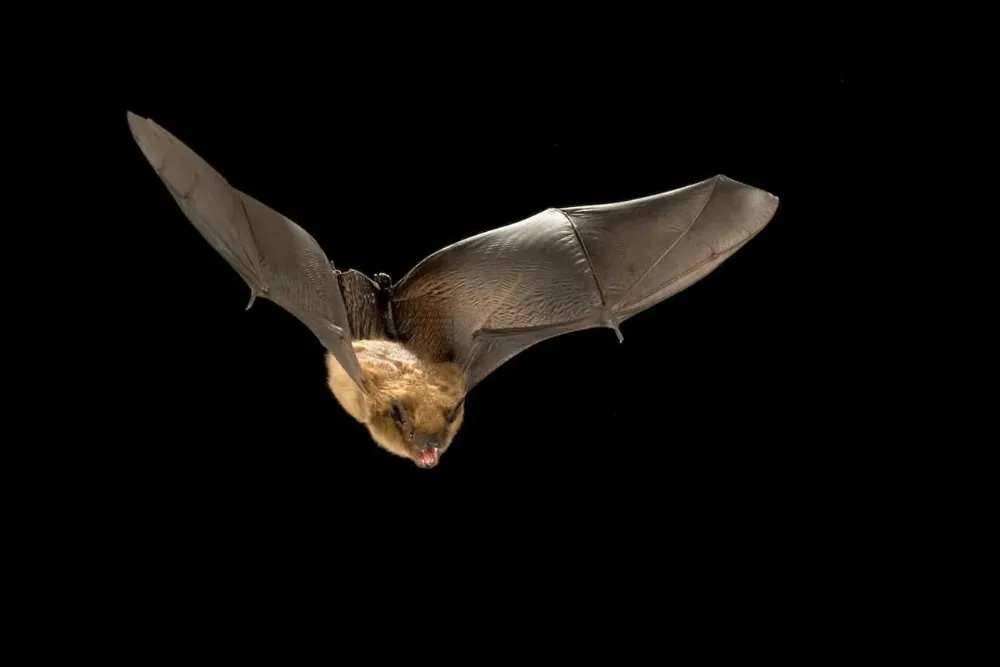
Many bats combine sensitive hearing and echolocation with vision to navigate through nighttime environments.
How Do Bats Navigate in the Dark?
Bats are the only mammals capable of sustained powered flight.
Many species are active during the evening or night, when visual information can be limited.
To navigate, numerous bats use a remarkable sensory adaptation called echolocation.
Instead of relying only on what their eyes can detect, they produce sounds and listen for the echoes that return from surrounding objects.
These echoes help the animals estimate the position of obstacles, identify possible prey, and guide their movements.
However, echolocation is not the only sense that bats use.
Vision, hearing, memory, and environmental information can also contribute.
The relative importance of each sense depends on the species, habitat, and activity.
What Is Bat Echolocation?
Echolocation is a biological process in which an animal uses reflected sound to obtain information about its surroundings.
The term combines the ideas of echo and location.
Many bats emit high-frequency calls that travel through the air.
When a sound wave reaches an object, some of its energy reflects back toward the bat.
The bat detects these returning echoes with its ears.
Its nervous system processes the sound information and helps the animal respond.
This allows the bat to assess nearby objects without needing to see them clearly.
However, the information contained in echoes depends on the sounds produced, the surfaces reflecting them, and the environmental conditions.
How Does Echolocation Work Step by Step?
The basic process can be explained in five stages.
Sound production: The bat emits an echolocation pulse.
Sound transmission: The pulse travels through the surrounding air.
Reflection: Some sound energy reflects from insects, branches, walls, or other objects.
Echo reception: The returning sound reaches the bat's ears.
Neural processing: The brain analyzes the echo information and helps guide flight or hunting behavior.
These stages happen extremely quickly.
During active hunting, a bat may repeatedly produce calls and update its estimate of a target's position.
However, echolocation is not a perfect photographic image created from sound.
It is a specialized sensory system that extracts information from acoustic signals.
How Do Bats Know How Far Away an Object Is?
One important cue is the time delay between an emitted sound and its returning echo.
Sound travels from the bat to an object and then returns.
Because the sound makes a round trip, the distance can be estimated from the total travel time.
The basic physical relationship is:
Distance = (speed of sound × echo delay) ÷ 2
At ordinary room temperatures, sound travels through air at approximately 343 meters per second.
For example, an echo delay of about 6 milliseconds corresponds to an object roughly one meter away.
This calculation illustrates the principle.
Real bats also receive information from echoes reflected by multiple surfaces while both the bat and its targets may be moving.
Why Do Bats Use High-Frequency Sounds?
Many echolocating bats emit ultrasound.
Ultrasound refers to sound with frequencies above the usual upper limit of human hearing, approximately 20 kilohertz.
Shorter sound wavelengths can provide useful information about relatively small objects.
This is important for bats hunting insects.
However, the choice of frequency involves trade-offs.
High-frequency sound tends to lose energy more rapidly in air than lower-frequency sound under comparable conditions.
Therefore, different bats use call designs suited to their prey and habitats.
Not all echolocation signals are equally high-pitched, and some bat calls contain frequencies humans may be able to hear.
Can Humans Hear Bat Echolocation?
Most humans cannot hear much of the ultrasonic energy used in the calls of many bats.
However, some bat sounds fall within the human hearing range.
Bats also produce social calls that may differ from their typical echolocation signals.
Specialized bat detectors can convert ultrasonic signals into sounds that humans can hear or record.
Scientists use these devices to study bat activity and sometimes help identify species or groups.
However, species identification from recordings is not always straightforward because calls vary with behavior, habitat, and environmental conditions.
How Do Bats Make Echolocation Sounds?
Many echolocating bats produce sounds using structures in the larynx.
The larynx is also involved in vocal sound production in many other mammals.
Depending on the species, calls may be emitted through the mouth or nose.
Some bats possess specialized facial structures that help shape the outgoing sound beam.
Other species use a different mechanism.
For example, Egyptian fruit bats produce short clicking sounds using their tongues.
These differences show that echolocation is not based on one identical sound-production system shared by every bat.
Do Bats Echolocate Through Their Mouth or Nose?
Both methods occur among bats.
Some species emit echolocation calls through the mouth.
Others emit them primarily through the nostrils.
Specialized structures called noseleaves can influence the direction and shape of the sound beam in certain nasal-emitting species.
Mouth opening and head movement can also affect sound direction.
However, the role of each structure varies among different bat groups.
Researchers investigate these differences to understand how bats direct acoustic information toward selected parts of their environment.
What Are Bat Noseleaves?
Noseleaves are specialized structures surrounding the noses of certain bat species.
They can have elaborate shapes and folds.
In some echolocating bats, these structures help shape the sound beam emitted through the nose.
This can influence how acoustic energy is distributed through space.
However, not every bat has an elaborate noseleaf.
Some species rely on mouth-emitted calls instead.
Noseleaf anatomy varies widely and should not be generalized from one bat family to all others.
Can Bats Detect Small Insects With Sound?
Yes. Many insect-eating bats use echolocation to detect and track flying insects.
The returning echoes can provide information about target position and movement.
However, prey detection becomes more complicated when insects are close to vegetation or other surfaces.
Echoes from leaves and branches may overlap with those produced by prey.
This creates acoustic clutter.
A study published in Nature in 2001 demonstrated that two gleaning bat species struggled to detect silent, motionless prey in cluttered environments.
Those bats were more successful when prey generated sounds or when acoustic clutter was reduced.
The findings show that echolocation is powerful but not unlimited.
What Is Acoustic Clutter?
Acoustic clutter occurs when many objects reflect sound back toward an echolocating animal.
In a forest, branches, leaves, trunks, and insects can all create echoes.
These reflected signals may overlap in time or contain similar characteristics.
This can make it more difficult to identify a small target against a complex background.
Scientists sometimes compare acoustic clutter with visual clutter.
Just as a small animal can be difficult to see among complicated vegetation, a small prey echo may be difficult to distinguish among many other echoes.
Different bat species use different hunting strategies to overcome this challenge.
How Do Bats Catch Insects in the Dark?
Many insectivorous bats search for flying prey using echolocation.
As a bat approaches an insect, its call pattern may change.
The time between successive pulses can decrease.
This gives the animal more frequent acoustic updates about the prey's location.
During the final stage of an attack, some bats produce an extremely rapid series of calls called the terminal buzz.
Research has shown that these call patterns can support precise prey capture.
However, not every insect-eating bat hunts in the same way.
Some rely heavily on sounds produced by prey moving through vegetation.
What Is a Bat's Terminal Buzz?
The terminal buzz is a rapid sequence of echolocation calls produced by many bats during the final approach to prey.
The rate of call production increases dramatically.
A scientific review titled How the Bat Got Its Buzz described call production rates reaching approximately 220 calls per second in some bats.
Such rapid calling can increase the rate at which new acoustic information becomes available.
The precise structure of the terminal buzz varies by species.
Some bats show additional changes in frequency during the final phase.
Researchers have proposed that these adjustments improve the bat's ability to track moving prey and respond to attempted escape.
However, the mechanisms and ecological benefits are not identical across all bats.
Search Calls vs. Approach Calls vs. Terminal Buzz
| Flight Phase | Typical Call Pattern | Function |
|---|---|---|
| Search phase | More widely spaced calls | Survey surroundings and locate possible targets |
| Approach phase | Calls become more frequent as a target is approached | Update target position |
| Terminal buzz | Very rapid sequence of short calls | Provide frequent updates during final capture attempts |
This simplified sequence is typical of many aerial insect-hunting bats. Other bats use different echolocation strategies.
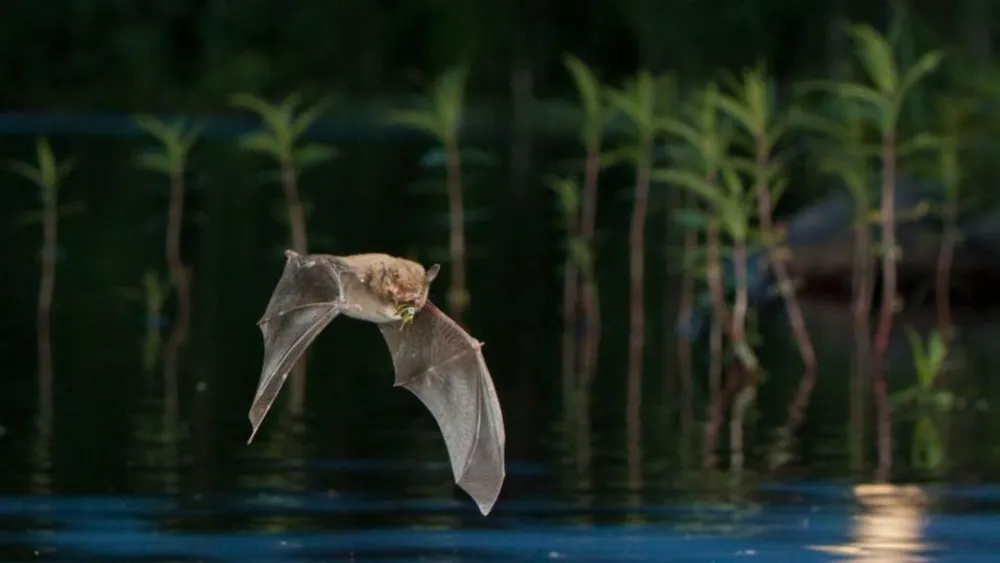
Many insect-eating bats adjust the timing of their echolocation calls as they approach prey.
Can Bats Tell Whether an Insect Is Moving?
Yes. Echolocation can provide information about moving targets.
Movement changes the relationship between emitted sounds and returning echoes.
For certain bats, changes in echo frequency and other signal properties help reveal prey movement.
However, the importance of different acoustic cues varies among species.
Some bats are especially specialized for detecting wing movements.
Others use broader combinations of echo delay, intensity, and spectral information.
It is therefore inaccurate to describe all bats as relying on one identical movement-detection method.
What Is the Doppler Effect in Bat Echolocation?
The Doppler effect occurs when movement between a sound source and an observer changes the frequency of the received sound.
Some bats use nearly constant-frequency echolocation signals.
These signals can be particularly useful for detecting changes associated with moving targets.
Certain horseshoe bats are famous for sophisticated Doppler-related hearing and vocal adjustments.
However, not all echolocating bats rely primarily on constant-frequency calls.
Many use frequency-modulated calls whose frequency changes rapidly during each pulse.
The suitability of a call depends on the animal's foraging ecology and habitat.
What Is the Difference Between FM and CF Bat Calls?
Two broad categories of echolocation signals are frequency-modulated and constant-frequency calls.
Frequency-modulated, or FM, calls change frequency during the pulse.
These calls can provide useful information about timing and object position.
Constant-frequency, or CF, calls maintain a relatively stable frequency over part of the signal.
They can be useful for detecting particular echo-frequency changes.
However, many species produce calls combining elements of both categories.
Real bat echolocation is more diverse than a simple two-type classification.
Are Bats Blind?
No. Bats are not blind.
All living bats have eyes, although their size and visual abilities vary.
Many bats use vision alongside echolocation.
Some fruit bats rely heavily on sight while searching for food and navigating.
In 2015, researchers showed that Egyptian fruit bats adjust their echolocation behavior according to the amount of visual information available.
They produced more frequent and stronger clicks under lower light levels.
This demonstrates that vision and echolocation can complement one another.
The expression blind as a bat is therefore scientifically misleading.
Can Bats See at Night?
Yes. Many bat species can use their vision under low-light conditions.
However, the sensitivity and visual capabilities of their eyes differ.
Some bats have relatively large eyes and rely heavily on sight.
Others use echolocation as a major source of detailed spatial information.
Both systems can contribute to navigation.
Therefore, using echolocation does not imply an absence of useful vision.
Scientists have demonstrated that at least some bats adjust their sensory behavior according to changes in illumination.
Why Do Bats Have Eyes if They Use Echolocation?
Vision and echolocation provide different kinds of information.
Vision can be useful for detecting large objects, environmental features, and distant cues when sufficient light is available.
Echolocation provides detailed information about nearby objects through sound reflections.
However, ultrasound is affected by distance, absorption, and acoustic clutter.
Combining sensory systems can therefore be advantageous.
The Egyptian fruit bat provides a clear example of an animal using both vision and echolocation during natural activities.
Do All Bats Use Echolocation?
No. Echolocation is widespread among bats, but it is not used in an identical way by all species.
Many insect-eating bats produce specialized laryngeal echolocation calls.
Egyptian fruit bats use tongue clicks.
Many other large fruit bats in the family Pteropodidae rely primarily on vision and smell for navigation and foraging rather than using the sophisticated airborne echolocation found in many other bats.
However, the evolutionary history of echolocation is complicated.
Researchers continue to investigate how the different systems evolved.
Therefore, it is safer to describe the observed sensory abilities of particular groups than to claim that every bat either always echolocates or never does.
Do Fruit Bats Use Echolocation?
Some fruit bats use echolocation, while many others rely mainly on vision and smell.
The Egyptian fruit bat, Rousettus aegyptiacus, is a particularly important example.
Unlike bats that produce ultrasonic calls using the larynx, Egyptian fruit bats generate brief clicking sounds with their tongues.
They can use these clicks to judge distances and guide movements.
However, Egyptian fruit bats also possess useful vision.
The relative contribution of each sense changes with lighting and behavioral demands.
How Do Egyptian Fruit Bats Echolocate?
Egyptian fruit bats produce extremely brief broadband clicks using their tongues.
They often emit the clicks in pairs.
The direction of the sound beam can change rapidly between successive clicks.
A 2017 study published in PLOS Biology investigated this unusual system.
The researchers found that the bats could shift the directional focus of their sound beams through their tongue-driven click system.
This provides a sophisticated method for collecting acoustic information from the surrounding space.
It also demonstrates that effective echolocation does not require a laryngeal call mechanism.
What Did the 2017 Fruit Bat Study Discover?
The 2017 research investigated how Egyptian fruit bats control the direction of their echolocation beams.
Researchers recorded freely flying bats using an array of ultrasonic microphones.
They analyzed the direction and spectral properties of emitted clicks.
The results revealed a specialized relationship between click frequency and sound-beam direction.
The study helped explain how paired tongue clicks allow the animals to sample different directions rapidly.
However, the mechanism differs from the beam-steering strategies used by many laryngeal echolocators.
The findings therefore highlight the diversity of echolocation systems among bats.
Can Fruit Bats Navigate Without Light?
Some fruit bats can navigate under very low-light conditions using echolocation.
Egyptian fruit bats have been studied extensively in this context.
Other fruit bats may depend more strongly on vision and environmental information.
Therefore, not every fruit bat should be assumed to have the same ability to navigate in complete darkness.
Species identity is essential when evaluating how a bat performs under particular light conditions.
Can Bats Use Vision and Echolocation Together?
Yes. Research has demonstrated interactions between these sensory systems.
A 2015 study in Current Biology examined Egyptian fruit bats under different lighting conditions.
The researchers observed that bats increased their echolocation click rate and intensity when less visual information was available.
They also adjusted their clicking behavior while approaching landing surfaces.
The study showed that bats can alter acoustic sampling depending on sensory conditions and the task being performed.
This is an example of multisensory integration.
However, not every bat species has been tested in exactly the same way.
How Do Bats Avoid Trees at Night?
Many bats detect nearby branches and other objects through echolocation.
As a bat approaches an obstacle, reflected sound can provide information about its position.
The bat can then adjust its flight path.
However, echolocation performance depends on object size, distance, surface properties, and surrounding clutter.
Vision and prior knowledge of the environment may also help.
It is therefore misleading to describe bats as having a perfect acoustic map that prevents every collision.
Can Bats Fly Through Complete Darkness?
Many echolocating bats can navigate in environments with little or no visible light.
They do not need light to generate sound or receive acoustic echoes.
However, their performance depends on the environment and the species.
Very complex acoustic surroundings may create difficulties.
Some fruit bats that depend heavily on vision may also perform differently in complete darkness.
The correct conclusion is that echolocation allows many, but not necessarily all, bats to navigate without relying on visible light.
Can Bats Detect Thin Wires?
The ability to detect a thin object depends on its size, material, orientation, and distance.
A small object may reflect only a limited amount of acoustic energy toward the bat.
Other environmental sounds and echoes can interfere with detection.
Therefore, echolocation does not guarantee that every bat will detect every thin wire or obstacle.
Some collisions with human-made structures remain possible.
The precise detection limit differs among species and call designs.
Why Do Bats Have Large Ears?
Some bats have large external ears that help collect sound.
The shape of the ears influences the acoustic information received.
This can contribute to detecting returning echoes or sounds produced by prey.
However, ear size varies considerably among bat species.
Some bats have unusually large ears, while others have relatively compact external ears.
Large ears are not a universal requirement for effective echolocation.
The relationship between ear shape and hearing depends on acoustic frequency, skull anatomy, and ecological specialization.
Do Bats Use Sound to Find Food on the Ground?
Some bats locate prey on vegetation or other surfaces.
These species are often described as gleaning bats.
They may use echolocation to navigate through the environment.
However, prey hidden among leaves can be difficult to distinguish acoustically.
The 2001 Nature study found that certain gleaning bats were much more successful when prey produced audible movement sounds.
This demonstrates how hearing can support hunting beyond listening to echoes of the bat's own calls.
Can Bats Hear Insects Moving?
Yes. Some bats detect sounds produced by insects or other prey.
For example, moving insects can create rustling or other acoustic signals.
These sounds may reveal prey that would otherwise be difficult to locate through echolocation alone.
However, the usefulness of passive hearing depends on the prey's activity and the acoustic environment.
A silent insect hidden among leaves may be harder to detect.
This is one reason different bat species have evolved different hunting strategies.
Do Insects Hear Bat Echolocation?
Some insects can detect ultrasonic sounds produced by hunting bats.
Certain moths possess hearing organs sensitive to ultrasound.
These sensory abilities can help insects respond to approaching predators.
However, not every insect can hear bat calls.
Different insects have different sensory systems.
Researchers study the interactions between bat echolocation and insect hearing as an example of an evolutionary arms race.
Can Moths Escape From Echolocating Bats?
Some moths respond to ultrasound with evasive flight maneuvers.
Others may produce sounds of their own.
However, the effectiveness of these defenses varies among species and circumstances.
The scientific review How the Bat Got Its Buzz discusses how bat call patterns and insect defenses may have influenced one another during evolution.
This relationship illustrates how predators and prey can develop increasingly specialized sensory and behavioral adaptations.
Do Bats Use Echolocation to Communicate?
Echolocation calls are primarily associated with sensing the environment, but bats also produce social vocalizations.
These sounds can be involved in interactions among individuals.
However, echolocation and social communication are not identical biological functions.
A call used for locating an object should not automatically be interpreted as a message directed toward another bat.
Some acoustic signals may contain information accessible to nearby individuals, but their roles require species-specific research.
Can Bats Recognize Other Bats by Sound?
Some bat species use vocal information during social recognition.
However, the precise cues and abilities differ among species.
Researchers have investigated individual and group differences in vocalizations.
These studies help explain how bats maintain social interactions while living in colonies.
However, recognition through social calls should not be confused with the basic mechanism of echolocation.
The two systems can involve hearing but serve different immediate purposes.
Is Bat Echolocation Similar to Dolphin Echolocation?
Yes, in principle.
Both bats and dolphins can produce sounds and use returning echoes to obtain spatial information.
However, their environments are very different.
Bats usually use airborne sound, while dolphins echolocate in water.
Sound travels at different speeds in these media.
The structures used to produce and receive sounds also differ.
The similarities illustrate how biological sonar evolved in different mammalian lineages.
Bat Echolocation vs. Dolphin Echolocation
| Feature | Echolocating Bats | Echolocating Dolphins |
|---|---|---|
| Main environment | Air | Water |
| Typical sound production | Larynx or specialized clicks, depending on species | Specialized nasal sound-production structures |
| Important use | Flight navigation and prey detection | Underwater navigation and prey detection |
| Echo reception | Ears | Specialized hearing pathways associated with the lower jaw and ears |
| Sound speed | Approximately 343 m/s in air near 20°C | Roughly 1,500 m/s in seawater, depending on conditions |
Both systems apply the same broad physical principle, but their anatomical and ecological adaptations differ.
How Do Scientists Study Bat Echolocation?
Researchers use ultrasonic microphones to record calls.
They may also use high-speed cameras or tracking systems to measure flight behavior.
Some experiments present obstacles or prey under controlled conditions.
Scientists then analyze the timing, frequency, intensity, and direction of the calls.
Microphone arrays can help reconstruct the spatial properties of an emitted sound beam.
For example, the 2017 study of Egyptian fruit bats used multiple microphones to investigate tongue-click beam steering.
These methods help scientists understand how sound production and sensory processing support navigation.
Can Bat Detectors Identify Species?
Bat detectors can record or transform ultrasonic calls.
In some circumstances, call structure can help identify a bat species.
However, different species may produce overlapping acoustic patterns.
Calls can also vary with habitat, flight speed, and behavior.
Therefore, reliable identification may require expert analysis and additional evidence.
Automated systems are useful tools but should not be assumed to identify every bat recording without error.
Why Is Bat Echolocation Important to Science?
Bat echolocation provides a natural model for investigating sensory processing and active perception.
Scientists study how an animal generates signals, receives echoes, and transforms acoustic information into movements.
The system also offers examples of specialized hearing and rapid motor control.
Research on bats has influenced broader understanding of biological sonar.
However, bat echolocation should not be treated as identical to human-engineered radar.
Radar generally uses electromagnetic waves, while echolocation uses sound.
Both can obtain information from reflected signals, but the underlying physical processes differ.
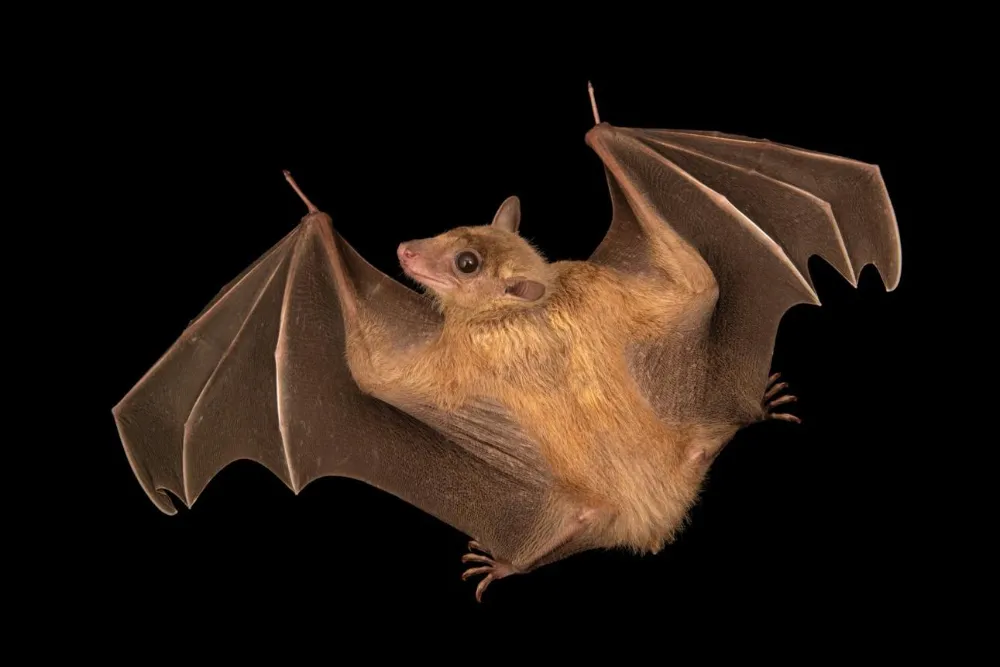
Egyptian fruit bats combine useful vision with tongue-click echolocation, illustrating the diversity of bat sensory systems.
Frequently Asked Questions
How do bats navigate in the dark?
Many bats use echolocation, producing sound pulses and interpreting returning echoes to detect obstacles and prey.
What is echolocation in bats?
Echolocation is a biological sonar system that uses reflected sounds to estimate the position and properties of nearby objects.
Are bats blind?
No. Bats have eyes, and many species use vision alongside other senses.
Can bats see at night?
Yes. Many bats have useful vision under low-light conditions, although visual abilities vary by species.
Do all bats use echolocation?
No. Echolocation systems differ widely, and many fruit bats rely heavily on vision and smell.
Can fruit bats echolocate?
Some can. Egyptian fruit bats use short tongue clicks to obtain acoustic information.
How do bats know how far away something is?
Echo delay provides important distance information because sound must travel to an object and return.
Do bats use ultrasound?
Many bats produce ultrasonic calls, although call frequencies vary among species.
Can humans hear bat echolocation?
Much of it is ultrasonic and usually inaudible to humans, but some bat sounds fall within human hearing range.
How do bats catch insects in darkness?
Many use echolocation to track prey and produce increasingly frequent calls during the final approach.
What is a bat terminal buzz?
It is a rapid sequence of echolocation calls often produced during the last stage of an insect capture attempt.
Can bats fly in complete darkness?
Many echolocating bats can navigate without visible light, although performance depends on species and surroundings.
How do bats avoid hitting trees?
They can detect branches and other obstacles through echoes, often with additional help from vision and environmental familiarity.
Do bats use their mouths or noses to echolocate?
Some emit calls through the mouth, others through the nose, and certain fruit bats produce tongue clicks.
Do bats and dolphins use the same kind of sonar?
Both use echolocation based on reflected sound, but they have different anatomical systems and operate in different environments.
The Bottom Line
Many bats navigate in the dark using echolocation.
They emit sounds and interpret echoes to estimate the locations of obstacles and potential prey.
Some species produce increasingly rapid calls during hunting, allowing frequent updates about moving targets.
However, echolocation is not perfect, especially in environments filled with overlapping echoes.
Bats are also not blind.
Many species combine useful eyesight with acoustic information, while different bat groups use specialized sound-production mechanisms.
These adaptations show how evolution has produced several sophisticated ways for mammals to explore environments where vision alone may not provide enough information.
Sources & Further Reading
Arlettaz, Jones and Racey (2001) — Effect of Acoustic Clutter on Prey Detection by Bats. Nature. Experimental evidence concerning echolocation limits in cluttered environments.
Ratcliffe et al. (2013) — How the Bat Got Its Buzz. Scientific review of terminal buzz calling and rapid acoustic updates during hunting.
Tongue-Driven Sonar Beam Steering by a Lingual-Echolocating Fruit Bat (2017). PLOS Biology. Research on click-based echolocation in Egyptian fruit bats.
Bats Regulate Biosonar Based on the Availability of Visual Information (2015). Current Biology. Evidence that Egyptian fruit bats adjust acoustic sampling when lighting changes.
Click-Based Echolocation in Bats: Not So Primitive After All (2011). Compares tongue-click echolocation with laryngeal echolocation.
Hearing, Echolocation, and Beam Steering from Day 0 in Tongue-Clicking Bats (2021). Research on the development of acoustic sensing in Egyptian fruit bats.
Echolocation Behaviour and Prey-Capture Success in Foraging Bats: Laboratory and Field Experiments on Myotis daubentonii (1999). Study of terminal calls and insect capture behavior.