Hummingbirds hover by beating and rotating their wings in a highly specialized pattern that generates upward aerodynamic force during both the downstroke and the upstroke. Their flexible shoulder joints and rapid wing movements allow them to remain almost motionless in front of a flower while drinking nectar. Unlike most birds, hummingbirds can sustain this form of hovering for extended periods. However, hovering requires substantial energy, and the amount of lift produced during each half of the wingbeat varies among species and flight conditions.
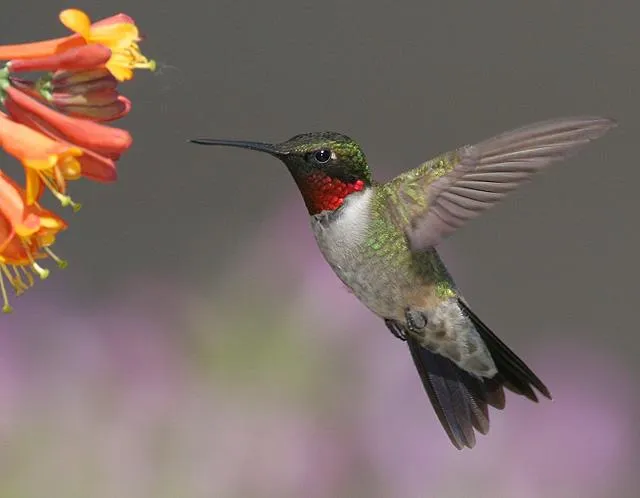
Hummingbirds can hold a nearly stationary position in the air while feeding from flowers.
How Do Hummingbirds Hover?
Hummingbirds are famous for their ability to remain suspended in the air while their wings move rapidly.
Most birds produce their greatest lifting force during the downward portion of a wingbeat.
Hummingbirds are different because their wing anatomy and movement allow them to produce substantial aerodynamic force during both halves of the cycle.
They rotate their wings as they sweep backward and forward.
This helps maintain the airflow patterns needed to support their weight.
At the same time, small adjustments in wing movement allow the bird to stabilize its body.
These adaptations make hovering one of the defining characteristics of hummingbird flight.
What Is Hovering Flight?
Hovering occurs when an animal maintains approximately the same position relative to the surrounding environment while remaining airborne.
To do this, it must generate enough aerodynamic force to counteract its body weight.
It must also control sideways movement and body rotation.
Hummingbirds can achieve this using their wings without relying on continuous forward speed.
However, hovering does not mean the bird is perfectly motionless.
Small changes in body position and wing movement occur continuously.
These adjustments help the bird respond to air currents and the movement of nearby flowers.
Why Can Hummingbirds Hover but Most Birds Cannot?
Hummingbirds possess several anatomical and physiological adaptations that make sustained hovering possible.
Their shoulder joints allow unusually extensive rotation of the wings.
The wings can produce aerodynamic force during both the downstroke and upstroke.
Powerful flight muscles support rapid wing movement.
The birds also have metabolic systems capable of supplying large amounts of energy during flight.
Most other birds are less specialized for sustained stationary hovering.
Some can hover briefly or remain in place using an opposing wind.
However, the long-duration, powered hovering characteristic of hummingbirds is exceptional among birds.
Do Hummingbirds Move Their Wings in a Figure Eight?
Hummingbird wing movement is often described as a figure-eight pattern.
This comparison reflects the way the wings sweep back and forth while rotating through the wingbeat cycle.
However, it is a simplified description rather than a literal, perfectly traced number eight.
High-speed studies show that wingtip paths depend on body orientation and the reference frame used.
The pattern may resemble a flattened or nearly horizontal figure eight.
Importantly, the bird continually adjusts wing angle and rotation.
These movements create aerodynamic forces that support the animal during hovering.
How Do Hummingbird Wings Produce Lift?
Lift is an aerodynamic force resulting from interactions between a wing and the surrounding air.
During hovering, a hummingbird's wings move rapidly through the air and produce forces that oppose gravity.
The wings also generate complex swirling airflow patterns called vortices.
These patterns can influence the pressure distribution around the wings and their aerodynamic performance.
Researchers have used particle image velocimetry to visualize the air moving behind hovering hummingbirds.
The results show that both halves of the wingbeat contribute to supporting the bird.
However, the contributions are not necessarily equal.
Do Hummingbirds Generate Lift on Both Wing Strokes?
Yes. Hummingbirds produce useful aerodynamic force during both the downstroke and upstroke.
The wing rotates between these movements so that it can continue interacting effectively with the air.
However, the amount of force produced during each half of the cycle differs.
A 2005 study of rufous hummingbirds found that approximately 75 percent of their weight support came from the downstroke and 25 percent from the upstroke.
Later research on Anna's hummingbirds found a somewhat more balanced contribution.
These findings show that the upstroke is important, but they do not support the claim that all hummingbirds generate exactly half their lift during each wing stroke.
What Did the 2005 Nature Study Discover?
In 2005, scientists published a study titled Aerodynamics of the Hovering Hummingbird in the journal Nature.
The researchers studied rufous hummingbirds, Selasphorus rufus.
They used digital particle image velocimetry to examine the air currents produced by the birds' wings.
The technique allowed them to estimate how much aerodynamic force was produced during different parts of the wingbeat.
The researchers found that the downstroke generated approximately three times as much weight support as the upstroke.
Specifically, the estimates were about 75 percent from the downstroke and 25 percent from the upstroke.
This challenged earlier assumptions that hovering hummingbirds distribute lift equally between the two wing movements.
What Did Scientists Learn From Anna's Hummingbirds?
A later investigation examined the airflow generated by hovering Anna's hummingbirds, Calypte anna.
The 2013 study, published in Proceedings of the Royal Society B, analyzed vortex structures in the birds' wakes.
Its force estimates suggested that approximately 66 percent of the required weight support came from the downstroke and about 35 percent from the upstroke.
The study also identified additional aerodynamic structures contributing to the overall force balance.
These estimates are not a simple percentage division that must add to exactly 100 percent because the analysis included separate force components and uncertainty.
The findings emphasize that wingbeat aerodynamics vary with species and experimental conditions.
Hummingbird Downstroke vs. Upstroke
| Feature | Downstroke | Upstroke |
|---|---|---|
| Wing movement | One half of the sweeping cycle | Return half of the sweeping cycle |
| Lift contribution | Generally greater in measured species | Substantial but often smaller |
| Rufous hummingbird study | About 75% of weight support | About 25% |
| Wing orientation | Adjusted for useful aerodynamic force | Rotated to maintain useful force |
| Importance | Major source of support | Helps sustain continuous hovering |
The percentages above are findings from a particular rufous hummingbird experiment, not universal values for every hummingbird.
What Are Leading-Edge Vortices?
A leading-edge vortex is a rotating region of airflow that can form near the front edge of a moving wing.
These structures can influence the aerodynamic forces generated during flight.
Leading-edge vortices are especially important in research on insect hovering and other rapidly flapping flyers.
Experiments on hummingbird wings have also demonstrated their presence.
However, the detailed flow patterns depend on wing shape, speed, angle, and species.
The 2005 and later hummingbird studies helped establish how these vortices contribute to hovering flight.
How Do Hummingbirds Rotate Their Wings?
Hummingbirds have specialized shoulder anatomy that permits extensive wing rotation.
During a hovering wingbeat, each wing changes its orientation as it moves through the air.
This is important because a wing needs to generate useful aerodynamic force even as its direction of movement changes.
The rotation allows the wing to maintain an effective relationship with the airflow.
However, the motion is more complex than simply flipping a flat surface upside down.
Feathers, wing joints, and aerodynamic forces interact throughout the wingbeat.
How Fast Do Hummingbird Wings Beat?
Hummingbirds beat their wings extremely rapidly.
The frequency varies by species, body size, flight behavior, and environmental conditions.
The Smithsonian Gardens explains that hummingbird wings can beat up to about 80 times per second.
Some small species have particularly high wingbeat frequencies.
However, a single number should not be assigned to every hummingbird.
Wingbeat frequency during normal hovering may differ from the rate recorded during high-speed courtship displays or other specialized behaviors.
Do Hummingbirds Beat Their Wings 80 Times per Second?
Some hummingbirds can reach wingbeat frequencies near 80 cycles per second.
However, other species usually fly with lower frequencies.
The commonly quoted figure is therefore an example of the group's remarkable performance rather than an exact constant.
Researchers measure wingbeat frequency using high-speed cameras, specialized sensors, or acoustic observations.
The frequency can change depending on how the bird is flying.
Why Do Hummingbird Wings Make a Humming Sound?
The humming sound associated with these birds comes from their rapidly moving wings.
Each wingbeat produces aerodynamic pressure changes and associated sound.
The repeated movements create a characteristic humming or buzzing noise.
The sound varies with species, wingbeat frequency, and flight conditions.
It is not primarily produced by the hummingbird's voice.
Hummingbirds can also make vocal sounds, but the familiar humming during flight is closely associated with wing movement.
Do Hummingbirds Flap Their Wings Faster Than Insects?
Not necessarily.
Many insects also beat their wings rapidly, and some have higher wingbeat frequencies than hummingbirds.
However, the sizes, wing mechanics, and aerodynamic conditions of insects and birds differ.
Hummingbirds have a vertebrate skeleton, feathers, and specialized flight muscles.
Insects use a very different anatomical flight system.
Some aerodynamic mechanisms, including leading-edge vortices, appear in both groups.
These similarities provide valuable examples of convergent solutions to hovering.
How Is Hummingbird Flight Different From Other Birds?
Many birds primarily generate lift during the downstroke while moving forward through the air.
Hummingbirds are specialized for producing aerodynamic support during both halves of the wingbeat.
They also have exceptional control over body position.
This allows them to hover, fly backward, move sideways, and change direction rapidly.
However, other bird groups possess their own specialized flight abilities.
Hummingbirds are exceptional hoverers rather than universally superior flyers in every situation.
Can Hummingbirds Fly Backward?
Yes. Hummingbirds can fly backward.
Their wing motion allows them to control the direction of aerodynamic force in unusual ways.
This is particularly useful when leaving flowers after feeding.
A hummingbird may approach a blossom, hover while drinking, and then reverse away from it.
However, backward flight is not their only maneuvering ability.
They can also move sideways and rapidly change direction.
How Do Hummingbirds Fly Backward?
Backward flight requires the bird to change the orientation of the forces generated by its wings.
Hummingbirds accomplish this through adjustments in wing movement, wing rotation, and body posture.
Instead of relying only on forward airspeed, they can control thrust and lift during rapid flapping.
The result is a form of highly maneuverable flight that allows precise positioning around flowers.
However, the exact wing kinematics depend on the maneuver.
Backward flight should not be imagined as hovering with every movement simply reversed.
Can Hummingbirds Fly Upside Down?
Hummingbirds can perform remarkable aerial maneuvers and may briefly adopt unusual body orientations.
However, flying upside down should not be interpreted as a normal long-duration feeding posture.
Their specialized wing control permits rapid changes in direction and orientation.
Popular descriptions sometimes exaggerate these abilities.
The well-established features are sustained hovering, backward flight, and exceptional maneuverability.
Why Do Hummingbirds Hover Near Flowers?
Hovering allows hummingbirds to drink nectar without landing on the flower.
Many flowers contain nectar deep within tubular structures.
A hummingbird can position its bill and tongue precisely while staying airborne.
This is especially useful when the flower cannot easily support the bird's weight.
However, hummingbirds do sometimes perch while feeding when suitable structures are available.
Hovering is a particularly valuable feeding adaptation, not the only possible way they obtain nectar.
How Do Hummingbirds Drink Nectar While Hovering?
Hummingbirds extend their bills toward the nectar source.
They use specialized tongues to collect liquid from flowers.
During this process, their wings continue generating the aerodynamic forces needed to support their bodies.
Small adjustments help maintain their position despite air currents and flower movement.
The ability to combine precise feeding movements with rapid flight is one of their most striking adaptations.
However, the mechanics of nectar collection are separate from the mechanics of wing-generated lift.
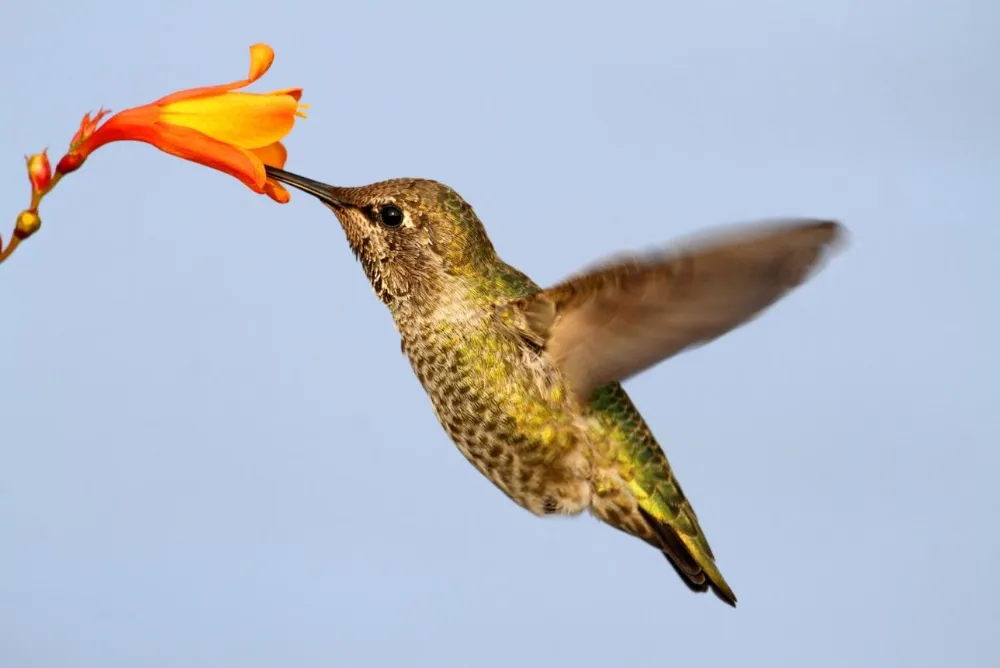
Hovering allows hummingbirds to reach nectar while maintaining precise control of their position relative to flowers.
Why Does Hovering Use So Much Energy?
Hovering requires continuous mechanical work against gravity and aerodynamic drag.
The wings must repeatedly accelerate and move through the air.
The bird also needs to stabilize its body.
These processes demand substantial muscular power.
The 2014 study of hummingbird wing performance noted that sustained hovering carries a high energetic cost.
Hummingbirds support this lifestyle through specialized muscles, circulation, respiration, and metabolism.
However, their energy expenditure changes with flight conditions.
Do Hummingbirds Have Fast Metabolisms?
Yes. Hummingbirds are known for exceptionally high metabolic demands during active flight.
Their small body size and rapid wing movements contribute to these requirements.
They obtain energy from nectar and other foods.
However, their metabolism is not maintained at exactly the same level throughout the day.
During periods of rest, hummingbirds can reduce energy expenditure.
Some also enter torpor, a temporary state of greatly reduced metabolic activity.
What Do Hummingbirds Eat Besides Nectar?
Hummingbirds obtain energy-rich sugars from nectar.
However, nectar alone does not provide all the nutrients needed for growth and maintenance.
Hummingbirds also consume small insects and other arthropods.
These foods supply proteins and other nutrients.
Different species use different combinations of feeding strategies.
Some catch small flying insects, while others collect prey from vegetation.
Their diet therefore supports both high-energy flight and broader nutritional requirements.
How Often Do Hummingbirds Need to Eat?
Hummingbirds typically feed repeatedly during their active periods.
However, there is no single feeding interval that applies to every species.
Feeding frequency depends on body size, temperature, food availability, and activity.
Hovering can be energetically expensive, but hummingbirds also conserve energy by perching and resting.
They may spend considerable time sitting between feeding events.
Therefore, claims that every hummingbird must drink nectar every ten minutes or die are oversimplified.
Can Hummingbirds Hover for Hours?
Hummingbirds are capable of repeated and sustained hovering as part of normal feeding behavior.
However, a claim that an individual bird can hover continuously for several hours without rest or feeding requires direct evidence.
Hovering uses substantial energy.
In nature, hummingbirds frequently alternate between feeding flights, perching, and other activities.
The duration of individual hovering bouts varies with conditions.
The important distinction is that hummingbirds are capable of sustained stationary flight, unlike most birds, not that they remain airborne continuously throughout the day.
Do Hummingbirds Ever Stop Flying?
Yes. Hummingbirds regularly perch and rest.
They may perch between feeding visits, during territory defense, or while observing their surroundings.
They also sleep.
Some enter torpor to conserve energy.
Their remarkable flight ability does not mean they must remain in the air all the time.
In fact, resting is important for balancing the energetic demands of their lifestyle.
What Is Hummingbird Torpor?
Torpor is a temporary state in which an animal substantially reduces its metabolic activity and body temperature.
Hummingbirds can enter torpor during periods when conserving energy is important.
For example, cold nights may make it difficult to maintain their normal body temperature without using large amounts of stored energy.
The Smithsonian National Zoo describes torpor as an important adaptation for meeting these energetic challenges.
However, torpor differs from ordinary sleep.
It is a specialized physiological state involving changes in metabolism and temperature regulation.
How Do Hummingbirds Survive Cold Nights?
Some hummingbirds use torpor to reduce energy consumption.
During torpor, their body temperature and metabolic rate may decrease substantially.
This helps conserve limited energy stores.
However, the use and depth of torpor vary among species and environmental conditions.
Not every hummingbird enters the same physiological state every night.
The ability to reduce energy expenditure complements their high-energy daytime flight.
How Does Body Size Affect Hummingbird Hovering?
Hummingbirds vary substantially in body size.
Small species and larger species may use different wingbeat frequencies and wing shapes.
Body mass influences the amount of aerodynamic force required to remain airborne.
Wing length, wing area, and wing motion also matter.
The 2014 study comparing 26 wings from 12 hummingbird taxa found meaningful variation in aerodynamic effectiveness.
However, body size alone does not determine hovering performance.
Wing geometry and flight conditions contribute to the overall result.
Do Smaller Hummingbirds Beat Their Wings Faster?
Smaller hummingbirds often have higher wingbeat frequencies than larger species.
However, this is a general relationship rather than an absolute rule.
Wing shape, body mass, flight behavior, and environment also influence frequency.
Scientists examine multiple anatomical variables when comparing hovering performance.
A single body measurement is not enough to predict every species' wingbeat rate.
How Do Hummingbirds Stay Stable in Wind?
Wind creates changing aerodynamic forces around a hovering bird.
Hummingbirds respond by adjusting wing movement and body orientation.
These corrections help maintain position relative to a flower or other target.
However, strong wind can make precise hovering more difficult and costly.
Hummingbirds may also use sheltered locations or perch when conditions are unfavorable.
Their ability to stabilize in moving air is impressive but not unlimited.
Can Hummingbirds Hover in the Rain?
Hummingbirds can fly in wet conditions, but rain can affect flight performance.
Water droplets and wet feathers change the mechanical and aerodynamic conditions experienced by a bird.
Hummingbirds may adjust flight behavior when exposed to rain.
However, performance depends on the intensity of precipitation and the species.
It would be inaccurate to assume that rain has no effect or that all hummingbirds must stop flying whenever it begins.
What Is Ground Effect in Hummingbird Flight?
Ground effect refers to changes in aerodynamic performance when an animal or aircraft flies close to a surface.
The interaction between the wing-generated airflow and the surface can influence the energy needed for hovering.
A 2014 study tested Anna's hummingbirds hovering at different heights above a solid surface.
The researchers found that hovering close to the surface reduced mechanical and metabolic power expenditure under the tested conditions.
However, the amount of benefit depended on distance from the surface.
These results describe a measurable aerodynamic effect, not a universal claim that hovering is always easier near any object.
What Did the 2014 Ground Effect Study Find?
Researchers studied Anna's hummingbirds at different heights above a surface.
They measured wing movement, airflow, and metabolic performance.
When the birds hovered particularly close to the surface, energy requirements were reduced compared with hovering at greater heights.
However, not every aspect of wing motion changed.
Some wingbeat characteristics remained relatively stable across the tested heights.
The study demonstrated that nearby surfaces can influence the energy cost of hovering.
This provided a useful connection between biological flight and aerodynamic theory.
Do Hummingbirds Hover Like Helicopters?
Hummingbirds and helicopters both generate aerodynamic force sufficient to remain airborne without moving forward.
However, they use very different mechanical systems.
Helicopters typically rely on rotating rotor blades.
Hummingbirds use rapidly flapping feathered wings that rotate and change orientation during the stroke.
A 2014 study compared the aerodynamic efficiency of hummingbird wings with an advanced miniature helicopter rotor.
The results showed interesting similarities in performance.
However, the comparison does not mean a hummingbird's wings function exactly like helicopter blades.
Hummingbird vs. Helicopter Hovering
| Feature | Hummingbird | Helicopter |
|---|---|---|
| Lift-producing structure | Two feathered wings | Rotating rotor blades |
| Movement pattern | Rapid flapping and wing rotation | Continuous rotor rotation |
| Energy source | Biological metabolism | Engine or motor |
| Hover control | Wing kinematics and body adjustments | Rotor pitch and flight controls |
| Can hover? | Yes | Yes |
Do Other Birds Hover?
Some other birds can remain almost stationary in the air under particular conditions.
For example, certain birds of prey may appear to hover while facing into a strong headwind.
However, this is different from the highly specialized sustained hovering of hummingbirds.
Kingfishers and other birds may briefly hover during hunting.
Their flight mechanics differ from those of hummingbirds.
Hummingbirds are especially well adapted to hovering repeatedly while feeding, regardless of whether they have a supporting headwind.
Why Are Hummingbirds Important Pollinators?
Many hummingbirds visit flowers to obtain nectar.
During these visits, pollen may attach to their bills, heads, or other body parts.
When they visit another flower, some pollen can be transferred.
This makes hummingbirds important pollinators for certain plant species.
However, not every hummingbird visit results in successful pollination.
The relationship depends on flower structure and the bird's feeding behavior.
Hovering allows hummingbirds to access flowers that may be difficult for other animals to use.
How Do Hummingbirds Help Flowers Reproduce?
Hummingbirds can carry pollen between flowers while feeding.
Some plants have evolved floral structures that encourage contact with particular parts of a hummingbird's body.
Long tubular flowers are a familiar example.
However, flower shape and pollinator relationships vary across ecosystems.
Not every red tubular flower depends exclusively on hummingbirds.
Likewise, hummingbirds can feed from flowers with different colors and shapes.
The ecological relationship reflects a long history of interactions between flowering plants and nectar-feeding animals.
How Do Scientists Study Hummingbird Hovering?
Scientists use high-speed cameras, motion tracking, airflow visualization, and aerodynamic measurements.
High-speed video makes it possible to observe wing movement that is too rapid for the human eye to follow.
Particle image velocimetry helps reveal airflow patterns around a hovering bird.
Researchers can also measure metabolic rates to evaluate energy expenditure.
Mechanical models and robotic wings help test hypotheses about lift production.
The combination of these methods has greatly improved scientific understanding of hummingbird aerodynamics.
Why Is Hummingbird Flight Important to Robotics?
Hummingbirds provide inspiration for small flying robots.
Their wings demonstrate how rapid movements and precise control can support stable hovering.
Engineers study wing shapes, aerodynamic vortices, and maneuvering strategies.
Some researchers compare biological hovering with miniature rotor systems.
However, copying an animal's external appearance does not automatically reproduce its flight capabilities.
Robotic designs must also address power supply, control systems, structural materials, and efficiency.
Hummingbirds remain valuable models for research on small-scale flight.
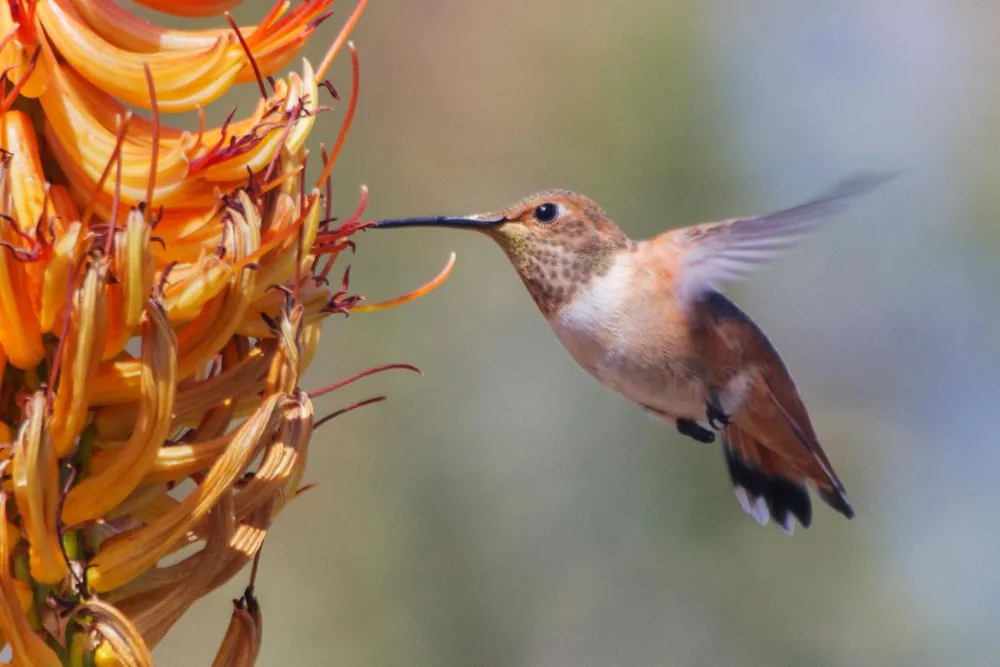
Hummingbirds combine rapid wing movement, precise maneuvering, and high-energy feeding to support sustained hovering.
Frequently Asked Questions
How do hummingbirds hover?
They rapidly flap and rotate their wings to produce aerodynamic force during both the downstroke and upstroke.
Why can hummingbirds hover in place?
Their specialized wing anatomy, shoulder movement, flight muscles, and precise control allow them to maintain a nearly stationary position.
How fast do hummingbird wings flap?
Wingbeat frequencies vary by species and behavior. Some hummingbirds can reach approximately 80 beats per second.
Do hummingbirds produce lift on the upstroke?
Yes. In studied hummingbirds, the upstroke contributes substantial weight support.
Is the lift equal during both strokes?
No. A 2005 study of rufous hummingbirds found approximately 75 percent of support during the downstroke and 25 percent during the upstroke.
Do hummingbird wings move in a figure eight?
Their rapid back-and-forth movement is often described as a flattened figure-eight pattern, although the real wing path is more complex.
Can hummingbirds fly backward?
Yes. They can fly backward by adjusting the aerodynamic forces produced by their wings.
Can hummingbirds fly sideways?
Yes. Their maneuverability allows sideways movement and rapid changes in direction.
Why do hummingbirds hum?
The characteristic humming sound is generated by their rapidly moving wings.
Why do hummingbirds hover near flowers?
Hovering allows them to reach nectar while remaining airborne and maintaining precise position relative to a flower.
Does hovering use a lot of energy?
Yes. Sustained hovering requires substantial muscular power and metabolic energy.
Do hummingbirds ever rest?
Yes. They regularly perch and may enter torpor to conserve energy.
Can hummingbirds hover without wind?
Yes. Their wings generate the aerodynamic forces needed for sustained hovering without requiring a headwind.
Can other birds hover?
Some other birds hover briefly or with help from wind, but hummingbirds are uniquely specialized among birds for prolonged stationary hovering.
Do hummingbirds hover like helicopters?
Both can remain airborne in one position, but hummingbirds use flapping wings while helicopters rely on rotating rotor blades.
The Bottom Line
Hummingbirds hover because their wing anatomy and movement allow them to generate useful aerodynamic force during both halves of a wingbeat.
Their wings rotate rapidly, and complex airflow structures help support their weight.
Scientific experiments have shown that the downstroke often contributes more lift than the upstroke, although exact proportions differ among species.
Hovering is energetically expensive, but hummingbirds possess specialized muscles and metabolic adaptations that make it possible.
These remarkable flight abilities allow them to drink nectar from flowers, fly backward, maneuver through vegetation, and maintain precise positions in the air.
Their flight provides one of nature's most sophisticated examples of aerodynamic control and remains an important subject for biological and engineering research.
Sources & Further Reading
Smithsonian Gardens — Hovering. Overview of wing rotation, hovering, backward flight, and feeding.
Smithsonian National Zoo — Hummingbirds. Bird anatomy, wingbeat performance, energetic demands, and torpor.
Warrick, Tobalske and Powers (2005) — Aerodynamics of the Hovering Hummingbird. Nature. Primary research establishing the 75/25 weight-support distribution in rufous hummingbirds.
Structure of the Vortex Wake in Hovering Anna's Hummingbirds (2013). Measurements of wing-generated vortices and aerodynamic contributions.
Hummingbird Wing Efficacy Depends on Aspect Ratio and Compares With Helicopter Rotors (2014). Research comparing wings from multiple hummingbird taxa and miniature rotors.
Hovering Performance of Anna's Hummingbirds in Ground Effect (2014). Experimental work on flight mechanics and energy use near surfaces.
Hovering Hummingbird Wing Aerodynamics During the Annual Cycle: Complete Wing (2017). Scientific study of hummingbird wing airflow and force production.