Octopuses change color by controlling specialized pigment-filled organs called chromatophores in their skin. Tiny muscles expand or contract these organs, revealing or concealing pigments and allowing the animal to change its appearance remarkably quickly. Reflective skin cells called iridophores and leucophores also contribute to the final appearance. Many octopuses can alter the texture of their skin using muscular projections called papillae. These adaptations help them hide from predators, approach prey, and display visual signals. Surprisingly, octopuses are generally considered to have limited conventional color vision, making their sophisticated camouflage an ongoing scientific puzzle.
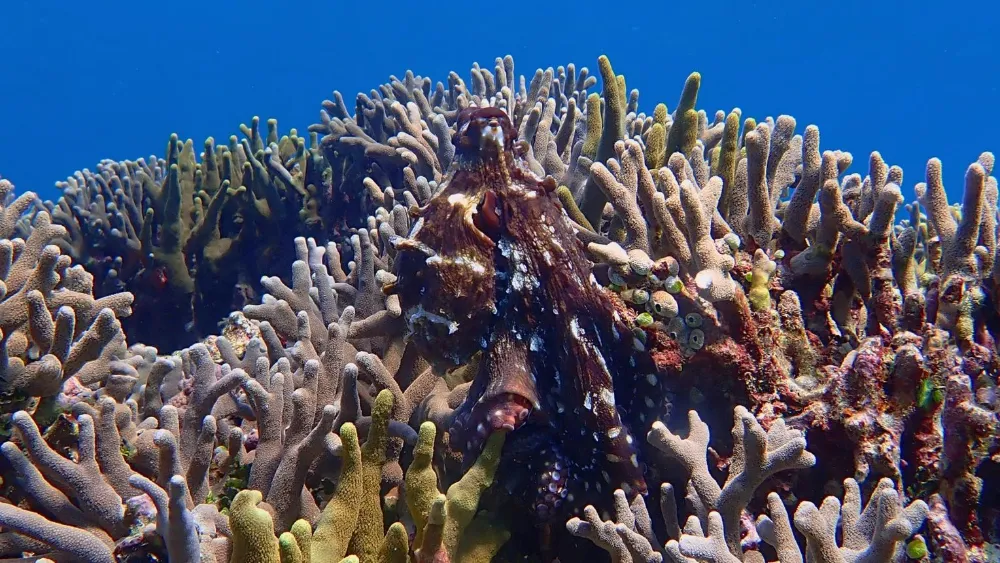
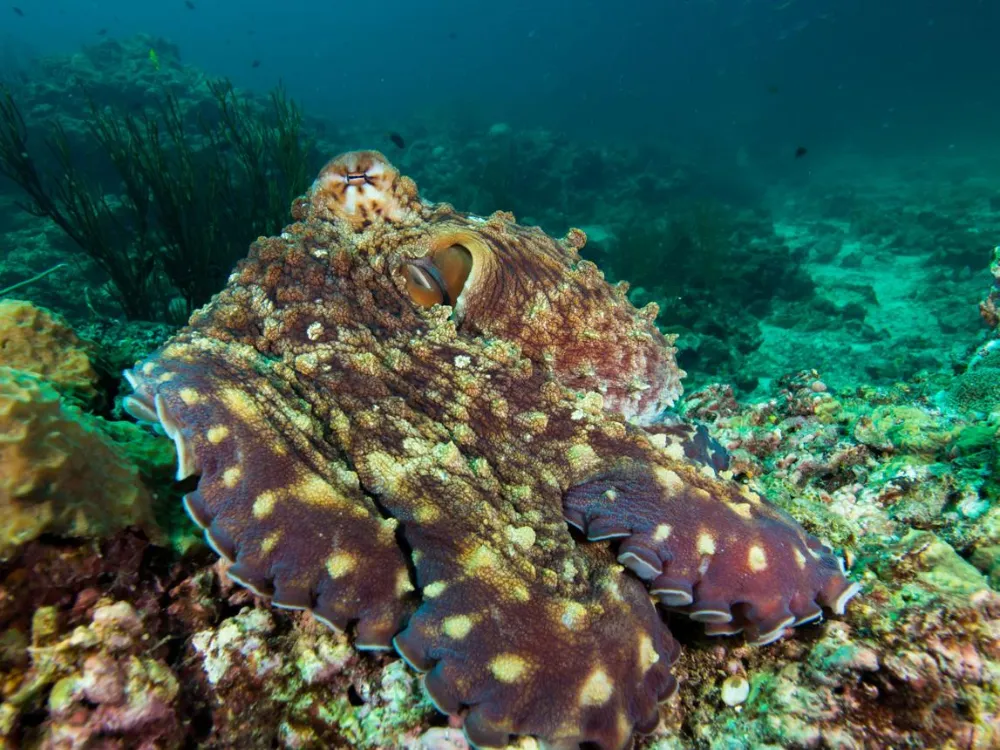
Octopuses can adjust skin colors and patterns to resemble the brightness and texture of their surroundings.
How Do Octopuses Change Color?
Octopuses are marine mollusks belonging to a group called cephalopods.
They are famous for their intelligence, flexible bodies, and remarkable camouflage.
One of their most extraordinary abilities is changing skin color and pattern rapidly.
The main mechanism involves pigment organs known as chromatophores.
These structures contain expandable sacs filled with pigment.
Muscles surrounding the sacs can enlarge their visible area or allow them to shrink.
When many chromatophores change together, the octopus can produce different colors, spots, stripes, and contrasting patterns.
However, pigment cells are not the only components involved.
Additional reflective cells and specialized skin muscles can create more complex optical effects and changes in surface texture.
What Are Chromatophores?
Chromatophores are specialized pigment-containing organs found in the skin of octopuses and several other cephalopods.
In an octopus, each chromatophore contains an elastic pigment sac.
Small muscles radiate outward from the sac and attach to surrounding tissues.
When these muscles contract, the sac expands.
The pigment becomes visible across a larger area of the skin.
When the muscles relax, the sac contracts and the visible pigment area becomes smaller.
The Smithsonian Ocean explains that this coordinated action can produce remarkably rapid changes in appearance.
However, the pigments themselves do not need to change chemically from brown to yellow or red during each display.
Much of the visible transformation results from controlling how much of each pigment is exposed.
How Do Chromatophore Muscles Work?
Each chromatophore is surrounded by a group of radial muscles.
These muscles are controlled through the nervous system.
When the muscles contract, they pull the flexible pigment sac outward.
This increases the surface area covered by the pigment.
When muscle tension decreases, the elastic sac retracts.
By coordinating large numbers of chromatophores, the octopus can create rapidly changing patterns across its body.
Different regions of the skin can display different combinations of expanded and contracted pigment organs.
This allows the animal to produce complex appearances rather than simply switching its entire body between two uniform colors.
How Fast Can Octopuses Change Color?
Some octopuses can change noticeable aspects of their color or body pattern within a fraction of a second.
The exact speed depends on the species, type of pattern, and circumstances.
The rapid response is possible because chromatophore organs are directly controlled by muscles and nerves.
The octopus does not need to wait for new pigment molecules to be manufactured during each change.
Instead, it adjusts the exposure of pigments already present in the skin.
However, not every full-body transformation happens at the same speed.
Changes in texture, posture, and complex camouflage patterns may involve additional movements.
Why Do Octopuses Change Color?
Octopuses use color changes in several biological situations.
The most familiar is camouflage.
A well-camouflaged octopus may become difficult for predators or prey to distinguish from surrounding rocks, sand, or vegetation.
However, color change can also occur during hunting, defensive encounters, and interactions with other octopuses.
Some species produce conspicuous patterns that contrast strongly with their surroundings.
These displays can have different meanings depending on the species and context.
It is therefore inaccurate to assume that every change in octopus color is intended to blend into the background.
How Do Octopuses Camouflage?
Octopus camouflage combines several different adaptations.
These include changing pigment patterns, modifying reflected light, altering skin texture, and adjusting body posture.
An octopus resting on a rocky seabed may develop a mottled pattern that resembles the contrast of surrounding stones.
Another individual among algae may adopt a different appearance.
Some species also extend skin projections to create a rough surface.
They may change the position of their arms to alter their body outline.
By combining these techniques, octopuses can become difficult to detect.
However, camouflage does not always require a perfect color match.
Matching brightness, contrast, texture, and spatial patterns can be especially important.
What Colors Can Octopuses Change Into?
The range of visible colors depends on the species.
Many octopuses can produce combinations of brown, reddish, yellowish, gray, white, and dark patterns.
Reflective skin structures can contribute additional optical effects.
However, an octopus cannot necessarily reproduce every imaginable color.
Its appearance is constrained by the pigments and reflective structures present in its skin.
Lighting conditions also influence how those colors appear to an observer.
Because water absorbs and scatters light, an octopus may look different at different depths.
Underwater photographs can also be affected by artificial lighting and camera settings.
Can Octopuses Turn Completely White?
Some octopuses can produce pale or nearly white appearances.
They may do this by reducing the visibility of darker pigment and allowing underlying reflective structures to dominate.
However, the exact mechanism and resulting appearance vary among species.
White coloration does not always indicate fear, stress, or illness.
It can occur in different behavioral and environmental contexts.
A reliable interpretation requires observing the animal's posture, surroundings, and other behavior.
Why Do Octopuses Turn Dark?
Darkening can occur when pigment-containing chromatophores expand over larger areas of the skin.
This makes dark pigments more visible.
However, a dark octopus is not necessarily angry.
Dark patterns may contribute to camouflage, defensive displays, or other behavior.
The meaning differs among species and circumstances.
Researchers therefore interpret color changes as part of broader body patterns rather than assigning one universal emotional meaning to every shade.
Do Octopuses Have Iridophores?
Yes. Reflective cells called iridophores contribute to coloration in several cephalopods.
Iridophores contain microscopic structures that reflect particular wavelengths of light.
These can produce iridescent or metallic-looking effects.
The Smithsonian describes their contribution to blue, green, silver, and gold appearances in cephalopods.
However, the abundance, arrangement, and behavior of these structures differ among species.
Iridophores are not identical to chromatophores.
Chromatophores work primarily through pigment exposure, while iridophores influence light through structural reflection.
What Are Leucophores?
Leucophores are another type of reflective cell found in some cephalopods.
They scatter and reflect a broad range of wavelengths.
This can help an animal reflect the general light characteristics of its surroundings.
For example, underlying reflective cells may influence the appearance of areas where the darker chromatophores are less expanded.
The Smithsonian explains that leucophores can contribute to camouflage by reflecting environmental light.
However, the presence and distribution of leucophores vary among cephalopod species.
They should not be imagined as identical bright white spots in every octopus.
Chromatophores vs. Iridophores vs. Leucophores
| Skin Structure | Main Function | Optical Mechanism |
|---|---|---|
| Chromatophores | Change visible pigment patterns | Muscle-controlled pigment exposure |
| Iridophores | Produce selective or iridescent reflection | Microscopic reflecting structures |
| Leucophores | Reflect and scatter broad-spectrum light | Broadband reflection |
| Skin papillae | Change surface texture | Muscular changes in skin shape |
These structures work together with body posture and behavior to produce the octopus's final appearance.
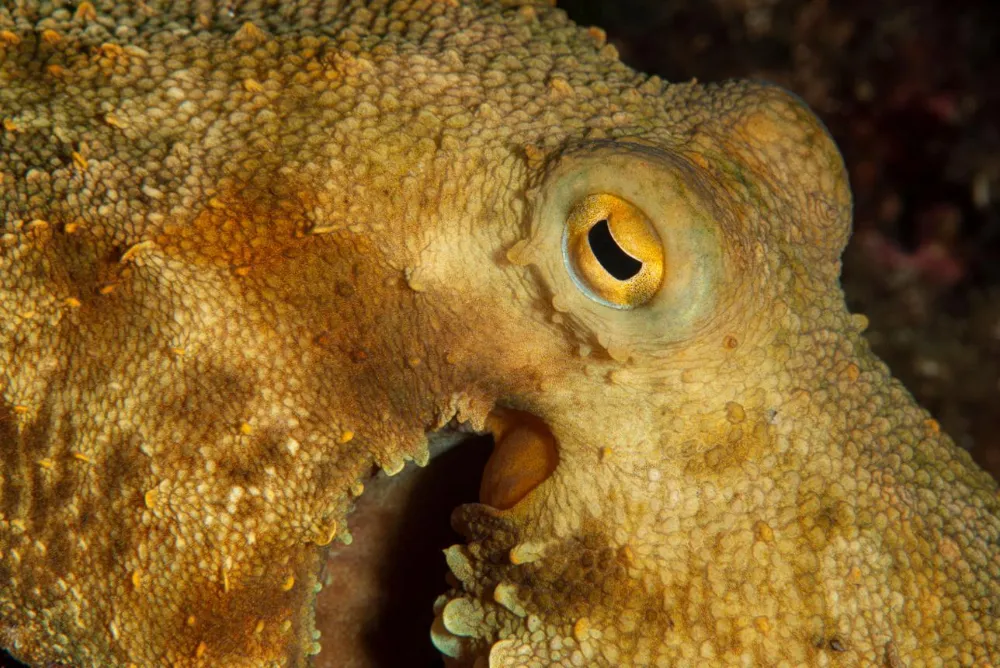
Rapid color changes depend on the coordinated activity of large numbers of pigment organs and other skin structures.
How Do Octopuses Change Skin Texture?
Octopuses can change more than color.
Many species can alter the surface of their skin by controlling muscular projections called papillae.
When papillae are extended, the skin becomes rougher.
The projections can help the animal resemble rocks, coral, or other irregular surfaces.
When they retract, the skin becomes smoother.
The Smithsonian Ocean describes this ability as an important component of cephalopod camouflage.
However, an octopus cannot literally transform its skin into real coral or stone.
It changes the visible shape and texture of its own living tissues.
What Are Octopus Skin Papillae?
Papillae are muscular projections associated with the skin surface.
They can be raised or lowered to change the animal's visible texture.
Some octopus species are especially skilled at producing rough, irregular appearances.
This helps disrupt the smooth outline that might otherwise reveal the animal.
However, the forms and extent of these projections vary among species.
Scientific descriptions should therefore avoid assuming that every octopus has exactly the same range of textures.
Can Octopuses Look Like Rocks?
Yes. Some octopuses can resemble rocks remarkably well.
They can produce mottled colors, uneven brightness, and textured skin.
They may also flatten their bodies or position their arms to reduce their recognizable outline.
This can make them difficult to distinguish from the surrounding seabed.
However, the animal is not reproducing every detail of a rock.
Effective camouflage can result from approximate matching of important visual features.
The success of the disguise also depends on the observer's visual system and viewing distance.
Can Octopuses Mimic Coral?
Some octopuses can resemble coral-covered or irregular reef surfaces.
They adjust pigment patterns and skin texture while positioning their bodies among natural structures.
This can reduce the contrast between the animal and its surroundings.
However, camouflage does not require the octopus to know the scientific identity of the object it resembles.
Its visual and motor systems respond to information about the environment.
The result may look like coral to a human observer without proving the animal intentionally selected a specific coral species to imitate.
Do Octopuses Change Color to Communicate?
Yes. Some octopuses use body patterns and color changes during interactions with other animals.
These can include defensive situations and encounters with other octopuses.
However, the meaning of a pattern depends on species and context.
A contrasting display does not necessarily indicate the same behavior in every octopus.
Researchers study color together with posture, arm positioning, movement, and other signals.
Camouflage and communication are therefore both important, but they should not be treated as identical functions.
Do Octopuses Change Color When They Are Angry?
Octopuses may display conspicuous patterns during threatening or defensive encounters.
However, describing such changes as anger can overinterpret their emotional state.
Researchers can document behavior, body posture, and visible displays.
They cannot directly infer a precise human-like emotion from skin color alone.
Therefore, a dark or contrasting pattern is better described as part of a behavioral display unless stronger evidence supports a more specific interpretation.
Do Octopuses Change Color When Sleeping?
Octopuses can show changes in skin patterns during periods of rest.
Studies of octopus sleep-like states have documented changes in body coloration and behavior.
However, visible color changes do not prove that an octopus is dreaming.
Dreaming is a subjective experience that cannot be directly confirmed from body patterns alone.
Researchers investigate rest states using behavior, responsiveness, and physiological measurements.
The relationship between octopus sleep and skin displays remains an active research topic.
Do Octopuses Dream in Color?
Scientists do not know whether octopuses have subjective dreams, or whether any such experiences include color.
It is tempting to interpret rapid skin changes during rest as visible evidence of a dream.
However, the animal's internal experience cannot be established from these changes.
Skin patterns during rest may be associated with activity in the nervous system, but the precise connection is not fully understood.
Therefore, the claim that scientists can watch an octopus's dreams on its skin is not scientifically demonstrated.
Can Octopuses See Color?
Octopus color vision is a fascinating scientific problem.
Most studied octopuses have only one principal visual pigment in their eyes.
Classical behavioral studies suggest that they have limited conventional color discrimination.
Nevertheless, they can produce remarkably effective camouflage against differently colored backgrounds.
Researchers have proposed several ways this could be possible.
One explanation emphasizes matching brightness and spatial contrast rather than precisely identifying every hue.
Another possibility involves optical effects related to the eye and pupil.
However, the exact explanation remains under investigation.
It is therefore more precise to say that conventional color vision appears limited than to claim that every aspect of octopus color perception is completely understood.
How Can Color-Blind Octopuses Camouflage?
Camouflage does not always require an animal to identify colors the same way humans do.
Matching brightness, contrast, pattern scale, and texture can produce highly effective visual concealment.
Reflective skin structures can also respond to the surrounding light environment.
A 2022 study measured the reflectance spectra of the gloomy octopus, Octopus tetricus.
The researchers compared octopus appearance with natural backgrounds and considered how different visual observers might perceive them.
The findings helped clarify how an octopus can achieve color resemblance despite having limited conventional color vision.
However, the study did not establish that all octopuses perfectly match every color.
What Did the 2022 Octopus Color Study Discover?
A 2022 study in the journal Vision examined the color appearance of Octopus tetricus.
The researchers used spectral measurements rather than relying only on human visual impressions.
They compared light reflected by octopus skin with light reflected by natural background materials.
The analysis considered how those signals might appear to potential predators.
This was important because humans and marine predators do not necessarily perceive the same colors identically.
The research provided a quantitative approach to the relationship between octopus coloration and background matching.
It also emphasized that camouflage is influenced by the visual system of the observer.
Can Octopus Skin Detect Light?
Research suggests that octopus skin can respond directly to light under some conditions.
A 2015 study examined skin taken from the California two-spot octopus, Octopus bimaculoides.
Researchers found that isolated skin preparations could show light-activated chromatophore expansion.
They called this response LACE.
The study also detected molecular components associated with phototransduction in the skin.
These findings suggest that octopus skin contains a local light-sensitive system.
However, they do not demonstrate that the skin forms detailed images or independently controls whole-body camouflage without input from the eyes and brain.
Does an Octopus Have Eyes in Its Skin?
No. Octopus skin is not covered with miniature image-forming eyes.
The 2015 study found evidence of local light sensitivity in the skin of one species.
That is different from possessing thousands of complete eyes.
Specialized cells may respond to light intensity or wavelength without producing a detailed picture of the surroundings.
The animal's actual eyes and nervous system remain central to normal visual behavior and camouflage.
Descriptions such as an octopus can see with its skin are therefore catchy but need careful qualification.
How Does the Octopus Brain Control Color Change?
Octopus chromatophores are controlled by nerves and muscles.
The nervous system can coordinate patterns across many regions of the body.
This allows rapid changes in spots, bands, dark patches, and other visible features.
However, scientists do not yet understand every neural process responsible for selecting a particular pattern.
Camouflage involves integrating sensory information with motor control.
Local skin responses may contribute to this system, but they do not replace the role of central neural control.
Why Is Octopus Color Change So Fast?
The speed comes partly from the direct muscular control of chromatophore organs.
Unlike systems that depend primarily on slowly synthesizing or moving large amounts of pigment, octopus chromatophores can change their exposed area rapidly.
Muscle contractions create immediate optical changes.
Large numbers of chromatophores can act in coordinated patterns.
Other skin structures contribute additional visual complexity.
The result is an unusually flexible appearance-control system.
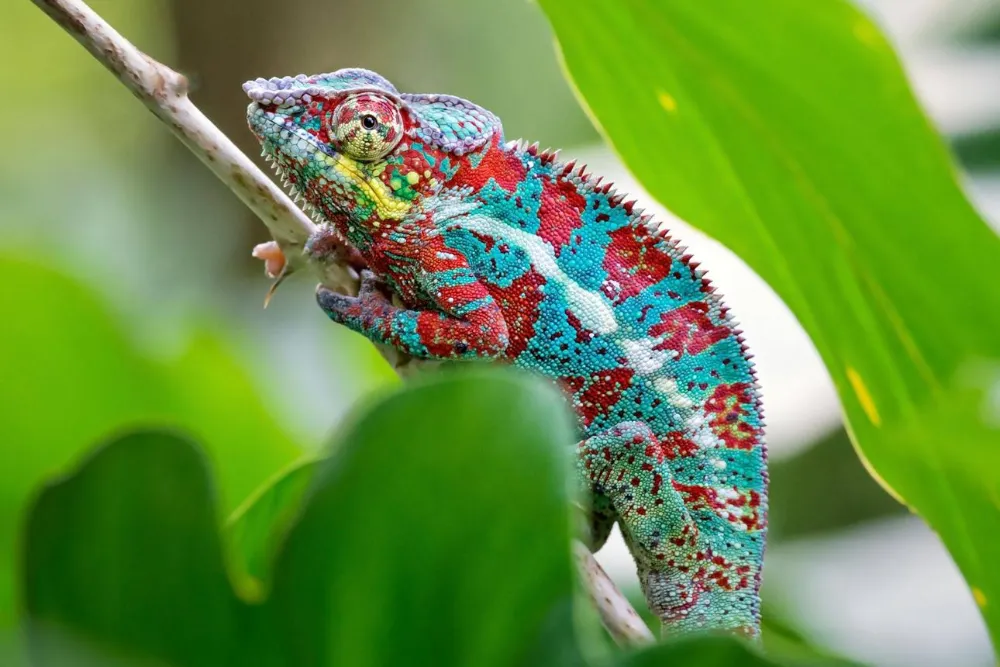
Octopus vs. Chameleon Color Change
| Feature | Octopus | Panther Chameleon |
|---|---|---|
| Animal group | Cephalopod mollusk | Reptile |
| Major rapid color mechanism | Muscle-controlled chromatophores | Changes in reflective guanine crystal arrangement |
| Additional optical structures | Iridophores and leucophores | Pigment cells and reflective iridophores |
| Changes in skin texture | Can be dramatic in some species | Much less extensive |
| Major functions | Camouflage, communication, defense | Social signaling, environmental responses, camouflage |
| Conventional color vision | Limited in most studied species | Color vision involved in social signaling |
Both animals can change appearance, but they rely on different evolutionary and physiological solutions.
Do Squid and Cuttlefish Change Color Like Octopuses?
Squid, cuttlefish, and octopuses are all cephalopods.
Many members of these groups possess chromatophores and reflective skin structures.
However, their behavior and anatomical details differ.
Cuttlefish are particularly well known for complex camouflage patterns.
Some squid use conspicuous visual displays for communication.
Octopuses often combine chromatophore changes with flexible body posture and skin texture.
The shared presence of chromatophores reflects important features of cephalopod evolution.
However, individual species should not be assumed to possess identical abilities.
Can Octopuses Change Their Body Shape?
Yes. Octopuses have highly flexible bodies supported by muscular structures rather than a rigid internal skeleton.
They can alter the arrangement of their arms and the shape of their bodies.
Some species use posture as part of camouflage or defensive displays.
However, they cannot literally transform into unrelated animal species.
Their flexible bodies and skin patterns can create convincing visual resemblances under particular circumstances.
These effects should be described as mimicry or camouflage rather than physical transformation into another organism.
How Does the Mimic Octopus Change Its Appearance?
The mimic octopus, Thaumoctopus mimicus, is known for distinctive postures and patterns that can resemble other marine animals.
It combines arm movements, body positioning, and color patterns.
However, popular descriptions sometimes exaggerate its abilities.
The animal does not actually become a fish, sea snake, or other organism.
Instead, it produces a visual resemblance that may influence how predators interpret it.
Scientists study this behavior to understand mimicry and predator avoidance.
Do Blue-Ringed Octopuses Change Color?
Blue-ringed octopuses are known for conspicuous blue markings that can become especially prominent during defensive displays.
These displays serve as warning signals.
Blue-ringed octopuses are venomous and should never be handled.
Their coloration involves specialized skin structures and pigment patterns.
However, the precise mechanisms can differ from those responsible for ordinary brown mottling in other octopus species.
It is important not to treat every octopus color display as camouflage.
Some displays make the animal more noticeable rather than less visible.
Can Octopuses Change Color to Hunt?
Color change can help an octopus approach prey without being noticed.
By blending into the environment, it may reduce the chance that potential prey detects its approach.
Some octopuses also change posture while moving through complex habitats.
However, the effectiveness of camouflage depends on the prey species and environmental conditions.
Not every hunting event involves an obvious visible color change.
Scientists distinguish camouflage used during hunting from other behaviors such as defensive displays and resting patterns.
Can Octopuses Turn Invisible?
No. Octopuses cannot become physically transparent or disappear.
However, their camouflage can make them extremely difficult to distinguish from the background.
This happens through the combined effects of color, pattern, texture, and posture.
An octopus may remain visible when examined closely but be difficult to detect from farther away.
The success of camouflage also depends on the visual capabilities of the observer.
Therefore, invisible is a popular description rather than a literal biological ability.
What Happens When an Octopus Cannot Camouflage?
Camouflage is one of several defense strategies used by octopuses.
If concealment fails, an octopus may retreat into a crevice, escape rapidly, or release ink.
Some species also produce conspicuous defensive displays.
However, the particular response depends on the species and situation.
Octopuses do not rely exclusively on color change for survival.
The Smithsonian Ocean describes their flexible bodies and ink defenses as additional adaptations that help them escape danger.
Why Is Octopus Camouflage Important?
Octopuses have soft bodies and face predators such as fish and marine mammals.
Camouflage can reduce the chance of detection.
It may also improve the success of certain hunting behaviors.
The ability to change appearance rapidly is especially valuable in habitats where the background varies over short distances.
Reefs, rocky seabeds, and patches of sand present different visual challenges.
An octopus capable of adjusting its appearance can respond to these changing conditions.
However, camouflage effectiveness is not the same in every habitat or against every predator.
How Do Scientists Study Octopus Camouflage?
Researchers use video recordings, high-resolution photography, spectrometry, and behavioral experiments.
They observe changes in skin pattern and compare the animal with its surroundings.
Some experiments analyze the reflectance spectrum of the skin.
Others examine chromatophore muscles and the neural pathways controlling them.
Scientists may also study how potential predators perceive the animal.
This matters because a pattern that appears obvious to a human may be less visible to another species.
The 2022 study of octopus reflectance demonstrated the importance of quantitative measurements in camouflage research.
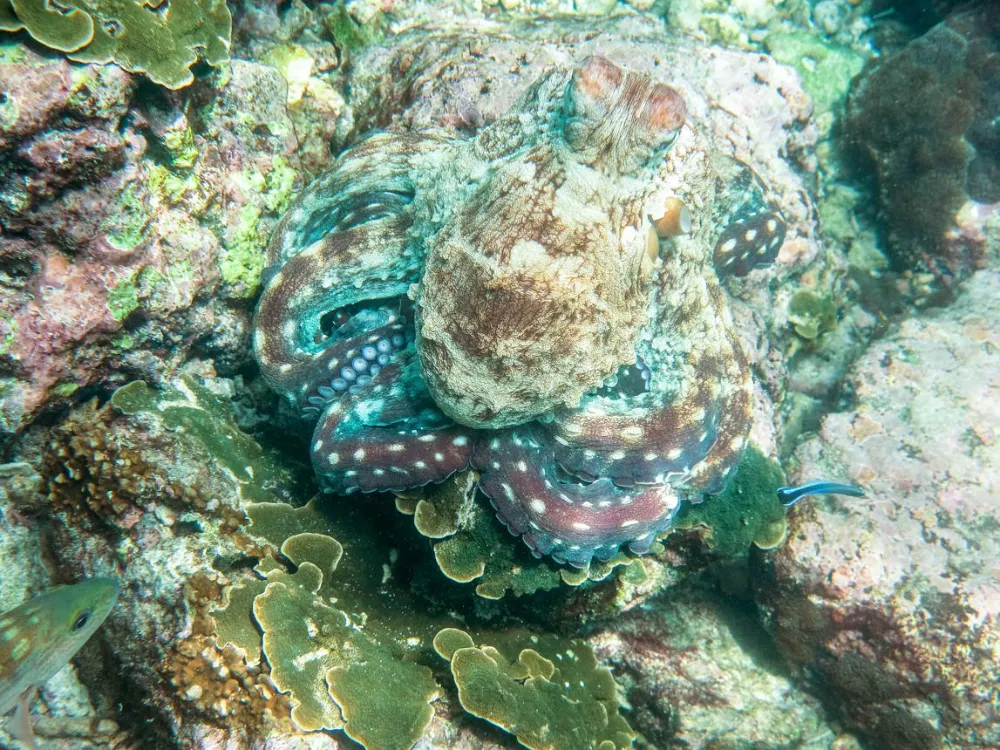
Octopuses combine pigment patterns, reflective structures, raised skin papillae, and body posture to blend into complex environments.
Frequently Asked Questions
How do octopuses change color?
They use muscle-controlled chromatophores that expand or contract pigment sacs in the skin, along with reflective structures that influence the final appearance.
Why do octopuses change color?
Color changes can help with camouflage, defense, hunting, and communication.
How fast can an octopus change color?
Some visible pattern changes can occur within fractions of a second, although timing varies by species and behavior.
What are octopus chromatophores?
They are pigment-containing organs whose visible area is controlled by surrounding muscles and nerves.
Can octopuses change skin texture?
Yes. Some species raise or lower muscular skin projections called papillae to resemble rough surfaces.
Can octopuses see color?
Most studied octopuses appear to have limited conventional color vision, although the full mechanisms underlying camouflage remain under investigation.
Can octopus skin detect light?
A 2015 experiment demonstrated local light-sensitive chromatophore responses in isolated skin from the California two-spot octopus.
Do octopuses have eyes in their skin?
No. Local light sensitivity does not mean the skin contains complete image-forming eyes.
Can octopuses turn white?
Some species can produce very pale appearances by adjusting pigment exposure and underlying optical reflection.
Why do octopuses turn dark?
Expanded dark chromatophores can increase visible pigmentation during camouflage or other behavioral contexts.
Do octopuses change color when sleeping?
Color and pattern changes have been observed during resting states, but these movements do not establish that the animal is dreaming.
Can an octopus mimic a rock?
Yes. Some octopuses use mottled color, textured skin, and body posture to resemble rocks and other seabed structures.
How is octopus color change different from chameleon color change?
Octopuses primarily use muscle-controlled pigment organs, while the dramatic hue changes studied in panther chameleons involve adjustments to guanine nanocrystal arrays.
Can octopuses become invisible?
No. They can become extremely well camouflaged, but they do not literally disappear.
Do all octopus species change color in the same way?
No. The range of colors, patterns, textures, and behavioral responses varies among species.
The Bottom Line
Octopuses change color using a specialized system of pigment-filled chromatophores controlled by muscles and nerves.
Reflective cells called iridophores and leucophores contribute additional optical effects.
Many octopuses can also change skin texture using muscular papillae.
These adaptations allow them to blend into complex marine environments and produce visual signals.
However, their ability to camouflage despite limited conventional color vision remains an important scientific puzzle.
Research on octopus skin has also revealed unexpected local sensitivity to light, demonstrating that this remarkable animal still has much to teach scientists about sensation, movement, and biological color.
Sources & Further Reading
Smithsonian Ocean — How Octopuses and Squids Change Color. Explains chromatophores, reflective cells, and skin papillae.
Smithsonian Ocean — Cephalopods: Octopus, Squid, Cuttlefish, and Nautilus. Detailed introduction to cephalopod anatomy, camouflage, and behavior.
Nahmad-Rohen et al. (2022) — The Colours of Octopus: Using Spectral Data to Measure Octopus Camouflage. Quantitative research on octopus skin reflectance and background matching.
Ramirez and Oakley (2015) — Eye-Independent, Light-Activated Chromatophore Expansion and Expression of Phototransduction Genes in the Skin of Octopus bimaculoides. Experimental evidence of local light sensitivity in octopus skin.
The Eye of the Common Octopus (Octopus vulgaris). Scientific review of octopus vision, sensory abilities, and unanswered questions about color perception.
Smithsonian Ocean — Octopus in the Open. Examples of chromatophores and reflective cells in octopus skin.