Sloths move so slowly because their bodies are adapted to conserve energy. Their low-energy diets, unusually low metabolic rates, slow digestion, and economical methods of regulating body temperature all favor a lifestyle built around careful, deliberate movement. Sloths are not simply lazy animals. Moving slowly is part of a specialized survival strategy that allows them to live on resources that provide relatively little usable energy. In the rainforest canopy, their careful movements and natural camouflage can also make them difficult for predators to notice.
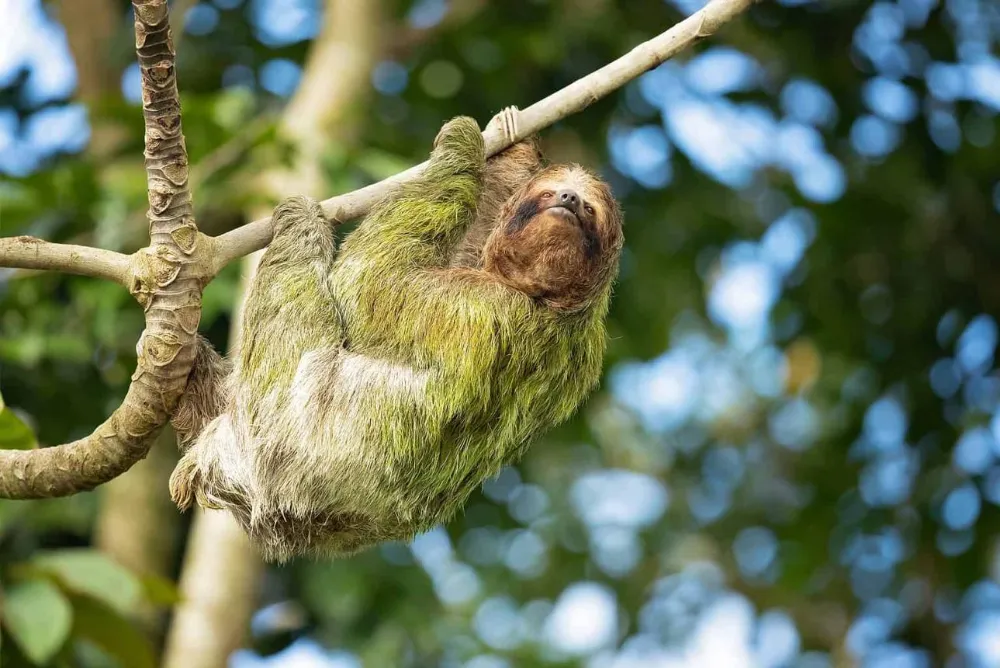
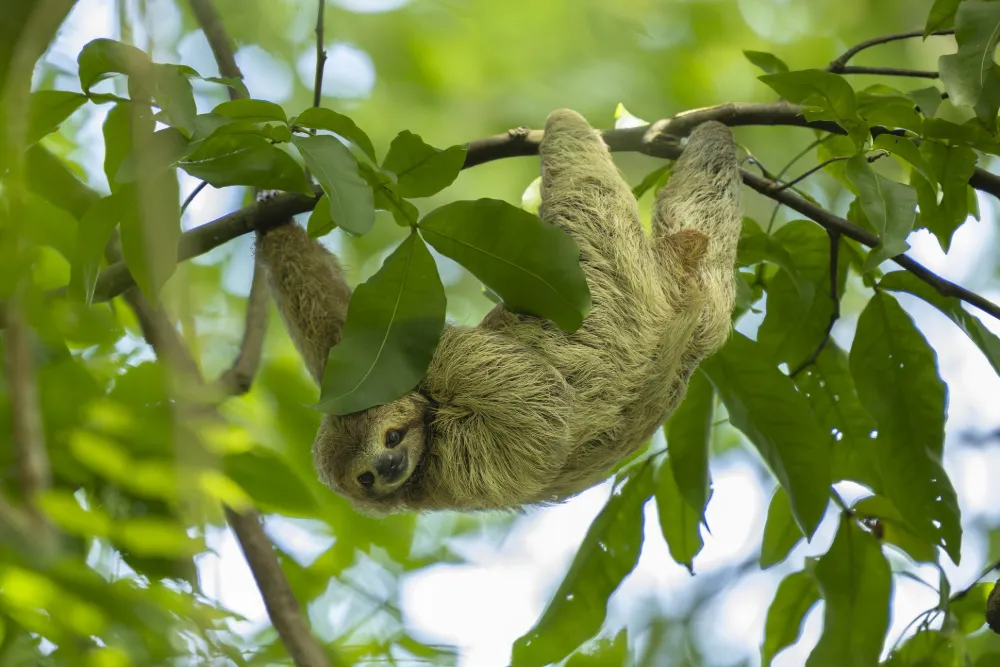
Three-toed sloths conserve energy by moving deliberately through the trees of tropical forests.
Why Are Sloths So Slow?
Sloths are among the slowest-moving mammals on Earth.
They spend much of their lives in trees, using long curved claws to maintain a secure grip on branches.
Their slow movements may seem unusual compared with monkeys or other climbing mammals.
However, sloths face a different set of ecological challenges.
Many sloths eat leaves, which generally provide less readily available energy than energy-rich fruits or animal prey.
They also rely on a slow digestive system that allows microorganisms to help break down difficult plant material.
Their bodies have evolved to use energy sparingly.
Instead of spending large amounts of energy on rapid movement, sloths minimize unnecessary activity.
This combination of diet, metabolism, digestive physiology, and lifestyle explains much of their characteristic slowness.
Do Sloths Have a Slow Metabolism?
Yes. Sloths have remarkably low metabolic rates.
Metabolism includes the chemical processes that allow an animal to maintain its body, obtain energy, and perform daily activities.
Animals with higher energy requirements generally need to consume more food or obtain food containing more usable energy.
Sloths have evolved a strategy involving low energy expenditure.
The Smithsonian National Zoo notes that sloth metabolism can be far below the rate expected for a mammal of similar body mass.
However, different species and different measurement methods produce different results.
A 2016 study published in The American Naturalist measured field metabolic rate, body temperature, and movement in two-toed and three-toed sloths.
The researchers found that three-toed sloths had exceptionally low field energy expenditure.
They also moved less and exhibited greater variation in body temperature than the two-toed sloths studied.
What Did the 2016 Sloth Metabolism Study Discover?
The 2016 study, titled Arboreal Folivores Limit Their Energetic Output, All the Way to Slothfulness, examined the energy budgets of wild sloths.
Researchers studied two-toed and three-toed sloths living in the same general environment.
This allowed them to compare related animals with different degrees of dietary specialization.
Both groups used relatively little energy.
However, the three-toed sloths had an especially low measured field metabolic rate.
The researchers described it as the lowest recorded for any mammal in the available comparative measurements.
They also found that three-toed sloths moved less than the two-toed sloths.
The results supported the idea that a low-energy leaf diet constrains how much energy these animals can spend.
Importantly, the study measured actual energy expenditure rather than merely assuming that slow movement must mean a low metabolism.
Why Does a Sloth's Diet Make It Slow?
Many sloths obtain much of their food from leaves.
Leaves can contain substantial amounts of structural carbohydrates, including cellulose and other difficult-to-digest materials.
They may also contain defensive chemical compounds produced by plants.
Compared with many other foods, leaves can provide a relatively low concentration of readily available energy.
Sloths depend on microbial fermentation to help process plant material.
However, this digestive strategy is slow.
The animal cannot necessarily increase food consumption quickly enough to support very high levels of physical activity.
As a result, moving slowly helps its overall energy budget remain sustainable.
What Do Sloths Eat?
Sloth diets vary among species.
Three-toed sloths are especially associated with leaf eating.
In a 2022 field study of the pale-throated three-toed sloth, Bradypus tridactylus, leaves accounted for approximately 97 percent of the studied dietary composition.
However, that percentage should not be treated as universal for all sloths.
Two-toed sloths can consume a somewhat broader variety of plant materials.
The Smithsonian National Zoo lists leaves, fruit, and fresh shoots as important foods for two-toed sloths.
Occasional consumption of other small food items has also been reported.
Therefore, describing every sloth as eating exactly the same leaves would be inaccurate.
Why Is Sloth Digestion So Slow?
Sloth digestion relies heavily on microbial processing of plant material.
Their digestive systems contain specialized compartments where microorganisms help break down food.
This process is called fermentation.
Fermentation allows the animal to extract energy from plant components that are difficult to digest directly.
However, processing fibrous material can take considerable time.
Studies of captive sloths have documented long food-retention times.
A 2015 investigation of captive Linnaeus's two-toed sloths, for example, found substantial individual variation in how long digested material remained in the gastrointestinal tract.
Some individuals retained solid food particles for more than 140 hours on average.
This demonstrates that digestion is slow, but it does not establish one exact digestion duration for every sloth.
How Long Does a Sloth Take to Digest Food?
Sloths are famous for prolonged digestion, but there is no single duration that applies to every species or food item.
Some descriptions refer to food remaining within the digestive system for many days or even several weeks.
The timing depends on the animal, diet, gut compartment, and how retention is measured.
The Smithsonian National Zoo describes very long digestive retention in two-toed sloths.
Scientific experiments also reveal differences among individuals.
Therefore, claims that every sloth needs exactly 30 days to digest every leaf are too absolute.
The scientifically important point is that sloth digestion is unusually slow and closely connected to their low-energy lifestyle.
Do Sloths Get More Energy From Warm Weather?
Environmental temperature can influence sloth physiology.
A study published in 2015 examined food consumption in captive brown-throated sloths, Bradypus variegatus.
Researchers found that the animals consumed more food when ambient temperatures were higher.
They proposed that temperature-related changes in gut fermentation could help explain the relationship.
Warmer conditions may allow digestive microorganisms to process food more effectively within certain ranges.
However, excessive heat can create its own physiological risks.
The study does not mean that hotter conditions are always better or that sloths benefit from unlimited increases in temperature.
How Do Sloths Regulate Body Temperature?
Sloths are mammals, but their body temperatures can fluctuate more than those of many familiar mammals.
They can reduce the energy required for temperature regulation by making use of environmental heat.
For example, a sloth may occupy a warm microhabitat or change its position relative to sunlight.
A 2022 study monitored wild pale-throated sloths using heart-rate and temperature loggers.
The researchers found evidence that the animals maintained suitable body temperatures while minimizing costly internal heat production.
This energy-saving strategy is consistent with their low-calorie diets.
However, sloths are not reptiles, and their temperature regulation should not be described as identical to that of lizards.
Are Sloths Cold-Blooded?
No. Sloths are mammals, and calling them cold-blooded is an oversimplification.
However, they do not always maintain the same narrow body-temperature range seen in many other mammals.
Scientists sometimes describe their body temperature as relatively variable.
This flexibility can help reduce energy expenditure.
Some sloths take advantage of warm surroundings rather than producing large amounts of metabolic heat.
Their physiological strategy demonstrates that mammalian temperature regulation is more diverse than the traditional simple division between warm-blooded and cold-blooded animals suggests.
Do Sloths Save Energy by Moving Slowly?
Yes. Slow movement helps sloths reduce unnecessary energy expenditure.
However, movement speed is only one component of their overall energy budget.
They also conserve energy through low metabolism, specialized digestion, and relatively inexpensive temperature regulation.
Moving slowly complements these physiological traits.
It would be misleading to assume that sloths could simply choose to become consistently fast animals without affecting their energy requirements.
Their entire lifestyle has evolved around a limited supply of usable energy.
Are Three-Toed Sloths Slower Than Two-Toed Sloths?
The two living sloth lineages differ in ecology, anatomy, and metabolism.
The 2016 field study found that three-toed sloths moved less and used less energy than two-toed sloths living in the same general environment.
However, these findings should not be interpreted as a precise universal speed ranking of every individual.
Movement varies with behavior, habitat, body size, and environmental conditions.
Two-toed sloths may also be active at different times from some three-toed sloths.
The important distinction is that the two lineages have related but not identical energy-conservation strategies.
Two-Toed vs. Three-Toed Sloths
| Feature | Two-Toed Sloths | Three-Toed Sloths |
|---|---|---|
| Living genus | Choloepus | Bradypus |
| Front-limb digits | Two functional digits with claws | Three functional digits with claws |
| Hind feet | Three digits | Three digits |
| Diet | Generally includes leaves and other plant materials | Often more strongly specialized for leaves |
| Field metabolism | Very low | Exceptionally low in measured populations |
| Movement | Slow, but may be relatively more active | Often especially slow and energy-conserving |
| Tree-dwelling adaptations | Long curved claws and specialized limbs | Long curved claws and specialized limbs |
The names two-toed and three-toed refer to the front limbs; both groups have three digits on their hind feet.
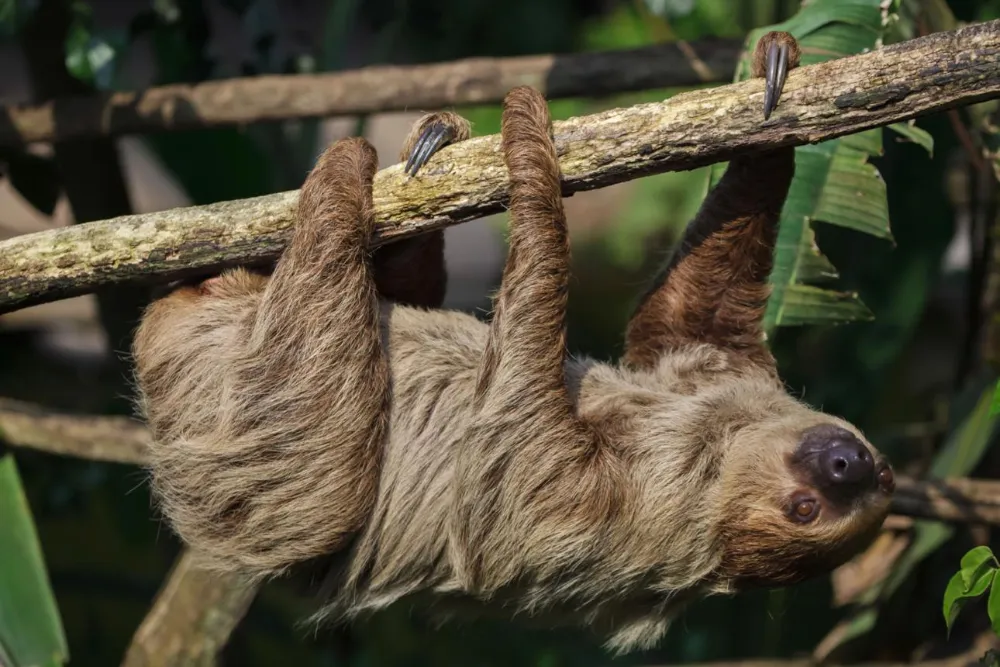
Two-toed sloths also move deliberately through trees, although their ecology differs from that of three-toed sloths.
How Fast Can a Sloth Move?
Sloths generally move slowly compared with many other mammals.
However, there is no single speed that describes every sloth under all conditions.
Walking on the ground, climbing through branches, and swimming involve different movements.
The animal's motivation and physical condition also matter.
Sloths may make faster movements when threatened or when interacting with their environment.
Smithsonian animal-care specialists have observed captive sloths moving more quickly than visitors often expect.
Therefore, widely repeated claims giving one exact maximum speed for all sloths should be treated cautiously unless the measurement method and species are specified.
Can Sloths Move Quickly When They Need To?
Sloths are capable of changing their movement speed.
They may react rapidly in certain situations, particularly when using their claws or responding to nearby disturbances.
However, their body design does not support prolonged rapid running like that of many terrestrial mammals.
Most of their movement is adapted for controlled travel among branches.
The Smithsonian National Zoo has reported that individual sloths can surprise keepers with relatively quick movements.
This demonstrates that slow average activity does not mean complete inability to move faster.
Why Are Sloths So Slow on the Ground?
Sloths are highly specialized for life in trees.
Their limbs and claws help them grip branches while hanging beneath them.
However, these adaptations make terrestrial movement awkward.
On the ground, sloths often pull themselves forward using their limbs.
They do not have the same limb posture or locomotor mechanics as mammals specialized for running.
Therefore, terrestrial slowness is influenced by body anatomy as well as low energy expenditure.
Sloths may descend to the forest floor, but they generally spend most of their time above it.
Why Do Sloths Hang Upside Down?
Sloths have long, curved claws and highly specialized limbs for gripping branches.
They can remain suspended beneath branches while resting, feeding, or moving.
This posture allows them to exploit food sources within the canopy.
However, hanging upside down is not completely effortless.
Sloths still require functioning muscles, tendons, joints, and supporting tissues.
Their anatomy reduces the difficulty of maintaining a grip compared with a mammal not specialized for suspension.
The Smithsonian describes their claws as a major adaptation for an upside-down lifestyle.
Do Sloths Have Strong Muscles?
Sloths have muscles adapted to their particular style of movement.
They can maintain secure grips and support their bodies while suspended from branches.
However, their overall muscular arrangement differs from that of terrestrial runners.
Some sloths have relatively low muscle mass compared with other mammals of similar size.
This contributes to lower energetic demands.
Strength should therefore be evaluated in relation to the task.
A sloth may be capable of maintaining a firm grip without being adapted for fast running.
Can Sloths Swim?
Yes. Sloths can swim.
Although their ground movement is awkward, they can move through water using coordinated limb movements.
The Smithsonian National Zoo describes sloths as competent swimmers.
However, swimming ability does not mean they are primarily aquatic animals.
They normally live in tropical forest canopies.
Water may be encountered when crossing flooded habitats or other landscape features.
Their swimming ability illustrates why movement performance should not be judged solely from how they travel across the ground.
Are Sloths Faster in Water Than on Land?
Sloths can move more effectively in water than their awkward terrestrial posture might suggest.
However, claims that they always swim a specific number of times faster than they walk require careful measurement.
Swimming and ground movement are different forms of locomotion, so comparisons depend on the conditions studied.
The well-supported conclusion is that sloths can swim and that their abilities in water differ from their movement on the forest floor.
How Do Sloths Avoid Predators?
Sloths rely on several defenses, including camouflage and remaining inconspicuous.
Their slow movement may reduce some of the visual cues that attract attention.
They also spend much of their time in trees, which can limit encounters with some terrestrial predators.
However, slow movement does not make them invisible or completely safe.
Predators such as jaguars and large birds of prey can attack sloths.
When threatened, sloths can defend themselves using their claws and, in some situations, their teeth.
Therefore, camouflage and slow movement are components of survival rather than guarantees against predation.
Does Moving Slowly Make Sloths Harder to See?
Many visual predators are sensitive to movement.
Reduced movement can potentially make an animal less conspicuous.
Sloths also have fur and body shapes that can blend into the canopy.
However, the effectiveness of concealment depends on the predator, habitat, and viewing conditions.
It is therefore best to say that slow movement may complement camouflage rather than claiming that predators cannot detect animals that move slowly.
Why Does Sloth Fur Sometimes Look Green?
Sloth fur can develop a greenish tint due to algae living among the hairs.
Some sloths have specialized grooves in their hair that provide suitable surfaces for algae.
The Smithsonian National Zoo describes this association in two-toed sloths.
The greenish appearance may help the animal blend into foliage.
However, algae are separate living organisms, not green pigment produced by the sloth's own skin.
The relationship between sloths and organisms living in their fur is ecologically complex.
Do Sloths Have Moths Living in Their Fur?
Yes. Some sloth species are associated with moths that live in their fur.
Their coats can also support algae and other small organisms.
However, the species involved and the ecological relationships vary.
It would be inaccurate to claim that every sloth has exactly the same number or type of moths.
Researchers have explored how these organisms interact with sloth ecology and behavior.
However, the presence of moths does not by itself explain why sloths move slowly.
Why Do Sloths Climb Down to Poop?
Some sloths descend from trees to defecate.
The behavior is particularly familiar in three-toed sloths.
However, the frequency varies by species and individual.
The Smithsonian describes sloths that descend approximately once a week to eliminate waste.
The reason this behavior evolved is not completely settled.
Researchers have proposed several explanations involving social or ecological interactions.
However, it is important to distinguish direct observations from hypotheses about the evolutionary purpose of the behavior.
Do Sloths Really Poop Only Once a Week?
Many sloths defecate relatively infrequently.
However, once a week is an approximate description rather than a universal fixed schedule.
A study of captive Linnaeus's two-toed sloths found that three individuals defecated about once every five days, while another showed much more frequent elimination.
Diet, individual physiology, and environmental conditions affect the pattern.
Low food intake and prolonged digestive retention help explain why defecation can occur less frequently than in many other mammals.
Do Sloths Sleep All Day?
No. Sloths are not continuously asleep.
They spend substantial periods resting or remaining relatively inactive.
However, resting and sleeping are not identical.
Sleep estimates vary depending on species and whether measurements come from captive or wild animals.
Some commonly repeated claims suggest sloths sleep for most of the day.
However, observations of wild sloths have found shorter sleep durations than many popular descriptions suggest.
Therefore, inactivity should not automatically be interpreted as sleep.
Why Do Sloths Sleep So Much?
Sloths have low energy requirements and often spend long periods resting.
However, their slow lifestyle is not explained entirely by sleep duration.
They may remain motionless while awake.
Resting can reduce energy expenditure and may also help limit conspicuous movement.
However, researchers distinguish these behaviors from physiological sleep whenever possible.
The main explanation for sloth slowness is their broader energy-conservation strategy, not simply that they are sleepy animals.
Are Sloths Nocturnal?
Activity patterns vary among species and circumstances.
Some sloths are active during parts of the night.
Others show activity across both daylight and nighttime periods.
Captive conditions can also differ from natural environments.
Therefore, there is no single daily schedule that applies perfectly to every sloth species.
The important biological characteristic is their generally low energy expenditure rather than one universal pattern of sleeping through daylight hours.
Are Sloths Lazy?
Calling sloths lazy applies a human judgment to an animal's evolutionary adaptation.
Sloths are not choosing a slow lifestyle because they lack motivation.
Their low-energy diets and physiology favor movements that minimize unnecessary expenditure.
They still obtain food, navigate trees, reproduce, and respond to threats.
Their behavior reflects successful specialization for a particular ecological niche.
In biological terms, slow movement is an adaptation rather than a personality flaw.
Are Sloths Related to Monkeys?
No. Sloths are not primates.
They belong to the order Pilosa, within the broader placental mammal group Xenarthra.
Their living relatives include anteaters, while armadillos are also members of Xenarthra.
Monkeys belong to the order Primates.
The groups share much older mammalian ancestry but are not close relatives.
Living in trees does not mean that two mammals belong to the same evolutionary lineage.
Are Sloths Related to Koalas?
Sloths and koalas share some superficial similarities.
Both can live in trees, consume foliage, and use relatively low-energy lifestyles.
However, koalas are marsupials, while sloths are placental mammals.
They belong to different evolutionary branches.
Their similarities provide an example of how animals from different lineages can evolve related adaptations under comparable ecological pressures.
This process is called convergent evolution.
Did Giant Sloths Move Slowly?
Extinct ground sloths included species much larger than modern tree-dwelling sloths.
Some were enormous terrestrial herbivores.
However, scientists cannot simply assume that their movement speed matched that of modern three-toed sloths.
Large ground sloths had different body proportions and ecological demands.
Their movement can be investigated through fossil anatomy and trackways.
However, the behavior of extinct species cannot be reconstructed perfectly from the habits of their living relatives.
Why Are Sloths Important to Rainforest Ecosystems?
Sloths are part of tropical forest food webs.
They consume plant material and provide prey for some predators.
Their fur can also support communities of small organisms.
However, the ecological contributions of different sloth species vary.
As tree-dwelling mammals, sloths depend on suitable forest habitat.
Changes in canopy connectivity and forest structure can affect their ability to move safely between feeding areas.
Protecting rainforest habitats therefore supports the ecological conditions on which these animals depend.
Are Sloths Endangered?
Conservation status differs among sloth species.
Some are relatively widespread, while others have limited distributions and face serious threats.
The pygmy three-toed sloth, for example, occupies a very restricted island habitat in Panama.
Habitat loss and other human pressures can affect sloths.
However, it is inaccurate to describe every sloth species as having the same conservation status.
Population assessments should be checked individually using current conservation data.
Can Sloths Survive Outside the Rainforest?
Sloths are adapted to particular tropical environments.
Many depend on appropriate trees, vegetation, and climatic conditions.
However, the specific habitats used vary among species.
Some tolerate different forest structures, while others have narrow habitat requirements.
Their specialized diets and physiology make them poorly suited to arbitrary environmental conditions.
These requirements are one reason sloths are not appropriate pets for ordinary households.
What Can Sloths Teach Scientists About Energy Conservation?
Sloths provide a compelling example of how animals can survive by minimizing energy expenditure.
Instead of maximizing speed or activity, they combine low metabolism with food-processing and temperature-regulation adaptations.
The 2016 field metabolism research documented exceptionally low energy use in three-toed sloths.
Later studies examined how environmental temperature influences feeding and thermoregulation.
Together, these findings show that movement speed cannot be understood independently of an animal's diet, physiology, and environment.
However, sloth physiology does not suggest that all animals would benefit from slowing down.
Different species face different ecological pressures and have evolved different strategies.
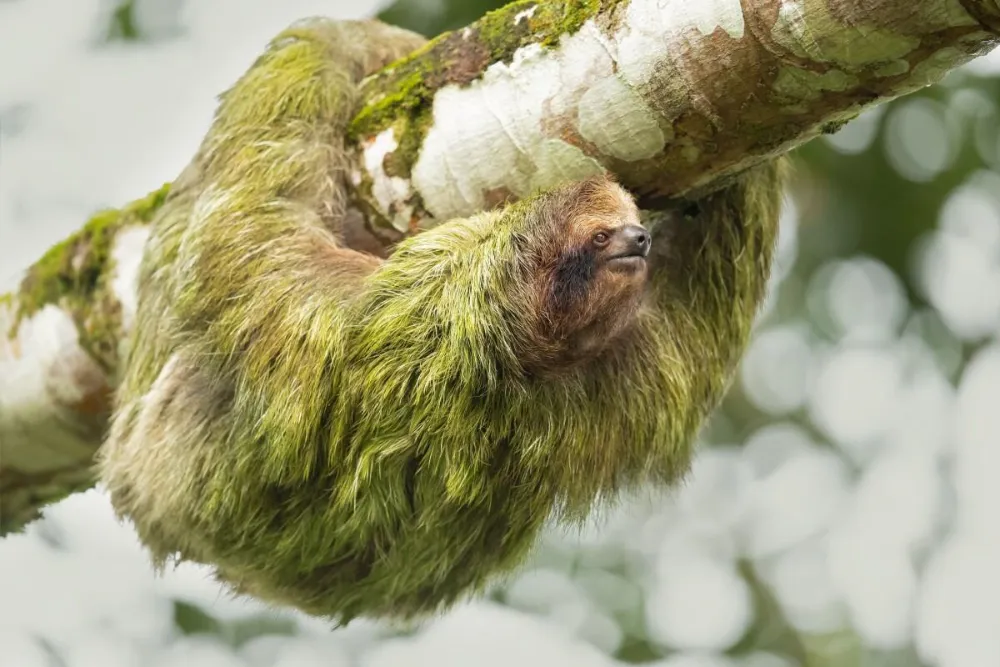
Slow movement, specialized claws, and inconspicuous coloration help sloths occupy a distinctive rainforest lifestyle.
Frequently Asked Questions
Why are sloths so slow?
Sloths move slowly because low-energy diets, very low metabolic rates, slow digestion, and economical temperature regulation favor energy conservation.
Do sloths have slow metabolisms?
Yes. Research has documented exceptionally low field metabolic rates, particularly in studied three-toed sloths.
How fast can a sloth move?
Speed varies by species, behavior, and whether the animal is on land, in a tree, or swimming. No single number describes all situations.
Can sloths move fast when threatened?
Sloths can make faster movements when necessary, but they are not adapted for prolonged rapid running.
Why do sloths move slowly on the ground?
Their limbs and claws are specialized for gripping branches rather than running across flat ground.
Can sloths swim?
Yes. Sloths can swim, despite their awkward terrestrial movement.
Why do sloths hang upside down?
Their long curved claws and specialized limbs allow them to hang securely from branches while resting, feeding, and moving.
Do sloths sleep all day?
No. Sloths spend long periods inactive, but inactivity is not always sleep. Sleep duration varies by species and environment.
Are sloths cold-blooded?
No. They are mammals, although their body temperatures can vary more than those of many other mammals.
How long does it take a sloth to digest food?
Sloths digest food slowly, sometimes retaining material for many days or longer. Exact duration varies by species and conditions.
Why do sloths poop only once a week?
Slow food processing and low food intake contribute to infrequent defecation, but actual frequency varies among individuals.
Why does sloth fur look green?
Algae growing in the fur can produce a greenish appearance that may help camouflage the animal among vegetation.
Are sloths related to monkeys?
No. Sloths belong to Xenarthra, while monkeys belong to Primates.
Are sloths related to koalas?
They are only distant mammalian relatives. Koalas are marsupials, while sloths are placental mammals.
Are all sloths endangered?
No. Conservation status varies by species. Some have much more restricted populations and greater conservation concerns than others.
The Bottom Line
Sloths move slowly because their bodies are built for a low-energy lifestyle.
Leaf-rich diets, prolonged digestion, extremely low metabolic rates, and economical temperature regulation all help explain their unusual movement.
Their slow behavior is not simply laziness or constant sleepiness.
It is part of an evolutionary strategy that allows them to survive in tropical forest canopies while conserving limited energy resources.
Sloths can still swim, grip branches securely, and respond to threats.
Their lifestyle demonstrates that evolutionary success does not always depend on speed. Sometimes, surviving with remarkably little energy is an extraordinary adaptation of its own.
Sources & Further Reading
Smithsonian National Zoo — Why Are Sloths So Slow? And Other Sloth Facts. Overview of sloth anatomy, metabolism, diet, movement, and conservation.
Pauli et al. (2016) — Arboreal Folivores Limit Their Energetic Output, All the Way to Slothfulness. The American Naturalist. Field study comparing metabolism, movement, and body temperature in two- and three-toed sloths.
Cliffe et al. (2015) — Sloths Like It Hot: Ambient Temperature Modulates Food Intake in the Brown-Throated Sloth. Research on temperature, digestive physiology, and food consumption.
Muramatsu et al. (2022) — Low-Cost Thermoregulation of Wild Sloths Revealed by Heart Rate and Temperature Loggers. Investigation of energy-saving temperature regulation in wild sloths.
Digestive Physiology, Metabolism and Methane Production of Captive Linné's Two-Toed Sloths (2015). Measurements of digestive retention and metabolic characteristics.
Smithsonian National Zoo — Two-Toed Sloth. Species account covering anatomy, digestive specialization, fur, and swimming.
Smithsonian National Zoo — How to Care for Sloths. Animal-care observations highlighting variation in movement and behavior.