Camels have humps because the humps store fat, providing a concentrated reserve of energy when food is scarce. Contrary to a widespread myth, camel humps do not store water. When a camel uses its fat reserves, its hump may become smaller or droop. Camels survive dry environments not because they carry a hidden water tank on their backs, but because they possess several adaptations that conserve water, tolerate dehydration, and manage body temperature. Dromedary camels have one hump, while domestic Bactrian and wild Bactrian camels have two.
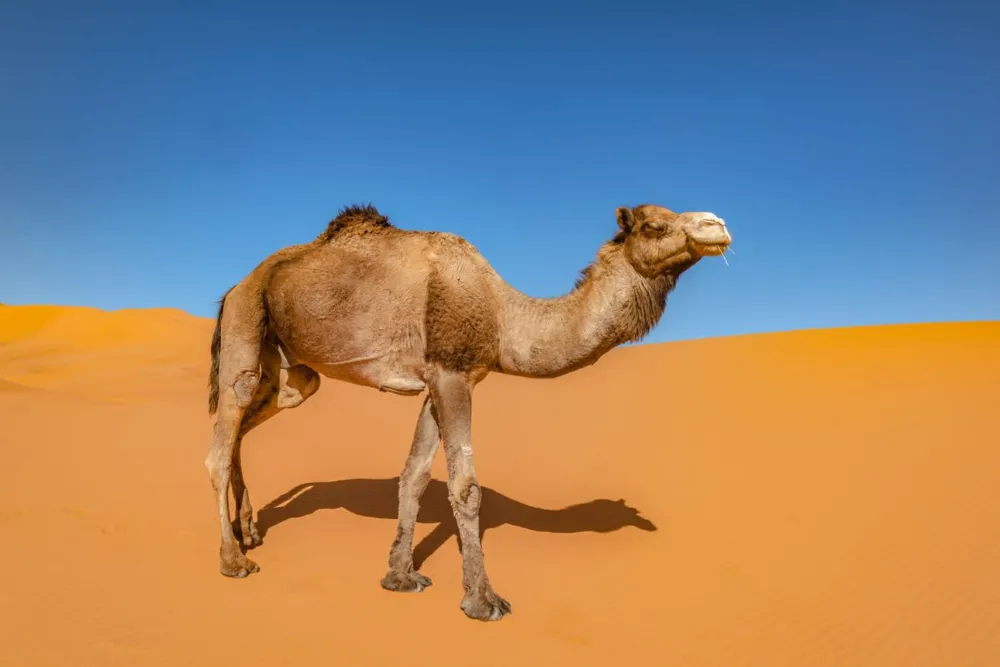
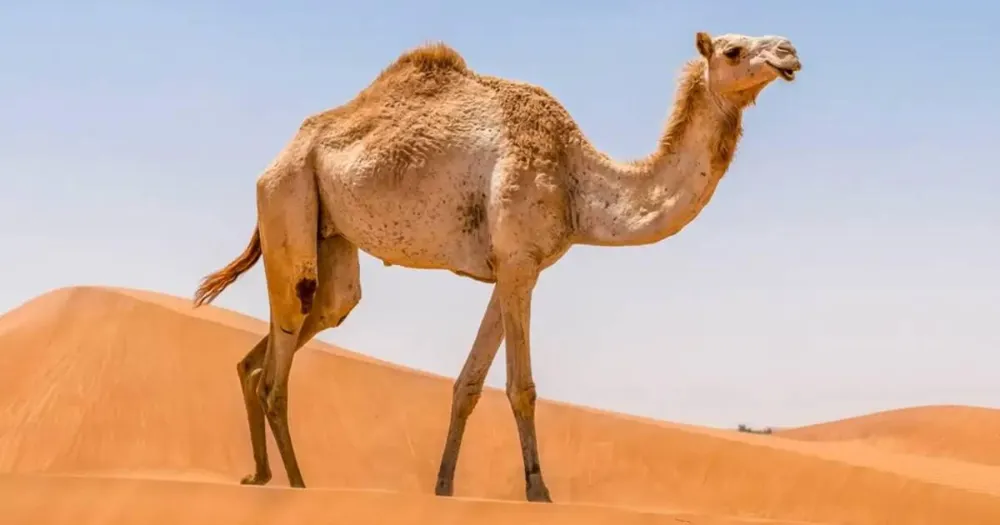
A dromedary camel has one hump composed mainly of fat rather than stored drinking water.
Why Do Camels Have Humps?
Camels are mammals adapted to living in environments where food and water may be difficult to obtain.
Their humps are among their most recognizable physical features.
However, a hump is not a hollow container filled with water.
It is a specialized accumulation of fatty tissue.
Fat contains considerable chemical energy that the animal can use when food is limited.
This makes the hump an important reserve during periods of nutritional stress.
By concentrating much of their fat in one region, camels may also avoid spreading a thick layer of insulating fat over the entire body.
However, the exact thermal advantages depend on environmental and physiological conditions.
What Is Inside a Camel's Hump?
A camel hump consists primarily of adipose tissue, commonly called body fat.
Adipose tissue contains specialized cells that store lipids.
In camel humps, these cells form a concentrated energy reserve beneath the skin.
Connective tissue helps organize and support the fat deposits.
A scientific review of camel hump anatomy describes the tissue as containing fat cells with large lipid droplets.
The hump is therefore a biological energy store, not a bag or chamber filled with liquid.
Do Camel Humps Store Water?
No. Camel humps store fat, not drinking water.
The Natural History Museum in London and San Diego Zoo both explicitly identify this as a common misconception.
Camels drink water through their mouths and absorb it through the digestive system like other mammals.
Their bodies then distribute water through blood and tissues.
The hump does not function as a separate reservoir from which the animal directly draws liquid water.
Camels can nevertheless survive considerable periods without drinking because they reduce water loss and tolerate dehydration unusually well.
Why Do People Think Camels Store Water in Their Humps?
Camels are famous for surviving in dry environments.
Their large humps appear to provide an obvious explanation for this ability.
As a result, the idea of a water-filled hump became widespread.
However, a visible structure does not necessarily perform the function people imagine.
The true function of the hump is primarily energy storage.
Water conservation depends on several other adaptations involving the kidneys, digestive system, respiratory passages, and temperature regulation.
How Does Fat Help Camels Survive?
Fat is an energy-rich substance.
When a camel has access to sufficient food, it can accumulate fat reserves.
During periods of food scarcity, stored lipids can be broken down and used to support metabolism.
This reduces immediate dependence on a continuous food supply.
However, fat cannot replace every nutrient indefinitely.
Camels still require appropriate food, minerals, and water to remain healthy.
The hump is therefore an adaptation for managing fluctuations in food availability rather than a source of unlimited nourishment.
Does Burning Camel Hump Fat Produce Water?
Yes. Fat metabolism produces metabolic water as one of its chemical products.
When fat molecules are oxidized, their hydrogen can ultimately contribute to the formation of water.
However, the amount of water produced must be considered alongside the water and energy demands of the animal.
A 1964 paper in Nature discussed why the fatty hump cannot adequately explain the full water balance of a dehydrated camel.
The major benefit of hump fat remains its energy content.
Metabolic water is a real physiological product, but it is not equivalent to carrying a large tank of stored liquid water.
What Is Metabolic Water?
Metabolic water is water produced during normal biochemical reactions that break down nutrients.
Animals can generate metabolic water when they oxidize fats, carbohydrates, or proteins.
This process occurs in many mammals, not only camels.
However, different nutrients produce different amounts of metabolic water.
The contribution of metabolic water to an animal's overall water balance varies with physiology and environmental conditions.
In camels, it does not eliminate the need to drink.
Why Does a Camel's Hump Get Smaller?
A camel hump may shrink when the animal uses its fat reserves.
As stored lipids are consumed for energy, the volume of fatty tissue decreases.
The external appearance can change accordingly.
San Diego Zoo notes that a hump may become smaller and lean to one side when the camel has insufficient food.
However, hump size is not a direct measurement of the animal's hydration level.
A small hump can indicate reduced fat reserves rather than simply a lack of water.
Why Do Camel Humps Droop?
When a hump loses substantial fat, it may become less firm.
The remaining tissue can lean or droop to one side.
This occurs because the fat deposit no longer maintains the same full shape.
However, drooping should not be interpreted as proof that the camel's hump has run out of water.
The hump was not filled with liquid water in the first place.
It is the condition of the fat reserve that primarily explains the change.
Can a Camel's Hump Grow Back?
A depleted hump can become fuller again when a camel receives sufficient nutrition and rebuilds its fat reserves.
The change is gradual and depends on the animal's health, diet, and metabolic condition.
However, the process is not an instantaneous response to drinking water.
Drinking rehydrates the animal, while rebuilding a fat reserve requires an adequate supply of energy from food.
The two processes should not be confused.
Does Drinking Water Make the Hump Bigger?
Not directly.
Drinking water replenishes the camel's body fluids.
It does not immediately fill the hump like a container.
Over time, adequate food and suitable conditions allow the animal to accumulate body fat.
That can restore the hump's size.
Therefore, changes in hump fullness are better connected with energy balance than with the amount of water consumed during one drinking session.
How Many Humps Does a Camel Have?
Living camels in the genus Camelus have either one or two humps.
The dromedary camel, Camelus dromedarius, has one.
The domestic Bactrian camel, Camelus bactrianus, has two.
The wild Bactrian camel, Camelus ferus, also has two.
However, the two Bactrian forms are distinct species in current biological classification.
Hump number is therefore useful for recognizing broad camel types but does not identify every species by itself.
Why Do Some Camels Have One Hump?
Dromedary camels naturally possess a single hump.
This is a characteristic of their evolutionary lineage.
The hump functions as a fat reserve.
Dromedaries are especially associated with dry regions of North Africa, the Middle East, and parts of Asia.
However, the presence of one hump is not evidence that a dromedary carries less drinking water in its body than every two-humped camel.
Water balance depends on numerous physiological factors.
Why Do Some Camels Have Two Humps?
Domestic and wild Bactrian camels have two separate humps.
These humps also contain fat rather than liquid water.
Bactrian camels are associated with the dry continental environments of Central Asia.
Many endure cold winters as well as hot summers.
However, scientists should not assume that having two humps automatically means twice the water-storage ability.
Both humps are primarily energy reserves.
One-Humped vs. Two-Humped Camels
| Feature | Dromedary Camel | Domestic Bactrian Camel |
|---|---|---|
| Scientific name | Camelus dromedarius | Camelus bactrianus |
| Humps | One | Two |
| Main hump contents | Fat | Fat |
| Typical climate association | Warm arid regions | Cold and dry continental regions |
| Coat | Generally shorter | Thicker winter coat |
| Common geographic association | North Africa, Middle East, South Asia | Central Asia |
Both species are adapted to difficult environments, but their anatomy and climatic conditions differ.
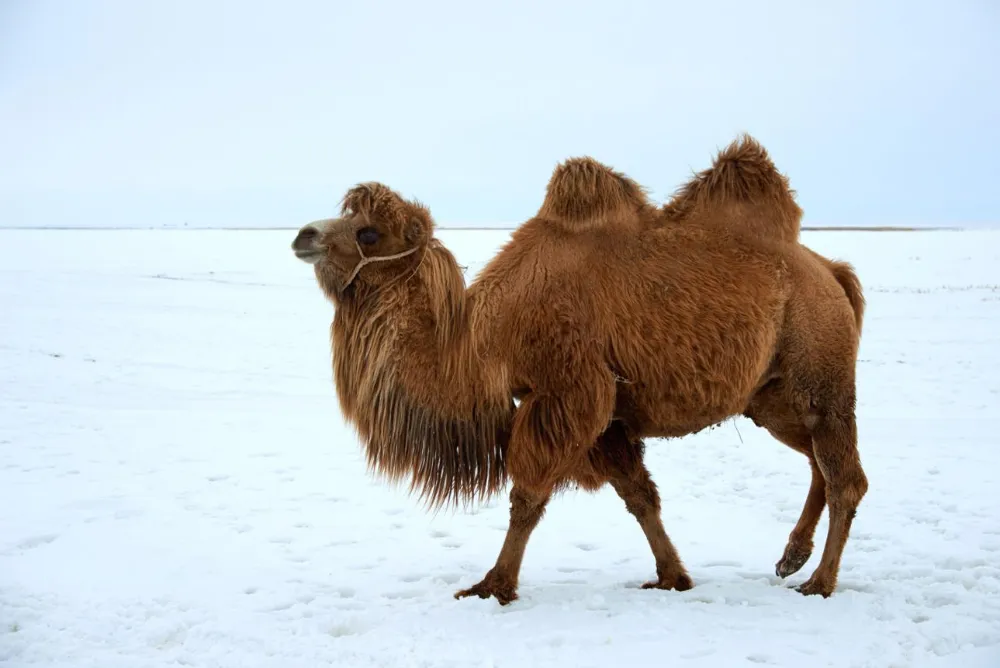
Bactrian camels have two fat-storing humps and are adapted to the seasonal extremes of continental Asia.
What Is the Difference Between Domestic and Wild Bactrian Camels?
Domestic Bactrian camels and wild Bactrian camels are recognized as separate species.
The domestic species is Camelus bactrianus.
The wild species is Camelus ferus.
Both have two humps.
However, they differ genetically and in aspects of their appearance and ecology.
San Diego Zoo describes wild Bactrian camels as generally slimmer, with smaller humps and less hair than domestic Bactrians.
Wild Bactrian camels also face serious conservation threats.
Are Camels Born With Humps?
Young camels do not begin life with the large, developed humps seen in well-nourished adults.
The hump becomes more prominent as the animal grows and accumulates fat.
However, the exact developmental timing varies.
Newborn camels have the anatomical structures associated with their species, even though the fat deposits are not yet fully developed.
Therefore, a calf lacking a large visible hump does not mean it belongs to a different type of camel.
How Do Camels Survive Without Water?
Camels can tolerate periods of limited water availability because of a combination of adaptations.
Their kidneys can conserve water by producing concentrated urine.
The digestive system can produce very dry feces.
The nasal passages help recover moisture from exhaled air.
Camels also tolerate considerable dehydration and variation in body temperature.
However, they cannot live without water indefinitely.
The duration they can survive depends on food, temperature, activity, and individual condition.
How Long Can a Camel Go Without Water?
The answer varies considerably.
San Diego Zoo describes camels surviving a week or more without drinking under some conditions.
However, that is not a fixed physiological limit.
Cool conditions and moist food may reduce the need to drink.
Extreme heat and physical activity can increase water requirements.
Therefore, statements that every camel can survive exactly one month without water are misleading.
Camels still require access to water to maintain normal long-term health.
How Much Water Can a Camel Drink?
Camels can drink large quantities of water relatively quickly after dehydration.
This helps restore lost body fluids.
However, the amount consumed depends on the camel's size and degree of dehydration.
A camel that is already well hydrated will not necessarily drink as much as one that has experienced substantial water loss.
The water is absorbed and distributed through the body rather than stored in the hump.
Where Do Camels Store Water?
Camels do not rely on one special external reservoir.
After drinking, water is distributed among normal physiological compartments, including body tissues and circulating blood.
Their survival advantage comes largely from conserving water and tolerating dehydration.
However, historical hypotheses about specialized internal water reservoirs have been investigated.
A 1964 paper in Nature discussed why proposed water stores could not completely explain camel dehydration tolerance.
The modern explanation involves multiple integrated adaptations.
Why Do Camels Produce Concentrated Urine?
Water conservation is essential in dry environments.
Camel kidneys can reduce the amount of water lost through urine.
They achieve this by concentrating dissolved waste products into a smaller volume of liquid.
However, kidney performance depends on hydration and physiological conditions.
The important principle is that less water is lost during waste elimination than would otherwise be necessary.
Why Is Camel Dung So Dry?
The camel digestive system conserves water as food material moves through the intestines.
This can produce unusually dry feces.
The Natural History Museum notes that camel dung may be dry enough to be used as fuel.
However, the moisture content of feces is not identical under every condition.
Diet and hydration can influence the result.
Dry feces are one component of an overall water-saving strategy.
How Do Camel Noses Conserve Water?
When mammals breathe out, they can lose water as vapor.
Camels possess nasal structures that help recover some of this moisture.
As exhaled air passes through the nasal passages, water vapor can condense on cooler surfaces.
The moisture can then be retained rather than lost to the environment.
The Natural History Museum describes the nose as functioning partly like a dehumidifier.
However, it does not recover every molecule of water from each breath.
How Do Camels Control Body Temperature?
Camels can tolerate variation in body temperature that helps reduce water expenditure.
Allowing body temperature to rise during hot periods can reduce the need for evaporative cooling.
Later, when conditions are cooler, heat can be released with less water loss.
However, temperature regulation is complex and depends on health, hydration, and environment.
The ability to tolerate fluctuations is one adaptation among several.
Do Camels Sweat?
Yes. Camels can sweat and use evaporative cooling.
However, they can reduce the need for sweating through other heat-management adaptations.
Allowing body temperature to fluctuate within physiological limits can help conserve water.
It is therefore incorrect to say that camels never sweat.
Their success in hot environments comes from controlling water loss, not eliminating normal cooling mechanisms.
Does Hump Fat Help Camels Stay Cool?
Concentrating fat in humps may provide a thermal advantage.
Fat acts as an insulating tissue.
If a large amount of fat were spread evenly beneath the skin, it could interfere with heat transfer across a much greater part of the body.
Locating substantial fat reserves on the back may leave other body surfaces relatively less insulated.
However, the relationship between fat distribution and heat balance depends on environmental conditions.
The principal established function of camel humps remains energy storage.
Why Do Camels Have Thick Fur in the Desert?
It may seem surprising that an animal living in a hot environment possesses a protective coat.
However, fur can reduce direct heat transfer from intense sunlight to the skin.
It also provides protection in cooler conditions.
Bactrian camels are particularly known for their thick winter coats.
However, coat structure differs by species and season.
A thick coat can therefore have functions beyond simply keeping an animal warm.
How Do Camels Protect Their Eyes From Sand?
Camels possess long eyelashes and other protective eye structures.
These can help limit the amount of windblown material reaching sensitive tissues.
Camels also have a third eyelid, called a nictitating membrane, that contributes to eye protection.
However, the structures do not make the eyes completely immune to irritation or injury.
The adaptations reduce exposure to environmental hazards.
Can Camels Close Their Nostrils?
Camels can narrow or close their nostrils.
This is helpful in dusty, sandy environments.
However, the nostrils must also open for normal breathing.
The ability to control the opening helps reduce the entry of airborne particles when conditions are unfavorable.
It is another adaptation that complements their desert lifestyle.
Why Do Camels Have Broad Feet?
Camel feet possess broad, padded structures.
These distribute body weight across a relatively large contact area.
That helps reduce sinking into loose sand.
However, the feet are also adapted for walking over other terrain.
Animal Diversity Web describes the pad-shaped feet of dromedaries as a notable adaptation for sandy ground.
They are not identical to the hard hooves of horses.
Can Camels Eat Thorny Plants?
Yes. Camels can consume coarse vegetation, including thorny plants.
Their mouths possess thickened, relatively tough tissues that help them manipulate such food.
However, that does not mean their mouths are completely insensitive or immune to injury.
The adaptation allows them to use plant resources that may be difficult for some other herbivores to exploit.
This can be valuable in dry environments where vegetation is sparse.
Are Camels Only Found in Hot Deserts?
No. Camels occupy or have been domesticated in a variety of dry environments.
Dromedaries are especially associated with warmer arid regions.
Bactrian camels live in areas that can experience extremely cold winters.
However, both types are adapted to water scarcity and variable environmental conditions.
The popular image of a camel standing in a hot sandy desert describes only part of the group's ecological diversity.
Can Bactrian Camels Survive Snow?
Yes. Bactrian camels are adapted to environments with severe winters.
They can develop dense winter coats that provide insulation.
However, they also experience hot conditions during parts of the year.
Their biology therefore reflects adaptation to large seasonal temperature changes, not simply constant cold.
Having two humps does not itself explain their ability to survive snowy weather.
Are Camels Related to Llamas?
Yes. Camels and llamas belong to the family Camelidae.
This family also includes alpacas, guanacos, and vicuñas.
However, llamas and alpacas do not have the prominent fat-storing humps characteristic of camels in the genus Camelus.
They represent a different branch of the camelid family.
This shows that not every camelid has a hump.
Why Don't Llamas Have Humps?
Llamas belong to a different evolutionary lineage within Camelidae.
They do not possess the specialized large fat deposits found on the backs of dromedary and Bactrian camels.
However, they still store body fat and possess adaptations suited to their environments.
The absence of a hump does not mean they are incapable of storing energy.
It reflects differences in anatomy and evolutionary history.
Can Camels Live Without Their Humps?
The hump is an important energy reserve, but it is not the only tissue necessary for camel survival.
Camels can use much of their stored hump fat during periods of food scarcity.
However, severe malnutrition can compromise health.
A greatly depleted hump may indicate inadequate energy reserves.
That does not mean the animal's normal physiology can function indefinitely without adequate nutrition.
What Happens if a Camel Runs Out of Hump Fat?
When energy reserves become depleted, the camel must rely increasingly on current food intake and other metabolic resources.
If insufficient nutrition continues, body condition deteriorates.
This can eventually lead to serious health problems.
However, the hump is not a simple fuel gauge that perfectly predicts survival time.
Age, activity, hydration, health, and environmental conditions also matter.
How Do Scientists Study Camel Humps?
Researchers use anatomical studies, tissue sampling, metabolic measurements, and biochemical analyses.
They examine how fat cells are organized in hump tissue.
Studies also investigate how stored lipids are released and used during nutritional stress.
A 2026 scientific review describes the microscopic anatomy and chemical composition of camel hump fat.
However, claims about a single perfect adaptation should be evaluated using evidence from the whole animal.
The hump works as one part of an integrated physiological system.
What Did Recent Camel Metabolism Research Find?
Recent reviews of camel physiology emphasize the importance of regulated fat metabolism.
Stored hump lipids can be mobilized when energy intake is insufficient.
Researchers have also investigated how camels maintain metabolic balance under challenging nutritional conditions.
However, the ability to manage fat metabolism should not be confused with an unlimited capacity to survive starvation.
These studies help explain how camels can remain active despite fluctuations in food availability.
Camel Hump Myths vs. Facts
| Claim | Scientific Answer |
|---|---|
| Camels store water inside their humps | False |
| Camel humps mainly contain fat | True |
| Hump fat can supply energy | True |
| Fat metabolism produces some water | True |
| Camels never need to drink | False |
| Dromedaries have one hump | True |
| Bactrian camels have two humps | True |
| A drooping hump necessarily means dehydration | False |
| Camels never sweat | False |
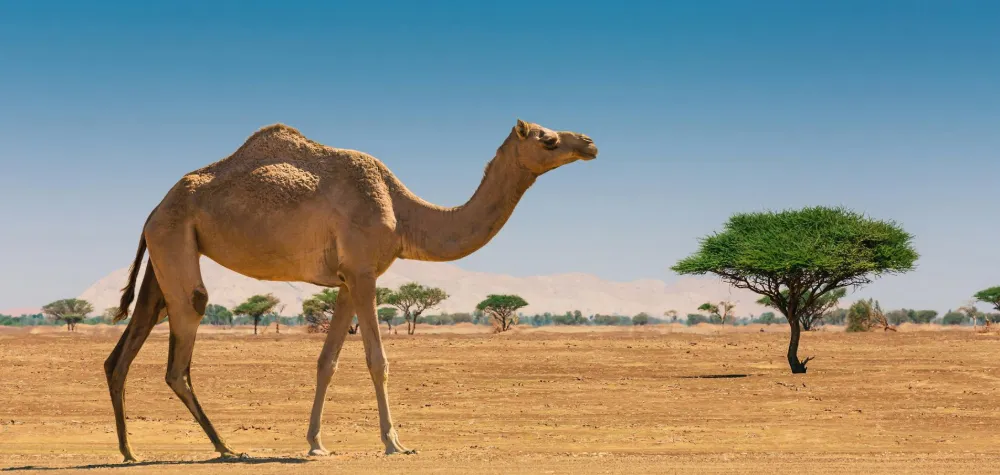
Camel humps are one part of a broader set of adaptations involving metabolism, water conservation, temperature regulation, and desert locomotion.
Frequently Asked Questions
Why do camels have humps?
Camels have humps to store fat that can provide energy when food is scarce.
Do camel humps store water?
No. Camel humps consist primarily of fat, not liquid water.
What is inside a camel hump?
A hump contains adipose tissue composed of fat-storing cells and supporting connective tissue.
Can camels make water from hump fat?
Fat metabolism produces some metabolic water, but it does not replace the camel's need to drink.
Why does a camel's hump droop?
A hump may droop when the animal uses much of its stored fat and the tissue becomes less full.
Can a camel's hump grow back?
Yes. The hump can become fuller as the camel rebuilds fat reserves with adequate nutrition.
Does drinking water refill a camel's hump?
No. Drinking rehydrates the body; rebuilding hump fat requires energy from food.
Why do some camels have one hump?
Dromedary camels have one hump as a characteristic feature of their species.
Why do Bactrian camels have two humps?
The two-hump arrangement is a characteristic of Bactrian camel evolutionary lineages.
How long can camels survive without water?
Some can go a week or more under suitable conditions, but survival depends on heat, activity, food, and other factors.
How do camels conserve water?
They produce concentrated urine and dry feces, recover moisture in their nasal passages, and can tolerate substantial dehydration.
Do camels sweat?
Yes. Camels can sweat, but they possess adaptations that reduce unnecessary water loss.
Are camels born with humps?
Young camels do not have the large fat-filled humps of well-nourished adults. The deposits develop as they grow.
Are Bactrian camels adapted to cold weather?
Yes. They can grow thick winter coats and live in regions with extremely cold winters.
Do llamas have humps?
No. Llamas are members of the camel family but lack the prominent fat-storing humps of dromedary and Bactrian camels.
The Bottom Line
Camels have humps because they provide concentrated reserves of fat.
These reserves help supply energy when food is limited.
Despite the popular myth, humps do not store liquid drinking water.
Camels survive in dry environments through several coordinated adaptations that reduce water loss and help maintain physiological function during dehydration.
Dromedaries have one hump, while domestic and wild Bactrian camels have two.
The camel hump is therefore best understood as an energy-storage adaptation within a broader system of desert survival mechanisms.
Sources & Further Reading
San Diego Zoo — Camel. Explains fat storage, hump changes, and differences between camel species.
Natural History Museum, London — How Do Camels Survive in Deserts? Discusses water conservation, nasal moisture recovery, body temperature, and hump fat.
Animal Diversity Web — Camelus dromedarius. Species anatomy, fat deposits, feeding, and desert adaptations.
Animal Diversity Web — Camelus bactrianus. Domestic Bactrian camel anatomy, habitat, and two-hump structure.
Montgomery, Ashworth and Fontaine (1964) — The Camel Capillary. Nature. Historical scientific discussion of camel dehydration and the limitations of the hump water-store hypothesis.
Camel Hump: Composition, Bioactivities, and Multifunctional Sustainable Applications (2026). Frontiers in Nutrition. Review of hump adipose tissue, lipid composition, and metabolism.
Nutritional Disorders and Metabolic Adaptations in Dromedary Camels. Review of fat mobilization, metabolism, and nutritional adaptation.