The black mamba is one of Africa’s most feared snakes, but many stories about it are exaggerated. It is indeed highly venomous, fast-moving, and potentially deadly without prompt treatment, yet it is not a monster that hunts humans on purpose. Its size, speed, aggression, and “kiss of death” reputation have all been shaped by real biology mixed with myth. Understanding the black mamba means separating dangerous facts from dramatic fiction.
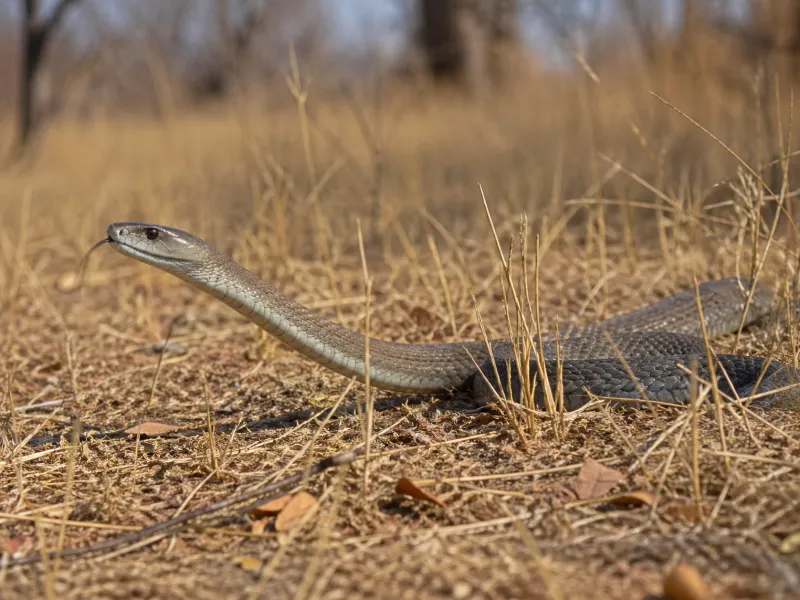
Few snakes carry as much legend as the black mamba. It appears in stories as a giant, unstoppable killer that chases people across the landscape and kills with certainty. The truth is more complex. The black mamba is a remarkable reptile with real medical importance, but it is also a shy wild animal that usually tries to avoid conflict.
In this guide, you will learn what the black mamba really is, how large it actually gets, how dangerous its venom is, which myths go too far, and why this snake deserves both caution and accuracy.
Quick comparison table
| Claim | Fact | Reality check |
|---|---|---|
| The black mamba is black all over | No. Its body is usually gray, olive, or brownish | The name mainly refers to the dark inside of the mouth |
| It is the biggest snake in Africa | No | It is one of Africa’s longest venomous snakes, but not the continent’s largest snake overall |
| It always chases humans | No | It may move fast in defense or while escaping, but it does not normally hunt people |
| Its bite is extremely dangerous | Yes | Untreated bites can be rapidly life-threatening |
| It kills instantly with a “kiss of death” | No | The venom is very serious, but death is not magical or immediate in the literal sense |
| It is one of the fastest snakes | Yes, in short bursts over ground | Its speed is real, though often exaggerated in popular stories |
What is a black mamba?
The black mamba is a highly venomous snake native to parts of sub-Saharan Africa. It belongs to the elapid family, the same broader family that includes cobras, kraits, and coral snakes. Elapids are known for fixed front fangs and potent neurotoxic venom in many species.
The black mamba is especially famous because it combines several striking features: a long slender body, strong mobility, alert behavior, and medically important venom. It is primarily active by day and is often associated with dry savanna, rocky hills, woodland, and areas with termite mounds, crevices, or abandoned animal burrows.
Its reputation is extreme, but its biology is real enough to command serious respect.
Why is it called the black mamba?
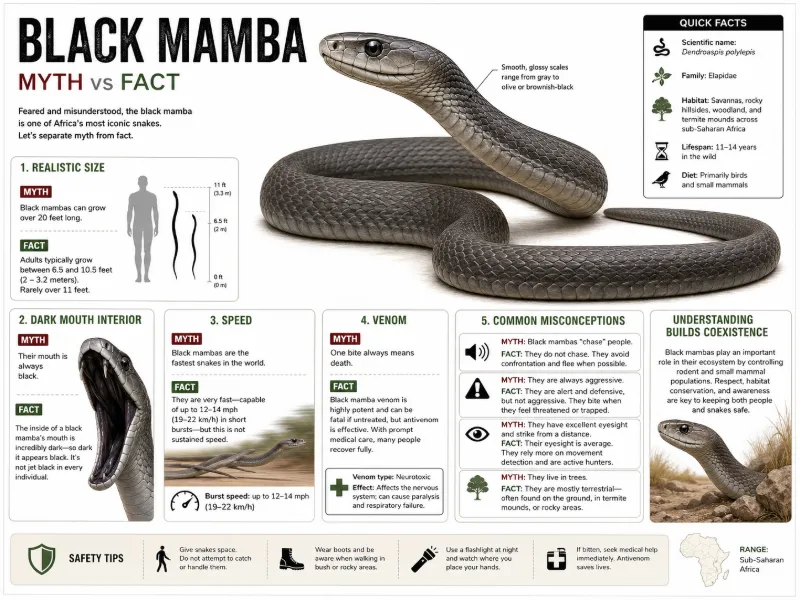
Many people assume the black mamba is named for a jet-black body, but that is not the main reason. The snake’s body is usually gray, olive-gray, brownish, or gunmetal in tone rather than deep black.
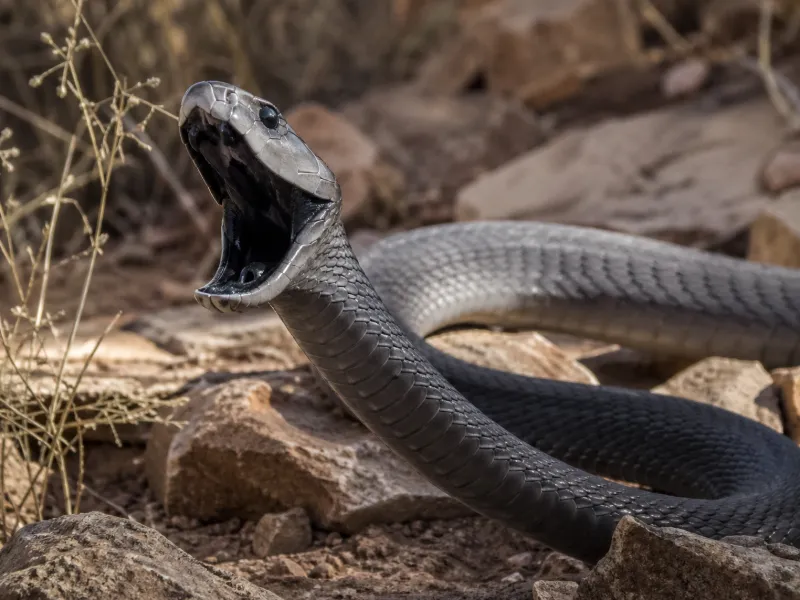
The name comes mainly from the inside of its mouth, which is dark, often described as blackish or inky. When threatened, the snake may open its mouth wide as a warning display, and that dark interior is one of its most memorable features.
So one of the first myths to correct is the simplest one: the black mamba is not usually black on the outside.
How big does a black mamba really get?
The black mamba is very large for a venomous snake. It is one of the longest venomous snakes in Africa and among the longest venomous snakes in the world. Many adults are long, slender, and impressive animals, and large individuals can exceed what most people imagine when they think of a cobra-sized snake.
At the same time, stories often exaggerate its size into something almost monstrous. It is not a giant python-like snake, and it is not the largest snake in Africa overall. Large constrictors such as pythons can be much heavier and bulkier.
The black mamba’s size is real and significant, but its legend often grows beyond typical biological reality.
Mythical size versus realistic size
Folklore and fear often stretch the black mamba into a creature of impossible length. In dramatic storytelling, it may become a snake of absurd proportions that seems almost supernatural. In reality, even a very large black mamba is still a real snake with normal anatomical limits.
What makes it seem even longer is its body shape. It is slim, elegant, and capable of lifting a noticeable portion of the front body off the ground when alert. That posture can make a large individual feel even more imposing than the raw length number suggests.
So the myth is not that the black mamba is small. The myth is that it is endlessly gigantic. The truth is that it is long, lean, and genuinely impressive without needing exaggeration.
Is the black mamba really the fastest snake?
The black mamba is widely described as one of the fastest snakes in the world over ground, and that reputation is not invented. It can move quickly, especially when escaping danger or traveling through open habitat.
However, speed claims are often turned into sensational numbers without context. A snake does not move at top speed like a horse across long distances, and its speed depends on terrain, temperature, motivation, and the situation. Short bursts in the right conditions are very different from dramatic movie-style pursuit.
The sensible conclusion is that the black mamba is indeed a fast-moving snake, but popular storytelling often pushes that fact too far.
Does the black mamba chase people?
This is one of the most repeated myths. The black mamba is often said to chase people with deliberate intent. In reality, it does not hunt humans as prey and does not set out to pursue people for revenge or sport.
What likely fuels the myth is defensive behavior. A frightened black mamba may move rapidly through the same space a person is using, or it may seem to come forward when trying to reach an escape route. In tense situations, humans can easily read this as active pursuit.
Like many dangerous wild animals, the black mamba is best understood as trying to survive. If given space, it usually prefers escape over confrontation.
How aggressive is the black mamba?
The black mamba is not best described as mindlessly aggressive, but it can be intensely defensive when cornered, trapped, or repeatedly threatened. If escape is blocked, it may raise the front of the body, flatten the neck somewhat, open the dark mouth, hiss, and strike.
This is serious defensive behavior, and it should never be dismissed. A black mamba that feels trapped can be extremely dangerous. But “dangerous when threatened” is not the same as “always aggressive.”
The snake’s reputation partly comes from the fact that when it does defend itself, it can do so with alarming speed and confidence.
How dangerous is black mamba venom?
Black mamba venom is medically very serious. It contains powerful neurotoxic components that can affect the nervous system and lead to rapidly worsening symptoms without treatment. A bite is a genuine emergency.
Untreated envenomation can become life-threatening, and the black mamba’s reputation for danger is not exaggerated in that sense. This is one of the reasons the species is so feared. The problem is not myth alone. The problem is that the snake’s venom is truly capable of causing severe systemic effects.
The good news is that modern medical treatment, including antivenom and supportive care, has greatly improved survival when treatment is reached in time.
What does “kiss of death” really mean?
The phrase “kiss of death” is dramatic language, not a scientific description. It reflects how feared the bite has been historically, especially in places and times where access to treatment was limited.
A black mamba bite is not a magical instant death sentence. Symptoms develop through real physiological processes, and outcome depends on venom dose, bite location, treatment speed, and medical care. The danger is severe, but it is still biology, not mythic curse.
So the phrase captures fear and seriousness, but not literal reality. It is better used as folklore than as science.
What happens after a black mamba bite?
Symptoms can begin quickly and may progress rapidly. Because the venom is neurotoxic, signs may include pain, swelling that is sometimes less dramatic than in some viper bites, tingling, drooping eyelids, difficulty speaking or swallowing, breathing problems, weakness, and worsening neurological effects.
The exact pattern varies, but the important point is urgency. A suspected black mamba bite requires immediate medical attention. Delaying care is dangerous. Supportive treatment for breathing can be especially important in severe cases.
The correct lesson is not panic, but speed: treat the bite as an emergency and get professional care fast.
Where black mambas live
Black mambas are found in parts of eastern, central, and southern Africa. They are often linked with savanna, dry woodland, rocky slopes, and other warm habitats where shelter sites are available. They may use hollow trees, rock crevices, termite mounds, and abandoned burrows.
They are not primarily dense rainforest snakes, nor are they animals of urban legend alone. Their ecology is tied to real African landscapes where visibility, heat, prey availability, and shelter all matter.
Understanding habitat is important because it reminds us that the black mamba is a wild ecological species, not just a symbol of danger.
What black mambas eat
Black mambas feed mainly on small mammals and birds. They are active hunters rather than heavy-bodied ambush constrictors. Their slender build and daytime activity suit a lifestyle of searching, striking, and moving efficiently.
They subdue prey with venom rather than by squeezing like a python. This hunting method is part of why speed and alertness matter so much in their biology.
Again, the truth is dangerous enough without myth. The black mamba is a real predator, but its prey is not people.
Why the black mamba became legendary
Several factors pushed the black mamba into legend. It is long, fast, venomous, alert, and dramatic in threat display. It also lives in regions where people and snakes may come into contact in open landscapes, farms, rocky areas, and rural environments.
When a snake has real medical importance and also looks intimidating, fear stories multiply quickly. Over time, accurate danger becomes mixed with embellished memory. A real fast strike becomes a deliberate chase. A large snake becomes a giant one. A dangerous bite becomes instant supernatural death.
This is how many animal legends form: reality provides the spark, and culture builds the fire.
Fact versus fiction summary
The black mamba really is a highly venomous African snake. It really is long, alert, and capable of moving quickly. It really can be dangerous when cornered and medically serious when it bites.
But it is not a black-bodied monster, not an endless giant, not a supernatural killer, and not an animal that normally hunts humans. Much of its worst image comes from fear amplified by storytelling.
The most accurate view combines both truths: the black mamba deserves serious caution, and it is also one of the most misunderstood snakes in the world.
How people should respond to black mambas
The correct response is distance, not drama. If a black mamba is encountered, it should be left alone and given a clear escape path. Attempting to handle, trap, or kill it greatly increases risk.
In regions where black mambas occur, education, awareness, proper footwear, cautious movement around shelter sites, and rapid access to medical care matter more than sensational fear. Most serious incidents happen when people and snakes are forced into close conflict.
Respect is safer than myth. A calm, informed response saves more lives than storytelling does.
Final takeaway
The black mamba is one of Africa’s most dangerous snakes, but much of its reputation has been inflated by myth. It is not truly black-bodied, not endlessly giant, and not a snake that normally chases humans. What is real is still impressive enough: it is a long, fast, highly venomous elapid with a dramatic threat display and medically serious bite. The black mamba does not need legend to be remarkable. The facts are already powerful.
FAQs
Is the black mamba really black?
Not usually on the outside. Its body is often gray, olive, or brownish. The name mainly refers to the dark inside of the mouth.
Can a black mamba kill a human?
Yes. Its venom is medically very serious, and untreated bites can be life-threatening. Rapid treatment is critical.
Do black mambas chase people?
Not as normal behavior. They usually try to escape, though defensive movement may be mistaken for pursuit.
How big is a black mamba?
It is one of Africa’s longest venomous snakes and can become very large, but stories often exaggerate its size beyond typical reality.