The wolf spider actively hunts prey instead of building webs to trap it. Unlike orb-weavers and many other spiders, it does not rely on a sticky capture web for feeding. Instead, it uses speed, camouflage, sharp vision, and quick ambush attacks to catch insects and other small animals on the ground. This hunting style makes the wolf spider one of the most mobile and effective wandering predators among common spiders.
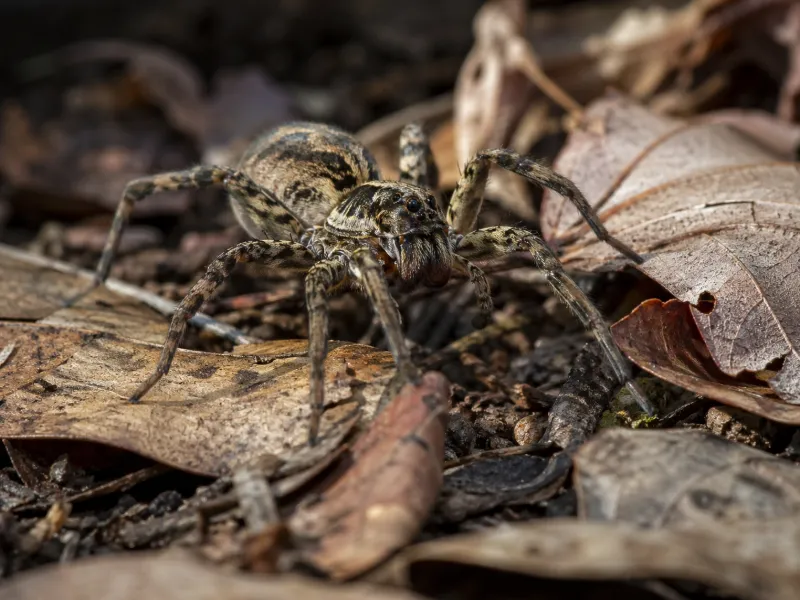
Many people imagine all spiders sitting in webs and waiting for food, but wolf spiders follow a different strategy. They move through leaf litter, soil, grass, rocks, and low vegetation, searching for prey directly rather than letting prey come to them.
In this guide, you will learn how wolf spiders hunt, why they do not build prey-catching webs, what they eat, where they live, and how their body design supports an active predatory lifestyle.
Quick answer
| Feature | Wolf Spider |
|---|---|
| Main hunting style | Active hunting and ambush predation |
| Does it build prey-catching webs? | No |
| Main tools for hunting | Speed, vision, camouflage, and quick strikes |
| Typical prey | Insects and other small arthropods |
| Common habitat | Ground level in grasslands, forests, gardens, fields, and leaf litter |
| Why it is different from web-building spiders | It chases or ambushes prey instead of trapping it in silk |
What is a wolf spider?
A wolf spider is a type of hunting spider known for running down prey instead of catching it in a web. Wolf spiders belong to a large family of ground-hunting spiders found in many parts of the world. They are usually robust, fast-moving, and well camouflaged in natural habitats.
The name “wolf spider” refers to its hunting behavior rather than any close connection to wolves. Like a mobile predator, it actively searches for food instead of waiting passively in one place.
Wolf spiders are often brown, gray, tan, or mottled, which helps them blend into soil, bark, leaves, and dry vegetation.
Why wolf spiders do not build webs to catch prey
Wolf spiders do produce silk, but they do not build the kind of large sticky capture webs that many people associate with spiders. Their silk is mainly used for other purposes such as egg sacs, draglines, retreats, or temporary shelter.
The reason they do not depend on prey-catching webs is that their body and behavior are adapted for movement and direct predation. They are built to roam, detect prey visually, and strike quickly at close range.
Instead of investing energy in constructing a trap, the wolf spider uses mobility and fast reactions. This suits life on the ground, where prey may be abundant but constantly moving through complex surfaces such as soil, leaves, and grass.
How wolf spiders hunt
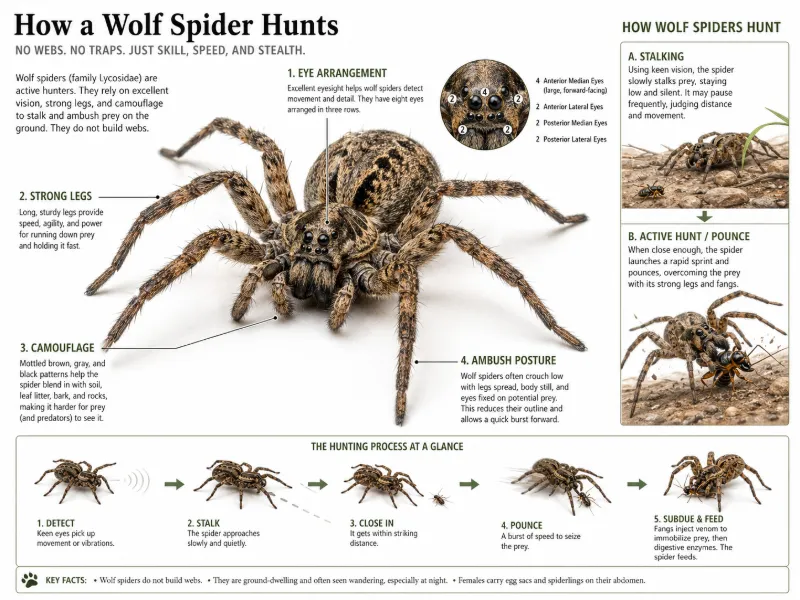
Wolf spiders usually hunt by either roaming or ambushing. Some move steadily through their habitat until they detect a suitable target. Others wait in a concealed position and then rush forward when prey comes close enough.
Once a prey animal is within range, the spider makes a rapid attack. It grabs the prey with its legs and mouthparts, then uses venom to subdue it. After the prey is immobilized, the spider begins feeding.
This hunting method is very different from the trap-based approach of web-building spiders. It depends on timing, accuracy, and strong sensory awareness rather than silk architecture.
Vision is especially important
Wolf spiders are known for having relatively strong vision compared with many other spiders. Their eye arrangement is one of their most distinctive features, and the larger forward-facing eyes help them detect movement and judge distance more effectively.
This matters because an active hunter must identify prey quickly and react at the right moment. A spider chasing prey across open ground cannot rely only on vibration signals the way a web spider might.
Vision does not do all the work, but it is a major reason wolf spiders can hunt so effectively without a web.
Speed and movement matter too
Wolf spiders are fast runners, and their body shape supports active movement. They are usually sturdy rather than delicate, with strong legs suited to short bursts of speed across uneven ground.
This speed allows them to close the distance quickly once prey is detected. It also helps them escape predators and move efficiently through changing environments.
Because they hunt on foot rather than by web, fast movement is one of the most important parts of their feeding strategy.
Camouflage helps them get close
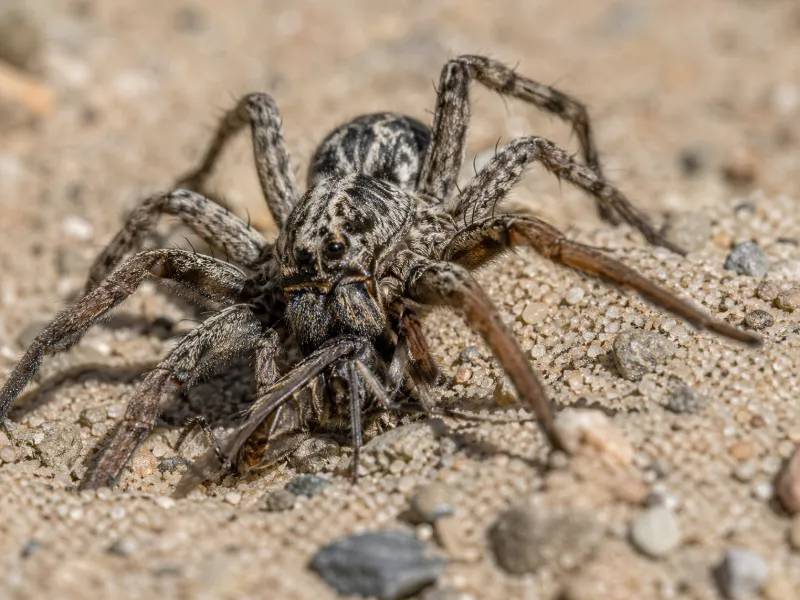
Most wolf spiders have earthy colors and striped or mottled patterns that help them blend into their surroundings. Brown, gray, black, and tan markings make them hard to see on soil, bark, dead leaves, and stones.
This camouflage gives them two major advantages. First, it helps them avoid predators. Second, it allows them to approach prey without being noticed too early.
For a ground-hunting spider, camouflage is almost as valuable as speed because hunting success often depends on getting close before striking.
What wolf spiders eat
Wolf spiders mainly eat insects and other small arthropods. Their prey may include flies, beetles, crickets, grasshoppers, ants, roaches, caterpillars, and other spiders, depending on the habitat and the size of the wolf spider.
They are opportunistic predators, which means they usually take prey they can overpower rather than specializing in a single species. A larger wolf spider can handle larger prey than a smaller one, but both follow the same general strategy.
Because they hunt directly, they are limited mainly by what they can detect, catch, and subdue.
Where wolf spiders live
Wolf spiders are found in many habitats, including forests, grasslands, fields, gardens, deserts, marsh edges, and even human-disturbed environments. Most species stay near the ground and are especially common in leaf litter, low plants, loose soil, and under rocks or debris.
Some species dig burrows, while others roam more openly. Their habitat choice often reflects local temperature, moisture, ground cover, and prey availability.
Because they do not need a large capture web, wolf spiders can use a wide variety of places where moving prey is available at ground level.
Do wolf spiders ever use silk?
Yes. Wolf spiders still make silk, but not for prey-catching webs. They may use silk for safety lines, egg sacs, resting retreats, or lining burrows. This shows that silk is still important in their biology even though it is not their main hunting tool.
Female wolf spiders are especially famous for carrying their egg sacs attached to the spinnerets. After the spiderlings hatch, many species also carry the young on their backs for a period of time.
This behavior makes wolf spiders especially memorable and shows that silk use in spiders is not limited to web-building alone.
How wolf spiders differ from web-building spiders
The biggest difference is feeding strategy. A web-building spider invests heavily in silk structure and then waits for prey to get trapped. A wolf spider invests more in movement, sensory awareness, and direct attack.
Web-builders often depend on vibration signals traveling through silk. Wolf spiders depend more on sight, ground vibration, and close-range detection. Web spiders may stay in one place for long periods, while wolf spiders often patrol actively.
Neither strategy is inherently better in every environment. They are simply different evolutionary solutions to the same problem: catching prey.
Are wolf spiders dangerous?
Wolf spiders are predators, but they are not aggressive hunters of humans. Their main prey is small invertebrates, not people or pets. If disturbed, they usually try to escape rather than attack.
They can bite if handled roughly or trapped against the skin, but this is defensive rather than predatory behavior. In most cases, they are best understood as beneficial hunting spiders that help reduce insect populations.
Because they roam rather than stay in webs, people notice them more often, which can make them seem more threatening than they really are.
Why active hunting works for wolf spiders
Active hunting works because wolf spiders are well adapted for it. Their strong legs, camouflage, eyesight, and quick strike behavior all support a roaming predatory lifestyle.
Ground habitats also offer many chances to encounter prey directly. Insects and other small arthropods move constantly through litter, grasses, and soil, which gives a wandering spider plenty of opportunities.
In this setting, not having to build and maintain a capture web can be an advantage. The spider remains flexible and can search wherever prey is most likely to be found.
Why wolf spiders matter in the ecosystem
Wolf spiders are important predators in many terrestrial ecosystems. By feeding on insects and other arthropods, they help shape local food webs and can reduce the numbers of certain small prey animals.
They are also prey themselves for birds, reptiles, amphibians, and larger invertebrates. That means they are part of both sides of the food chain.
Because they are common, mobile, and adaptable, wolf spiders are often among the most influential small predators at ground level.
Final takeaway
The wolf spider actively hunts prey instead of building webs because it is adapted for direct predation on the ground. It relies on speed, camouflage, good vision, and fast ambush attacks rather than sticky silk traps. This makes the wolf spider one of the most effective wandering predators among common spiders and an important hunter in many natural and human-shaped environments.
FAQs
Do wolf spiders build webs?
Wolf spiders make silk, but they do not build prey-catching webs like orb-weavers and many other spiders.
How do wolf spiders catch prey?
They catch prey by actively hunting, stalking, or ambushing it and then striking quickly at close range.
What do wolf spiders eat?
They mainly eat insects and other small arthropods such as beetles, flies, crickets, and other spiders.
Are wolf spiders good for the environment?
Yes. They help control insect populations and are important predators in many terrestrial ecosystems.