Burmese python nests in the Florida Everglades are egg-laying sites where invasive female pythons coil around large clutches of eggs until they hatch. These snakes do not build nests like birds; they choose hidden, warm, protected places such as raised dry ground, vegetation mats, burrows, culverts, levees, tree islands, or man-made structures. A single nest can contain dozens of eggs, making nesting females a major target for Everglades python control.
| Feature | Burmese Python Nest in the Everglades | Why It Matters |
|---|---|---|
| Species | Burmese python, Python bivittatus | A large nonnative constrictor established in South Florida |
| Native range | Southeast Asia | It is invasive in the Florida Everglades |
| Nest type | Hidden egg-laying site, not a constructed bird-like nest | The female uses shelter, cover, and temperature rather than building with sticks |
| Common nest sites | Dry elevated ground, vegetation clumps, burrows, culverts, pipes, levees, tree islands, and dense cover | Eggs need protection from flooding, predators, and temperature extremes |
| Clutch size | Often several dozen eggs; large females may produce very large clutches | High reproduction makes population control difficult |
| Female behavior | Coils around eggs, guards them, and may use muscle contractions to help regulate temperature | This parental care can improve egg survival |
| Incubation | Usually several weeks to a few months, depending on temperature and nest conditions | Warm, stable sites improve hatching success |
| Hatchlings | Independent after hatching | Young pythons disperse and begin hunting small prey |
| Ecological impact | Python reproduction supports continued predation pressure on native wildlife | Nest removal can prevent future generations of invasive predators |
| Human safety | Large females can bite and defend the nest | Do not approach or handle wild pythons without training |
What Is a Burmese Python Nest?
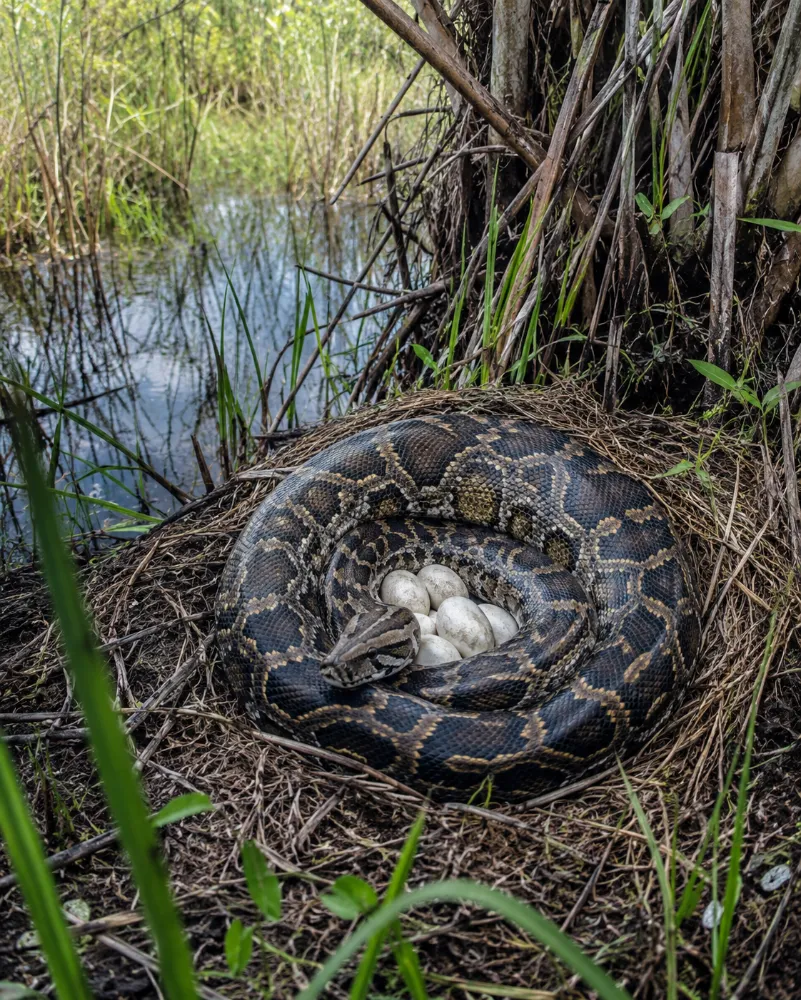
A Burmese python nest is not a woven structure like a bird nest. It is a protected egg-laying site chosen by a female python. The female lays a clutch of leathery eggs in a hidden location, then coils her body around them. Her body becomes the living “nest wall,” helping protect the eggs from disturbance, dehydration, predators, and unstable temperatures.
In the Florida Everglades, the word “nest” usually means the egg clutch and the female’s brooding position, not a structure built from sticks or grass. The snake may use existing shelter such as dense vegetation, raised soil, old animal burrows, tree islands, culverts, hollow spaces, or abandoned human-made materials.
This nesting behavior is one reason Burmese pythons are difficult to manage. A single large female can produce many eggs, and the nest may be hidden in remote wetlands where people rarely walk.
Why Burmese Python Nests Matter in the Florida Everglades
Burmese pythons are invasive predators in South Florida. They are not native to the Everglades, but they have established a breeding population there. Their nests matter because every successful clutch can add many new predators to an already stressed ecosystem.
The Everglades supports native mammals, birds, reptiles, amphibians, fish, and invertebrates. Burmese pythons eat a wide range of animals, including mammals and birds that evolved without this giant constrictor as a common predator. When large females successfully nest, the population becomes harder to reduce.
Removing one nesting female can remove both the adult snake and a whole clutch of eggs. That makes nest detection especially important for wildlife managers.
Where Do Burmese Pythons Nest in the Everglades?
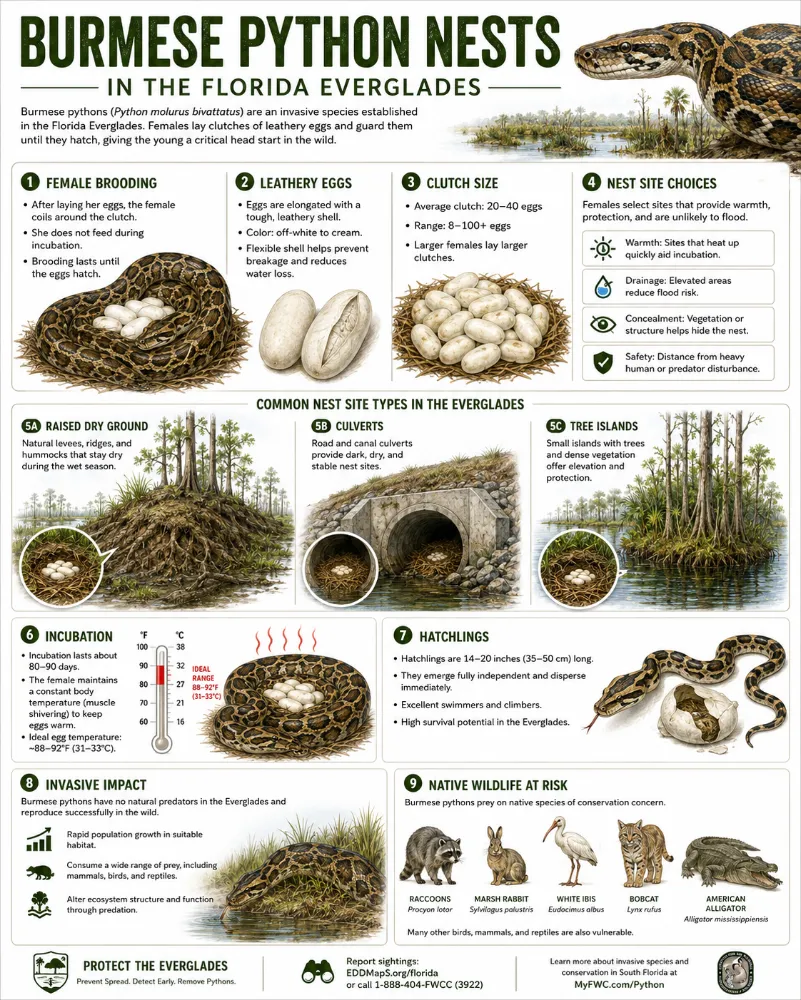
Burmese pythons need nest sites that protect eggs from flooding, overheating, drying out, and predators. The Everglades is a wetland, so dry and slightly elevated places can be especially valuable. A python nest may be hidden in vegetation, inside a cavity, near a levee, in a culvert, or in a raised patch of land surrounded by marsh.
Possible nesting areas include:
Tree islands
Dense grass and vegetation mats
Old mammal burrows
Raised levees and canal banks
Dry hammocks
Hollow logs or root systems
Roadside or canal-side embankments
Concrete pipes and culverts
Abandoned human-made structures
Brush piles or thick ground cover
The best nest sites are warm, concealed, and less likely to flood. Because much of the Everglades is seasonally wet, small differences in elevation can make a big difference for egg survival.
Do Burmese Pythons Build Nests?
Burmese pythons do not build nests in the same way birds, alligators, or some rodents do. They do not weave grasses, carry sticks, or pile vegetation into a mound. Instead, the female selects a suitable egg-laying site and uses her body to protect the eggs.
Her coiled body can help maintain a stable microclimate around the clutch. Female pythons are famous for brooding behavior, which is unusual among many snakes. They may remain with the eggs for long periods and can tighten, loosen, or shift their coils as conditions change.
In this sense, the female python is part of the nest. The shelter provides the site; the female provides defense and temperature support.
How Many Eggs Are in a Burmese Python Nest?
Burmese python clutch size depends strongly on the female’s body size, health, age, and nutritional condition. Larger females can produce more eggs than smaller females. In Florida, nests with several dozen eggs are important because even partial hatching success can add many young pythons to the landscape.
Typical discussion of Burmese python nests often includes:
Smaller clutches from younger or smaller females
Several dozen eggs from mature females
Very large clutches from exceptionally large females
Higher conservation concern when a nest contains many viable eggs
Egg number matters because the Everglades problem is not only about adult snakes. It is about reproduction. Every nest represents potential population growth.
Why Large Female Pythons Are So Important
Large female Burmese pythons are especially important in control programs because they can produce large clutches. A small python may remove one predator from the ecosystem, but a large gravid or nesting female may represent dozens of future snakes.
This is why researchers and python removal teams often pay special attention to reproductive females. Finding a nesting female can prevent an entire clutch from hatching. Finding a gravid female before egg laying can also prevent another generation of pythons from entering the wetland.
In population control, not all removals have the same reproductive value. Removing a large breeding female can have a greater long-term effect than removing a single juvenile.
Female Brooding Behavior
Burmese python mothers show a level of parental care that surprises many people. After laying eggs, the female coils around the clutch. She may remain with the eggs until hatching, rarely leaving the nest except under certain conditions.
Brooding behavior may include:
Coiling tightly around the eggs
Shifting body position over the clutch
Covering exposed eggs
Defending the nest from disturbance
Using muscle contractions that can help generate heat
Adjusting her position as temperature and humidity change
This behavior helps explain why approaching a nesting female can be risky. A brooding python may be more defensive than a snake encountered while moving through the marsh.
Can Burmese Pythons Warm Their Eggs?
Yes. Female Burmese pythons can use muscular contractions to produce heat around the eggs. This behavior is often called shivering thermogenesis. The snake does not become warm-blooded like a mammal, but she can raise temperatures around the clutch under some conditions.
This is especially important when eggs need a stable incubation environment. Temperature affects embryo development, hatch timing, and survival. In the Everglades, natural warmth is abundant, but nest microclimate still matters because eggs can be damaged by cooling, overheating, flooding, or drying.
The female’s body position helps regulate the clutch environment. She may tighten or loosen coils, expose parts of the clutch, or shift her body as conditions change.
What Do Burmese Python Eggs Look Like?
Burmese python eggs are not hard and brittle like chicken eggs. They are leathery, pale, and somewhat flexible. They are usually laid in a cluster, and the eggs may stick together in a mass.
Fresh python eggs are often white or cream-colored. As development continues, healthy eggs may remain plump, while infertile or failing eggs may discolor, collapse, or rot. In the wild, egg condition depends on fertility, humidity, temperature, flooding risk, and microbial growth.
Because eggs are hidden and guarded, most people will never see a wild Burmese python nest in the Everglades. Wildlife professionals usually find them through tracking, trained searching, chance discovery, or by locating large females during the breeding season.
How Long Do Burmese Python Eggs Take to Hatch?
Incubation time depends on temperature and nest conditions. In general, python eggs develop over several weeks to a few months. Warm, stable conditions may support successful development, while cold, flooded, or unstable conditions may reduce survival.
During incubation, the female does not feed normally. Brooding requires energy. After the eggs hatch, the young snakes are independent and the female’s parental role ends.
Hatchlings leave the egg using a small temporary egg tooth. Once they emerge, they disperse into surrounding habitat and begin life as small but fully functional predators.
What Happens After the Eggs Hatch?
Burmese python hatchlings do not need parental feeding. They are born with instincts for hiding, moving, sensing prey, and eventually hunting. At first, they may stay near cover and avoid larger predators.
Young pythons may eat small animals such as:
Small mammals
Birds
Lizards
Frogs
Small reptiles
As they grow, their prey size increases. Adult Burmese pythons are capable of eating much larger animals, including wading birds, raccoons, opossums, rabbits, and even deer-sized prey in some cases.
Why Everglades Habitat Helps Python Reproduction
The Florida Everglades provides warmth, water, cover, and abundant potential prey. These conditions help Burmese pythons survive and reproduce. Although the landscape is challenging because of seasonal flooding, pythons can use dry refuges, levees, tree islands, and human-made structures as nesting and resting sites.
Important habitat advantages include:
Warm subtropical climate
Long active season
Dense vegetation for concealment
Many canals, levees, and edge habitats
Large wetland areas with limited human access
Availability of native prey
Protected spaces for nesting and hiding
The same features that make the Everglades rich in wildlife also make it difficult to search for hidden pythons and nests.
Why Python Nests Are Hard to Find
Burmese python nests are difficult to locate because the snakes are cryptic, secretive, and well camouflaged. A brooding female may remain motionless in dense vegetation or inside a hidden cavity. The nest may be far from roads, trails, or open water access.
Challenges include:
Dense sawgrass and marsh vegetation
Remote wetland terrain
Seasonal flooding
Limited visibility
Large search areas
Snake camouflage
No obvious bird-like nest structure
Nests hidden in cavities, pipes, or vegetation
This is why python control often uses multiple tools, including night surveys, radio-tracked “scout” snakes, trained search teams, public reporting, and targeted removal during breeding season.
How Researchers Find Python Nests
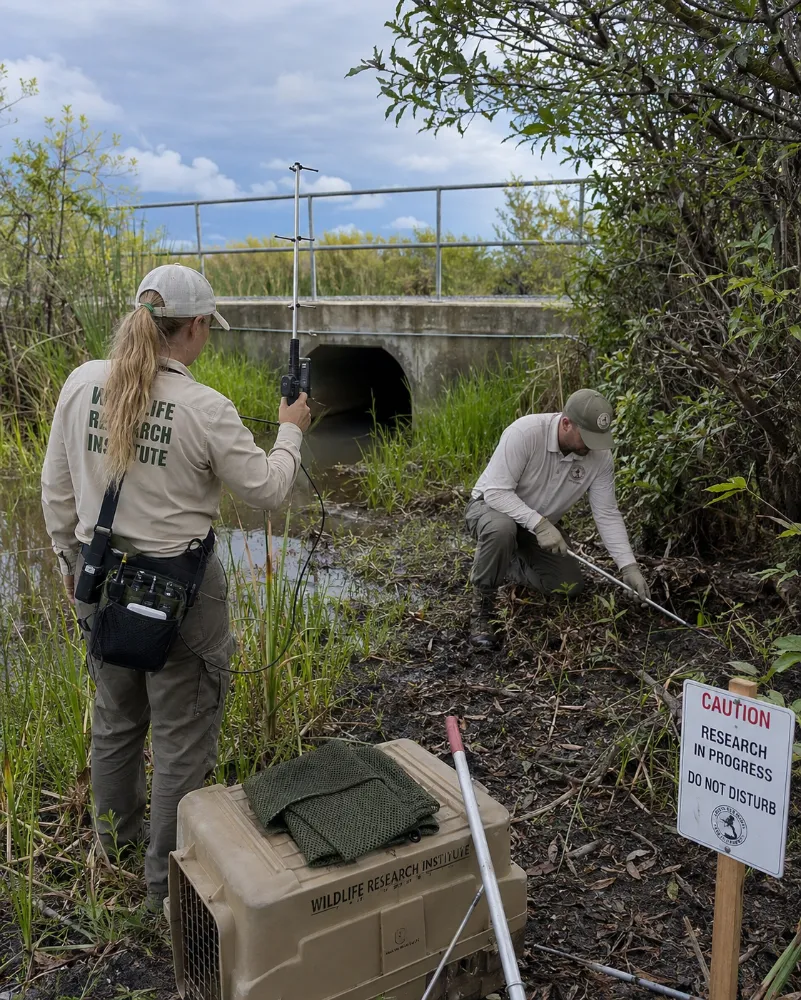
Researchers and wildlife managers use several strategies to locate reproductive pythons. One important method is tracking male pythons during the breeding season. Males may lead researchers to females because they search for mates.
Common research and removal methods include:
Radio telemetry
Tracking male pythons during breeding season
Road and levee surveys
Night searches with lights
Checking likely nesting structures
Public reporting
Professional python removal programs
Examining captured females for reproductive status
Finding nests is not just about removing eggs. Nest observations also teach scientists how pythons choose sites, how females brood, and which habitats support successful reproduction.
Python Nests in Culverts, Pipes, and Human-Made Structures
Human-made structures can provide warm, protected spaces that pythons may use for shelter or nesting. Culverts, concrete pipes, abandoned construction materials, and drainage structures can mimic natural cavities.
These sites may protect eggs from heavy rain, predators, and temperature swings. They may also be close to roads, levees, canals, and other travel corridors used by pythons.
This matters because invasive species often succeed by using human-altered environments. A pipe or culvert may look like simple infrastructure to people, but to a python it may be a hidden, stable, dry chamber suitable for brooding eggs.
Are Burmese Python Mothers Aggressive at the Nest?
A nesting Burmese python may defend her eggs if disturbed. She may hiss, strike, or bite. Burmese pythons are not venomous, but they are large constrictors with strong muscles and sharp teeth. A bite from a large snake can cause injury, and handling a large python without training can be dangerous.
Most wild pythons avoid people when possible, but a brooding female has a strong reason to stay in place. She may not flee as quickly as a non-nesting snake.
For safety:
Do not approach a suspected nest.
Do not attempt to move eggs.
Do not grab or handle a large python.
Keep pets away.
Report sightings through proper Florida wildlife channels.
Let trained personnel handle removal.
Are Burmese Pythons Venomous?
No. Burmese pythons are not venomous. They kill prey by constriction. The snake bites to grip, coils around the prey, and tightens its body. The prey dies because blood flow and breathing are disrupted, not because venom is injected.
Even without venom, large Burmese pythons are powerful animals. Adults can exceed the size of any native snake in Florida. They should be treated with caution and respect.
In the Everglades, the danger is less about venom and more about ecological impact. Burmese pythons are large predators that reproduce successfully and consume native wildlife.
Do Native Animals Eat Python Eggs?
Some native animals may eat python eggs or young pythons when they find them. Predators such as mammals, birds, and reptiles may take eggs or hatchlings. However, the female’s brooding behavior can make egg predation more difficult.
The Everglades food web is complex. A python can be predator, prey, competitor, and scavenger depending on its size and life stage. Small hatchlings are vulnerable, while large adults have few natural enemies.
The problem is that even if some eggs or hatchlings are lost, enough may survive to maintain or expand the population.
Why Python Nests Threaten Native Wildlife
Each successful nest can produce a new generation of predators. As pythons grow, they can consume larger and more varied prey. This adds pressure to native animals already affected by habitat loss, water management changes, roads, disease, and other invasive species.
Burmese pythons may eat:
Raccoons
Opossums
Marsh rabbits
Bobcats in some cases
Wading birds
Waterfowl
Small mammals
Reptiles
Occasionally larger prey such as deer
Because pythons are generalist predators, they do not depend on one prey species. This makes them especially difficult for native prey communities to withstand.
How Python Reproduction Affects Everglades Mammals
Python reproduction helps maintain a predator population that has been linked to major declines in medium-sized mammals in parts of the Everglades. When nests hatch successfully, new snakes enter the system and eventually become larger predators.
The effects are strongest in areas where pythons have been established the longest. Mammals that once appeared commonly in road surveys and field observations became much less common in heavily invaded areas.
This does not mean every mammal decline has only one cause. Ecosystems are complex. But Burmese python predation is one of the most important modern pressures on Everglades mammal communities.
Why Removing Python Nests Helps
Removing a python nest prevents eggs from hatching. Removing the brooding female also removes a breeding adult from the population. This double effect makes nest removal one of the most valuable forms of python control.
Benefits of nest removal include:
Prevents hatchlings from entering the ecosystem
Removes a reproductive female
Reduces future predation pressure
Provides scientific data on reproduction
Helps identify important nesting habitats
Improves targeting for future removal programs
However, nest removal alone cannot solve the python problem. The Everglades is too large, and many nests remain hidden. Successful control requires long-term monitoring, research, public reporting, habitat access, and professional removal.
Can Burmese Pythons Be Eradicated From the Everglades?
Complete eradication is extremely difficult because Burmese pythons are widespread, secretive, well camouflaged, and reproductive. They live in remote wetlands where detection is hard. Many individuals may never be seen by people.
Control is still important even if total eradication is unlikely. Removing large females, active nests, and breeding adults can reduce local impacts and protect key wildlife areas.
Conservation success may depend on reducing python numbers in priority zones, protecting native prey, improving detection tools, and preventing further releases of nonnative reptiles.
How Climate and Water Levels Affect Nesting
Temperature and water level are critical for python nesting. Eggs need warmth, oxygen, and moisture balance, but they cannot survive being submerged for long periods. A dry raised nest site can be valuable during the wet season.
Weather may influence:
Where females choose nest sites
How long incubation takes
Whether eggs survive flooding
How much brooding effort females need
When hatchlings emerge
The Everglades is a seasonal wetland, so successful nesting depends on matching the egg-laying site to local hydrology and temperature.
Signs of a Possible Python Nest
Most people will not find a python nest, and no one should search for one without training. However, wildlife workers may look for clues in known python habitat.
Possible signs include:
A large female python staying in one concealed location
Snake tracks or movement paths near dry cover
Repeated python sightings in a small area during breeding season
Use of culverts, pipes, burrows, or dense vegetation
Eggshells or hatchlings near a hidden site
Radio-tracked male pythons gathering near a female
These signs are not proof by themselves. Many animals use similar shelters. Professional confirmation is needed.
What Should You Do If You Find a Python or Nest in Florida?
If you see a Burmese python or suspected nest in Florida, do not approach, touch, or attempt removal unless you are properly trained and legally authorized. Large pythons can injure people, and disturbing a nesting female may increase risk.
Safe steps include:
Stay at a safe distance.
Keep pets and children away.
Take a photo only if it is safe.
Record the location as accurately as possible.
Report the sighting to Florida wildlife authorities or invasive species reporting systems.
Do not release captive snakes or other exotic pets into the wild.
Responsible reporting helps experts respond and improves knowledge of where pythons are breeding.
Why Pet Release Created a Conservation Problem
Burmese pythons became established in Florida largely through the exotic pet trade and releases or escapes. Young pythons may seem manageable, but they grow into very large snakes that require specialized care, secure enclosures, and long-term commitment.
Releasing an unwanted pet snake is harmful and irresponsible. It can introduce disease, harm native wildlife, and create long-term ecological damage.
Anyone who can no longer care for an exotic pet should contact proper surrender programs, reptile rescues, or wildlife authorities. Prevention is far easier than controlling an established invasive predator.
How Burmese Python Nests Compare With Alligator Nests
Alligators and Burmese pythons both lay eggs in the Everglades, but their nests are very different. Alligators build mound nests from vegetation, mud, and plant material. The heat of decaying vegetation helps incubate the eggs. Female alligators guard the nest and may help hatchlings reach water.
Burmese pythons do not build mounds. They lay eggs in a protected site and coil around them. The female’s body helps protect and warm the clutch, rather than relying on a mound of rotting vegetation.
| Feature | Burmese Python Nest | Alligator Nest |
|---|---|---|
| Nest structure | Hidden egg site with female coiled around eggs | Built mound of vegetation and mud |
| Incubation support | Female brooding and warm microhabitat | Heat from decomposing vegetation |
| Parental care | Female guards eggs until hatching | Female guards nest and may assist hatchlings |
| Visibility | Often very hidden | Mound may be more visible |
Common Myths About Burmese Python Nests
Myth: Burmese pythons build nests like birds.
Fact: They choose hidden egg-laying sites and coil around the eggs.Myth: Python mothers abandon the eggs immediately.
Fact: Female Burmese pythons brood and guard their eggs until hatching.Myth: One nest is not important.
Fact: One large nest can contain dozens of potential hatchlings.Myth: Burmese pythons are venomous.
Fact: They are nonvenomous constrictors.Myth: Python nests are easy to find.
Fact: They are often hidden in dense, remote, or enclosed sites.Myth: Python nests only occur deep in untouched swamp.
Fact: Pythons may also use levees, culverts, pipes, and other human-altered structures.
Final Takeaway
Burmese python nests in the Florida Everglades are hidden egg-laying sites guarded by large invasive female pythons. These snakes do not build nests like birds. Instead, they select warm, protected, often elevated or enclosed sites and coil around their eggs until they hatch.
Nesting is central to the Everglades python problem. A single breeding female can produce many eggs, and successful hatchlings become future predators in an ecosystem already affected by python predation.
Understanding where pythons nest, how females brood, and how eggs survive helps wildlife managers target removal efforts. For the public, the safest rule is simple: observe from a distance, report sightings, never release exotic pets, and let trained professionals handle invasive pythons and nests.
FAQs About Burmese Python Nests in the Florida Everglades
Do Burmese pythons build nests in the Everglades?
Burmese pythons do not build nests like birds. A female selects a hidden, protected egg-laying site and coils around her eggs. The “nest” is usually the egg clutch, shelter site, and brooding female together.
Where do Burmese pythons nest in Florida?
They may nest in raised dry areas, dense vegetation, tree islands, burrows, levees, canal banks, culverts, concrete pipes, hollow spaces, and other protected sites that reduce flooding and temperature stress.
How many eggs can a Burmese python lay?
A Burmese python can lay several dozen eggs, and very large females can produce especially large clutches. Clutch size depends on female size, age, health, and condition.
Do female Burmese pythons guard their eggs?
Yes. Female Burmese pythons coil around their eggs and brood them until hatching. They may defend the nest and adjust their body position around the clutch.
Can Burmese pythons warm their eggs?
Yes. Female Burmese pythons can use muscular contractions to help generate heat around the clutch. This behavior helps support egg development under certain conditions.
How long does it take Burmese python eggs to hatch?
Incubation usually takes several weeks to a few months, depending on temperature, humidity, and nest conditions. Warmer stable sites generally support better development.
Are Burmese python nests dangerous?
A nest can be dangerous if a large brooding female is present. Burmese pythons are not venomous, but they can bite and are very strong. People should not approach or handle wild pythons or nests without training.
Why are python nests a problem in the Everglades?
Each successful nest can produce many new invasive predators. Burmese pythons prey on native wildlife, and reproduction allows the population to persist and spread.
Do Burmese python hatchlings stay with their mother?
No. After hatching, young Burmese pythons are independent. They disperse and begin hunting small prey on their own.
What do baby Burmese pythons eat?
Young Burmese pythons may eat small mammals, birds, lizards, frogs, and other small animals. As they grow, they can take larger prey.
Are Burmese pythons native to Florida?
No. Burmese pythons are native to Southeast Asia. In Florida, they are invasive and harmful to native ecosystems.
How do researchers find Burmese python nests?
Researchers may use radio-tracked snakes, breeding-season surveys, night searches, likely nesting habitat checks, and reports from trained removal teams or the public.
Can python nests be found in man-made structures?
Yes. Burmese pythons may use culverts, concrete pipes, drainage structures, and other sheltered human-made spaces if they provide suitable warmth, cover, and protection.
Should I remove a Burmese python nest myself?
No. Do not attempt to remove a python nest unless you are trained and legally authorized. Report the location and let qualified personnel handle the snake and eggs.
How can people help prevent the python problem?
People can help by never releasing exotic pets, reporting python sightings in Florida, supporting responsible pet ownership, respecting invasive species rules, and allowing trained teams to remove pythons safely.