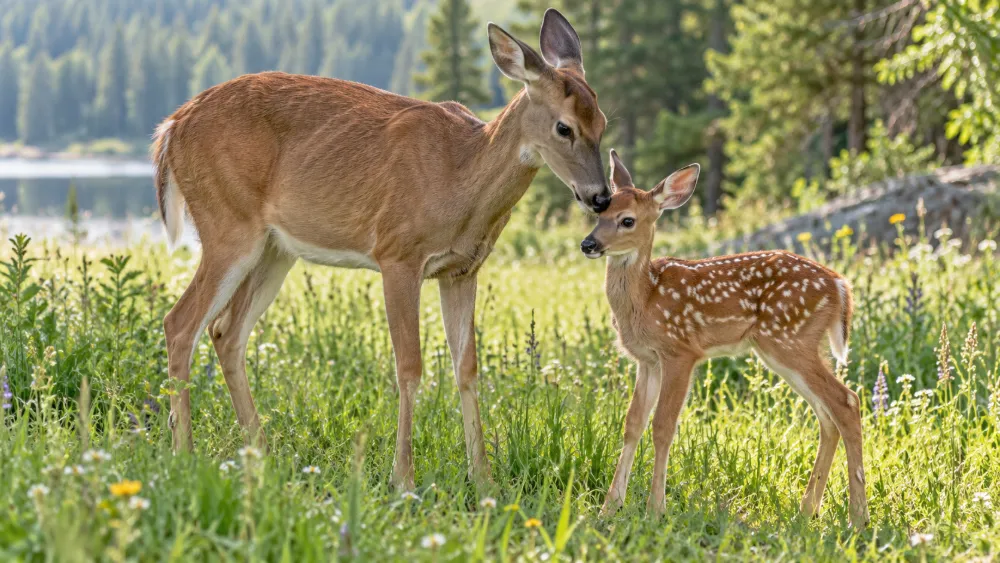
A baby deer is usually called a fawn.
The word is commonly used for young deer such as white-tailed deer, mule deer and roe deer, especially during their first year of life.
However, there is one useful complication: the deer family includes animals such as elk and moose, and their young are normally called calves rather than fawns.
So if someone simply asks, “What is a baby deer called?” the expected answer is fawn. But the exact term can depend on the species.
Quick Answer: What Is a Baby Deer Called?
A baby deer is called a fawn.
| Deer | Common Term |
|---|---|
| Baby white-tailed deer | Fawn |
| Baby mule deer | Fawn |
| Baby roe deer | Fawn |
| Baby elk | Calf |
| Baby moose | Calf |
| Adult female deer | Doe |
| Adult male deer | Buck |
What Does “Fawn” Mean?
A fawn is a young deer, especially a young animal that is still dependent on its mother.
Dictionaries commonly define the word as a young deer, particularly one less than a year old or not yet fully weaned.
The term can apply to either sex.
This means both a young male deer and a young female deer can be called fawns.
What Is a Female Baby Deer Called?
A female baby deer is still called a fawn.
As she matures, she is commonly called a doe.
There is no widely used equivalent of horse terminology such as “filly” that replaces fawn specifically for young female deer.
So:
-
young female deer = fawn;
-
adult female deer = doe.
What Is a Male Baby Deer Called?
A male baby deer is also a fawn.
As he matures, he is commonly called a buck.
In some deer species and regional traditions, an adult male may instead be called a stag or hart.
For North American white-tailed and mule deer, buck is the standard everyday term.
Why Do Baby Deer Have White Spots?
Many deer fawns are born with rows of white spots across their reddish-brown coats.
Those spots provide camouflage.
Sunlight passing through leaves creates a broken pattern of bright and dark patches on the ground. A spotted fawn lying motionless in vegetation can blend into that background remarkably well.
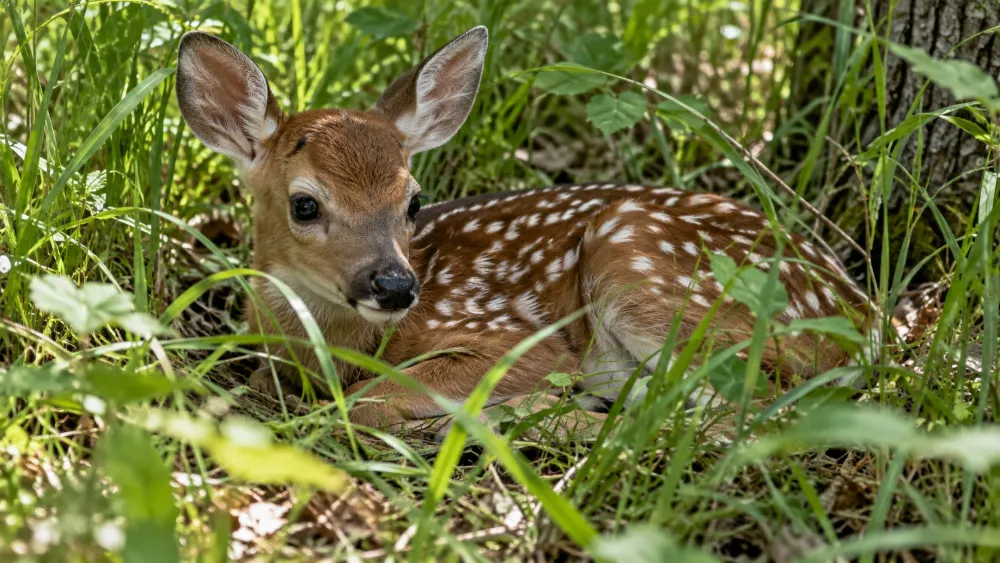
White-tailed deer fawns also have very little scent when they are young.
The combination of camouflage, low scent and remaining extremely still helps reduce the chance of being discovered by predators.
Why Is a Baby Deer Sometimes Left Alone?
A fawn lying alone in grass or woodland is usually not abandoned.
This is normal white-tailed deer behavior.
During the first weeks of life, the mother may leave the fawn hidden while she moves elsewhere to feed.
This helps avoid drawing attention to the young deer.
The doe returns periodically during the day to nurse and check on her fawn.
The fawn's natural response is to remain extremely still and quiet—even if a person approaches.
Should You Pick Up a Baby Deer That Is Alone?
Usually, no.
Wildlife agencies advise people to leave apparently healthy fawns where they are.
Approaching, touching or moving a fawn can disturb its normal hiding behavior and may prevent the mother from returning while people remain nearby.
If you encounter a quiet fawn:
-
do not pick it up;
-
do not feed it;
-
keep dogs and other pets away;
-
leave the area quietly;
-
and give the mother an opportunity to return.
If the animal is clearly injured, trapped or beside a dead mother, contact a licensed wildlife rehabilitator or local wildlife authority instead of attempting to raise it yourself.
How Big Is a Newborn Deer Fawn?
Size depends on the deer species.
For white-tailed deer, the U.S. National Park Service reports newborn fawns weighing roughly 6–8 pounds in one studied population.
Despite their small size and long, delicate-looking legs, healthy fawns can stand relatively soon after birth.
During the earliest period, however, hiding rather than running is their main defense against predators.
How Many Fawns Does a Deer Have?
White-tailed does commonly give birth to one or two fawns.
Twins are common in healthy adult females, while triplets and occasionally larger litters can occur.
Litter size varies with:
-
the mother's age;
-
nutrition;
-
health;
-
habitat quality;
-
and population conditions.
Young females giving birth for the first time are more likely to have a single fawn than a mature, healthy doe in high-quality habitat.
When Do Deer Have Babies?
The timing depends on species and location.
Across much of North America, white-tailed deer fawns are born during late spring and early summer.
At Valley Forge National Historical Park, for example, most fawns are born between mid-May and July.
Birth timing helps ensure that young deer arrive during a season when temperatures are relatively mild and nutritious vegetation is abundant.
When Does a Fawn Stop Being a Fawn?
In ordinary English, fawn generally refers to a deer during its first year.
After that, the animal may be described as a yearling.
Sex-specific adult terms also become increasingly appropriate:
-
female = doe;
-
male = buck.
Age terminology used by wildlife managers and hunters can be more precise, but there is no need to create a separate everyday name for every month of a deer's first year.
Are All Baby Deer Called Fawns?
No—and this is where the word “deer” can cause confusion.
Biologically, the deer family Cervidae includes animals such as:
-
white-tailed deer;
-
mule deer;
-
roe deer;
-
elk;
-
moose;
-
and reindeer or caribou.
Young white-tailed and mule deer are commonly called fawns.
Young elk and moose, however, are normally called calves.
This is why both statements can be true:
-
“A baby deer is called a fawn.”
-
“A baby elk is called a calf.”
The first is the normal vocabulary answer. The second reflects species-specific terminology within the wider deer family.
What Is a Baby Moose Called?
A baby moose is called a calf.
An adult female moose is a cow, while an adult male is a bull.
Moose belong to the deer family but use cattle-like terminology for age and sex.
What Is a Baby Elk Called?
A baby elk is also called a calf.
Adult females are cows and adult males are bulls.
Elk calves can also be born with spots, so appearance alone does not determine whether the correct English word is fawn or calf.
Fawn vs. Calf
The easiest way to remember the difference is:
-
ordinary deer such as white-tailed and mule deer → fawn;
-
elk and moose → calf.
Both groups belong to the same biological deer family, but English common names do not always follow taxonomy perfectly.
What Is a Group of Deer Called?
A group of deer is called a herd.
Female white-tailed deer may form family groups with their fawns, while males can form separate bachelor groups outside the breeding season.
For the full terminology, see our What Is a Group of Deer Called? guide.
FAQ
What do you call a baby deer?
A baby deer is usually called a fawn.
Is a baby deer called a calf?
Most deer such as white-tailed and mule deer have young called fawns. However, some members of the deer family, including elk and moose, have young called calves.
What is a female baby deer called?
A female baby deer is a fawn. As an adult she is commonly called a doe.
What is a male baby deer called?
A male baby deer is also a fawn. As he matures he is commonly called a buck.
Why do fawns have spots?
The white spots break up the outline of a fawn's body and help it blend into dappled vegetation while hiding from predators.
Why would a mother deer leave her baby alone?
A doe often leaves a young fawn hidden while she feeds elsewhere. She returns periodically to nurse it. This reduces attention around the fawn's hiding place.
Should I rescue a baby deer that is alone?
Usually not. A quiet, healthy-looking fawn lying alone is often behaving normally. Leave it undisturbed unless there is clear evidence of injury, entrapment or another emergency.
What is a one-year-old deer called?
A deer around one year old may be described as a yearling.
What is a baby elk called?
A baby elk is called a calf.
What is a baby moose called?
A baby moose is also called a calf.
Final Answer
A baby deer is usually called a fawn.
The term applies to young deer of either sex. A female later becomes a doe and a male is commonly called a buck.
There is one useful exception to remember: some members of the deer family use different terminology. Young elk and moose are called calves.
And if you see a spotted fawn lying quietly by itself, do not immediately assume it has been abandoned. Hiding alone while its mother feeds nearby is one of the young deer's most important survival strategies.
Related Baby Animal Names
Related Deer Guide
Sources and Further Reading
-
U.S. National Park Service — White-tailed Deer Fawns at Valley Forge
-
U.S. National Park Service — White-tailed Deer Mating and Reproduction
```