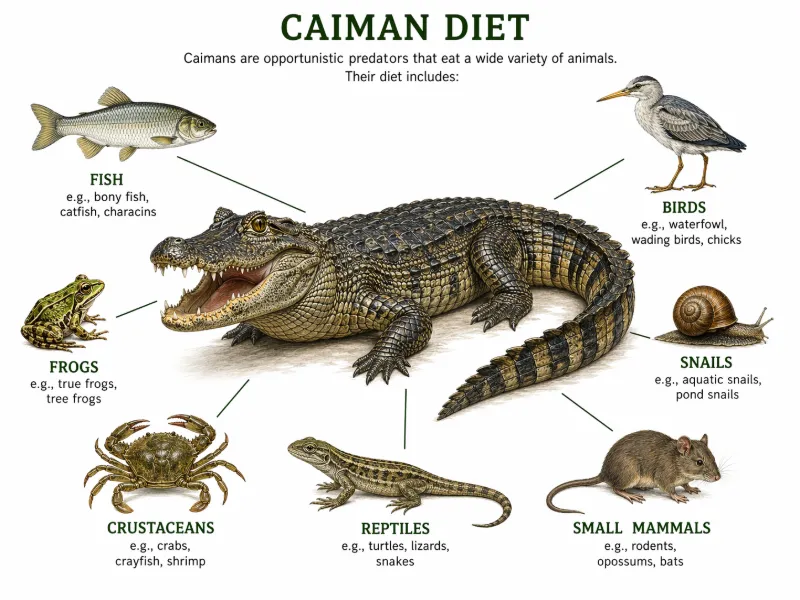
Caimans are carnivorous reptiles that eat a wide variety of animals. Their diet can include fish, insects, crustaceans, snails, frogs, birds, reptiles, and mammals, depending on the species, the size of the caiman, and the habitat where it lives.
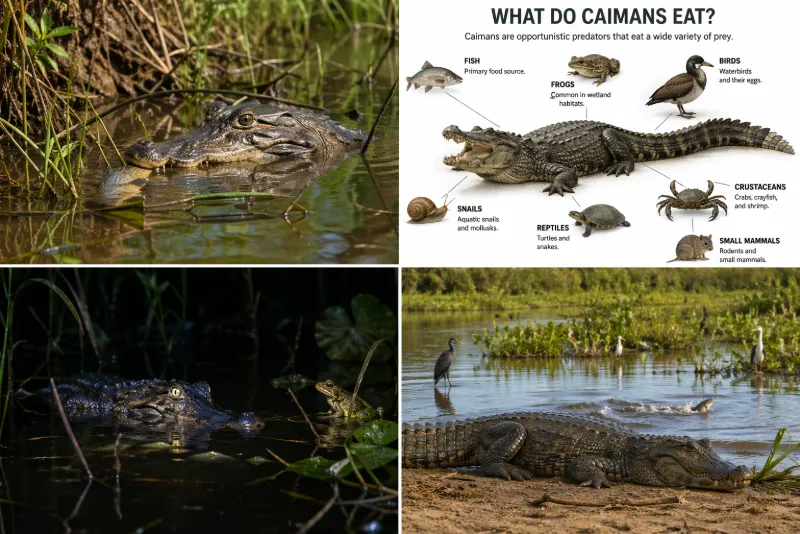
Young caimans usually feed on smaller prey such as insects, tadpoles, snails, and little fish, while larger adults are capable of catching much bigger animals. In rich wetland ecosystems, some of the largest caimans can become major predators that hunt fish, turtles, water birds, and mammals that come close to the water.
In this guide, you will learn what caimans eat, how their diet changes as they grow, how they hunt, and what kinds of prey different caiman species are most likely to take.
Quick answer
| Question | Answer |
|---|---|
| What do caimans eat? | Caimans eat fish, insects, crustaceans, snails, amphibians, birds, reptiles, and mammals |
| Are caimans carnivores? | Yes, caimans are carnivorous predators |
| Do young caimans eat the same food as adults? | No, young caimans eat smaller prey and adults take larger animals |
| Do caimans eat mammals? | Large caimans can eat mammals, especially animals near the water’s edge |
| How do caimans hunt? | They usually hunt by ambush, waiting quietly until prey comes close |
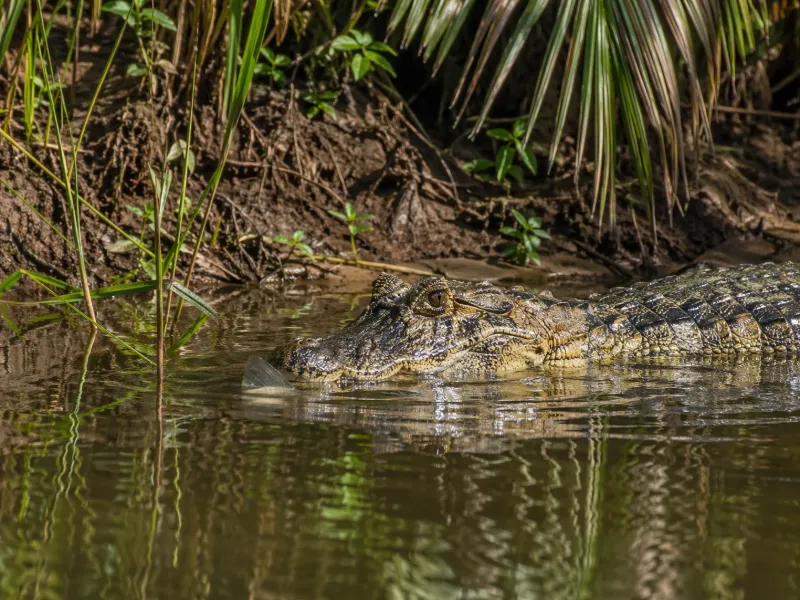
Caimans are carnivores
Caimans are meat-eating reptiles. They do not live on plants, fruit, or algae. Instead, they survive by catching and eating other animals.
Because they live in rivers, marshes, swamps, flooded forests, and wetlands, they usually feed on the animals that are most common in and around the water. That means aquatic and semi-aquatic prey is especially important.
However, caimans are also opportunistic. If a suitable prey animal comes within reach, a caiman may try to take it whether it is a fish, a frog, a bird, a turtle, or a mammal.
Fish are one of the most important foods
For many caiman species, fish are among the most important foods. Wetlands and rivers provide a steady supply of fish, especially in tropical regions where warm water supports rich aquatic life.
Caimans often wait near the water surface or along the bank and strike when fish come close. Smaller caimans may focus on small fish, while larger individuals can take much bigger prey.
In places where seasonal drought shrinks water bodies and concentrates fish, caimans may have especially good feeding opportunities. That is one reason wetland cycles can strongly affect their diet.
Young caimans eat insects and other small prey
Baby and juvenile caimans cannot handle the same prey as large adults. Their jaws are smaller, and they are more vulnerable to predators themselves, so they usually begin with smaller animals.
Young caimans often eat insects, spiders, crustaceans, aquatic larvae, tadpoles, snails, and tiny fish. These animals are abundant in shallow water and are easier to catch and swallow.
This early diet is important because it helps young caimans grow quickly. As they become larger and stronger, they shift toward bigger prey.
Snails and crustaceans can be important too
Many caimans do not rely only on fish. In some habitats, hard-shelled prey such as snails and crustaceans can form an important part of the diet.
This is especially true for smaller caimans and medium-sized species that regularly feed in shallow marshes, flooded grasslands, and slow-moving water. Crabs, freshwater crustaceans, and large snails can be common and easy to find.
Because caimans have strong jaws, they are well equipped to grip and crush many of these prey items.
Amphibians are common prey in wetlands
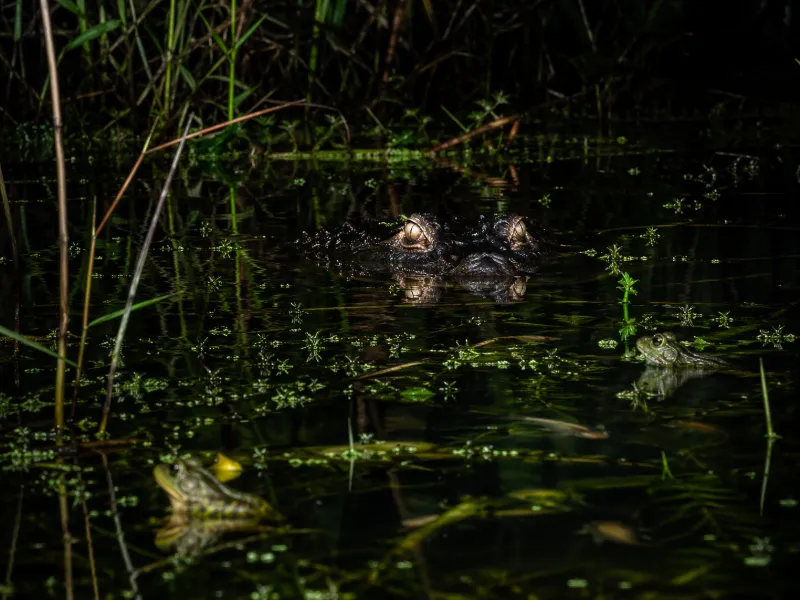
Frogs, toads, and tadpoles are often eaten by caimans, especially when these prey animals are abundant during wet periods or breeding seasons.
Amphibians are especially important for smaller and younger caimans because they are easier to catch than large birds or mammals. In shallow water and marshy vegetation, frogs can become frequent targets.
In tropical wetland ecosystems, amphibians are often a regular part of the food web that supports caimans and many other predators.
Caimans also eat birds
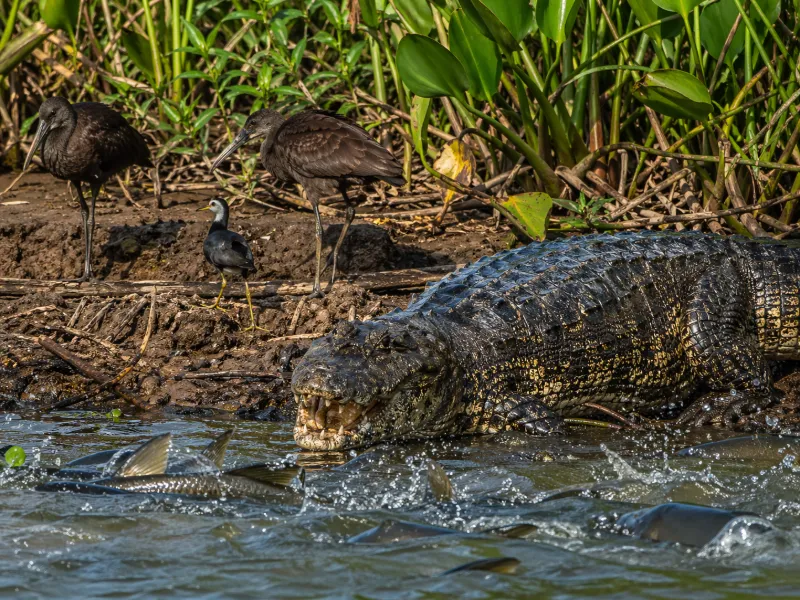
Caimans may catch birds that swim, wade, nest, or drink at the water’s edge. Water birds are especially vulnerable because they spend time close to the habitats where caimans wait in ambush.
Duck-like birds, herons, young waterfowl, and other wetland birds may all be at risk if they move too close to a hidden caiman. Nestlings and young birds can be particularly vulnerable.
Large adults are more capable of catching sizable birds, while smaller caimans may focus on young or less mobile individuals.
Large caimans can eat reptiles
Caimans may also eat reptiles, including lizards, snakes, and turtles. In some areas, turtles can be important prey for large individuals.
Small reptiles may be taken by medium-sized caimans, while larger reptiles require stronger jaws and more power. Eggs and hatchlings may also be eaten if a caiman finds them in or near wetland habitat.
This broad diet helps explain why caimans are such important predators in tropical ecosystems. They are not limited to one narrow food source.
Do caimans eat mammals?
Yes, large caimans can eat mammals. This is especially true for bigger species such as the black caiman and for large adults of other species when the right opportunity appears.
Mammals that come close to the water to drink, cross, or forage may be vulnerable. Depending on the region and species, prey can include rodents, small to medium mammals, and other animals that use the water’s edge.
In famous South American wetlands, large caimans may take prey such as capybaras or other mammals under the right conditions. However, not every caiman is large enough to do this regularly. Size matters a great deal.
The diet changes as a caiman grows
One of the most important things to understand is that a caiman’s diet changes with age.
Young caimans start with small prey such as insects, snails, tadpoles, and tiny fish. Medium-sized caimans expand into larger fish, frogs, crustaceans, birds, and reptiles. Large adults can take the broadest range of prey, including large fish, turtles, birds, and mammals.
This gradual shift helps reduce competition between young and old caimans. Small juveniles do not need to compete directly with giant adults for exactly the same food.
Different caiman species eat different things
Not all caimans feed in exactly the same way. Diet varies by species, habitat, and body size.
The black caiman, for example, is a very large predator that can take big prey in South American wetlands. The spectacled caiman is more medium-sized and highly adaptable, often eating a wide range of fish, invertebrates, amphibians, birds, and small vertebrates.
Yacare caimans often feed heavily on fish, snails, and other wetland prey in places such as the Pantanal. Dwarf caimans usually focus on smaller prey associated with forest streams, including fish, crustaceans, insects, frogs, and other small animals.
So the question is not just “What do caimans eat?” but also “Which caiman are you talking about?”
How caimans hunt
Caimans usually hunt by ambush. Instead of chasing prey over long distances, they wait quietly in the water or near the bank until something comes close enough to seize.
Their eyes and nostrils sit high on the head, so they can keep most of the body hidden below the surface. Their dark color also helps them blend into muddy water, wetland plants, and shaded banks.
When prey enters range, a caiman can strike quickly with its jaws and powerful body. Small prey may be swallowed right away, while larger prey may be dragged into the water and repositioned before being eaten.
Do caimans hunt at night?
Yes, many caimans are especially active at night. Darkness gives them a major advantage because they are harder for prey to detect.
At night, fish move in shallow water, frogs call near the edges of ponds, and mammals or birds may come to drink. These conditions create many feeding opportunities for a patient ambush predator.
That is why caimans are often easier to spot during nighttime wildlife tours, when their eyeshine reflects in torchlight or headlights.
Do caimans eat dead animals?
Sometimes. Although caimans are active predators, they may also scavenge when an easy meal is available.
If a dead fish, bird, or mammal is found in the water or near the shore, a caiman may feed on it. This opportunistic behavior is common in many predators and helps reduce wasted food in wetland ecosystems.
Still, caimans are best known as hunters rather than as strict scavengers.
What eats young caimans?
Young caimans are predators, but they are also prey for many larger animals. Birds, large fish, snakes, mammals, and even bigger crocodilians may eat baby caimans.
This is one reason young caimans stay hidden in shallow vegetation and begin life feeding on small prey. Their early years are dangerous, and only a fraction survive to adulthood.
As they grow, their risk from predators drops, and their own place in the food web becomes stronger.
Why caiman diet matters in wetland ecosystems
Caimans help shape wetland food webs by controlling populations of fish, amphibians, invertebrates, reptiles, birds, and sometimes mammals. Because they feed at different levels depending on species and size, they influence many parts of the ecosystem.
Young caimans may help reduce insects and small aquatic animals. Large adults may regulate bigger prey populations and affect where animals drink, swim, or feed.
That is why healthy caiman populations often matter for the balance of tropical wetlands, rivers, and flooded forests.
Final takeaway
Caimans are carnivores that eat a wide variety of prey, including fish, insects, crustaceans, snails, amphibians, birds, reptiles, and mammals. Young caimans feed mostly on smaller prey, while larger adults can hunt much bigger animals. Most caimans use ambush hunting, waiting quietly in rivers, wetlands, and marshes until prey comes close enough to grab.
The exact diet depends on the species, the size of the animal, and the habitat where it lives, but overall, caimans are flexible and effective wetland predators.
FAQs
Do caimans eat fish?
Yes. Fish are one of the most important foods for many caiman species.
Do caimans eat mammals?
Large caimans can eat mammals, especially animals that come close to the water’s edge.
Do baby caimans eat the same food as adults?
No. Baby caimans usually eat insects, tadpoles, snails, and small fish, while adults can take much larger prey.
Do caimans hunt at night?
Yes. Many caimans are especially active at night, when their stealth gives them an advantage.