No, porcupines cannot shoot their quills. Their quills are specialized hairs that stand upright when the animal is threatened, but they cannot be fired like arrows or launched at a distant predator. Instead, quills detach when an attacker makes contact with the porcupine's body or quill-covered tail. North American porcupine quills have tiny backward-facing barbs that help them enter skin and resist removal. This defensive system can cause serious injuries without requiring the porcupine to chase or attack an enemy from a distance.
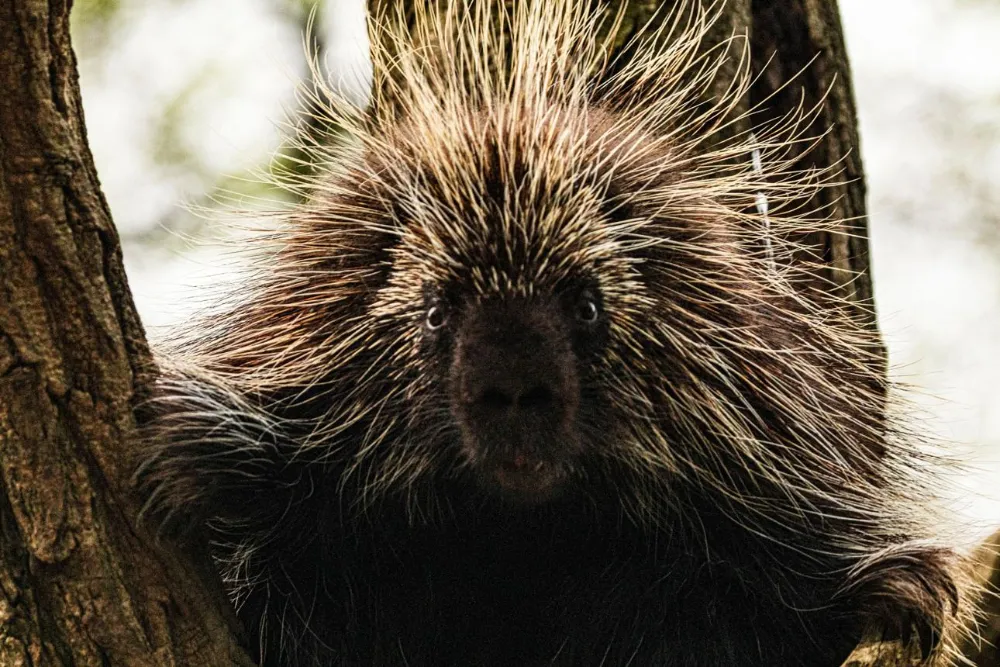
Porcupines cannot launch their quills, but their specialized hairs provide an effective defense against close contact.
Can Porcupines Shoot Their Quills?
Porcupines cannot shoot, throw, or deliberately launch their quills.
The idea that porcupines fire sharp spines at approaching enemies is one of the most persistent myths about these animals.
In reality, the quills remain attached to the animal until they are shed naturally or detached through contact.
When threatened, a porcupine can raise its quills and position its body defensively.
If another animal touches those sharp structures, some quills may penetrate its skin.
They can then detach from the porcupine and remain embedded in the attacker.
This process explains how a dog or wild predator can end up covered in quills without the porcupine ever firing a projectile.
The Smithsonian National Zoo, San Diego Zoo, and the U.S. National Park Service all explicitly reject the shooting-quills myth.
Why Do People Think Porcupines Shoot Quills?
The myth probably survives because porcupine quills can detach surprisingly easily.
After an encounter, an animal may have numerous quills stuck in its face or body.
To someone who did not witness the interaction, it might appear that the porcupine attacked from a distance.
Porcupines can also raise their quills suddenly when alarmed.
Some species move or lash their tails during defensive encounters.
These behaviors create the impression of an aggressive weapon system.
However, the quills themselves do not travel through the air under muscular propulsion.
San Diego Zoo notes that loose quills can sometimes become airborne when a porcupine shakes, but that is ordinary shedding or displacement rather than purposeful shooting.
How Do Porcupine Quills Actually Work?
Porcupine quills are modified hairs composed primarily of keratin.
Keratin is a structural protein also found in mammalian hair and nails.
Unlike ordinary soft fur, porcupine quills are stiff and sharply pointed.
Many are hollow, making them relatively light.
In North American porcupines, numerous quills are attached loosely enough to detach during contact.
When a predator presses against them, their sharp tips can enter the skin.
The quills then remain behind as the porcupine and predator separate.
This allows the porcupine to defend itself without relying on speed or a powerful bite.
Are Porcupine Quills Modified Hairs?
Yes. Quills are specialized mammalian hairs.
They are made from keratin rather than bone or metal.
Their structure differs from the soft hairs of an ordinary mammal's coat.
A quill has evolved to function as a sharp defensive spine.
However, quills are not identical among all porcupines.
Species differ in length, thickness, shape, and surface structure.
North American porcupines have quills with distinctive microscopic barbs near the tips.
Some Old World porcupines have larger or differently shaped quills that lack the same microscopic barbed structure.
Are Porcupine Quills Hollow?
Many porcupine quills are hollow or contain substantial internal spaces.
This makes them lighter than a solid spine of similar dimensions.
In North American porcupines, hollow quills contribute to the animal's characteristic coat of relatively lightweight protective spines.
However, the internal structure and dimensions vary among species and quill types.
The fact that a quill is hollow does not mean it contains venom or functions like a needle that injects a chemical.
The major defensive effect comes from the quill's physical shape and its interaction with tissue.
How Many Quills Does a Porcupine Have?
An adult North American porcupine is commonly described as having approximately 30,000 quills.
This estimate is reported by the Smithsonian National Zoo and the National Park Service.
However, the exact number varies among individuals.
It should not be treated as a fixed number for every porcupine species.
Different porcupines have different body sizes and quill arrangements.
Some have long conspicuous spines, while others have shorter, denser quills.
Can Porcupines Raise Their Quills?
Yes. Porcupines can erect their quills when they become alarmed.
Muscles associated with the quills help them stand outward from the body.
This increases the apparent size of the animal and presents sharp surfaces toward a potential attacker.
The response resembles piloerection, the process that raises ordinary mammalian hair.
However, standing quills are much more effective as physical protection than raised soft fur.
When a predator moves closer, the raised quills make accidental or deliberate contact more hazardous.
How Do Porcupines Defend Themselves?
Porcupines generally benefit from avoiding unnecessary fights.
They may attempt to move away from a threat.
If escape becomes difficult, they can adopt a defensive posture.
A North American porcupine may raise its quills, turn its back toward the predator, and move its tail.
Its heavily quilled back and tail provide protection.
A predator that bites or presses into these areas may receive multiple puncture wounds.
The quills can detach and remain embedded in the attacker.
However, the exact defensive behavior varies among species and situations.
Do Porcupines Attack With Their Tails?
Some porcupines use their tails during defensive encounters.
The North American porcupine can lash its quill-covered tail toward a nearby attacker.
This movement can bring the sharp quills into direct contact with the predator.
However, the tail does not function as a launcher.
The quills are not fired outward independently of the animal.
Instead, tail movement creates an opportunity for physical contact.
San Diego Zoo and the Smithsonian National Zoo both describe tail-based defense in New World porcupines.
Can a Porcupine Throw Quills by Shaking?
A porcupine may shed loose quills when it shakes or moves.
Some of those loose quills may fall or briefly become airborne.
However, this is not the same as intentionally shooting them toward a target.
There is no specialized mechanism that propels quills through the air like darts.
Most dangerous quill injuries occur through direct contact.
Therefore, people should not confuse the accidental movement of detached quills with an active projectile defense.
Why Do Porcupine Quills Get Stuck in Skin?
North American porcupine quills possess microscopic backward-facing barbs near their tips.
These barbs interact with tissue when the quill penetrates.
They help resist movement in the reverse direction.
As a result, a quill can be easier to insert than to remove.
However, porcupine quills do not remain embedded through magic, suction, or poison.
The effect is primarily mechanical.
The tiny barbs grip surrounding tissue and make withdrawal more difficult.
What Are the Barbs on Porcupine Quills?
Barbs are small backward-facing projections along part of a quill's surface.
They are especially well studied in the North American porcupine, Erethizon dorsatum.
Because the projections point backward relative to the tip, they can resist the quill being pulled out.
The barbs are microscopic and cannot be clearly distinguished without magnification.
In a landmark 2012 study, scientists used scanning electron microscopy to examine these structures.
They found that the geometry of the barbs influenced both penetration and removal forces.
What Did the 2012 Porcupine Quill Study Discover?
In 2012, researchers published a study in the Proceedings of the National Academy of Sciences titled Microstructured Barbs on the North American Porcupine Quill Enable Easy Tissue Penetration and Difficult Removal.
The team compared natural barbed quills with quills whose barbs had been removed.
They also constructed artificial replicas to study the mechanical effects of the surface structures.
One important finding was unexpected.
The presence of barbs did not merely make withdrawal more difficult.
The barbs also reduced the force needed for penetration.
In one comparison, natural barbed quills required approximately 54 percent less penetration force than otherwise comparable quills with the barbs removed.
The researchers also found substantially greater resistance during withdrawal.
These results demonstrated that tiny surface features can influence mechanical performance in two different ways.
Why Do Barbs Make Quills Easier to Insert?
It may seem surprising that barbs reduce penetration force.
Sharp backward-facing structures appear more likely to catch on tissue than to slide into it.
However, the 2012 experiments showed that the geometry creates localized stress concentrations during insertion.
These stresses help initiate and propagate small changes in the tissue ahead of the quill.
As a result, the quill can penetrate with less force.
The researchers reproduced aspects of this effect using artificial quills.
However, the precise outcome depends on quill geometry, tissue properties, and experimental conditions.
Why Are Porcupine Quills Hard to Remove?
Once a barbed quill enters tissue, the backward-facing projections can engage with surrounding fibers.
Attempting to pull the quill out may cause the barbs to bend outward and grip more strongly.
This increases resistance during withdrawal.
The 2012 experiments showed that natural barbed quills required more force to remove than comparable quills without barbs.
However, the measured forces came from controlled experiments using particular tissues and quill samples.
They should not be interpreted as a fixed removal force for every real-world injury.
In an animal, the depth and location of the quills may create additional complications.
Porcupine Quills: Myth vs. Science
| Claim | Scientific Answer |
|---|---|
| Porcupines shoot their quills | False |
| Porcupines can raise their quills | True |
| Quills can detach during contact | True |
| North American quill tips have microscopic barbs | True |
| Barbs make quills more difficult to remove | True |
| Quills are made of keratin | True |
| All porcupines have identical quills | False |
| Lost quills can be replaced | True |
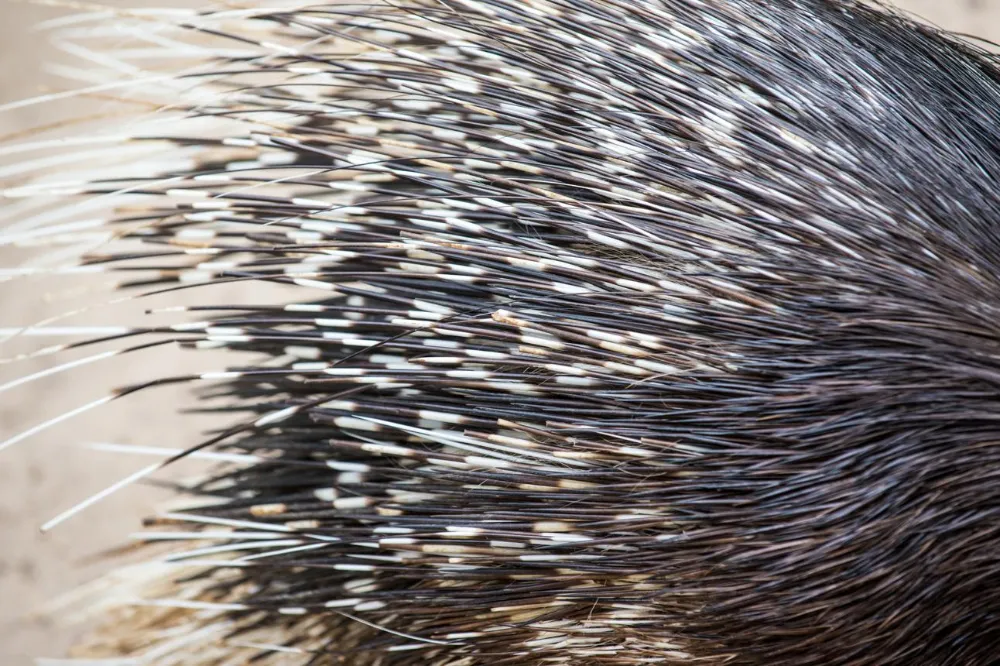
Porcupine quills are stiff modified hairs; the tiny barbs on North American quill tips require magnification to see clearly.
Can Porcupine Quills Move Deeper Into Skin?
Embedded quills can become more deeply lodged as surrounding tissues move.
The National Park Service describes how movement may contribute to further penetration.
However, a detached quill is not alive.
It does not crawl through the body or actively propel itself deeper.
Any movement is caused by physical forces, including the actions of surrounding muscles and tissues.
Because embedded quills can break or become difficult to locate, injuries involving quills should not be treated casually.
Are Porcupine Quills Poisonous?
Porcupine quills are not venom-injecting structures.
They do not contain a specialized system for delivering poison in the way that venomous fangs or stingers can.
Their principal defensive effects are mechanical.
They puncture tissue and may remain lodged because of their shape.
However, a nonvenomous puncture can still cause serious harm.
Pain, inflammation, embedded fragments, and complications involving sensitive body regions remain possible.
Therefore, calling quills nonpoisonous should never be interpreted as meaning quill injuries are harmless.
Can Porcupine Quills Cause Infections?
Quill punctures can produce wounds that require medical or veterinary attention.
Some research has investigated antimicrobial properties associated with porcupine quills.
However, the existence of such properties does not guarantee that every puncture remains free of infection.
The risk depends on the wound, retained fragments, contamination, and other circumstances.
It is therefore unsafe to assume that an embedded quill can simply be ignored.
Persistent pain, swelling, or signs of infection require professional assessment.
What Happens if a Dog Gets Porcupine Quills?
Dogs sometimes encounter porcupines while investigating wildlife.
A dog may receive quills in its muzzle, mouth, face, or other parts of its body after approaching or biting a porcupine.
Because the quills can be barbed, removal may be difficult.
Broken fragments can also complicate treatment.
If a dog has porcupine quills embedded in its body, contact a veterinarian promptly.
Do not assume that visible quills are the only ones present, especially if the mouth or throat may be involved.
Attempting extensive removal at home can cause additional problems.
Can Porcupines Hurt Humans?
Yes. Direct contact with porcupine quills can cause puncture wounds in humans.
However, porcupines generally do not seek encounters with people.
They rely mainly on defensive adaptations rather than actively pursuing humans.
Keeping a respectful distance prevents most problems.
Do not attempt to touch, restrain, or pick up a wild porcupine.
If a quill puncture occurs, particularly near the eye or another sensitive area, seek appropriate medical care.
Do Porcupines Attack Without Warning?
Porcupines generally prefer avoiding unnecessary danger.
When approached or cornered, they may display defensive behaviors.
These can include raising quills, turning the protected part of the body toward an attacker, or moving the tail.
Some porcupines may also make vocal sounds or chatter their teeth.
However, defensive signals vary among species.
A person should not rely on receiving a particular warning before giving the animal space.
The safest approach is to avoid close contact from the beginning.
Can Porcupines Throw Quills Through the Air?
Porcupines have no specialized mechanism for deliberately projecting quills through the air.
Loose hairs or quills can occasionally be displaced by movement.
However, they do not travel like arrows aimed at a predator.
The dangerous interaction usually involves contact with the quill-covered body or tail.
Therefore, a porcupine standing several feet away cannot intentionally fire a volley of quills into an observer.
Do Porcupines Lose Their Quills After an Attack?
Yes. Quills can detach during defensive contact.
A predator may leave an encounter with quills embedded in its skin.
The porcupine does not necessarily lose every quill in the affected area.
The amount lost depends on contact and other factors.
Like other modified hairs, quills can also be shed naturally.
The animal can grow replacement quills over time.
Do Porcupine Quills Grow Back?
Yes. Lost quills can be replaced.
Porcupine quills are specialized hairs produced by the skin.
When they are shed or detached, new quills can grow.
However, regrowth is not instantaneous.
The precise growth rate may differ among species and individuals.
It is therefore incorrect to assume that a porcupine permanently loses its defensive covering after one encounter.
Do Baby Porcupines Have Quills?
Young porcupines are born with quills, but the quills are relatively soft at birth.
They harden after the animal is born.
This is an important adaptation because rigid sharp quills would create difficulties during birth.
However, developmental timing and the appearance of newborn animals vary among species.
Newborn porcupines should not be handled simply because their quills initially appear softer than those of adults.
What Is a Baby Porcupine Called?
A young porcupine is commonly called a porcupette.
Porcupettes are born with developing defensive quills.
They depend on maternal care early in life.
However, their development differs among porcupine species.
Some are capable of climbing relatively early, while others take longer to become independent.
They should be observed from a distance rather than approached or handled.
Are All Porcupines the Same?
No. Living porcupines belong to two major families.
New World porcupines belong to Erethizontidae.
Old World porcupines belong to Hystricidae.
They are both rodents, but the groups differ in anatomy, behavior, and geographic distribution.
Many New World porcupines are skilled climbers.
Several Old World porcupines are more strongly terrestrial.
However, individual lifestyles vary among species.
The structure and defensive use of quills also differ.
North American vs. African Porcupines
| Feature | North American Porcupine | African Crested Porcupine |
|---|---|---|
| Scientific name | Erethizon dorsatum | Hystrix cristata |
| Family | Erethizontidae | Hystricidae |
| Geographic range | North America | Parts of Africa and Italy |
| Typical lifestyle | Climbs trees frequently | Primarily terrestrial |
| Quill structure | Many short quills with microscopic tip barbs | Long, conspicuous quills with different surface structure |
| Can shoot quills? | No | No |
The differences help explain why findings from experiments on North American quills should not automatically be applied to every porcupine species.
Do African Porcupines Shoot Their Quills?
No. African porcupines cannot shoot their quills.
Some Old World species have long, conspicuous quills that make their defensive displays particularly impressive.
However, those quills are not projectile weapons.
The animal must use body movement and direct contact to create an injury.
The 2012 mechanical study also found structural differences between North American barbed quills and African porcupine quills.
Therefore, a large African porcupine should not be described as possessing exactly the same microscopic barbs as a North American porcupine.
Can Porcupines Climb Trees?
Many New World porcupines are excellent climbers.
The North American porcupine frequently moves through trees to find food or shelter.
Its claws and feet are adapted for gripping bark and branches.
Some South American porcupines have prehensile tails that provide additional support.
However, many Old World porcupines spend much more time on the ground.
Therefore, tree climbing is common among some porcupine groups but is not equally characteristic of every species.
Do Porcupines Have Prehensile Tails?
Some New World porcupines possess prehensile tails.
A prehensile tail can grasp or hold onto branches.
This is especially useful in an arboreal environment.
The Smithsonian National Zoo describes South American prehensile-tailed porcupines as skilled tree climbers.
However, the North American porcupine does not have the same highly specialized grasping tail.
Its tail is particularly important in defensive encounters.
Are Porcupines Rodents?
Yes. Porcupines belong to the mammalian order Rodentia.
They share the characteristic rodent pattern of continuously growing incisors.
These teeth are useful for gnawing plant material.
However, porcupines are not simply large hedgehogs.
They belong to a different evolutionary group.
The presence of defensive spines in several unrelated mammals is an example of how similar ecological challenges can produce superficially similar adaptations.
Are Porcupines Related to Hedgehogs?
Porcupines and hedgehogs are both mammals with defensive spines, but they are not close relatives.
Porcupines are rodents.
Hedgehogs belong to the order Eulipotyphla.
Both groups evolved specialized hairs that help protect them from predators.
However, their anatomy, feeding habits, and evolutionary histories differ.
Therefore, the presence of spines does not imply that the animals belong to the same family or order.
Porcupine Quills vs. Hedgehog Spines
| Feature | Porcupine Quills | Hedgehog Spines |
|---|---|---|
| Made of keratin | Yes | Yes |
| Defensive function | Yes | Yes |
| Typical detachment during predator contact | Common in North American porcupines | Not used in the same way |
| Microscopic backward-facing tip barbs | Well documented in North American porcupines | Not equivalent to North American porcupine quills |
| Can shoot spines | No | No |
| Mammal order | Rodentia | Eulipotyphla |
Can Hedgehogs Shoot Their Spines?
No. Hedgehogs cannot shoot their spines.
They defend themselves mainly by raising their spines and, in many species, curling into a protective ball.
The spines create a barrier against direct attack.
However, hedgehogs do not fire them through the air.
The similarity between hedgehog spines and porcupine quills has probably helped spread the misconception that spiny mammals can launch their protective hairs.
What Animals Hunt Porcupines?
Porcupines face predators despite their formidable defenses.
In North America, fishers are particularly well known for successfully hunting porcupines.
Other large carnivores may also attempt attacks.
However, approaching a porcupine can be dangerous because of the quills.
Different predators use different strategies to reduce the risk of injury.
The existence of successful predators demonstrates that quills provide protection without making porcupines completely invulnerable.
How Do Fishers Hunt Porcupines?
Fishers are members of the weasel family.
They are among the mammals known to prey on North American porcupines.
Because the porcupine's back and tail are heavily defended, predators may seek opportunities to attack less protected parts of the body.
However, individual hunting encounters vary.
The precise sequence of behavior depends on the predator and prey.
Porcupine quills increase the risks of attack but do not prevent every successful predation event.
What Do Porcupines Eat?
Porcupines are primarily plant-eating rodents.
North American porcupines consume a variety of plant materials depending on the season.
These can include bark, twigs, leaves, and other vegetation.
Old World and South American porcupines have their own dietary patterns.
However, quills are not related to hunting prey.
They are defensive structures rather than tools for capturing animals.
Are Porcupines Aggressive Animals?
Porcupines are usually better understood as defensive animals rather than aggressive hunters.
They are not specialized for chasing down enemies.
Instead, their quills allow them to protect themselves when threatened.
However, a cornered porcupine may respond forcefully to an approaching predator.
Such behavior is defensive rather than evidence that the animal routinely seeks fights.
The safest way to observe porcupines is to maintain distance and allow them a clear escape route.
What Can Porcupine Quills Teach Scientists?
Porcupine quills have inspired research in biomechanics and medical engineering.
The 2012 study demonstrated how microscopic backward-facing barbs can produce both relatively easy insertion and strong resistance to withdrawal.
Researchers reproduced aspects of these properties using synthetic materials.
Such designs may inform the development of specialized needles, tissue adhesives, or other biomedical devices.
However, these applications involve engineered designs and controlled testing.
A natural porcupine quill is not itself a safe medical instrument.
The research illustrates how biological structures can inspire technological solutions.
Why Is the Porcupine Quill Such an Effective Defense?
The quill combines several useful features.
It is sharp enough to penetrate tissue during direct contact.
It is relatively lightweight.
In North American porcupines, microscopic barbs increase the difficulty of removal.
Numerous quills cover important parts of the animal's back and tail.
The animal can also raise its quills and orient its body defensively.
These features operate together.
Instead of needing to fire a weapon, the porcupine turns much of its outer body into a dangerous surface for would-be attackers.
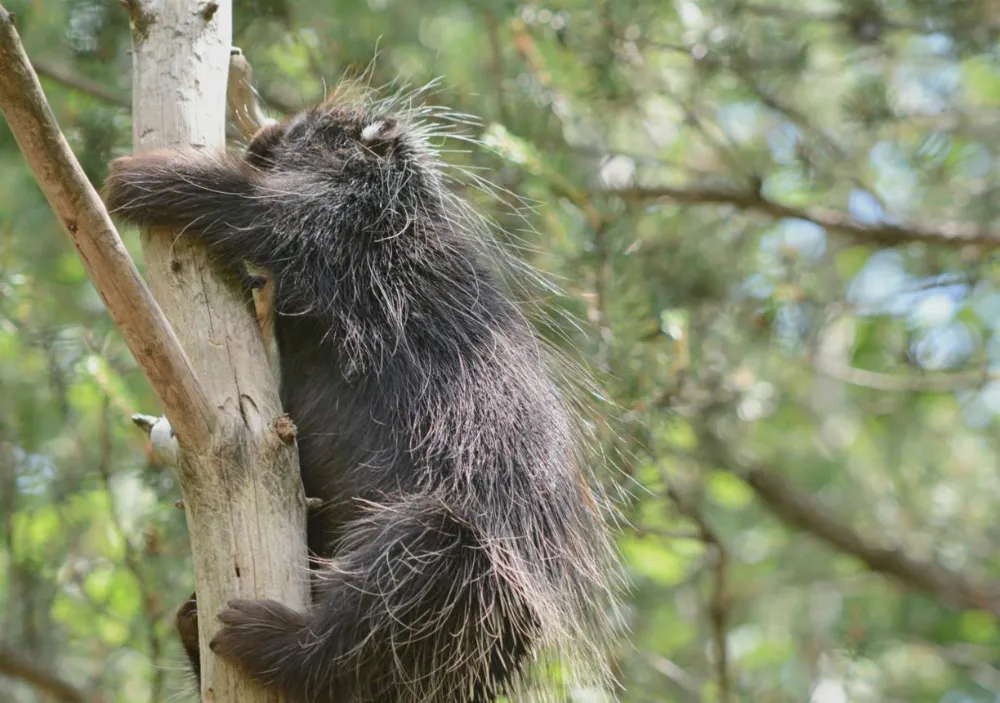
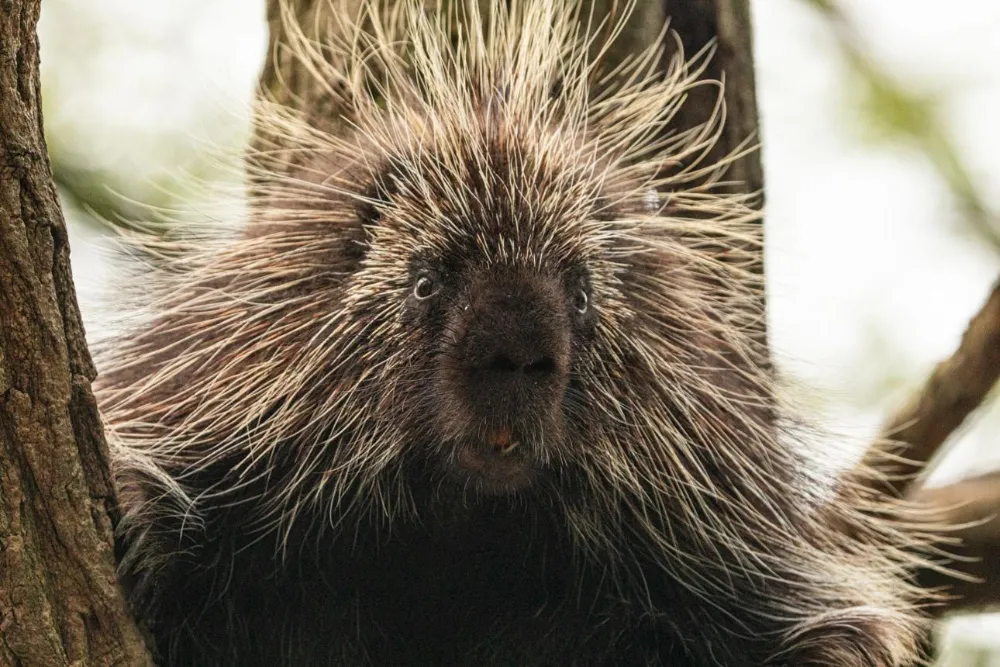
North American porcupines are skilled climbers whose quills protect them while they move through woodland habitats.
Frequently Asked Questions
Can porcupines shoot their quills?
No. Porcupines cannot launch their quills toward a distant target. Quills detach mainly during physical contact.
Can porcupines throw their quills?
No. Loose quills can sometimes fall or be displaced during movement, but porcupines do not intentionally throw them.
How do porcupines defend themselves?
They raise their quills, adopt defensive positions, and may use their tails to bring the quills into contact with attackers.
Do porcupine quills detach easily?
North American porcupine quills are loosely attached and can detach when a predator contacts them.
Why are porcupine quills hard to remove?
Microscopic backward-facing barbs on North American quill tips grip surrounding tissue and increase withdrawal resistance.
Are porcupine quills poisonous?
No. Their principal defensive effect is mechanical puncture rather than venom injection.
Can porcupine quills move inside the body?
Embedded quills may become more deeply lodged through tissue movement, but they do not move independently.
Do porcupine quills grow back?
Yes. Quills are specialized hairs and can be replaced after shedding or loss.
How many quills does a porcupine have?
A North American porcupine is commonly estimated to have about 30,000 quills, but the number varies.
Do baby porcupines have quills?
Yes. Baby porcupines are born with relatively soft quills that harden after birth.
Do African porcupines shoot quills?
No. African porcupines also depend on contact-based defense rather than projectile quills.
Are porcupines related to hedgehogs?
They are distant mammalian relatives. Porcupines are rodents, while hedgehogs belong to a different mammalian order.
Can hedgehogs shoot their spines?
No. Hedgehogs cannot launch their spines and instead use them for close-contact protection.
What should I do if my dog gets porcupine quills?
Contact a veterinarian promptly. Embedded quills can be difficult to remove and may cause complications, particularly around the mouth and eyes.
Can porcupines climb trees?
Yes. North American and many other New World porcupines are excellent climbers.
The Bottom Line
Porcupines cannot shoot their quills.
Their quills are specialized keratin hairs that form an effective defensive covering.
When threatened, a porcupine can raise its quills and use its body or tail to discourage close contact.
Quills can detach and become embedded in an attacker when physical contact occurs.
Research on North American porcupines has shown that microscopic backward-facing barbs can make quills both easier to insert and more difficult to remove.
However, porcupine groups differ in quill structure and behavior.
The animal's defense is therefore best understood as a sophisticated contact-based system, not a biological version of a dart gun.
Sources & Further Reading
Smithsonian National Zoo — North American Porcupine. Confirms that porcupines cannot shoot quills and explains their defensive behavior.
Smithsonian National Zoo (2026) — 11 Fascinating Facts About North American Porcupines. Explains quill structure, defense, and the shooting-quills myth.
San Diego Zoo — Porcupine. Describes quills as modified keratin hairs and explains defensive postures.
U.S. National Park Service — Acadia Porcupines. Details North American porcupine anatomy, climbing, and quill defense.
Cho et al. (2012) — Microstructured Barbs on the North American Porcupine Quill Enable Easy Tissue Penetration and Difficult Removal. PNAS. Experimental analysis of penetration force and withdrawal resistance.
PubMed — Porcupine Quill Microstructured Barbs Study. Indexed research record and DOI information for the 2012 study.
Smithsonian National Zoo — Prehensile-Tailed Porcupine. Background on New World porcupine diversity and tree-climbing adaptations.