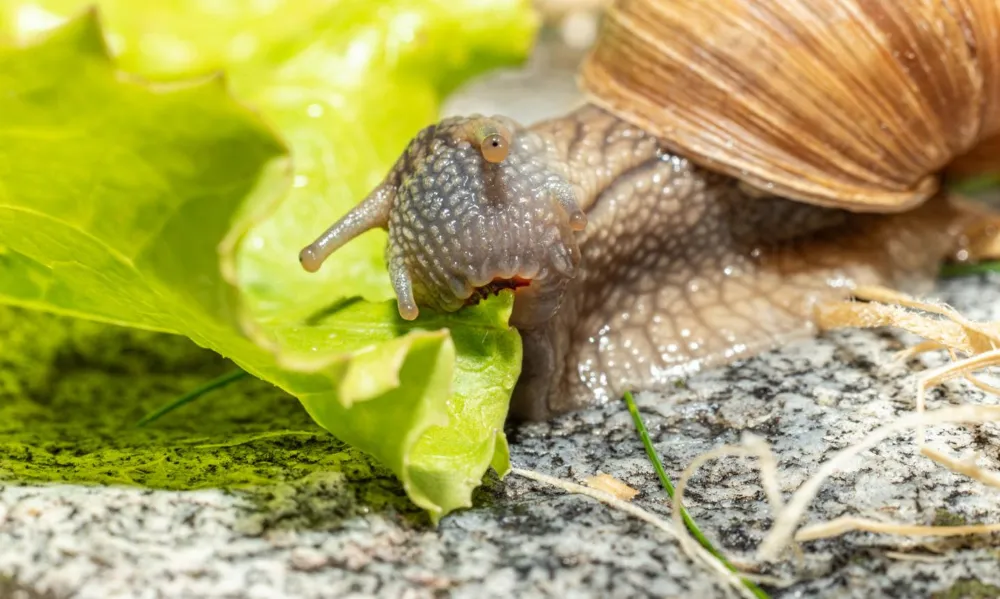
Yes, snails have teeth, but they are very different from human teeth. Most snails feed using a specialized ribbon-like structure called a radula, which is covered with rows of tiny tooth-like projections. These microscopic teeth help scrape, cut, or collect food. Some snails have thousands of radular teeth, and the number and shape vary greatly among species. Unlike human teeth, radular teeth are continually produced and moved forward to replace those worn down during feeding. Most garden snails use their radula to eat plant material, while some marine and land snails have evolved specialized teeth for hunting other animals.
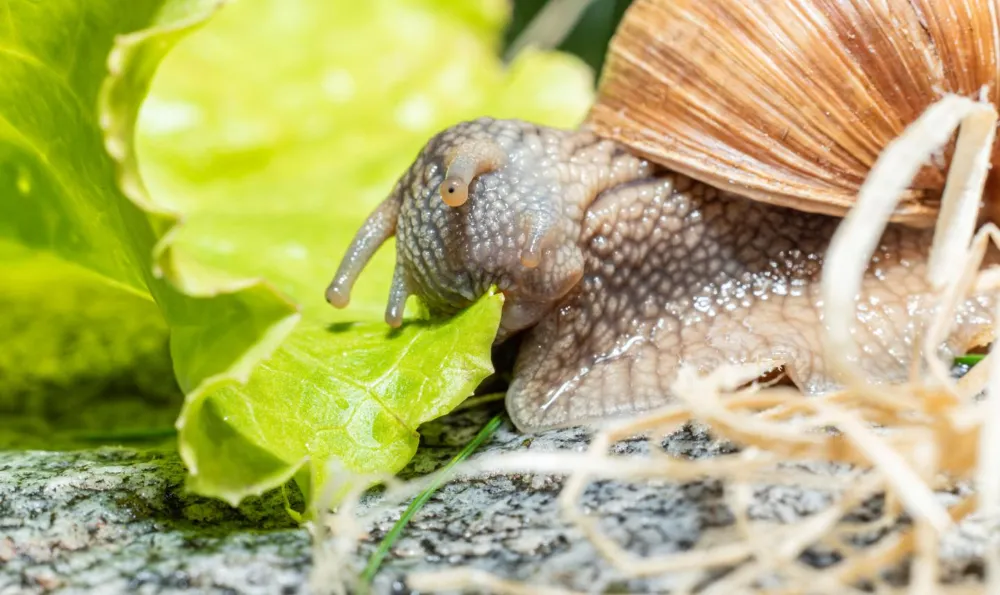
Garden snails use a microscopic tooth-covered feeding structure called a radula to scrape plant material.
Do Snails Have Teeth?
Yes. Most snails have numerous tiny teeth arranged on a feeding structure called the radula.
However, these teeth are not attached to upper and lower jawbones like human teeth.
Instead, they form rows along a flexible, ribbon-like membrane inside the snail's mouth.
As the snail feeds, this structure moves against food surfaces.
The tiny teeth help remove small amounts of material.
The food then enters the digestive system.
Researchers often describe the radula as functioning somewhat like a rasp or a very fine biological file.
This comparison is useful because the individual teeth are much smaller than the teeth of familiar vertebrates.
However, the details vary among snail species, especially between plant-eating and predatory forms.
What Are Snail Teeth Called?
The tooth-covered feeding organ of most snails is called the radula.
Individual projections on this organ are called radular teeth.
The word radula refers to the entire feeding ribbon, not to a single tooth.
This distinction is important because popular descriptions sometimes say a snail has a tongue made entirely of teeth.
In reality, the radula is a specialized molluscan structure with its own anatomy and movement system.
It is supported by muscular tissues and other components of the feeding apparatus.
Most radular teeth are based on chitin, a structural material also found in other invertebrate tissues.
However, their mechanical properties can vary according to additional materials and structural modifications.
What Is a Radula?
A radula is a flexible membrane bearing repeated rows of tiny teeth.
It is a characteristic feeding structure of many mollusks, including most gastropods.
Gastropods are the group containing snails and slugs.
Different species have radulae adapted to different diets.
Plant-eating snails may use them to scrape leaves or algae.
Predatory snails may use modified teeth to cut or grasp animal prey.
Some marine snails can even use specialized radular teeth to penetrate hard biological surfaces.
The Natural History Museum in London compares the structure to a conveyor belt of microscopic ridges.
However, it is not a mechanical conveyor belt in the engineering sense.
Its movement comes from the animal's specialized feeding muscles.
How Many Teeth Does a Snail Have?
There is no single tooth count that applies to every snail.
The number depends on the species, the dimensions of its radula, and the number of teeth in each row.
Some snails have several thousand teeth.
Others have more than ten thousand.
A classic Illinois Natural History Survey description of the land snail Polygyra albolabris recorded 120 tooth rows with 91 teeth per row.
That produces a total of 10,920 teeth.
However, this measurement describes a particular species and anatomical arrangement.
It is not the universal number of teeth in every garden, marine, or freshwater snail.
Scientific researchers usually count teeth by examining the radula with magnification.
Do Snails Really Have 14,000 Teeth?
The claim that snails have 14,000 teeth is a popular animal fact.
It is plausible for some species, but it should not be presented as an exact number for all snails.
Different species possess different numbers of rows and teeth.
A documented example from the Illinois Natural History Survey recorded 10,920 teeth in one land snail species.
Studies of other gastropods have described still different arrangements.
Furthermore, radular teeth are continually renewed.
The total can therefore depend on how the teeth are counted and which portions of the radula are included.
The scientifically accurate statement is that many snails have thousands of microscopic teeth, not that every snail has exactly 14,000.
Can a Snail Have More Teeth Than a Human?
Yes, if individual radular teeth are counted.
Adult humans typically have up to 32 permanent teeth, including wisdom teeth.
Some snail species possess thousands of microscopic radular teeth.
However, this is not a comparison between equivalent anatomical structures.
Human teeth are mineralized organs rooted in the jaws.
Snail radular teeth are much smaller structures attached to a flexible feeding membrane.
Having more tiny radular teeth does not imply that a snail has greater biting strength than a human.
Where Are a Snail's Teeth Located?
The teeth are located inside the mouth on the radula.
In a land snail, the mouth opens on the underside of the head.
The radula lies within the feeding apparatus and moves when the snail eats.
Because the teeth are so small, they are difficult to see without magnification.
A person observing a garden snail from above usually cannot see the radula.
However, close-up video of a snail feeding against transparent material may reveal the movement of its mouthparts.
Microscopy is generally required to see the individual tooth shapes clearly.
Do Snails Have Mouths?
Yes. Snails have mouths and digestive systems.
The mouth is usually located near the front of the body beneath the head.
For many species, the radula is a central part of the feeding apparatus.
Some land snails also possess a jaw-like structure that works together with the radula.
This allows the animal to remove food particles from a surface.
However, mouth anatomy varies substantially among gastropods.
Predatory marine snails may have specialized feeding structures quite different from those of an ordinary garden snail.
Do Snails Have Tongues?
Snails do not have a tongue identical to the muscular tongue of a human.
However, their radula is often described as a tongue-like organ because it moves inside the mouth and helps manipulate food.
Its surface is covered with microscopic teeth.
The comparison is helpful for introducing the anatomy, but it should not be taken literally.
A human tongue is not covered in rows of hard scraping teeth.
A snail radula has a very different structure and biological function.
How Do Snails Eat With Their Teeth?
A typical plant-eating land snail presses its mouth against a suitable food surface.
It then moves the radula in a repeated scraping motion.
The radular teeth contact the food and remove small particles.
These particles are moved into the mouth and digestive system.
A 2019 study of the garden snail Cornu aspersum used high-speed video to investigate this feeding motion.
The researchers found that the radula moved forward and downward before being drawn upward and backward.
This cycle allowed the teeth to contact and scrape the feeding surface.
The experiment demonstrated how the radula works mechanically rather than merely describing its appearance.
What Did Scientists Discover About Snail Feeding in 2019?
The 2019 study examined how the garden snail Cornu aspersum uses its radula.
Researchers combined high-speed filming with microscopy and force measurements.
They recorded the radula moving against different feeding surfaces.
They also examined the microscopic teeth and their arrangement.
In the sampled individuals, the radula contained approximately 140 to 150 rows of teeth.
Different tooth types were arranged across each row.
The researchers estimated how much of the radula contacted a surface during feeding.
They found that only part of the entire tooth-covered membrane formed the active contact region at a given moment.
This showed that a snail does not necessarily use every radular tooth simultaneously.
Do Snails Chew Their Food?
Snails can break food into small pieces, but their feeding process differs from mammalian chewing.
Humans use opposing teeth and jaw movement to bite and grind food.
Many snails instead use a scraping radula to remove material from a surface.
Some also use a jaw-like structure.
The resulting movement is often described as rasping rather than chewing.
However, the exact feeding mechanism varies among different snail species.
Predatory gastropods may use their radulae in ways that are very different from the gentle scraping of leaves.
Can You Hear a Snail Eating?
Snails do not normally produce loud feeding sounds.
However, close-up recordings of some snails rasping against surfaces may capture faint noises.
Whether the sound is audible depends on the species, food texture, surroundings, and recording equipment.
The existence of a rasping feeding mechanism does not mean every snail can be heard chewing from a distance.
Most garden-snail feeding is quiet under ordinary conditions.
What Do Garden Snails Eat?
Many garden snails feed on plant material, algae, fungi, and decaying organic matter.
The exact diet depends on the species and the resources available.
The common garden snail Cornu aspersum is known for eating various soft plant tissues.
It may scrape leaves and other suitable surfaces using its radula.
However, not all snails are plant eaters.
Some are predators that feed on other invertebrates.
The structure of the radula often reflects these different diets.
Can Snails Eat Lettuce?
Many garden snails can eat lettuce and other soft plant leaves.
They use the radula to scrape small particles from the surface.
This can leave irregular holes or damaged areas in the leaf.
However, a snail's ability to eat a plant does not mean the plant provides a complete balanced diet.
Different snail species have different nutritional requirements.
The example of lettuce is useful for understanding the scraping mechanism, not for recommending that every snail species eat only lettuce.
Do Snails Eat Algae With Their Teeth?
Yes. Many freshwater and marine snails scrape algae from rocks, plants, and other surfaces.
The radula can remove thin layers of algae or microorganisms.
This feeding behavior is often called grazing.
Different species have radular teeth suited to the texture of their food and the surfaces where it grows.
However, not every snail that lives in water is primarily an algae eater.
Some aquatic species feed on decaying matter or animal prey.
Do All Snails Have the Same Teeth?
No. Radular teeth vary greatly among snail species.
Some have broad scraping structures suited to grazing.
Others possess sharper teeth suited to cutting or gripping food.
Predatory marine gastropods may have highly specialized radulae.
A 2021 study in Scientific Reports compared radular structures across several land gastropods.
The researchers found meaningful differences in tooth arrangement and feeding mechanics.
These variations are important because tooth morphology is connected to feeding ecology and evolutionary history.
Do Snails Have Different Types of Radular Teeth?
Yes. A radula may contain several tooth categories.
In many species, these include central, lateral, and marginal teeth.
Central teeth occur near the middle of a transverse row.
Lateral teeth occur farther from the center.
Marginal teeth may occupy the outer portions of the row.
However, not every radula possesses all three types in the same arrangement.
Some groups have reduced or highly specialized structures.
Researchers use these anatomical differences to compare and classify gastropods.
Central, Lateral and Marginal Snail Teeth
| Tooth Type | Typical Position | Important Detail |
|---|---|---|
| Central or rachidian | Middle of a row | May be present or absent depending on the species |
| Lateral | Either side of the central region | Shape and number vary among species |
| Marginal | Outer portions of a row | Can be numerous and specialized for particular feeding tasks |
These names describe general anatomical positions, not identical tooth shapes across all mollusks.
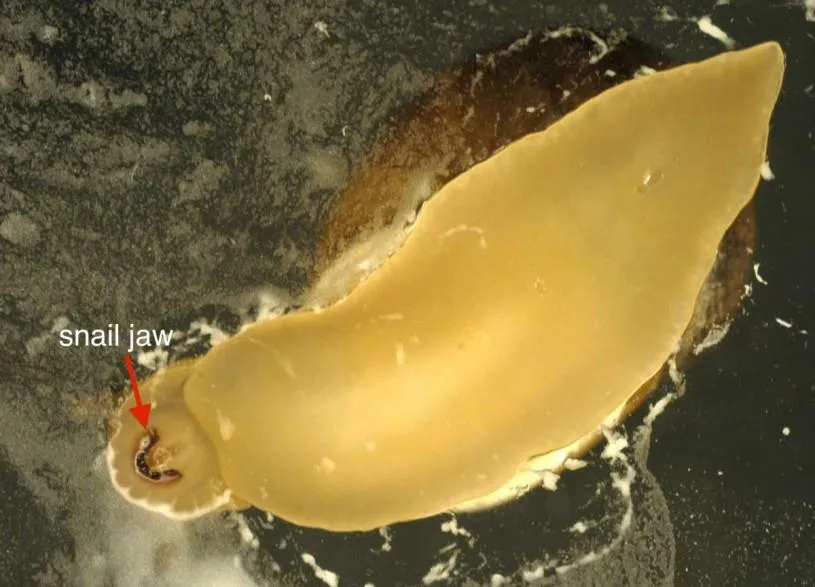
The radula moves inside the snail's mouth as it scrapes food from a surface; its individual teeth are too small to see clearly without magnification.
Do Snail Teeth Grow Back?
Yes. Radular teeth are continually renewed in many gastropods.
As the teeth are used, they gradually wear down.
New teeth are produced in a specialized region of the radular sac.
The developing teeth move forward toward the part of the radula involved in feeding.
Older worn teeth eventually leave the functional region.
A 2022 review of radula development described this process as a major feature of gastropod feeding anatomy.
However, renewal rates and tooth development differ among lineages.
How Often Do Snails Replace Their Teeth?
Snail radular teeth are replaced through a continuing developmental process.
However, there is no single replacement interval that applies to every snail.
The rate may vary with species, growth, feeding activity, and environmental conditions.
Researchers can study the formation and movement of teeth along the radular membrane.
However, it is misleading to claim that every snail replaces its entire set of teeth on one fixed schedule.
The system is better understood as gradual renewal from the developing region toward the working surface.
Why Do Snails Need to Replace Their Teeth?
Repeated scraping creates mechanical wear.
A snail feeding on leaves, algae, or hard surfaces may use its radular teeth many times.
These structures can become worn or damaged.
Continual replacement helps maintain an effective feeding apparatus.
This is especially important for species that frequently scrape abrasive surfaces.
However, the amount of wear depends on the material being eaten and the structure of the teeth.
Are Snail Teeth Hard?
Snail radular teeth can be mechanically strong, despite their small size.
Most contain chitin-based structural material.
Some species incorporate additional materials that change the hardness and stiffness of particular regions.
A 2023 study of the marine gastropod Gastropteron rubrum investigated variations in radular tooth mechanical properties.
Researchers measured differences between tooth regions and examined their chemical composition.
They found that the distribution of hardness and stiffness was complex.
However, these findings should not be generalized to every snail without considering species differences.
Are Snail Teeth Made of Chitin?
Yes. Chitin is a major structural component of gastropod radular membranes and teeth.
Chitin is a biological polymer widely found among invertebrates.
However, the teeth may contain additional proteins and, in some groups, mineral-associated components.
The combination influences mechanical performance.
It is therefore more accurate to describe radular teeth as chitin-based structures than to assume every snail tooth is chemically identical.
Can Snails Bite Humans?
Most familiar garden snails are not dangerous to people through biting.
Their tiny radular teeth are adapted for scraping relatively soft food materials.
A person may feel mild rasping if a garden snail feeds against the skin, but this should not be treated as a typical serious bite.
However, different snails have very different feeding systems.
Some predatory marine snails, especially cone snails, have specialized venom-delivery structures that can be dangerous.
Therefore, statements about harmless garden snails should not be extended to all marine gastropods.
Does a Snail Bite Hurt?
A typical small garden snail is unlikely to cause a painful injury simply by scraping the skin.
However, contact with wild snails should not be encouraged as a demonstration.
Wild animals and their mucus or surrounding soil can carry microorganisms or parasites.
People should wash their hands after handling snails or working in areas where they occur.
Additionally, predatory marine snails can have very different defensive and feeding mechanisms.
It is best not to touch unidentified marine gastropods.
Do Snails Have Jaws?
Some land snails possess jaw-like structures that work with the radula.
These structures can help hold food while the radular teeth scrape against it.
However, their jaws are not identical to the bony jaws of mammals.
The 2019 garden snail study examined both the radula and associated feeding anatomy.
Researchers found coordinated movement within the feeding apparatus.
The precise structure differs among snail species.
Do Snails Eat Other Snails?
Yes. Some snail species are predators of other snails.
The Natural History Museum in London describes predatory snails that consume other gastropods.
Some use specialized radular teeth to cut or scrape animal tissues.
Other marine predators may penetrate prey shells.
However, most ordinary garden snails are not specialized snail-hunting predators.
Gastropod diets range from grazing and scavenging to active predation.
How Do Predatory Snails Use Their Teeth?
Predatory snails often possess radular teeth specialized for obtaining animal food.
Some use sharp teeth to grasp or cut prey.
Other species combine the radula with specialized secretions or feeding structures.
The Bailey-Matthews National Shell Museum describes how different marine gastropods use the radula to obtain prey.
However, a predatory radula may differ greatly from the broad scraping structure of a garden snail.
These differences reflect distinct ecological roles.
Can Marine Snails Drill Through Shells?
Some marine snails can create holes in the shells of other mollusks.
They may combine mechanical abrasion with chemical secretions that help weaken shell material.
Moon snails are a well-known example.
The University of Puget Sound describes their feeding process, in which a specialized structure and associated secretions help them penetrate clam shells.
However, the precise process is not identical among all shell-drilling gastropods.
The ability to bore through shells represents an adaptation to predatory feeding.
Do Cone Snails Have Teeth?
Yes. Cone snails possess highly specialized radular teeth.
In some species, a tooth acts like a small hollow harpoon.
The animal can use this structure to deliver venom into prey.
The Bailey-Matthews National Shell Museum describes cone snail teeth as a striking example of radular specialization.
However, this mechanism is very different from the rasping teeth of an ordinary garden snail.
Cone snails should never be picked up or handled in the wild because some species can deliver dangerous venom.
Do Cone Snails Shoot Their Teeth?
Some cone snails can project a specialized radular tooth into prey using a modified feeding apparatus.
However, the process is not the same as a garden snail scraping a leaf.
The tooth functions as part of a venom-delivery system.
Species differ in prey preferences and feeding mechanics.
This illustrates the remarkable evolutionary diversity of gastropod teeth.
The ordinary statement that snails have a sandpaper-like tongue is useful for many species but cannot explain every specialized marine predator.
Do Slugs Have Teeth?
Yes. Slugs are gastropod mollusks, and many have a radula with numerous tiny teeth.
They use the structure to scrape or collect food.
Slugs are closely related to snails, although their external shells are reduced or absent.
Some slug species eat plant material.
Others may eat fungi, decaying matter, or animal prey.
The 2021 study in Scientific Reports included land slugs in its comparison of radular tooth arrangement and feeding mechanics.
Snail Teeth vs. Slug Teeth
| Feature | Many Snails | Many Slugs |
|---|---|---|
| Animal class | Gastropoda | Gastropoda |
| Feeding structure | Radula | Radula |
| Tooth structure | Rows of microscopic projections | Rows of microscopic projections |
| Tooth renewal | Continual in studied forms | Continual in studied forms |
| External shell | Often present | Reduced or absent |
| Food preferences | Highly variable | Highly variable |
Do Sea Snails Have Teeth?
Yes. Many marine snails possess a radula.
However, their radulae vary enormously in structure.
Herbivorous marine snails may graze on algae.
Predatory species may feed on worms, bivalves, or other snails.
Some have specialized teeth for drilling or venom delivery.
The Smithsonian National Museum of Natural History describes the radula as an important anatomical feature of cowries and other gastropods.
Researchers use microscopic tooth patterns to help identify and classify some species.
Do Freshwater Snails Have Teeth?
Many freshwater snails possess radular teeth.
Some use them to scrape algae and microorganisms from aquatic surfaces.
Others may feed on different materials.
The exact shape and number of teeth depend on the species.
Because freshwater snails occupy a wide range of habitats, their feeding anatomy also varies.
They should not all be described as having exactly the same diet or tooth count.
Do Giant African Land Snails Have Teeth?
Yes. The giant African land snail, commonly identified as Lissachatina fulica, possesses a radula.
A 2021 study of several land gastropods reported approximately 84 teeth per transverse row in the examined Lissachatina fulica specimens.
However, this number refers to teeth within one row, not the entire radula.
The total tooth count depends on the number of rows and the anatomical state of the specimen.
It is therefore important to distinguish the number of teeth per row from the total number of teeth.
Can You See Snail Teeth Without a Microscope?
Usually not.
The individual teeth are extremely small.
Even when the radula is visible during feeding, its fine tooth structure generally requires magnification.
Researchers often use light microscopy, scanning electron microscopy, or other imaging methods.
The Smithsonian studies radular structures through microscopy because their shape is useful for understanding mollusk anatomy and classification.
Images taken under a microscope can make the teeth appear dramatically larger than they are in reality.
How Do Scientists Count Snail Teeth?
Researchers may remove or expose the radula and examine it under magnification.
They count rows and identify different types of teeth.
Microscopy can reveal central, lateral, and marginal tooth arrangements.
In some studies, researchers also analyze the wear or mechanical properties of individual teeth.
However, counting may be complicated by developing teeth, worn regions, and unusual tooth shapes.
This is one reason that popular tooth counts can differ among sources.
Can Snail Teeth Help Identify Species?
Yes. Radular tooth patterns can provide useful taxonomic information.
Scientists may compare the number of teeth, their shapes, and their arrangement in rows.
Some related species display distinctive patterns.
The Smithsonian National Museum of Natural History describes radular anatomy as one of the features examined when identifying cowries.
However, radular morphology is usually considered alongside shells, soft anatomy, genetics, and other evidence.
A single tooth shape does not necessarily identify every snail species with certainty.
How Are Snail Teeth Different From Human Teeth?
Human teeth and snail radular teeth serve functions related to obtaining food, but they differ anatomically.
Human teeth are mineralized structures within the jaws.
Snail radular teeth are microscopic projections attached to a flexible feeding membrane.
Human permanent teeth do not continually regenerate after being lost.
Radular teeth are produced continually in many snails.
Their movement and replacement create a feeding system adapted to repeated scraping.
Therefore, comparing the number of human teeth with the number of snail teeth is interesting but does not imply that the structures are directly equivalent.
Snail Teeth vs. Human Teeth
| Feature | Snail Radular Teeth | Human Teeth |
|---|---|---|
| Typical number | Hundreds to thousands or more, depending on species | Up to 32 permanent teeth |
| Location | Radular membrane inside feeding apparatus | Upper and lower jaws |
| Major material | Chitin-based with additional structural components | Enamel, dentin and other dental tissues |
| Typical feeding action | Scraping, rasping, cutting or other specialized actions | Biting, cutting and grinding |
| Replacement | Continuous in many gastropods | Limited human tooth replacement |
Are Snail Teeth Stronger Than Steel?
This claim requires careful qualification.
Some mollusks have extraordinarily strong radular teeth.
Limpets, which are marine gastropod mollusks, are especially famous for the mechanical strength of their radular teeth.
However, a property measured in limpet teeth should not automatically be assigned to ordinary garden snails.
Mechanical strength also has several meanings, including tensile strength, hardness, and stiffness.
Comparing biological structures with steel requires specifying which property was measured and under what conditions.
Therefore, the blanket claim that all snail teeth are stronger than steel is misleading.
Are Limpets Snails?
Limpets are gastropod mollusks.
Many have low, cone-shaped shells and attach firmly to rocky surfaces.
They use radular teeth to graze on algae.
However, limpets are not identical to ordinary land snails.
Different gastropod lineages have evolved distinct shells, radulae, and feeding strategies.
Studies of limpet teeth provide important insights into biological materials but do not describe all gastropods equally.
Why Is the Snail Radula Important to Evolution?
The radula illustrates how a broadly shared anatomical structure can evolve for different ecological tasks.
Some gastropods use broad scraping teeth to graze.
Others use sharper structures to obtain animal prey.
Cone snails have evolved a highly specialized venom-delivery system from radular teeth.
These differences reflect long evolutionary histories and distinct feeding environments.
Researchers can compare tooth morphology and developmental patterns to investigate how feeding systems have changed over time.
However, dietary specialization involves multiple anatomical and behavioral traits, not radular teeth alone.
What Can Snail Teeth Teach Engineers?
Radular teeth demonstrate how tiny biological structures can withstand repeated mechanical contact.
Researchers study tooth shape, material gradients, surface wear, and forces generated during feeding.
The 2023 investigation of Gastropteron rubrum revealed different mechanical properties within individual teeth.
Such findings contribute to understanding biological materials.
They may also inspire future engineering designs.
However, studying a natural structure does not mean that a ready-made technological application already exists.
The main scientific value lies in understanding how structure and function interact at small scales.
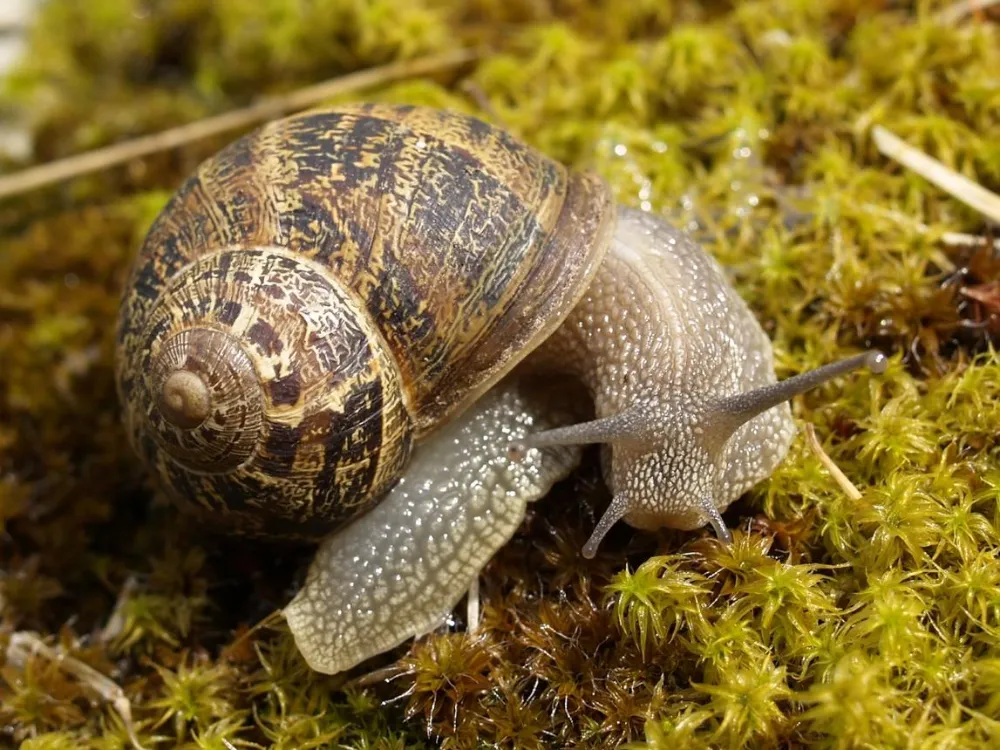
Snails use their radulae to obtain food in habitats ranging from gardens to freshwater streams and the ocean.
Frequently Asked Questions
Do snails have teeth?
Yes. Most snails possess tiny teeth arranged on a ribbon-like feeding structure called the radula.
How many teeth does a snail have?
The number varies by species. Some have thousands or more, with different numbers of teeth in each row.
Do all snails have 14,000 teeth?
No. The figure is a popular generalization. Tooth counts differ among species and anatomical arrangements.
What is a snail radula?
A radula is a flexible feeding membrane covered with rows of microscopic teeth used to scrape or otherwise process food.
Where are snail teeth located?
They are inside the mouth on the radula, not attached to human-like jawbones.
Do snails have tongues?
The radula is often described as tongue-like, but it is structurally different from a human tongue.
Do snails chew their food?
Many snails rasp or scrape food with the radula rather than chewing with opposing teeth like mammals.
Can snails bite humans?
Ordinary garden snails are generally not dangerous through biting, but some predatory marine snails have specialized feeding structures and can be dangerous.
Do snail teeth grow back?
Yes. In many gastropods, new radular teeth are formed continuously to replace worn teeth.
Are snail teeth made of chitin?
Yes. Chitin is a major structural component, although additional materials can influence their mechanical properties.
Do slugs have teeth?
Yes. Many slugs possess radulae with microscopic teeth.
Do sea snails have teeth?
Many marine snails have radular teeth, including specialized forms used for grazing, predation or venom delivery.
Do snails eat other snails?
Some predatory species do. Their feeding structures are adapted for consuming animal prey.
Are snail teeth stronger than steel?
Some molluscan radular teeth have remarkable material properties, but claims about strength depend on the species and the property being compared.
Can you see snail teeth?
Individual radular teeth are usually too small to see clearly without magnification.
The Bottom Line
Snails really do have teeth, but they are not like human teeth.
Most snails possess a radula, a flexible feeding structure bearing numerous rows of microscopic teeth.
These teeth help scrape algae, remove plant material, and perform other feeding tasks.
Some predatory snails have highly specialized radular teeth, including structures used to capture prey.
The total number of teeth varies greatly among species, so popular claims that every snail has exactly 14,000 teeth are inaccurate.
Radular teeth are also continually replaced as they wear down.
This remarkable feeding system shows how evolution has adapted one basic anatomical structure for an enormous variety of diets and environments.
Sources & Further Reading
Natural History Museum of Los Angeles County (2026) — A Microscopic Look at Snail Jaws. Explains radular teeth, snail jaws and feeding diversity.
Natural History Museum, London — For the Love of Snails and Slugs. Introduces radular feeding and the ecological diversity of snails and slugs.
Smithsonian National Museum of Natural History — Cowries. Describes radular anatomy and its usefulness in feeding and classification.
Krings et al. (2019) — In Slow Motion: Radula Motion Pattern and Forces Exerted to the Substrate in the Land Snail Cornu aspersum During Feeding. Original microscopy, high-speed video and biomechanics research.
Radular Force Performance of Stylommatophoran Gastropods With Distinct Body Masses (2021). Scientific Reports. Comparison of teeth and feeding mechanics among terrestrial gastropods.
Main Patterns of Radula Formation and Ontogeny in Gastropoda (2022). Scientific review explaining continuous radular tooth formation and renewal.
Elemental Composition and Material Properties of Radular Teeth in Gastropteron rubrum (2023). Study of tooth hardness, stiffness, structure and wear-related adaptation.
Bailey-Matthews National Shell Museum — A Radical Radula. Describes specialized radulae, including predatory snails and cone snails.
Howard Hughes Medical Institute — Snail Teeth. Microscopy images and explanation of radular tooth structure and replacement.
Illinois Natural History Survey — Fieldbook of Illinois Land Snails. Historical anatomical description including a documented count of 10,920 teeth in one land snail species.