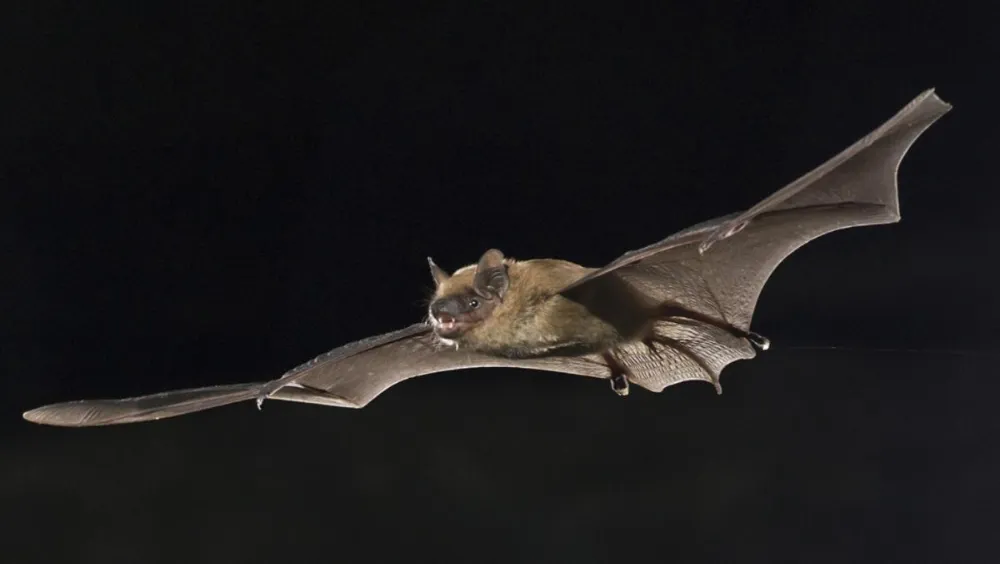
Yes, many bats have tails, but not all bats do. In numerous species, the tail is partly or almost completely enclosed within a thin membrane stretching between the hind legs. This structure is called the uropatagium, or tail membrane. It can contribute to flight control and, in some insect-eating bats, help capture prey. Other bats have tails that extend beyond the membrane, while some fruit bats have very short tails or lack them entirely. A bat's tail shape therefore depends on its species and evolutionary adaptations.
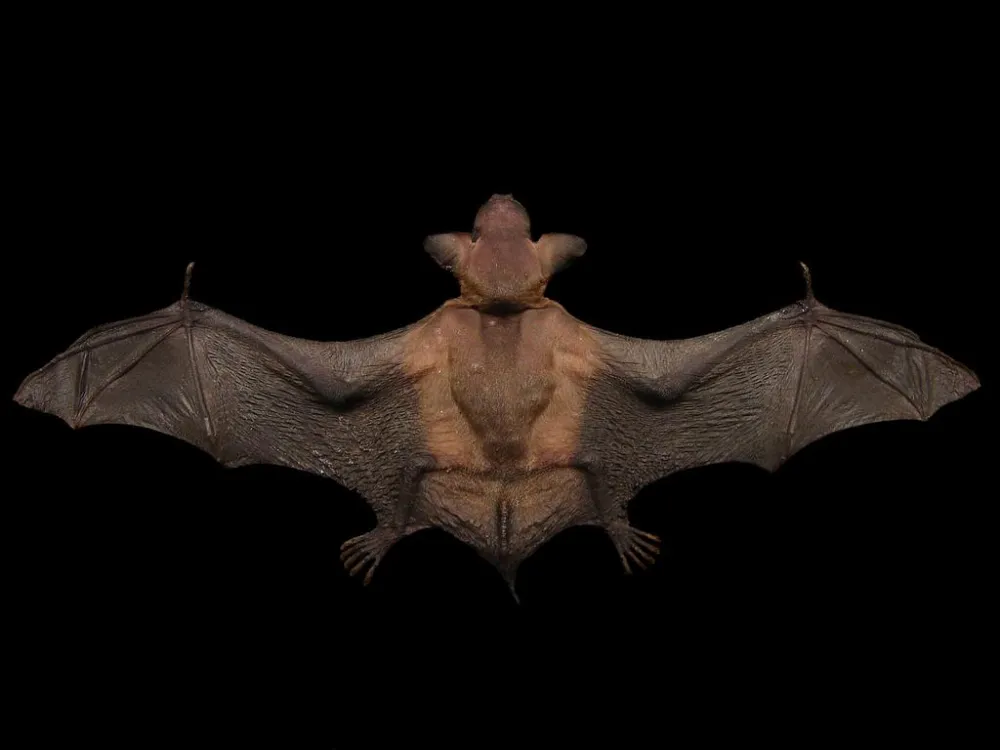
Many bats have tails supported by a membrane of skin between the hind legs.
Where Is a Bat's Tail?
A bat's tail extends from the rear of its body, just as the tails of many other mammals do.
However, it may be difficult to recognize because it is often surrounded by a thin membrane of skin.
In many insect-eating bats, this membrane stretches between the hind legs and encloses much of the tail.
When the bat spreads its legs during flight, the membrane can form a broad surface behind the body.
This creates an appearance very different from the long, freely hanging tails of animals such as rats, cats, or monkeys.
The tail itself contains vertebrae and associated muscles and connective tissues.
Its size, shape, and relationship with the surrounding membrane vary considerably between species.
What Is a Bat's Tail Membrane?
The membrane extending between a bat's hind legs is called the uropatagium, sometimes referred to as the interfemoral membrane.
It is part of the bat's specialized flight-related skin system.
In species with well-developed tail membranes, the uropatagium may connect the hind legs and incorporate much of the tail.
Like bat wing membranes, it contains living tissues, including blood vessels, nerves, connective tissue, and specialized skin structures.
Its functions can include:
Flight control: Contributing to changes in aerodynamic forces and body orientation.
Prey capture: Helping some insect-eating bats catch or retain prey.
Flight stability: Supporting maneuvering in certain situations.
Reproduction: Providing a temporary supporting surface during birth in some species.
Not every species uses its tail membrane for all these purposes.
Its size and functions reflect differences in feeding behavior, flight style, and evolutionary history.
Do All Bats Have Tails?
No. Tail anatomy varies substantially among bats.
Many insect-eating species have clearly developed tails that are partly enclosed by the uropatagium.
Free-tailed bats possess tails that project beyond the rear edge of the membrane.
Some fruit bats have only a short tail, while other species lack an external tail entirely.
According to anatomical information from the University of Texas, many members of the fruit bat family Pteropodidae lack tails, although some possess short ones.
Therefore, the statement that all bats have long tails is incorrect.
It is more accurate to say that tails are widespread among bats but vary greatly in length and visibility.
Why Do Some Bats Have Hidden Tails?
In many bat species, the tail is incorporated into the membrane stretching between the hind legs.
When the bat is flying with its wings and legs spread, the membrane becomes part of its overall aerodynamic shape.
This can make the tail difficult to distinguish from the surrounding skin.
When the bat folds its wings or hangs upside down, the membrane may also fold around the lower body.
The tail has not disappeared; it is simply associated with a specialized sheet of skin.
Such arrangements are common in many familiar temperate insect-eating bats.
What Are Free-Tailed Bats?
Free-tailed bats are species in which a substantial portion of the tail extends beyond the edge of the uropatagium.
Many belong to the family Molossidae.
One well-known example is the Mexican free-tailed bat (Tadarida brasiliensis), also called the Brazilian free-tailed bat.
Its tail projects beyond the tail membrane, making the feature relatively easy to recognize.
Bat Conservation International identifies this exposed tail as one of the species' distinguishing characteristics.
Mexican free-tailed bats are fast-flying insectivores that frequently forage in open air.
They have long, narrow wings suited to sustained, rapid flight.
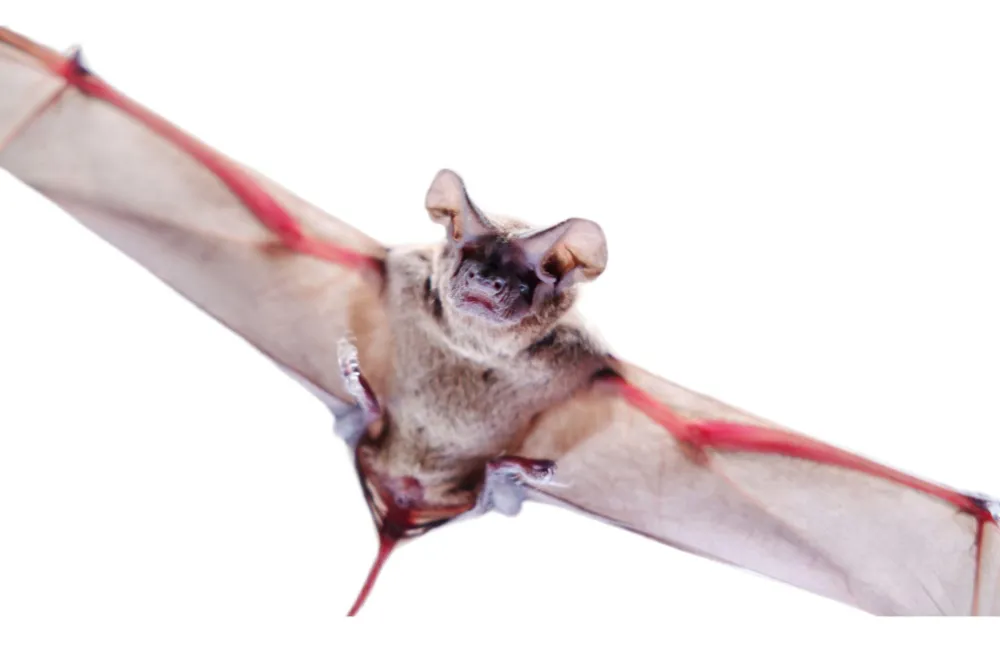
The Mexican free-tailed bat has an exposed tail that extends beyond the rear edge of its tail membrane.
Do Fruit Bats Have Tails?
Some fruit bats have short tails, while others lack tails entirely.
Many members of the family Pteropodidae, which includes flying foxes and several smaller fruit bats, have reduced tail structures.
For example, the lesser short-nosed fruit bat (Cynopterus brachyotis) has a short tail.
In contrast, various flying fox species lack an obvious external tail.
Fruit bats also tend to have less extensive interfemoral membranes than many aerial insect-eating bats.
This difference is associated with their distinct anatomy and ecology.
However, fruit bats are not a single uniform body type, so individual species must be considered separately.
Do Flying Foxes Have Tails?
Many flying foxes do not have an external tail.
Flying foxes belong to the genus Pteropus, a group of relatively large fruit bats.
They possess broad wings, large eyes, and bodies adapted primarily for feeding on fruits, flowers, and other plant resources.
Unlike many insect-eating bats, they do not typically depend on a large tail membrane for capturing flying insects.
Nevertheless, the absence of a long tail should not be used as the only feature for identifying a flying fox.
Body size, head shape, wing structure, geographic location, and other anatomical characteristics are also important.
How Do Bat Tails Help Them Fly?
The tail and uropatagium contribute to the aerodynamic system of many bats.
By changing the position or tension of the membrane, a bat can modify the forces acting on its body during flight.
These changes may contribute to stability, turning, braking, or other maneuvers.
However, the bat's wings remain the primary structures responsible for generating lift and propulsion.
Bat wings are supported by elongated finger bones and powered by specialized flight muscles.
The tail membrane works alongside these structures rather than replacing them.
The importance of the tail membrane varies with its size and the flight behavior of the species.
Do Bats Use Their Tails to Catch Insects?
Some insect-eating bats use their tail membranes to help capture food while flying.
As an insect approaches, the bat may maneuver its wings or hind legs to bring the prey into contact with the membrane.
The membrane can help form a temporary pouch or catching surface.
The bat may then transfer the prey toward its mouth.
The Smithsonian Institution describes this behavior in its educational materials about bat flight and feeding.
However, many insects are also captured directly with the mouth.
Not every bat has a large enough tail membrane or the same hunting technique.
Can Bats Use Their Tails Like Nets?
In certain species, the uropatagium functions somewhat like a flexible net or pouch.
This comparison is especially useful when describing bats that catch insects in flight.
The membrane can temporarily hold an insect while the bat repositions its body or transfers the prey to its mouth.
But the membrane is not a rigid net, and it does not function identically in all bats.
It is a living structure whose shape changes through the movement of the hind legs, tail, and associated muscles.
Bat species that forage for fish or other unusual prey may have additional adaptations associated with their legs and flight membranes.
These behaviors demonstrate that bat feeding structures can be more varied than their wings alone suggest.
Do Bat Tails Have Bones?
Yes. When bats possess tails, those tails contain vertebrae.
These are known as caudal vertebrae.
The vertebrae provide skeletal support and connect with muscles and other tissues.
The number and arrangement of tail vertebrae vary among species.
In bats with exposed tails, the vertebral structure may extend beyond the tail membrane.
In species with more enclosed tails, the bones are largely surrounded by the uropatagium.
This is one way bat tails differ from the boneless arms of octopuses or the cartilaginous skeletons of sharks.
Can Bats Move Their Tails?
Yes. Many bats can move their tails through muscular control.
Tail movements can influence the shape and position of the surrounding membrane.
These changes may contribute to flight maneuvers and prey capture.
However, the degree of independent tail movement differs between species.
Some bats possess longer or more flexible tails, while others have reduced tail structures.
It would therefore be misleading to assume that every bat can move its tail in the same way.
Do Bats Use Their Tails When Hanging Upside Down?
Bats primarily hang upside down using their hind feet and specialized claws.
Their toes can grip suitable surfaces while the animals rest.
Some species may adjust the tail membrane or body position while hanging, but the tail is not generally the main attachment structure.
In many bats, the folded wings and tail membrane lie close to the body during rest.
The exact resting posture varies among species.
Do Bats Use Their Tail Membranes During Birth?
In some bat species, females use the membrane between their hind legs to help support newborn pups during birth.
Because many bats give birth while hanging from a roost, maintaining control of the newborn is important.
The tail membrane can form a pouch-like surface that helps catch or support the young bat.
The Smithsonian describes this behavior in its educational material about bats.
However, birth positions and maternal behavior differ among species.
Not all bats use their tail membranes in exactly the same manner.
Bat Tail Types: Species Comparison
| Bat | Tail Type | Notable Feature |
|---|---|---|
| Big brown bat | Tail largely within membrane | Well-developed uropatagium |
| Little brown bat | Tail largely within membrane | Membrane contributes to flight and feeding |
| Mexican free-tailed bat | Partly exposed tail | Tail extends beyond uropatagium |
| Lesser short-nosed fruit bat | Short tail | Reduced tail membrane |
| Many flying foxes | No external tail | Reduced or absent tail structures |
These examples illustrate the diversity of tail structures among different bat families.
How Can You Tell Whether a Bat Has a Tail?
A bat's tail may be easier to identify in a clear photograph showing the animal's lower body and hind legs.
Look for the membrane stretching between the legs.
In species with enclosed tails, the tail may appear as a narrow central support within that membrane.
In free-tailed bats, the tail extends beyond the membrane's rear edge.
In some fruit bats, the tail may be very short or absent.
Because tail structure is an important anatomical character, researchers and wildlife specialists sometimes use it when identifying bat species.
However, tail shape alone is not always sufficient for reliable identification.
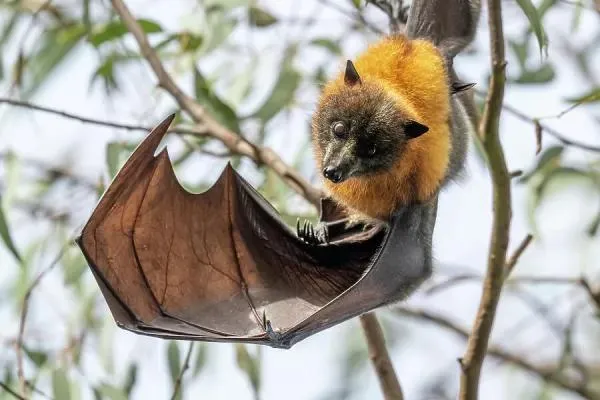
Many flying foxes have no obvious external tail, unlike numerous insect-eating bats.
Do Baby Bats Have Tails?
Baby bats develop the basic tail anatomy characteristic of their species.
Young bats belonging to species with tails possess the skeletal and soft-tissue structures that form those tails.
As they grow, the tail and surrounding membrane develop along with the rest of the body.
Species that naturally lack an external tail do not develop a long exposed one simply because they are young.
Tail appearance therefore depends more on species anatomy than on age alone.
Are Bat Tails Similar to Mouse Tails?
Both bat tails and mouse tails, when present, contain vertebrae and other mammalian tissues.
However, their external structures and functions differ considerably.
A mouse typically has a long, exposed tail that contributes to balance and other functions.
Many bats have tails partly enclosed within the membrane between their hind legs.
This membrane can contribute to aerial maneuvering and prey capture.
The differences reflect adaptations to distinct forms of movement and behavior.
Frequently Asked Questions
Do bats have long tails?
Some bats have relatively long tails, but many have shorter tails or tails enclosed within a membrane. Certain fruit bats lack external tails.
Do all bats have tails?
No. Tail structures vary among bat species. Some have obvious tails, others have concealed or reduced tails, and some have none externally.
What is the membrane between a bat's legs called?
It is called the uropatagium, or interfemoral membrane. It may incorporate the tail and contribute to flight or prey capture.
Do fruit bats have tails?
Some fruit bats have short tails, while many flying foxes and certain other fruit bats lack obvious external tails.
What is a free-tailed bat?
A free-tailed bat has a tail that extends beyond the rear edge of the membrane between its hind legs.
Do bats use their tails to steer?
The tail and surrounding membrane can contribute to flight control in some species, although the wings provide most of the lift and propulsion.
Can bats catch insects with their tails?
Some insect-eating bats use their tail membranes to help capture or hold prey, but the behavior varies by species.
Do bat tails contain bones?
Yes. Bat tails, when present, contain caudal vertebrae, together with muscles, skin, and connective tissues.
Do vampire bats have tails?
Vampire bats generally have reduced or absent external tails and a reduced interfemoral membrane compared with many aerial insect-eating bats.
Why is a bat's tail hard to see?
In many bats, the tail is partly or completely enclosed within the membrane between the hind legs, making it less obvious than an exposed mammalian tail.
The Bottom Line
Many bats have tails, but their tail anatomy varies greatly among species.
In numerous insect-eating bats, the tail is enclosed within a specialized membrane called the uropatagium. This structure can assist with flight control, prey capture, and certain other behaviors.
Free-tailed bats have tails that extend beyond the membrane, while some fruit bats have very short tails or none at all.
The diversity of bat tails demonstrates how closely anatomy is connected to flight, feeding, and evolutionary adaptation.
Sources & Further Reading
The following museum, university, wildlife agency, and bat conservation resources explain tail anatomy, the uropatagium, and variation among bat species.
Smithsonian Institution — Bat Facts. Explains wing and tail membranes, flight anatomy, feeding, and the use of the interfemoral membrane during reproduction.
Bat Conservation International — Mexican Free-tailed Bat. Describes the exposed tail of Tadarida brasiliensis.
University of Texas — Lesser Short-nosed Fruit Bat Anatomy. Explains variation in fruit bat tails and the relationship between the tail and uropatagium.
American Museum of Natural History — Bat Conservation Case Studies. Describes anatomical diversity, including differences in tail membranes and tail morphology.
Florida Fish and Wildlife Conservation Commission — Brazilian Free-tailed Bat. Provides species-specific tail and body characteristics.