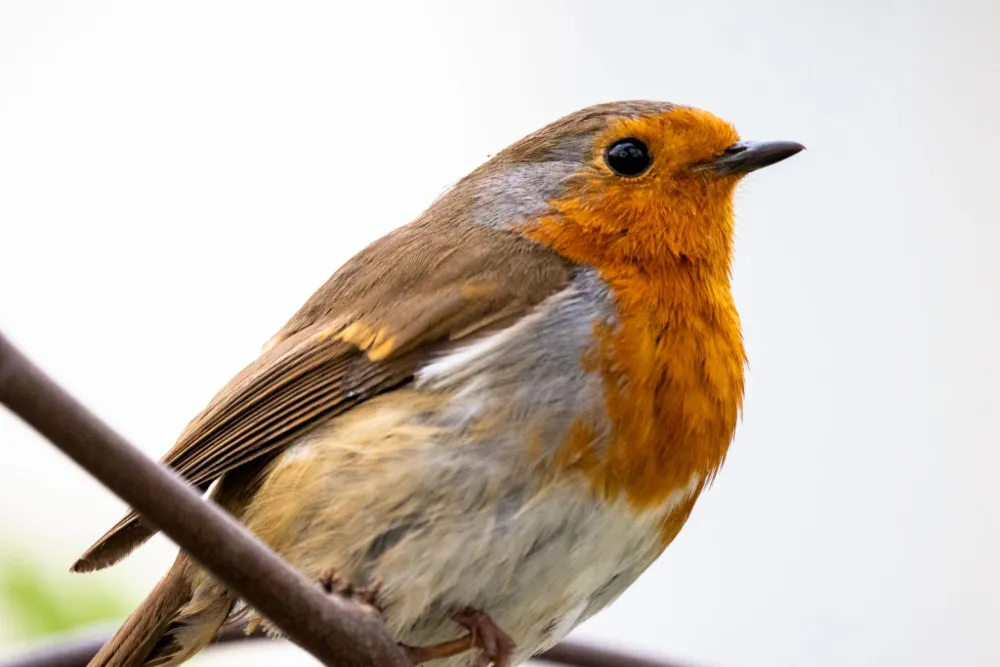
Yes, birds have ears, but their ears are usually hidden beneath feathers. Unlike humans and most other mammals, birds do not have visible external ear flaps. Instead, they have small ear openings on the sides of their heads, usually just behind and slightly below their eyes. Specialized feathers cover these openings while allowing sound to reach the hearing organs inside. Birds can hear surprisingly well without visible ears, and some species, especially owls, have extraordinary abilities to locate sounds.
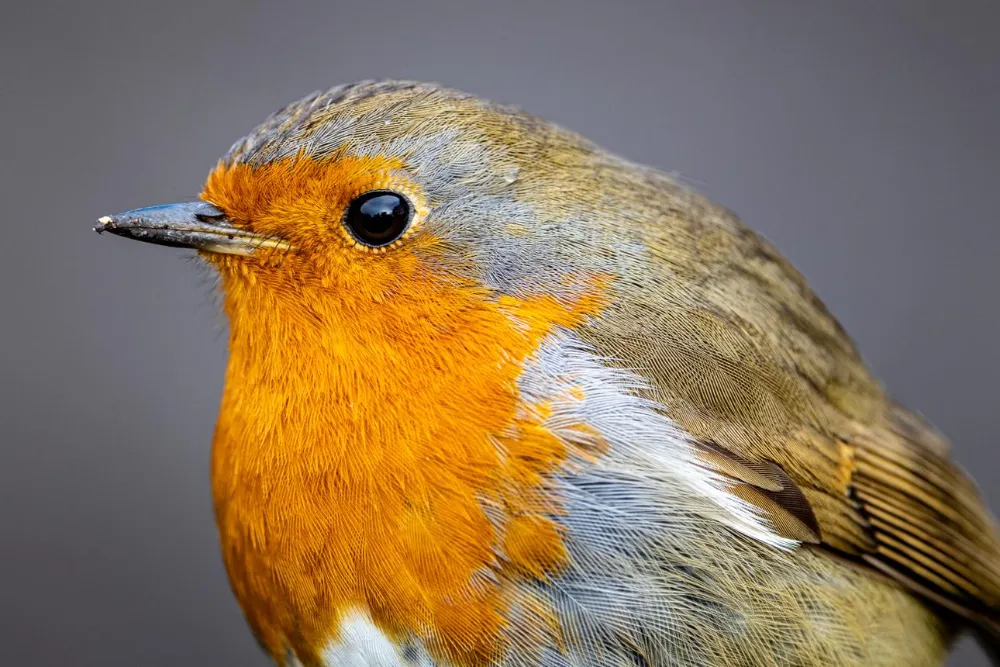
A European robin has ears hidden beneath feathers on either side of its head.
Where Are Birds' Ears Located?
Most birds have two ear openings, one on each side of the head.
These openings are usually positioned slightly behind and below the eyes.
Unlike the external ears of humans, which have visible flaps called pinnae, bird ear openings are generally covered by small feathers.
The openings lead into short auditory canals that transmit sound toward the eardrums.
Because feathers conceal the openings, it can be difficult to identify a bird's ears without carefully examining its head.
For example, in common songbirds such as robins and sparrows, the ear region is covered by feathers that blend with the surrounding plumage.
Some birds with exposed or sparsely feathered heads have more visible ear openings.
The exact location, size, and shape of the openings vary among species.
Why Can't You See a Bird's Ears?
Bird ears are difficult to see because most species lack protruding external ear flaps.
Instead, they have relatively flat openings that are protected by feathers.
These specialized feathers are known as auricular feathers or ear coverts.
They differ in structure from some of the surrounding body feathers.
According to the Cornell Lab of Ornithology, auricular feathers have an open texture that allows sound to pass while helping protect the ear opening.
They can also help reduce interference from wind and airborne debris.
This arrangement is especially useful for flying animals that regularly experience moving air around their heads.
Birds therefore have external ear openings, even though they lack the large external structures familiar in mammals.
Do Birds Have Ear Holes?
Yes. Birds have ear openings, sometimes called external auditory meatuses.
Each opening leads into an auditory canal connected to the middle and inner ear.
The opening is not normally visible beneath the feathers of most birds.
However, it is a genuine anatomical structure rather than simply a gap between feathers.
The size and position can differ among species.
For example, some owls have relatively large ear openings associated with their specialized hearing abilities.
In other birds, the opening is smaller and more symmetrical between the left and right sides.
Bird ear openings should not be confused with nostrils, which are generally located on or near the beak.
What Are Auricular Feathers?
Auricular feathers are specialized feathers covering the external ear openings of many birds.
Their structure allows sound to reach the ear while providing protection.
They can help reduce the entry of dust and debris, as well as some wind-related noise.
Unlike the rigid outer ears of humans, auricular feathers do not form large protruding sound-collecting flaps.
In many songbirds, the ear coverts appear as a small patch of feathers behind the eye.
These feathers may have a different texture or arrangement from the surrounding plumage.
However, their appearance varies, and they are not equally noticeable in every species.
In certain owls, additional specialized facial feathers help collect and direct sounds toward the ears.
How Do Birds Hear Without External Ears?
Birds hear by detecting sound vibrations through their external ear openings, middle ears, and inner ears.
The basic process involves several steps:
Sound enters the ear opening: Airborne sound waves travel through the external auditory canal.
The eardrum vibrates: Sound pressure causes movement of the tympanic membrane.
The middle ear transmits vibration: A small bone called the columella transfers mechanical energy toward the inner ear.
The inner ear detects sound: Specialized sensory hair cells respond to vibration.
Nerve signals reach the brain: Auditory pathways process information about sound.
This system allows birds to hear calls, songs, approaching animals, and environmental sounds.
Although it resembles mammalian hearing in some basic functions, its anatomy differs in important ways.
Do Birds Have Eardrums?
Yes. Birds have eardrums, also called tympanic membranes.
The eardrum lies at the inner end of the external auditory canal.
When airborne sound waves reach the membrane, they cause it to vibrate.
These vibrations are transmitted through the middle ear toward the inner ear.
Birds have a single main middle-ear bone called the columella, whereas mammals have three middle-ear bones.
This anatomical difference reflects the evolutionary history of different vertebrate groups.
Despite their simpler middle-ear bone arrangement, birds possess highly functional auditory systems.
Do Birds Have Good Hearing?
Yes. Many birds have well-developed hearing, although auditory sensitivity varies by species.
Birds rely on sound for several important activities:
Recognizing members of their own species
Communicating with mates
Defending territories
Locating offspring or parents
Detecting predators
Finding prey
Coordinating social behavior
Some birds are especially sensitive to the frequencies used in their own songs and calls.
Others have adaptations for detecting sounds made by prey or environmental disturbances.
Bird hearing should not be described as universally better or worse than human hearing.
The answer depends on which frequencies, sound levels, and auditory tasks are being compared.
Do Owls Have Ears?
Yes. Owls have well-developed ears that are usually concealed beneath their facial feathers.
Many owl species possess unusually sensitive hearing, allowing them to locate prey using sound.
In species such as the barn owl, the external ear openings are not positioned identically on both sides of the head.
One ear opening may be higher or differently oriented than the other.
This asymmetry contributes to the owl's ability to estimate the direction and elevation of sounds.
The facial disc also helps direct sound toward the ears.
These adaptations are particularly useful for hunting in dim light or locating prey hidden beneath vegetation or snow.
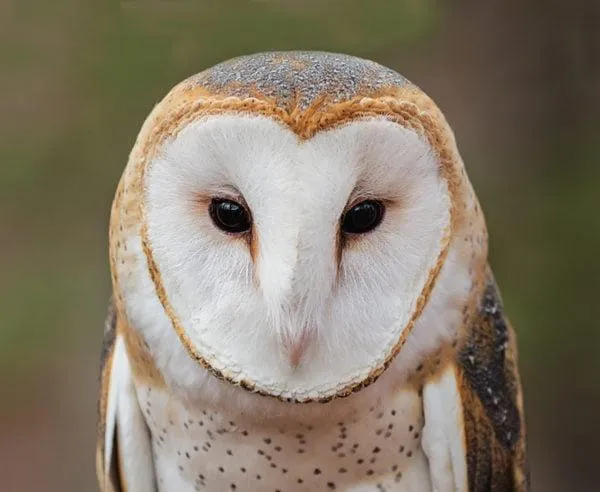
A barn owl's facial disc helps direct sounds toward its hidden ears, supporting remarkably precise hearing.
Why Are Owl Ears Asymmetrical?
Many owl species have asymmetrical ear openings that help them determine where sounds originate.
Sound from a particular location reaches the two ears with small differences in timing and intensity.
The brain can use this information to estimate the position of a sound source.
In some owls, differences in the vertical position or orientation of the ears make these cues especially useful.
The British Trust for Ornithology explains how this arrangement helps owls locate prey in three-dimensional space.
However, not every owl species has the same degree or type of ear asymmetry.
Ear structure and hunting behavior vary within the owl group.
Are Owl Ear Tufts Actually Ears?
No. The pointed tufts of feathers seen on some owls are not their ears.
These structures are called ear tufts because they resemble the external ears of certain mammals.
However, they are simply groups of feathers projecting upward from the head.
Great horned owls and some screech-owls have prominent ear tufts.
The actual ear openings are located lower on the head and remain hidden beneath other feathers.
Ear tufts may contribute to visual communication or camouflage, depending on the species and circumstances.
The presence or absence of ear tufts does not reliably indicate how well an owl can hear.
Do Chickens Have Ears?
Yes. Chickens have ears on both sides of their heads.
The openings are located behind the eyes and are partly covered by feathers.
Chickens also have visible areas of skin called earlobes, which occur beneath the ears.
These earlobes can be red, white, or other colors depending on breed and individual characteristics.
However, the earlobes are not equivalent to the projecting outer ear structures of humans.
According to poultry science resources from the University of Kentucky, chickens hear well and use vocal communication in feeding, social interactions, and predator awareness.
Mother hens also produce calls that help chicks recognize food-related situations.
Do Ducks Have Ears?
Yes. Ducks have ear openings covered by specialized feathers.
Like other birds, ducks do not possess the external pinnae found in humans.
Their auditory organs allow them to detect environmental sounds and communicate with other ducks.
Waterfowl also possess adaptations that protect their ears during diving.
According to University of Kentucky poultry resources, some waterfowl can close their external ear openings before entering the water.
This helps protect the auditory system during aquatic activity.
However, the exact mechanism and diving adaptations vary among waterfowl species.
Do Parrots Have Ears?
Yes. Parrots have ears hidden beneath the feathers on the sides of their heads.
Parrots depend heavily on hearing for vocal communication.
Many species are capable of learning and imitating sounds, including calls from other individuals and, in some captive birds, human speech.
Hearing is essential for recognizing and producing these vocalizations.
The ears themselves are usually difficult to see unless the surrounding feathers are displaced.
Parrot hearing is closely connected to the neural systems involved in vocal learning and social communication.
Do Penguins Have Ears?
Yes. Penguins have ears, even though their heads appear smooth and streamlined.
The external openings are covered by feathers.
Penguins rely on hearing for important communication, especially in breeding colonies.
Adults and chicks can use vocal signals to recognize one another among large gatherings of birds.
Penguins also possess anatomical adaptations associated with living in aquatic environments.
However, their ears are not shaped like the visible ears of mammals.
The absence of external ear flaps does not mean they are unable to hear.

Penguins have concealed ear openings and rely on hearing for communication, particularly within breeding colonies.
Can Birds Hear Humans Talking?
Yes. Many birds can hear human speech and other sounds made by people.
However, hearing speech does not necessarily mean understanding language in the human sense.
Some species can learn to associate particular sounds with events, individuals, or behaviors.
Parrots are especially well known for their capacity to imitate and learn vocalizations.
Other birds may recognize familiar human voices or respond to repeated sounds.
The ability to hear, identify, imitate, and understand sounds involves different cognitive processes.
These abilities vary among species and individuals.
Can Birds Hear Better Than Humans?
Birds and humans have different auditory abilities, so there is no simple universal answer.
Humans can hear a broad range of sound frequencies, while birds often have hearing specialized for the frequencies important to their communication and ecology.
Some birds can identify very small differences between calls or precisely locate sounds.
Owls are particularly skilled at locating prey through hearing.
Songbirds may be highly sensitive to subtle acoustic differences in their vocalizations.
However, not all birds have the same hearing range or sensitivity.
Performance depends on species, age, environment, and the particular auditory task being tested.
Do Birds Have Inner Ears?
Yes. Birds possess inner ears containing sensory structures involved in hearing and balance.
The auditory portion includes a specialized organ called the basilar papilla.
This contains sensory hair cells that detect sound-related vibrations.
Birds also possess vestibular structures that help them sense head position and movement.
These balance organs contribute to coordinated posture, flight, walking, and other activities.
The auditory and balance systems are closely associated anatomically but perform different functions.
Do Birds Use Their Ears for Balance?
Yes. Like other vertebrates, birds possess vestibular organs within their inner ears.
These organs detect movements and changes in head orientation.
Sensory information from the vestibular system helps coordinate the eyes, head, and body.
This is important during flight, landing, perching, walking, and swimming.
However, the inner ear does not control balance alone.
Visual information, muscles, joints, and the nervous system also contribute to coordinated movement.
Bird Ears vs. Human Ears
| Feature | Birds | Humans |
|---|---|---|
| Ear openings | Two, usually hidden beneath feathers | Two, clearly visible |
| External ear flaps | No mammal-like pinnae | Present |
| Ear-covering structures | Auricular feathers in many species | External ear and surrounding skin |
| Eardrums | Present | Present |
| Middle-ear bones | One main ossicle | Three ossicles |
| Inner-ear hearing structures | Basilar papilla | Cochlea with organ of Corti |
| Balance organs | Present | Present |
| Sound localization | Well developed; specialized in some species | Well developed |
Both groups possess sophisticated hearing systems, but their external and internal ear structures differ in several important ways.
Why Are Bird Ears Important for Survival?
Hearing provides birds with information that vision alone may not supply.
A bird can detect sounds coming from areas outside its current field of view.
Bird calls can communicate territory ownership, mating status, danger, or social identity.
Young birds may depend on auditory cues from parents.
Predatory birds such as owls can also use hearing to locate animals that are difficult to see.
These functions make hearing an important part of bird behavior and ecology.
Auditory adaptations differ among species according to habitat, activity patterns, and evolutionary history.
Frequently Asked Questions
Where are a bird's ears?
Most birds have ear openings on the sides of their heads, usually just behind and slightly below their eyes.
Do birds have ears under their feathers?
Yes. In most species, small specialized feathers cover the ear openings while allowing sound to pass through.
Do birds have external ears?
Birds have external ear openings and canals, but they lack the protruding external ear flaps found in humans and many other mammals.
Do birds have eardrums?
Yes. Birds have tympanic membranes that vibrate when sound enters the auditory canals.
Can birds hear without visible ears?
Yes. Their hidden ear openings connect to fully developed hearing structures inside their heads.
Do owls have ears or just feathers?
Owls have real ears hidden beneath feathers. The prominent ear tufts on certain species are feathers, not auditory organs.
Do chickens have ear holes?
Yes. Chicken ear openings are located on the sides of the head near the eyes and are partly covered by feathers.
Do ducks have ears?
Yes. Ducks possess ears and can hear sounds both for communication and environmental awareness.
Do penguins have ears?
Yes. Penguins have feather-covered ear openings and use hearing to communicate with other penguins.
Can birds hear music?
Yes. Many birds can hear musical sounds, although how they perceive rhythm, pitch, and musical patterns varies among species.
Do birds have earwax?
Bird ear anatomy and secretions differ from those of humans. Birds have mechanisms that help protect the ear canal, but their ears should not be assumed to produce the same amount or type of visible earwax as human ears.
Can birds become deaf?
Yes. Birds can experience hearing impairment because of injury, disease, developmental problems, aging, or other factors.
The Bottom Line
Birds have ears, but most of their ear openings are hidden beneath specialized feathers on the sides of their heads.
Unlike humans, birds do not have protruding ear flaps. Instead, they rely on ear openings, eardrums, middle-ear structures, and inner-ear sensory organs to detect sound.
Some birds, especially owls, possess remarkable hearing adaptations that help them locate prey. Other species depend heavily on hearing for songs, communication, and social behavior.
The absence of visible ears does not mean birds cannot hear. Their concealed hearing systems are an important part of their ability to survive and interact with their environments.
Sources & Further Reading
The following ornithological organizations, universities, and scientific resources explain bird ear anatomy, hearing, and specialized auditory adaptations.
Cornell Lab of Ornithology — Bird Academy Glossary. Defines auricular feathers and explains their role in protecting ear openings while allowing sound to pass.
University of Kentucky Cooperative Extension — How Well Can Poultry Hear?. Explains hearing in chickens and other poultry, including concealed ear openings and auditory behavior.
British Trust for Ornithology — Owl Hearing. Describes owl ear anatomy, facial discs, and asymmetric hearing adaptations.
Cornell Lab of Ornithology — How Can an Owl Catch a Mouse Under Snow?. Explains how specialized hearing helps owls locate hidden prey.
Smithsonian National Zoo — Eastern Screech-Owl. Provides species-specific information about asymmetrical ear openings and sound localization.