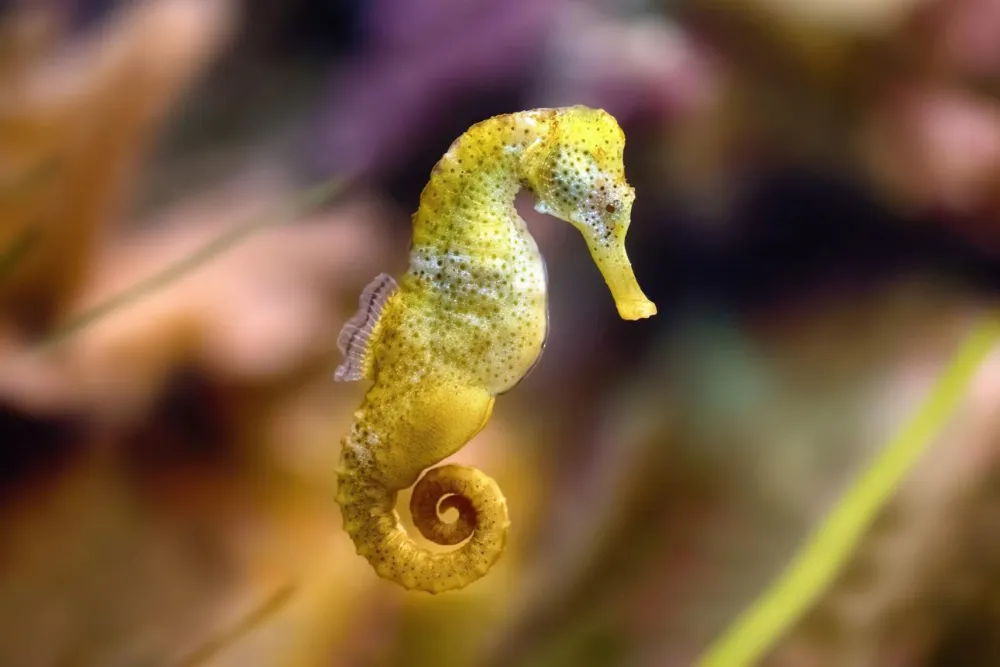
No, seahorses do not have a true stomach. Unlike humans and many other fish, seahorses have a relatively simple digestive tract without a distinct acid-producing stomach. Food passes through their digestive system, where nutrients are broken down and absorbed, primarily in the intestine. Because seahorses cannot store and process large meals in a conventional stomach, they feed frequently on small animals such as tiny crustaceans. Their unusual digestive anatomy is one reason feeding is such an important part of seahorse biology.
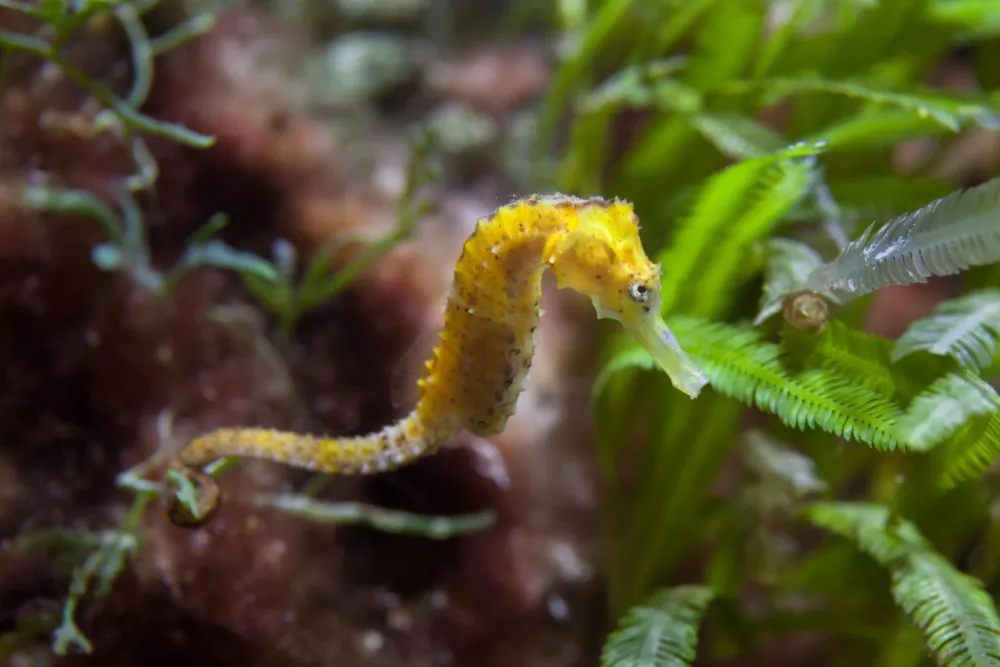
Seahorses have a specialized digestive system without a true stomach and feed on small marine animals.
Why Don't Seahorses Have Stomachs?
Seahorses belong to the family Syngnathidae, which also includes pipefish and seadragons.
Members of this family have several unusual anatomical characteristics, including elongated tubular snouts, specialized feeding mechanisms, and simplified digestive systems.
Seahorses are described as agastric fish, meaning that they lack a true stomach.
In many vertebrates, the stomach is a distinct organ where food is stored temporarily and exposed to strong acidic conditions and digestive enzymes.
Seahorses do not have this conventional gastric chamber.
Instead, their digestive tract is adapted to process relatively small prey items that can be swallowed whole.
This anatomical arrangement represents an evolutionary specialization rather than a disease or developmental abnormality.
How Do Seahorses Digest Food Without a Stomach?
Seahorses digest food through a relatively simple gastrointestinal tract that includes an esophagus and intestine.
After prey enters the mouth, it passes through the digestive system without entering a conventional acid-producing stomach.
Digestive enzymes and other secretions help break down nutrients.
The intestine plays a central role in digestion and nutrient absorption.
Scientists studying the long-snouted seahorse (Hippocampus guttulatus) have identified specialized cells within different regions of the digestive tract.
These cells produce mucus and other secretions associated with digestive function.
Research has also shown that the intestinal absorption surface changes during early development.
The absence of a true stomach therefore does not mean that seahorses cannot digest food.
It means they accomplish digestion through a different arrangement of digestive structures.
What Does a Seahorse's Digestive System Look Like?
The digestive tract of a seahorse is relatively simple compared with that of many familiar vertebrates.
A study of young Hippocampus guttulatus identified four main digestive regions:
Buccopharyngeal cavity: The region involved in receiving swallowed prey.
Esophagus: The passage connecting the mouth region to the intestine.
Midgut: A major region involved in nutrient digestion and absorption.
Hindgut: The posterior digestive region leading toward the anus.
Although this organization is simpler than a human gastrointestinal tract, it still contains specialized tissues.
Different regions perform different functions during food processing.
Research using micro-computed tomography and histochemistry has helped scientists examine these structures during seahorse development.
Why Do Seahorses Need to Eat So Often?
Seahorses feed frequently because their digestive systems are adapted to processing small prey without a conventional stomach.
Rather than consuming a large meal and storing it for prolonged gastric digestion, they capture small food items repeatedly.
In the wild, seahorses may spend substantial portions of their active periods searching for and consuming suitable prey.
Their feeding frequency depends on factors such as:
Species and body size
Age and developmental stage
Water temperature
Prey availability
Prey size and nutritional composition
Activity level and physiological condition
Seattle Aquarium notes that seahorses can feed dozens of times during a day.
However, this should not be interpreted as an exact feeding schedule shared by every wild seahorse.
Different species and individuals have different nutritional needs.
Do Seahorses Eat All Day?
Seahorses often feed repeatedly throughout their active periods.
They are usually opportunistic predators, capturing suitable prey when it comes within reach.
Many species spend time attached to seagrass, coral, or other underwater structures using their prehensile tails.
From these positions, they can watch for passing crustaceans.
Their eyes can move independently, helping them monitor the surrounding water.
When prey approaches, the seahorse rapidly moves its head and uses suction to draw the animal into its mouth.
This repeated feeding behavior helps supply the nutrients required for survival and growth.
What Do Seahorses Eat?
Seahorses are carnivorous fish that feed mainly on small aquatic animals.
Their prey varies by species, size, habitat, and developmental stage.
Common food items include:
Copepods: Tiny planktonic crustaceans.
Amphipods: Small crustaceans often associated with vegetation and the seafloor.
Mysid shrimp: Small shrimp-like crustaceans.
Other zooplankton: Small drifting animals.
Larval fish: Small fish at early developmental stages, when suitably sized.
Seahorses generally prefer prey small enough to pass through their narrow tubular mouths.
They do not bite or tear food into pieces like many predatory fish.
Instead, they usually swallow their prey whole.
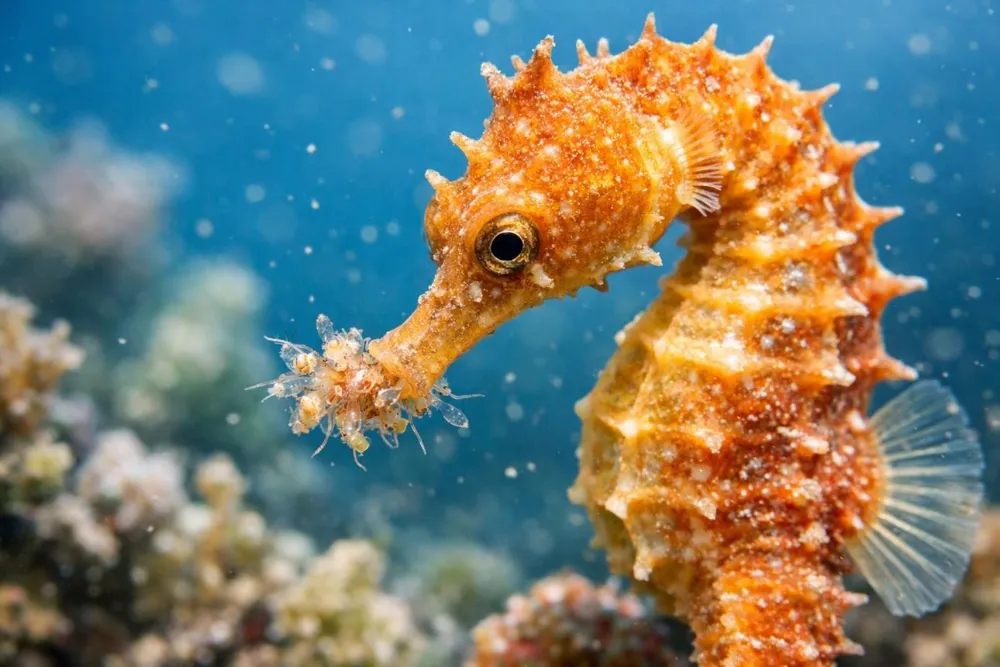
Seahorses capture small crustaceans using rapid suction feeding through their narrow snouts.
How Do Seahorses Eat Without Teeth?
Seahorses do not have functional teeth for chewing prey.
Instead, they possess narrow tubular snouts and highly specialized suction-feeding mechanisms.
When a seahorse detects suitable prey, it rapidly adjusts the position of its head.
Specialized movements of the skull and mouth create a rapid flow of water into the snout.
The prey is drawn into the mouth along with the water.
This feeding strategy allows seahorses to capture small animals without requiring jaws that bite or grind food.
The Aquarium of the Pacific describes suction feeding in seahorses and their relatives as an exceptionally rapid movement.
The prey is swallowed whole and then processed by the digestive tract.
Can Seahorses Chew Their Food?
No. Seahorses do not chew food in the way humans and many other vertebrates do.
They lack teeth specialized for cutting, crushing, or grinding prey.
Their mouths are adapted for drawing small animals into the body using suction.
As a result, prey size is an important limitation.
A seahorse cannot simply tear apart a large animal that is too big to enter its narrow snout.
Its feeding strategy depends on capturing animals that can be swallowed whole.
Do Seahorses Have Intestines?
Yes. Seahorses have intestines, even though they lack true stomachs.
The intestine is an important site of digestion and nutrient absorption.
Its lining contains specialized cells that contribute to digestive processes.
Researchers studying young seahorses have identified developmental changes in intestinal tissues.
These changes may improve the capacity to digest and absorb nutrients as the fish matures.
Therefore, describing a seahorse as having no digestive organs would be incorrect.
It has a functional digestive system that differs from the typical vertebrate arrangement.
Do Baby Seahorses Have Stomachs?
No. Baby seahorses also lack conventional stomachs.
Their digestive systems develop specialized functions as they grow.
Research on Hippocampus guttulatus examined changes in the digestive tract from birth through the first 60 days of development.
The study found changes in mucus-producing cells and intestinal structures associated with nutrient processing.
Newborn seahorses are especially dependent on appropriately sized food.
Young individuals must capture tiny prey that can pass through their small mouths.
Insufficient or unsuitable nutrition can seriously affect their survival and development.
Why Is Digestion Difficult for Young Seahorses?
Young seahorses face nutritional challenges because their digestive systems are still developing.
The absence of a conventional stomach limits certain forms of gastric digestion.
At early developmental stages, their intestinal tissues may also have a relatively limited capacity for processing particular nutrients.
A 2019 study published in Aquaculture examined the digestive system of the long-snouted seahorse using histochemistry and micro-computed tomography.
The researchers identified changes in secretory cells and intestinal structure during early growth.
The results suggest that digestive development plays an important role in the ability of juvenile seahorses to use nutrients efficiently.
This is especially relevant for conservation breeding and aquarium research.
Do Seahorses Have Digestive Enzymes?
Yes. The absence of a stomach does not mean seahorses lack digestive enzymes.
Enzymatic digestion occurs through processes associated with the digestive tract and supporting organs.
These processes break down food components into substances that can be absorbed and used by the body.
However, seahorses lack the conventional gastric glands responsible for acid-based stomach digestion in many other vertebrates.
Research on their digestive physiology examines how different enzymes, secretions, and intestinal structures compensate for this anatomical arrangement.
The exact processes can change during development and vary among species.
Do Seahorses Have Livers?
Yes. Seahorses possess livers.
The liver performs important metabolic and physiological functions, including processing nutrients and supporting digestion.
Seahorses also possess other internal organs necessary for circulation, respiration, reproduction, and waste removal.
Having no true stomach should not be confused with having no digestive organs at all.
Their anatomy is specialized rather than incomplete.
Do Seahorses Digest Food Quickly?
Seahorses process food through a relatively simple digestive system without a conventional gastric storage chamber.
Food can pass through their digestive tract relatively rapidly compared with animals that retain meals in a large stomach.
However, there is no single digestion time that applies to every seahorse.
The rate of food processing depends on prey type, temperature, body size, age, and other physiological conditions.
It is therefore misleading to state that every seahorse completely digests its food in an exact number of minutes.
Controlled feeding and digestive studies are needed to establish species-specific passage and absorption rates.
Can Seahorses Starve Easily?
Seahorses can become nutritionally stressed if they do not obtain sufficient suitable prey.
Their feeding strategy and lack of a conventional stomach make regular food availability particularly important.
However, starvation risk depends on the animal's age, condition, metabolic demands, and environment.
Newborn and rapidly growing seahorses can be especially sensitive to nutritional problems.
Research into seahorse breeding often focuses on providing prey with appropriate size and nutritional composition.
Seahorse conservation organizations also emphasize the importance of proper feeding practices in captivity.
How Are Seahorses Different From Other Fish?
Seahorses differ from many familiar fish in several aspects of feeding anatomy.
Their heads have elongated tubular snouts, and their jaws are specialized for suction feeding.
They lack conventional teeth and a true stomach.
They also swim using rapid movements of their dorsal fins rather than relying on a large tail fin for propulsion.
Some of these characteristics are shared with their close relatives, including pipefish and seadragons.
| Feature | Seahorses | Many Other Bony Fish |
|---|---|---|
| True stomach | Absent | Present in many species |
| Functional teeth | Absent | Present in many species |
| Main feeding method | Rapid suction through tubular snout | Varies widely |
| Typical prey | Small crustaceans and other tiny animals | Species-dependent |
| Food processing | Intestinal digestion without a true stomach | Often includes gastric digestion |
| Feeding frequency | Typically frequent | Highly variable |
Although stomachless digestion is unusual compared with many familiar vertebrates, seahorses are not the only fish that lack true stomachs.
Do Other Fish Have No Stomachs?
Yes. Several fish lineages have evolved digestive systems without conventional stomachs.
This condition is called agastric digestion.
In different groups, the absence of a stomach is associated with changes in digestive anatomy and physiology.
However, stomachless fish are not necessarily closely related to one another.
The condition has evolved in multiple fish lineages.
Seahorses provide a particularly recognizable example because their unusual feeding strategy is combined with a tubular snout and toothless jaws.
How Does Seahorse Feeding Affect Conservation?
Seahorse feeding biology is important for conservation and captive breeding.
Many seahorse species depend on coastal habitats such as seagrass beds, coral reefs, and other structurally complex environments.
These habitats provide shelter, attachment points, and access to small prey.
Habitat degradation can affect the availability of suitable food and protected feeding areas.
In captive breeding, providing appropriately sized and nutritionally suitable prey is essential.
Research on juvenile digestion helps improve understanding of feeding requirements during vulnerable developmental stages.
Conservation organizations such as Project Seahorse investigate seahorse ecology, fisheries, and habitat protection.
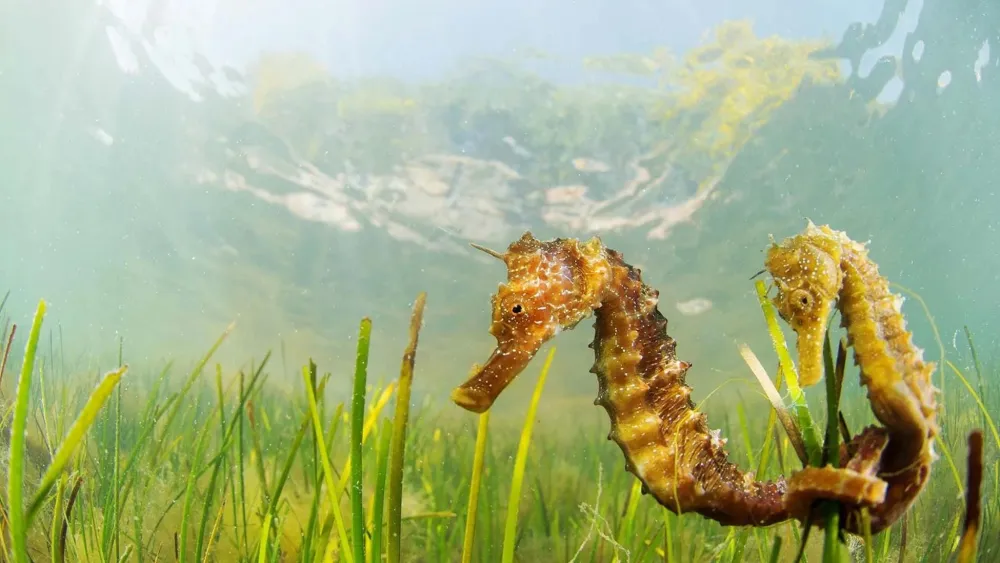
Healthy seagrass habitats provide seahorses with shelter and access to the small animals they eat.
Frequently Asked Questions
Do seahorses have a stomach?
No. Seahorses lack a true stomach and digest food through a specialized digestive tract that includes the intestine.
Why do seahorses have no stomach?
The absence of a conventional stomach is part of the evolutionary specialization of seahorses and their relatives in the family Syngnathidae.
How do seahorses digest food?
They use intestinal digestion and associated digestive secretions rather than a conventional acid-producing stomach.
How often do seahorses eat?
Seahorses typically feed frequently during their active periods, but the exact frequency depends on species, age, food availability, and environmental conditions.
Do seahorses have teeth?
No. Seahorses use rapid suction through their narrow tubular snouts to capture small prey, which they swallow whole.
Do baby seahorses have stomachs?
No. Young seahorses also lack true stomachs, and their intestinal digestive functions continue developing after birth.
What is a seahorse's favorite food?
Seahorses commonly eat small crustaceans such as copepods, amphipods, and mysid shrimp. Diet varies among species and habitats.
Can seahorses eat large fish?
Seahorses generally capture prey small enough to enter their narrow tubular mouths. They cannot chew large prey into smaller pieces.
Are seahorses carnivores?
Yes. Seahorses feed on small aquatic animals and are classified as carnivorous fish.
Do pipefish have stomachs?
Pipefish are close relatives of seahorses and also belong to a group characterized by the absence of a conventional stomach.
The Bottom Line
Seahorses do not have true stomachs, but they possess functional digestive systems that process food through specialized intestinal structures.
They capture small prey using rapid suction feeding, swallow it without chewing, and obtain nutrients without conventional gastric digestion.
Their unusual anatomy helps explain their frequent feeding behavior and the importance of suitable prey, especially for developing young.
Seahorses demonstrate that vertebrates can evolve effective digestive systems without a conventional stomach.
Sources & Further Reading
The following aquarium, conservation, and peer-reviewed research sources provide information about seahorse feeding, stomachless digestion, and digestive development.
Aquarium of the Pacific — Syngnathid Animal Care. Explains the absence of stomachs and teeth, suction feeding, and frequent feeding behavior.
Seattle Aquarium — Seahorses. Describes seahorse feeding anatomy, their tubular snouts, and simplified digestive systems.
Histochemistry of Goblet Cells and Micro-Computed Tomography to Study the Digestive System in the Long-Snouted Seahorse Hippocampus guttulatus. Peer-reviewed research published in Aquaculture on digestive development in stomachless seahorses.
iSeahorse / Project Seahorse — Frequently Asked Questions. Describes seahorse feeding, absence of teeth and stomachs, and natural prey selection.