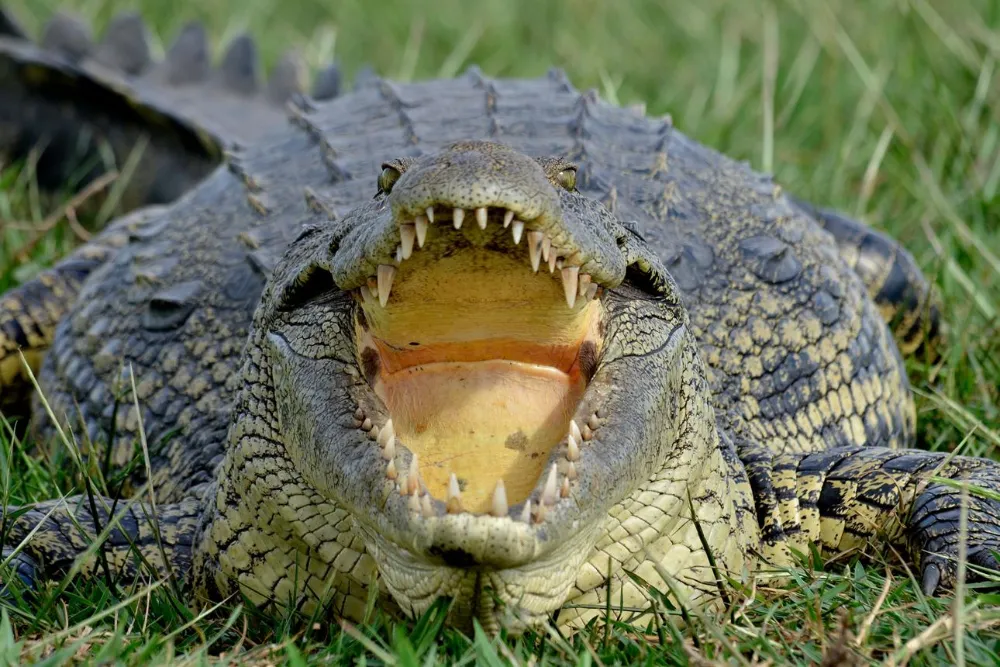
Yes, crocodiles have tongues, but they cannot stick them out of their mouths like humans, dogs, or many lizards can. A crocodile's tongue is a broad, muscular structure that lies along the floor of its mouth and is closely connected to surrounding tissues. Although it has some mobility, it cannot extend far beyond the jaws. The tongue also has specialized sensory structures and works with tissues at the back of the mouth to help separate the oral cavity from the throat when the animal is underwater. In some crocodile species, the tongue contains glands that remove excess salt.
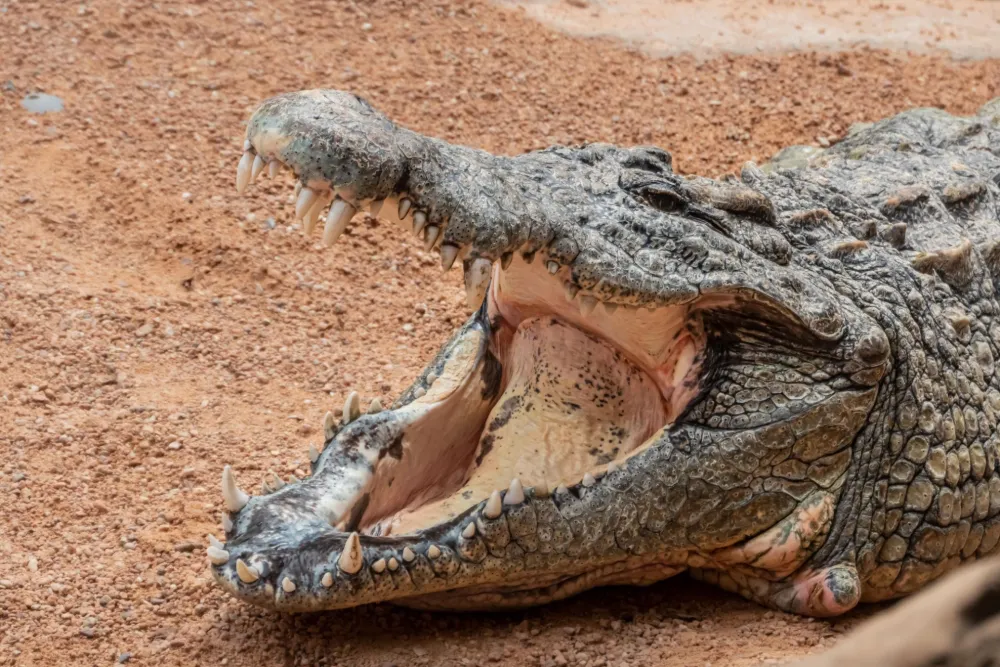
Crocodiles have muscular tongues inside their mouths, even though they cannot extend them outward like many other animals.
Where Is a Crocodile's Tongue?
A crocodile's tongue lies on the floor of its mouth, between the lower jaws.
Unlike the narrow, protrusible tongues of many lizards, it is relatively broad and occupies a substantial portion of the lower oral cavity.
Its surface can appear pale yellow, pinkish, or grayish depending on the species, individual, and lighting conditions.
When a crocodile opens its mouth widely, the tongue may look like a flattened surface rather than a distinct, projecting organ.
This appearance sometimes leads people to believe that crocodiles have no tongues.
However, anatomical examinations clearly demonstrate the presence of organized tongue tissues.
These include muscle, connective tissue, epithelium, blood vessels, nerves, and specialized glands.
Why Can't Crocodiles Stick Out Their Tongues?
Crocodiles cannot extend their tongues far outside their mouths because the tongue is closely attached to the floor of the oral cavity and supported by associated anatomical structures.
Its arrangement differs from that of highly protrusible tongues found in certain other reptiles.
For example, some lizards can extend their tongues outside the mouth to collect chemical information or capture food.
Crocodiles do not possess that same degree of tongue protrusion.
Their tongues are adapted to different functions, including oral manipulation and participation in the specialized throat-sealing system.
However, the common statement that a crocodile's tongue is completely immovable is incorrect.
Its tissues can move and contribute to the functioning of the mouth and throat.
The important distinction is between limited internal tongue mobility and the ability to project the tongue outward.
Is a Crocodile's Tongue Attached to Its Mouth?
Yes. The crocodile's tongue is closely associated with the tissues of the lower mouth.
This connection limits how far the tongue can extend.
It also supports coordination between the tongue and surrounding structures.
The tongue contains skeletal muscle and other tissues that allow controlled changes in its position and shape.
A detailed anatomical study of the Nile crocodile (Crocodylus niloticus) identified a substantial mass of striated tongue musculature beneath the surface tissues.
The researchers also documented specialized glands and sensory structures.
These observations confirm that the tongue is a functional anatomical organ rather than a fixed, featureless pad.
What Does a Crocodile's Tongue Look Like?
Crocodile tongues are broad, relatively flat structures that occupy much of the floor of the mouth.
They lack the long, narrow shape associated with many protrusible reptile tongues.
The surface includes specialized epithelial tissue and small anatomical features that may be difficult to see without magnification.
Microscopic studies have revealed:
Surface epithelium: Protective tissue covering the tongue.
Muscle fibers: Tissue involved in tongue movement.
Connective tissue: Structural support beneath the surface.
Glands: Specialized structures whose functions vary between species.
Sensory structures: Tissue associated with detecting environmental and oral stimuli.
Some crocodiles have visible openings associated with salt-secreting glands.
However, the exact appearance and distribution of these structures differ between crocodilian groups.
Can Crocodiles Move Their Tongues?
Yes. Crocodile tongues have functional muscles and can participate in controlled movement.
Although they cannot be extended far outside the mouth, they are not completely rigid.
Their movements are especially important in relation to surrounding oral and pharyngeal tissues.
Recent anatomical research has demonstrated that the tongue-associated components of the crocodilian gular valve are functionally connected to other structures at the back of the mouth.
This allows coordinated changes in the arrangement of tissues that separate the mouth from the throat.
The tongue is therefore part of a dynamic anatomical system rather than a permanently fixed plate.
What Is the Gular Valve in Crocodiles?
The gular valve is a specialized structure that helps crocodilians separate the mouth from the throat when submerged.
It is also commonly called the palatal valve.
The system includes tissue associated with the tongue and lower throat, together with a corresponding fold attached near the rear of the palate.
When these structures come together, they form a seal that limits the movement of water from the open mouth toward the pharynx.
This is especially useful for an animal that captures prey in water.
A crocodile may need to open its jaws underwater while preventing water from entering the airway.
The gular valve helps make this possible.
However, the valve does not allow crocodiles to breathe underwater.
Crocodiles are air-breathing reptiles with lungs, and they must access atmospheric oxygen.
How Does the Gular Valve Work?
The gular valve operates through coordinated movement and contact between tissue folds at the back of the oral cavity.
One component is associated with the tongue and the hyolingual apparatus.
Another component lies near the posterior edge of the palate.
When the folds meet, they create a barrier between the oral cavity and the throat.
A 2025 study published in The Anatomical Record investigated the functional relationship between these structures.
The researchers described a connective-tissue structure called the velar chord.
This structure helps coordinate movement between the upper and lower components of the valve.
The study showed that the upper fold is not simply a motionless flap, as some earlier descriptions suggested.
Instead, its shape and tension can change through its connection with the tongue-associated structures.
These findings provide a more detailed explanation of how crocodilians maintain an effective throat seal.
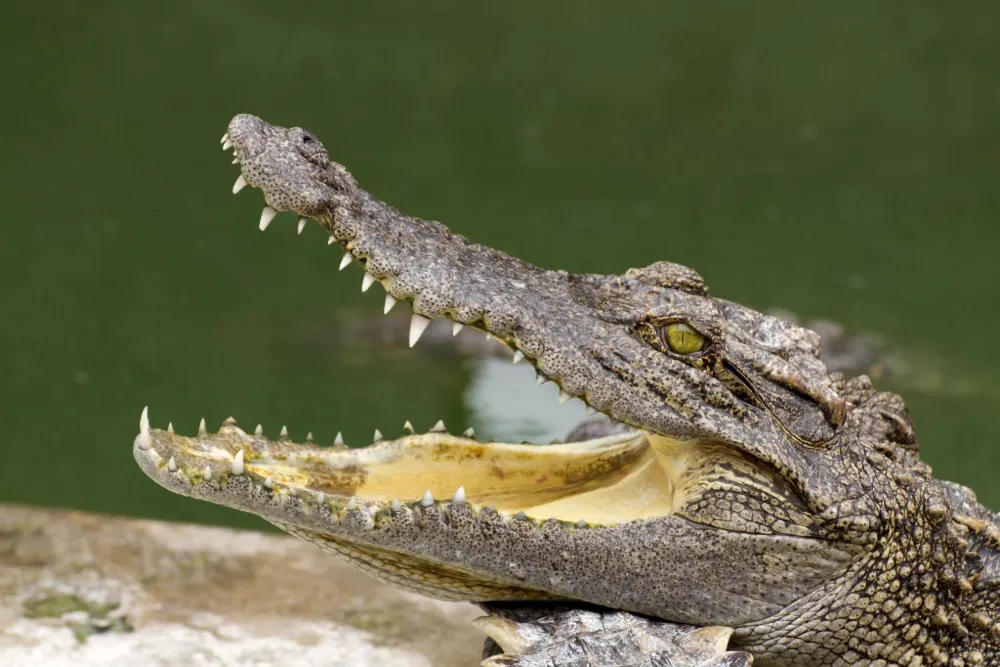
The broad tongue lies along the lower mouth, while specialized folds farther back form a barrier between the oral cavity and throat.
Can Crocodiles Open Their Mouths Underwater?
Yes. Crocodiles can open their mouths underwater.
The gular valve helps separate the water-filled oral cavity from the airway.
This allows crocodiles to capture or hold prey underwater without necessarily allowing water into the respiratory tract.
However, a crocodile cannot breathe through its mouth while that mouth is completely submerged.
It must still obtain oxygen from the air.
Crocodiles also have muscular mechanisms that allow them to close their external nostrils during submersion.
The nostril-closing system and gular valve serve different but complementary protective functions.
Together, these adaptations support the animal's semiaquatic lifestyle.
Do Crocodiles Swallow Water When Eating?
Crocodiles have anatomical adaptations that help reduce unwanted water entry into the throat while their mouths are submerged.
Nevertheless, they must coordinate feeding and swallowing with the operation of their oral and pharyngeal structures.
When swallowing, food must pass from the mouth toward the esophagus.
The protective structures therefore cannot remain sealed in exactly the same configuration throughout every stage of feeding.
The gular valve is especially important when the mouth is open underwater.
Descriptions that claim crocodiles can swallow large prey underwater without any change in valve function oversimplify this process.
Some crocodilian feeding behaviors involve repositioning prey before swallowing.
Do Crocodiles Use Their Tongues to Taste?
Research has identified taste-bud-like sensory structures in crocodilian tongues.
These findings suggest that the tongue participates in oral sensory processing.
A microscopic study of Nile crocodile tongues described specialized epithelial structures resembling taste buds.
Another comparative study examined tongue tissues in Nile crocodiles and spectacled caimans.
The researchers identified sensory structures associated with nerves, including units resembling taste buds.
However, the presence of these structures does not establish that crocodiles experience the same range or intensity of taste sensations as humans.
The exact contribution of tongue-based chemical sensing to natural feeding behavior requires further investigation.
Do Crocodiles Have Salt Glands on Their Tongues?
Yes. Certain crocodile species possess salt-secreting glands within their tongues.
These glands help regulate salt levels in the body.
One of the best-studied examples is the saltwater crocodile (Crocodylus porosus), also known as the estuarine crocodile.
A landmark study published in Science in 1981 identified functional salt glands in the tongue of this species.
Researchers demonstrated that these glands can release a concentrated solution containing sodium chloride.
This adaptation helps crocodiles maintain appropriate internal salt concentrations when living in saline environments.
The discovery helped explain how saltwater crocodiles can occupy coastal waters, estuaries, and other habitats where salinity may be high.
How Do Crocodile Tongue Salt Glands Work?
Lingual salt glands transport excess salt from the body into specialized secretions.
The secretions leave through openings on the tongue surface.
These glands are supplied by blood vessels and controlled through physiological mechanisms.
Research on Crocodylus porosus has shown that their structure and activity can change in response to environmental salinity.
A 2008 study published in the Journal of Experimental Biology examined crocodiles acclimated to freshwater and saltwater conditions.
The researchers found changes in gland structure and function associated with the different environments.
This ability to adjust salt-excreting capacity contributes to the physiological flexibility of saltwater crocodiles.
However, tongue salt glands are not equally developed or functional in all crocodilian species.
Do Alligators Have Salt Glands on Their Tongues?
Alligators and crocodiles are closely related, but their tongue glands differ in important ways.
True crocodiles possess specialized lingual salt glands, although their activity and development vary among species.
Alligators do not possess the same well-developed, functional salt-excreting system found in saltwater crocodiles.
This difference is one reason many crocodile species can tolerate highly saline environments better than alligators.
However, habitat tolerance also depends on behavior, age, physiological condition, and access to freshwater.
Alligators may occasionally enter brackish or saline environments, but prolonged exposure to high salinity can be challenging.
Do Alligators Have Tongues?
Yes. Alligators have tongues.
Like crocodiles, their tongues are broad structures positioned along the floor of the mouth.
They cannot project their tongues far outside the jaws in the way many lizards can.
Alligators also possess a gular valve that helps protect the throat while the mouth is submerged.
The anatomical similarities reflect the shared evolutionary history of crocodilians.
However, differences in tongue gland structure and environmental adaptation remain important.
Crocodiles vs. Alligators: Tongue Anatomy
| Feature | Crocodiles | Alligators |
|---|---|---|
| Have tongues | Yes | Yes |
| Can extend tongue far outside mouth | No | No |
| Tongue musculature | Present | Present |
| Gular valve | Present | Present |
| Tongue sensory structures | Present | Present |
| Functional lingual salt glands | Present in studied true crocodiles | Not developed to the same functional extent |
| High-salinity tolerance | High in some species | Generally more limited |
Both animals have similar basic oral anatomy, but their physiological adaptations are not identical.
Why Are Saltwater Crocodiles Adapted to the Sea?
Saltwater crocodiles can occupy both freshwater and marine environments.
Their ability to tolerate saline water involves several adaptations.
Lingual salt glands are particularly important because they help remove excess sodium and chloride.
However, they are not the only factors determining where these animals can survive.
Water balance, kidney function, drinking behavior, prey availability, and movement between different habitats also matter.
Saltwater crocodiles are commonly found in estuaries, mangrove forests, tidal rivers, and coastal waterways.
They can also travel through marine waters between suitable habitats.
Their tongue glands provide an important physiological advantage in these environments.
Do Baby Crocodiles Have Tongues?
Yes. Hatchling crocodiles possess tongues and the basic oral structures characteristic of their species.
These structures are present long before the animals reach adult size.
As the crocodile grows, the mouth, tongue, jaw muscles, and associated tissues develop further.
Young crocodiles use their mouths to capture small prey such as insects, fish, and other aquatic animals.
Their tongues do not become highly protrusible as they mature.
They retain the basic crocodilian arrangement in which the tongue is closely associated with the floor of the mouth.
Do Crocodiles Use Their Tongues to Catch Prey?
Crocodiles do not catch prey by shooting their tongues outward.
Instead, they capture prey using their powerful jaws and teeth.
Their jaws are adapted to grip and restrain animals.
Small prey may be swallowed whole, while larger prey can require additional manipulation.
The tongue contributes to oral function but is not the primary prey-capture structure.
This differs from certain lizards and amphibians that use rapidly projecting tongues to capture food.
Do Crocodiles Chew Their Food?
Crocodiles generally do not chew food through repeated grinding movements like humans.
Their teeth are adapted primarily for gripping, puncturing, and holding prey.
They may swallow smaller prey whole.
For larger food items, crocodiles can use powerful body movements and other feeding behaviors to separate manageable pieces.
Some crocodilians perform rolling movements while holding prey, commonly described as death rolls.
The tongue does not replace the mechanical actions of the jaws and body during feeding.
Can Crocodiles Breathe Through Their Tongues?
No. Crocodiles do not breathe through their tongues.
They have lungs and must obtain atmospheric oxygen.
The tongue-associated gular valve helps prevent water from entering the throat during submersion.
However, this protective mechanism is not a respiratory organ that extracts oxygen from water.
Crocodiles can remain submerged for extended periods under appropriate conditions, but they must eventually surface to breathe.
Their diving ability depends on physiological adaptations involving oxygen storage, metabolism, and circulation.
Are Crocodile Tongues Similar to Snake Tongues?
No. Crocodile and snake tongues differ substantially in shape and function.
Many snakes have slender, forked tongues that can extend beyond the mouth.
Snakes use tongue movements to collect chemical particles from the environment.
These particles are transferred to a specialized chemosensory organ associated with the roof of the mouth.
Crocodile tongues are broader and have limited outward extension.
They participate in oral functions and are associated with the gular valve.
In some crocodile species, they also contain important salt-excreting glands.
These differences reflect distinct evolutionary adaptations within reptiles.
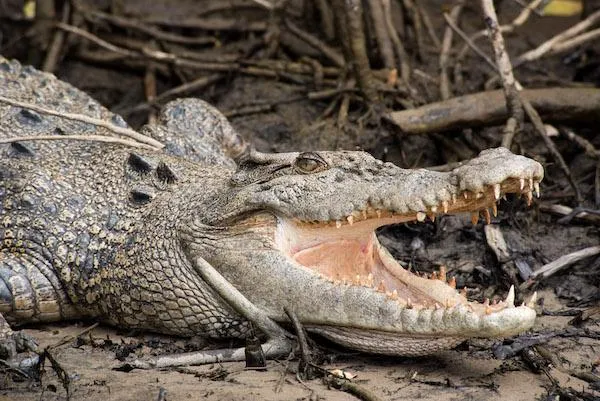
Saltwater crocodiles possess specialized tongue glands that help remove excess salt in saline environments.
Why Is the Crocodile Tongue Important to Scientists?
Crocodile tongues are useful for studying reptile anatomy, salt balance, sensory biology, and the evolution of semiaquatic adaptations.
Researchers use several methods to examine these structures, including:
Gross anatomical dissection
Light microscopy
Scanning electron microscopy
Histological staining
Computed tomography
Experimental studies of gland activity
These methods reveal structures that cannot be identified from ordinary photographs of crocodile mouths.
The discovery of salt glands and the detailed study of the gular valve demonstrate that crocodile tongues perform more functions than their external appearance suggests.
Research published in 2025 provided additional evidence that the upper and lower components of the gular valve work together dynamically.
Such findings improve understanding of the evolutionary adaptations that allow crocodilians to hunt and survive in aquatic habitats.
Frequently Asked Questions
Do crocodiles have tongues?
Yes. Crocodiles have broad, muscular tongues located along the floor of their mouths.
Can crocodiles stick out their tongues?
No. Crocodiles cannot extend their tongues far outside their jaws because of the tongue's anatomical connections with the lower mouth.
Are crocodile tongues stuck to the roof of their mouths?
No. The tongue lies along the floor of the mouth, not the roof. It is closely associated with lower oral tissues and the throat-sealing system.
Can crocodiles move their tongues?
Yes. Their tongues have muscles and limited movement, but they cannot protrude them like many lizards can.
Do alligators have tongues?
Yes. Alligators have tongues with a similar basic arrangement to crocodile tongues.
Do crocodiles have taste buds?
Anatomical studies have identified taste-bud-like structures in crocodilian tongues, but their exact sensory capabilities are not fully understood.
Do crocodiles have salt glands?
Certain crocodile species have salt glands in their tongues. These are especially important in saltwater crocodiles.
Why don't crocodiles drown when opening their mouths underwater?
A specialized gular valve helps separate the mouth from the throat, reducing water entry into the airway.
Do crocodiles breathe underwater?
No. Crocodiles breathe air through lungs. They can submerge and hold their breath, but they cannot extract oxygen from water through gills.
Do baby crocodiles have tongues?
Yes. Hatchling crocodiles have tongues and the basic oral structures characteristic of crocodilians.
Do crocodiles use their tongues to hunt?
They primarily capture prey with their jaws and teeth rather than extending their tongues.
Are crocodile tongues poisonous?
No. Crocodile tongues are not venom-injecting organs. Their danger to prey comes primarily from powerful jaws and teeth.
The Bottom Line
Crocodiles have tongues, but they cannot stick them out like many other animals can.
The tongue is a muscular organ closely associated with the floor of the mouth. It plays a role in oral functions and contributes to the specialized gular valve that helps protect the throat when a crocodile opens its jaws underwater.
In some species, including saltwater crocodiles, the tongue also contains glands that remove excess salt.
These features show that the crocodile tongue is much more than a flat structure hidden behind powerful teeth.
Sources & Further Reading
The following peer-reviewed research papers provide direct anatomical and physiological evidence about crocodilian tongues, oral sensory structures, gular valves, and salt glands.
Putterill and Soley (2004) — General Morphology of the Oral Cavity of the Nile Crocodile. II. The Tongue. Detailed anatomical and microscopic examination of the Nile crocodile's tongue.
Young, Cramberg and Young (2025) — The Velar Chord and Dynamic Integration of the Gular Valve in Crocodylians. Research on the dynamic connection between tongue-associated structures and the throat-sealing valve.
Leitch and Catania (2013) — Crocodylians Evolved Scattered Multi-Sensory Micro-Organs. Comparative study of sensory structures and tongue anatomy in crocodiles and caimans.
Taplin and Grigg (1981) — Salt Glands in the Tongue of the Estuarine Crocodile Crocodylus porosus. Landmark study identifying functional salt-secreting glands in crocodile tongues.
Cramp et al. (2008) — Functional and Morphological Plasticity of Crocodile Salt Glands. Experimental research on how salt gland structure and function respond to environmental salinity.