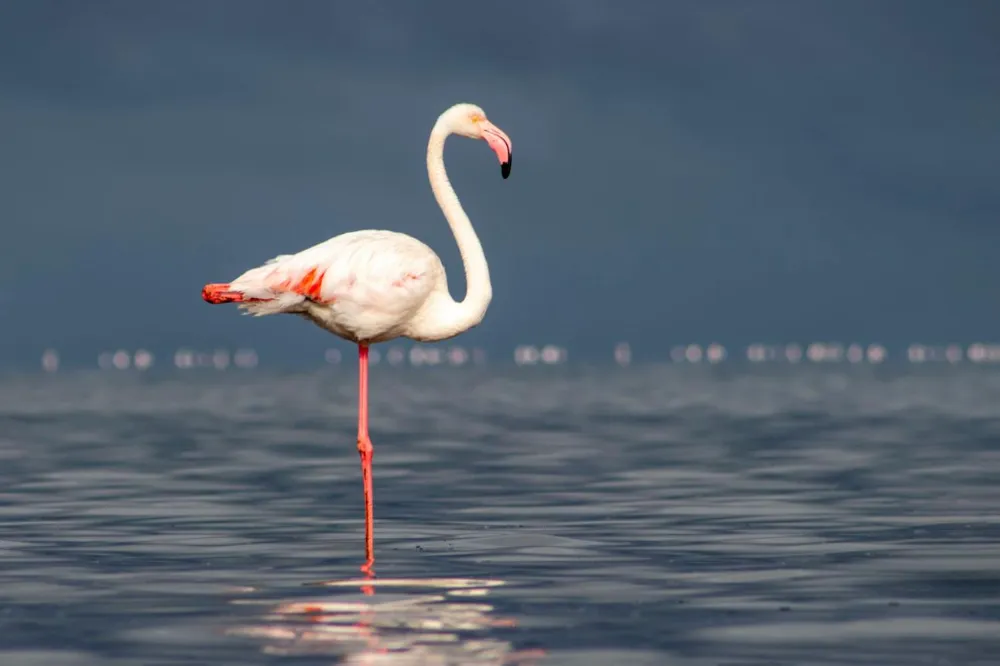
Flamingos stand on one leg for several possible reasons, including conserving body heat and reducing the muscular effort needed to remain upright. Research shows that flamingos are more likely to rest on one leg under certain cooler conditions, particularly when standing in water. Biomechanical experiments have also revealed that their unusual leg anatomy allows them to support their body weight using a largely passive mechanism. This means a flamingo may use very little active muscle force while resting on one leg—even when sleeping.
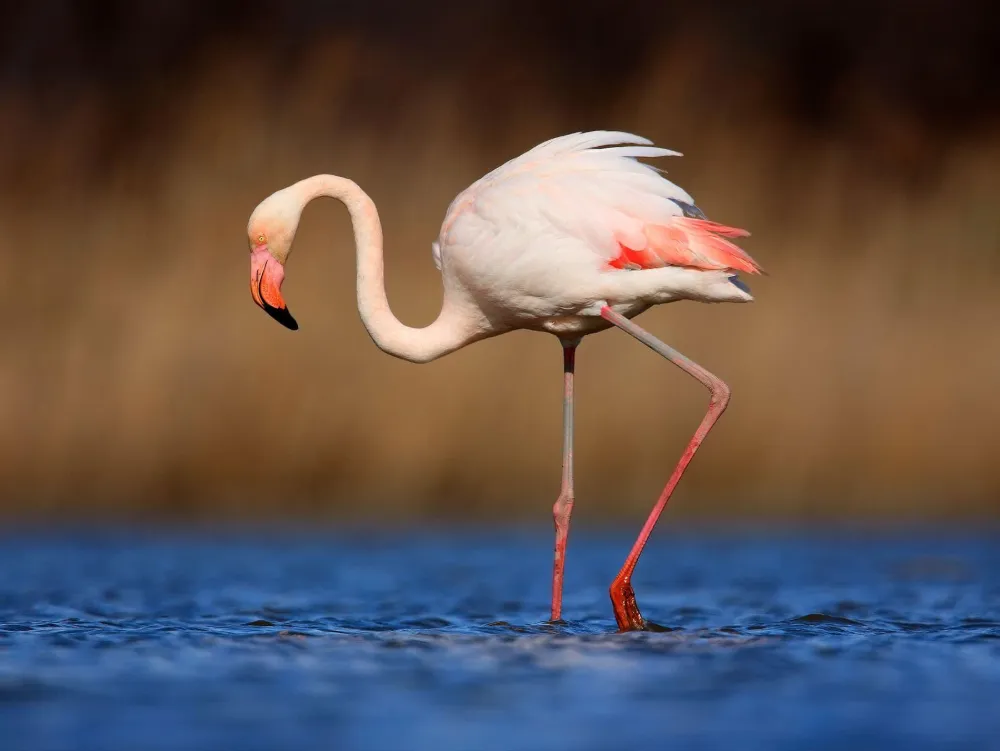
Flamingos often rest on one leg, a posture associated with heat conservation and surprisingly efficient mechanical support.
Why Do Flamingos Stand on One Leg?
Flamingos are famous for standing on one leg, sometimes remaining in this position for long periods.
Scientists have investigated several possible explanations for this behavior.
Two of the best-supported ideas involve body temperature regulation and energy-efficient posture.
First, standing on one leg allows the bird to tuck its other leg close to its body, reducing the amount of exposed skin through which heat can escape.
Second, studies of flamingo biomechanics show that the position of their joints allows a standing leg to support body weight with little continuous muscle activity.
These mechanisms can operate together.
A flamingo standing in cool water may benefit from reducing heat loss, while its leg structure makes the position mechanically efficient.
However, researchers have not demonstrated that every flamingo adopts the posture for exactly the same reason in all environments.
Does Standing on One Leg Help Flamingos Stay Warm?
Yes. There is scientific evidence supporting the idea that standing on one leg can help flamingos conserve body heat.
Birds lose heat through exposed body surfaces, including their legs and feet.
Flamingos spend considerable time in shallow lakes, lagoons, and wetlands, where their legs are often partly submerged.
Water can draw heat from the body more effectively than air under comparable conditions.
By lifting one leg and tucking it against the body, a flamingo reduces the amount of exposed leg surface in contact with water or cool air.
The tucked leg may also receive some protection from the bird's feathers.
This can reduce heat loss during rest.
The Smithsonian National Zoo identifies heat conservation as one important explanation for the one-legged stance.
What Does Research Say About Flamingo Heat Loss?
In a study first published online in 2009 and later appearing in Zoo Biology, researchers Matthew Anderson and Sarah Williams observed captive Caribbean flamingos (Phoenicopterus ruber).
They recorded the birds' resting postures under different environmental conditions.
The researchers found that flamingos were more likely to stand on one leg in water than on land.
They also reported a negative relationship between temperature and the proportion of birds standing on one leg.
In other words, one-legged resting became less common as temperatures increased.
These observations support the hypothesis that one-legged resting contributes to thermoregulation.
However, the study measured behavior rather than directly quantifying all heat losses from the birds' legs.
The findings therefore provide evidence for the thermal explanation without proving that it is the only reason for the behavior.
How Do Flamingos Balance on One Leg?
Flamingos have specialized leg anatomy that allows them to maintain an extremely stable one-legged posture.
At first glance, balancing on a single narrow leg may appear difficult.
However, the forces acting on the standing leg can be arranged so that gravity helps maintain the posture instead of constantly destabilizing it.
Researchers have proposed a mechanism called a passive gravitational stay apparatus.
This means that the bird's body weight and joint arrangement can help keep the standing leg in a stable configuration without continuous high levels of muscular effort.
When the flamingo settles into its resting position, it can reduce unnecessary body movement.
The supporting leg remains underneath the body, while the other leg is lifted and tucked away.
This arrangement helps explain how flamingos can remain upright for long periods.
What Did Scientists Discover About Flamingo Balance in 2017?
A 2017 study published in Biology Letters investigated the mechanical basis of one-legged standing in flamingos.
The researchers, Young-Hui Chang and Lena H. Ting, examined both living flamingos and preserved flamingo bodies.
They discovered that flamingo cadavers could be positioned to support body weight on one leg without active muscle contraction.
Remarkably, the same specimens could not maintain a comparably stable two-legged standing posture under the conditions tested.
This suggested that the one-legged posture has a passive mechanical advantage.
The researchers also studied living flamingos using measurements of the forces exerted against the ground.
They found that quietly resting flamingos displayed very little body sway while standing on one leg.
These findings provided evidence that one-legged standing can require relatively little active muscular effort.
The study did not demonstrate that every component of balance is entirely passive in a living bird.
Instead, it showed that specialized body mechanics can greatly reduce the demands placed on the muscles.
Do Flamingos Lock Their Legs in Place?
Flamingos can maintain a stable one-legged posture through a mechanically favorable arrangement of their joints and body weight.
This is sometimes described informally as a leg-locking mechanism.
However, the phrase can be misleading if it suggests that flamingos use exactly the same tendon-locking structure found in some perching birds.
The 2017 research described a passive, gravity-assisted support mechanism associated with the proximal leg joints.
Gravity and the position of the body help create a stable standing configuration.
This reduces the need for continuous muscular forces at those joints.
The mechanism is particularly effective during quiet standing.
Active movements, such as walking, turning, or reacting to disturbances, require additional muscular control.
Do Flamingos Get Tired Standing on One Leg?
Flamingos can remain on one leg for extended periods without the level of muscle effort that a human might expect.
That is partly because their anatomy allows a passive support mechanism to operate during quiet resting.
In humans, balancing on one leg generally requires continuous adjustments from several muscle groups.
In flamingos, the arrangement of the body and leg joints can minimize some of these demands.
Therefore, standing on one leg is not necessarily more tiring for a flamingo than standing on two.
However, this does not mean that flamingo muscles never work during the posture.
The birds still make adjustments when they move, respond to external forces, or change their balance.
The important finding is that quiet one-legged standing can be mechanically efficient.
Can Flamingos Sleep Standing on One Leg?
Yes. Flamingos can sleep while standing on one leg.
The Smithsonian National Zoo confirms that they can maintain this posture for long enough to sleep.
During rest, a flamingo may tuck its head into its feathers and lift one leg beneath its body.
The bird's specialized leg mechanics help keep the body stable with relatively little muscular effort.
Sleeping birds are less actively engaged in movements than alert birds, making a stable resting posture particularly useful.
However, one-legged standing does not automatically mean a flamingo is asleep.
Flamingos may use the same position while awake and resting.
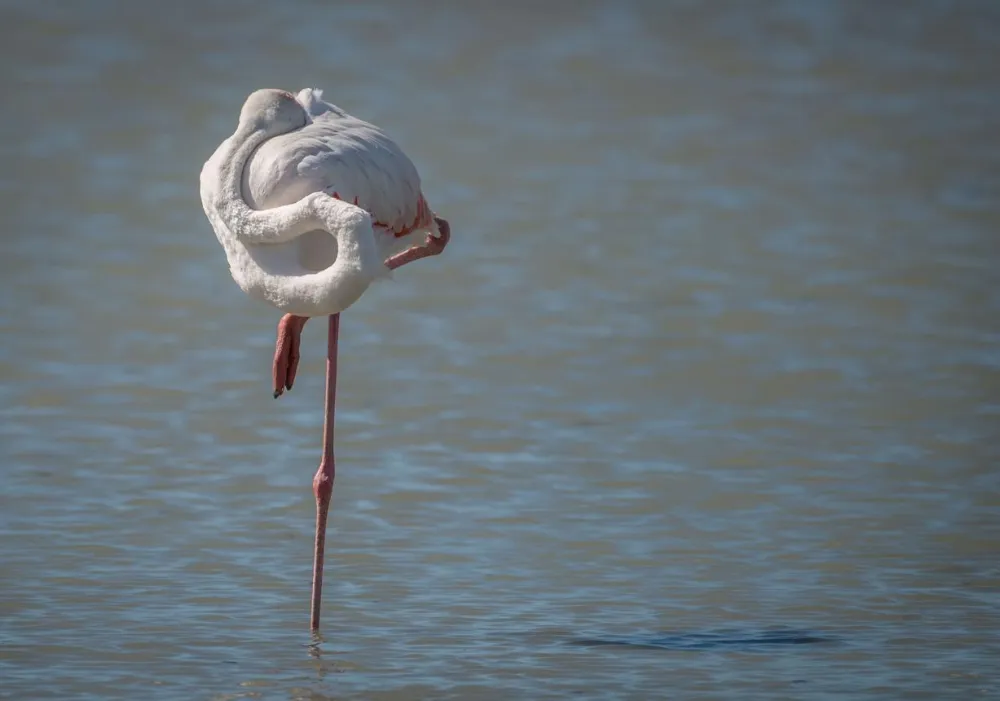
Flamingos can sleep while standing on one leg, with their heads tucked into their feathers.
Do Flamingos Sleep With One Eye Open?
Some birds can exhibit unihemispheric slow-wave sleep, a form of sleep in which activity differs between the two cerebral hemispheres.
This ability has been documented in certain bird species and can be associated with keeping one eye open.
However, the existence of this sleep pattern in birds does not establish that every sleeping flamingo is using it.
The posture of standing on one leg and the neural mechanisms involved in sleep are separate biological questions.
A flamingo may stand on one leg without sleeping, and sleeping posture alone does not reveal which parts of its brain are active.
Claims that flamingos stand on one leg specifically because half their brain is asleep should therefore be treated cautiously.
Do Flamingos Switch Legs?
Yes. Flamingos can alternate between standing on the left and right legs.
The observational study by Anderson and Williams found no consistent overall preference for one supporting leg among the Caribbean flamingos they examined.
Individual birds used both legs during resting periods.
This suggests that one-legged standing does not generally depend on always using the same limb.
Switching legs may be useful for adjusting posture and exposure to environmental conditions.
However, the study did not establish that flamingos always change legs after a particular amount of time.
Leg-switching frequency may vary among individuals and circumstances.
Do Flamingos Prefer Their Left or Right Leg?
Research on captive Caribbean flamingos did not find a consistent preference for the left or right supporting leg.
The birds divided their one-legged resting time between the two sides.
This means the behavior is not equivalent to a clear population-wide preference for one limb.
However, absence of a group-level preference does not mean every individual necessarily spends precisely equal time on both legs.
Individual variation can occur.
The main conclusion is that flamingos generally have the ability to use either leg for resting.
Why Do Flamingos Stand on One Leg in Water?
Standing on one leg is especially common when flamingos rest in water.
Wetland environments can create significant opportunities for heat loss through exposed legs and feet.
By lifting one leg out of the water, the bird reduces direct contact between that limb and the surrounding environment.
The lifted leg can be tucked close to the body, where conditions may be warmer.
In the Caribbean flamingo study, the proportion of one-legged birds was higher in water than on land.
This result is consistent with the heat-conservation hypothesis.
However, flamingos may also stand on one leg on dry ground.
Therefore, water exposure cannot be the only factor associated with the posture.
Do Flamingos Stand on One Leg in Hot Weather?
Yes. Flamingos can stand on one leg even in warm conditions.
The behavior has been observed in tropical and subtropical environments where conserving heat may be less important at certain times.
This is one reason scientists have continued to investigate additional explanations.
The biomechanical research suggests that one-legged standing can be a relatively low-effort resting posture independent of strong cold exposure.
Heat conservation and energy-efficient support may therefore help explain different aspects of the same behavior.
However, their relative contributions have not been fully quantified across all flamingo species and habitats.
Where Are a Flamingo's Knees?
A flamingo's knees are located high up on the legs, close to the body, and are usually hidden beneath feathers.
The prominent joint visible halfway down what looks like the leg is actually the ankle.
This arrangement is common among birds, although flamingos make it especially noticeable because of their exceptionally long legs.
When a flamingo bends its visible leg backward, it is moving the ankle joint rather than bending the knee backward.
The knee bends in the familiar anatomical direction but is less visible.
Understanding this anatomy helps explain the geometry of the one-legged resting posture.
It is also essential when interpreting biomechanical studies of flamingo balance.
How Many Legs Do Flamingos Have?
Flamingos have two legs.
The appearance of a one-legged flamingo does not mean that the bird is missing a limb.
Usually, the second leg is folded and tucked close to the body, where it may be partly hidden beneath the feathers.
At a distance, the tucked foot and leg can be difficult to distinguish.
This creates the familiar appearance of a bird balancing on a single slender limb.
Flamingos also use both legs for walking, wading, and other movements.
Can Flamingos Stand on Two Legs?
Yes. Flamingos can stand and walk on two legs.
They do not rely exclusively on one-legged standing.
Two-legged posture is common during movement, feeding adjustments, and various social activities.
Flamingos may also rest on two legs.
The fact that one-legged standing can be mechanically efficient does not make two-legged standing impossible or unhealthy.
Different postures serve different behavioral and mechanical purposes.
How Is a Flamingo's One-Legged Posture Different From Human Balance?
Humans and flamingos both rely on gravity, muscles, bones, joints, and the nervous system to maintain upright posture.
However, their bodies are adapted to very different forms of locomotion and resting.
Humans generally maintain one-legged balance by continuously controlling the position of the body over the supporting foot.
Flamingos have unusually long legs and a specialized joint configuration that can produce a stable, passive standing arrangement.
This makes prolonged one-legged resting comparatively efficient.
| Feature | Flamingos | Humans |
|---|---|---|
| Normal number of legs | Two | Two |
| One-legged resting | Common | Uncommon |
| Passive standing support | Supported by biomechanical evidence | Much less specialized for one-legged rest |
| Muscle demand during quiet one-legged stance | Can be very low | Requires ongoing balance control |
| Visible middle leg joint | Ankle | Knee |
| Sleep while standing on one leg | Observed | Not a normal human resting behavior |
Do Other Birds Stand on One Leg?
Yes. One-legged resting occurs in several bird groups.
Examples include ducks, herons, shorebirds, and some other water-associated birds.
In these animals, tucking one leg into the body feathers may reduce heat loss through exposed limbs.
However, their biomechanics are not necessarily identical to those of flamingos.
A 2025 educational article from the Smithsonian National Zoo explains that various shorebirds tuck a leg beneath their feathers while resting.
The article describes thermoregulation and energy conservation as important potential benefits.
These behaviors show that one-legged resting is not exclusive to flamingos, even though flamingos are especially famous for it.
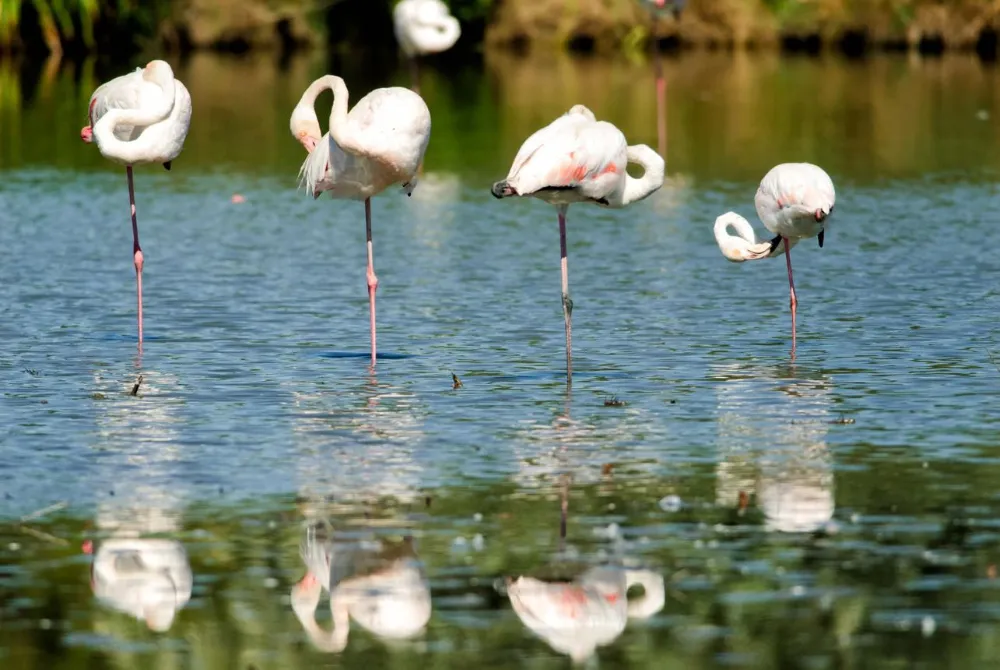
Flamingos may rest on one leg individually or within large groups, especially in wetland habitats.
Are Flamingos the Best Birds at Balancing?
Flamingos are exceptionally well adapted to prolonged one-legged standing, but there is no established scientific ranking identifying them as the best-balancing birds.
Different species have evolved specialized balance mechanisms for different activities.
Perching birds can grip narrow branches.
Hummingbirds can stabilize their bodies during hovering flight.
Wading birds can stand in shallow water and adjust their position while searching for food.
These abilities involve different anatomical and neurological demands.
Flamingos are particularly interesting because their one-legged resting posture can be supported by passive mechanical forces.
Is Standing on One Leg a Sign of Stress in Flamingos?
One-legged standing is normal behavior in healthy flamingos.
It should not be interpreted as a sign of stress or illness by itself.
Birds may adopt the posture while resting comfortably.
However, unusual behavior must always be considered in context.
An injured bird might avoid placing weight on a painful limb, but this cannot be diagnosed from one-legged standing alone.
Wildlife professionals and veterinarians evaluate many additional signs, including activity, feeding, posture changes, and visible injuries.
Do Baby Flamingos Stand on One Leg?
Young flamingos gradually develop the coordination and body proportions needed for adult-like resting postures.
Flamingo chicks have shorter legs and different proportions from mature birds.
As they grow, their legs lengthen and their ability to balance develops.
The familiar adult one-legged stance becomes part of their behavioral repertoire.
However, the exact age at which young flamingos consistently adopt the posture can vary, and published research does not establish one universal milestone across all species.
Why Does the Flamingo's One-Legged Stance Matter to Science?
Flamingos provide an interesting example of how anatomy and behavior can reduce the energetic demands of posture.
Scientists have used mechanical experiments and force measurements to understand how the birds maintain stability.
The research also has broader implications for biomechanics.
Engineers studying passive support mechanisms are interested in systems that can hold weight without continuous energy consumption.
The principles observed in animal anatomy can inform the design of mechanical supports and robotic systems.
However, the flamingo's anatomy is a biological system with specialized tissues and evolutionary adaptations.
Engineering devices inspired by these mechanisms do not necessarily reproduce their biological operation exactly.
Frequently Asked Questions
Why do flamingos stand on one leg instead of two?
Standing on one leg may reduce heat loss and can require relatively little active muscular force because of specialized leg mechanics.
Do flamingos stand on one leg to keep warm?
Research supports this explanation. One-legged resting was more common under cooler conditions and when flamingos stood in water.
How do flamingos balance on one leg without falling?
The arrangement of their joints and body weight allows a largely passive support mechanism to maintain stability during quiet standing.
Do flamingos sleep standing up?
Yes. Flamingos can sleep while standing, including on one leg.
Do flamingos ever switch legs?
Yes. They can alternate between supporting themselves on the left and right legs.
Do flamingos have a favorite leg?
A study of Caribbean flamingos found no consistent overall preference for one supporting leg, although individuals may vary.
Do flamingos get tired standing on one leg?
Their passive mechanical support can reduce the muscular effort required, making one-legged resting relatively efficient.
Can flamingos stand on both legs?
Yes. Flamingos regularly use both legs for walking, moving, and standing.
Why do flamingos bend their legs backward?
The visible joint that appears to bend backward is the ankle, not the knee. The knee is located higher up and is mostly hidden by feathers.
Do flamingos stand on one leg because the other leg is injured?
No. One-legged resting is normal flamingo behavior and does not indicate injury by itself.
Do flamingos stand on one leg in the wild?
Yes. The behavior occurs in both wild flamingos and birds living in managed care.
Are flamingos the only birds that stand on one leg?
No. Many other birds, including shorebirds and some waterfowl, also rest with one leg tucked beneath their feathers.
The Bottom Line
Flamingos stand on one leg because the posture can provide several biological advantages.
Observational research suggests that lifting one leg may help reduce heat loss, especially when birds are resting in cool water.
Biomechanical experiments also demonstrate that flamingos can support their bodies on one leg with very little active muscular effort.
These findings help explain how flamingos can maintain their famous posture for long periods, including while sleeping.
The complete explanation for when and why flamingos choose one leg over two is still being studied, but the combination of thermal and mechanical benefits offers strong scientific insight into this remarkable behavior.
Sources & Further Reading
The following peer-reviewed scientific studies and zoological resources explain flamingo one-legged standing, thermoregulation, passive support mechanics, and resting behavior.
Chang and Ting (2017) — Mechanical Evidence That Flamingos Can Support Their Body on One Leg with Little Active Muscular Force. A peer-reviewed study in Biology Letters demonstrating passive mechanical support during one-legged standing.
Anderson and Williams (2010) — Why Do Flamingos Stand on One Leg?. Observational research in Zoo Biology relating one-legged resting to temperature and water exposure.
Smithsonian National Zoo — Why Are Flamingos Pink? And Other Flamingo Facts. Explains flamingo sleep, one-legged resting, and possible thermal and muscular benefits.
San Diego Zoo Wildlife Alliance — Flamingo. Provides an overview of flamingo biology, behavior, and the uncertainty surrounding one-legged standing.
Smithsonian National Zoo (2025) — Why Do Shorebirds Stand on One Leg?. Discusses similar resting postures in other birds and their potential thermoregulatory benefits.