Yes, dolphins have hair at certain stages of their lives, even though adult dolphins usually look completely hairless. Newborn bottlenose dolphins have short, whisker-like hairs on their snouts, also called rostrums. These hairs typically disappear as the calves develop, leaving small sensory pits in the skin. Scientists have discovered that these former whisker structures can remain sensitive and may help some dolphins detect weak electric fields produced by prey. Dolphins do not have thick fur because their smooth skin and insulating blubber are better suited to life in water.

Adult bottlenose dolphins have smooth skin and lack the visible fur that covers many land mammals.
Do Dolphins Really Have Hair?
Dolphins are mammals, and hair is one of the defining characteristics of the mammalian evolutionary lineage.
However, dolphins have far less visible hair than most land mammals.
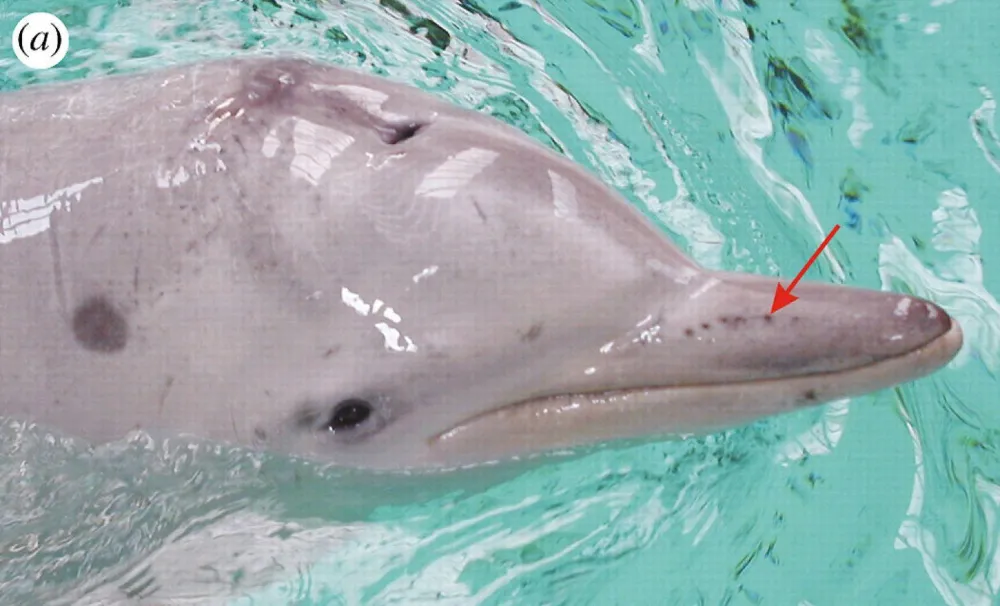
In bottlenose dolphins (Tursiops truncatus), newborn calves possess a small number of specialized facial hairs called vibrissae, or whiskers.
These hairs occur on the rostrum, the elongated snout at the front of the head.
As the dolphin develops, the visible whiskers are generally lost.
Adult dolphins usually appear entirely smooth, although specialized structures associated with the original hair follicles remain.
This is an important distinction: dolphins are not simply fish-like animals that never possessed hair. They are mammals whose hair characteristics have changed during evolution.
Why Do Baby Dolphins Have Whiskers?
Newborn dolphins possess short whisker-like hairs that are associated with specialized sensory structures.
These hairs develop from follicles on the snout, much like the whiskers of many other mammals.
In land mammals, vibrissae commonly help detect physical contact and nearby objects.
The role of the temporary whiskers in newborn dolphins is less completely understood.
An anatomical study published in The Anatomical Record examined the whisker follicles of newborn and adult bottlenose dolphins.
The researchers found that newborn follicles contain specialized sensory structures and extensive nerve connections.
These findings suggest that the whiskers may contribute to tactile sensing early in life.
However, the study did not establish every behavioral function of these whiskers in wild dolphin calves.
Scientists therefore distinguish between the structures' demonstrated anatomy and their possible functions.
Where Are Dolphin Whiskers Located?
In newborn bottlenose dolphins, the whiskers occur in small groups on the upper snout, also called the rostrum.
They are much shorter and less conspicuous than the whiskers of seals or cats.
The number, length, and arrangement of these hairs can vary among cetacean species.
Scientific observations of young bottlenose dolphins have documented several short whiskers on each side of the rostrum.
They may curve backward toward the head rather than projecting straight outward.
Because the hairs are small and temporary, they may be difficult to identify in ordinary photographs.
Photographs of newborn calves should not be interpreted as showing long mammalian whiskers unless those structures are actually visible.

Newborn bottlenose dolphins possess temporary whisker-like hairs on the rostrum, although these may be too small to see in ordinary photographs.
Do Adult Dolphins Have Whiskers?
Adult bottlenose dolphins generally do not have externally visible whiskers.
During development, the original whisker follicles change into small structures commonly called vibrissal crypts.
These crypts remain visible as tiny pits on the snout.
Researchers have found that the crypts retain extensive nerve connections even after the externally visible hairs disappear.
There is some complexity in the anatomical research.
One microscopic study reported a very small remaining hair structure within certain adult follicular complexes, while another study found that adult bottlenose dolphin crypts lacked the functional hair shafts and associated follicular structures of newborns.
These findings describe different microscopic features and methods, but they agree on the main visible characteristic: adult bottlenose dolphins lack the projecting facial whiskers seen in newborn calves.
The adult crypts may remain important for sensing the environment.
Can Dolphins Sense Electricity With Their Whisker Pits?
Yes. Scientific experiments have demonstrated the ability to detect weak electric fields in at least some dolphin species.
This ability is known as electroreception.
Many aquatic animals produce weak electrical signals through ordinary muscular and nervous-system activity.
Such signals can potentially help predators detect prey at close range.
In 2012, researchers demonstrated electroreception in the Guiana dolphin (Sotalia guianensis).
They identified specialized vibrissal crypts that appeared to function as electroreceptors.
Later experiments on bottlenose dolphins also found that trained animals could respond to weak electrical stimuli.
These results suggest that the structures originally associated with whisker follicles may acquire an important sensory role in some adult dolphins.
Electroreception could be particularly useful when dolphins search for prey hidden in sand or sediment.
However, the exact importance of this ability during natural feeding remains an active area of research.
Do All Dolphins Have Electrical Senses?
Electroreception has been experimentally demonstrated in some dolphin species, but it has not been confirmed to the same extent across every species.
The Guiana dolphin and bottlenose dolphin are two important examples.
Other toothed whales may possess related sensory structures, but the presence of a structure does not automatically prove an identical sensory ability.
Different dolphin species live in diverse habitats, including coastal waters, open oceans, and rivers.
The usefulness of electroreception may vary with environmental conditions and feeding strategies.
Researchers continue to investigate whether these sensory abilities are widespread among toothed whales.
Why Don't Dolphins Have Fur?
Dolphins lack thick fur because their bodies are highly specialized for aquatic life.
Unlike seals and sea otters, which can use dense fur for insulation, dolphins depend primarily on a layer of fatty tissue called blubber.
This layer lies beneath the skin and serves several functions.
Thermal insulation: Blubber helps reduce heat loss in water.
Energy storage: Fat reserves provide an important source of stored energy.
Body shape: Blubber contributes to the dolphin's smooth external contours.
Mechanical functions: Different regions of blubber have structural properties important for movement.
Water conducts heat away from the body much faster than air, so marine mammals need effective ways to maintain body temperature.
Dense fur works well for some marine mammals, but dolphins evolved a different combination of insulation and body structure.
Their limited external hair is consistent with a streamlined aquatic body.
Is Dolphin Skin Smooth?
Yes. Dolphins generally have smooth, flexible skin that forms a streamlined surface.
The epidermis, or outermost skin layer, differs in several ways from the skin of many land mammals.
Its structure helps protect the animal in a constantly aquatic environment.
Dolphins also replace surface skin cells regularly.
The shedding of outer skin layers helps maintain the condition of the surface.
However, dolphin skin is not perfectly featureless.
It can contain scars, pigmentation patterns, small sensory pits, and other anatomical details.
Skin condition also changes with age, environmental exposure, and health.
Do Dolphins Have Hair Follicles?
Yes. Hair follicles are present during dolphin development, and specialized follicular structures have been documented in newborn dolphins.
In bottlenose dolphins, these structures are particularly associated with temporary facial vibrissae.
After the external whiskers disappear, the follicular regions undergo developmental changes.
The resulting vibrissal crypts may retain extensive sensory innervation.
These structures are scientifically interesting because they illustrate how a mammalian hair-associated organ can change its function over evolutionary and developmental time.
Rather than simply becoming useless, some former whisker structures may contribute to different sensory functions in adulthood.
Are Dolphins Mammals If They Have Almost No Hair?
Yes. Dolphins are mammals despite having very little visible hair.
Mammals are defined by a combination of evolutionary and anatomical characteristics, not by the requirement that every adult animal have a thick fur coat.
Dolphins share important mammalian traits:
They breathe air using lungs.
They maintain relatively stable internal body temperatures.
Female dolphins produce milk to feed their calves.
They give birth to live young.
They belong to the evolutionary lineage of mammals.
They develop specialized hair-related structures.
Dolphins must regularly surface to breathe through their blowholes.
Their calves depend on maternal milk during early life.
These characteristics distinguish dolphins from fish, even though dolphins spend their lives in water.
For a broader explanation of mammalian characteristics, see our guide to the main characteristics of mammals.
Do Dolphins Have Blubber Instead of Hair?
Dolphins rely primarily on blubber for insulation rather than a thick layer of fur.
Blubber is not simply a replacement for hair in every biological sense.
It is a specialized tissue with functions that include insulation, energy storage, and mechanical support.
The thickness and composition of blubber vary among dolphin species, body regions, ages, and environmental conditions.
Species living in colder waters may have different insulation requirements from those inhabiting warmer regions.
Because heat balance depends on body size, metabolism, circulation, and behavior, blubber thickness alone does not fully determine a dolphin's ability to tolerate cold water.
Do Whales Have Hair Too?
Some whales retain visible hairs or whisker-like structures, especially around the head.
The presence and distribution of these hairs vary among species.
Certain baleen whales possess specialized facial hairs, while many toothed whales have temporary hairs during early development.
Scientific research examining whale and dolphin embryos has identified differences in follicle structure and sensory innervation.
For example, a comparative anatomical study investigated hair follicle structures in Atlantic white-sided dolphins, harbor porpoises, and minke whales.
It found variation in follicle shape, size, and associated nerves.
These findings show that hair-related structures remain diverse among modern cetaceans.
Do Porpoises Have Hair?
Porpoises are close relatives of dolphins and share many adaptations to aquatic life.
Like dolphins, porpoises generally lack dense external fur.
Studies of cetacean development have identified vibrissal follicles in the fetuses of some porpoise species.
The exact structures and developmental changes vary between species.
Porpoises and dolphins are not identical animals, but both are members of the toothed whale group.
Their reduced hair covering reflects their long evolutionary adaptation to life in water.
Dolphins vs. Seals vs. Sea Otters: Hair and Insulation
| Feature | Dolphins | Seals | Sea Otters |
|---|---|---|---|
| Visible body hair | Usually absent in adults | Present | Very dense fur |
| Facial whiskers | Temporary in many calves | Prominent | Prominent |
| Main insulation | Blubber | Blubber, with fur contributing in some species | Dense fur |
| Typical habitat | Aquatic | Marine and coastal | Coastal marine |
| Air breathing | Yes | Yes | Yes |
| Mammal | Yes | Yes | Yes |
These differences demonstrate that marine mammals evolved multiple ways to maintain body temperature and interact with their surroundings.
How Did Dolphins Evolve to Have So Little Hair?
Dolphins evolved from terrestrial mammalian ancestors over millions of years.
As their ancestors became increasingly adapted to aquatic life, their body structure changed substantially.
These evolutionary changes included the development of streamlined bodies, flippers, specialized tails, and modified respiratory anatomy.
Reduction of extensive external hair was another major change.
Unlike many terrestrial mammals, dolphins do not need a dense coat of fur for insulation.
Blubber and physiological adaptations help them maintain body temperature in the water.
The persistence of temporary whiskers and specialized follicular structures offers evidence of their mammalian ancestry.
It also provides an example of how structures can change rather than simply disappear completely during evolution.
Can Dolphin Hair Grow Back?
The temporary visible whiskers of newborn bottlenose dolphins usually disappear during early development.
Adults do not normally regrow a coat of fur like that of a seal or sea otter.
The developmental changes associated with vibrissal follicles are specialized and should not be compared directly with ordinary hair shedding in humans.
Research indicates that mature vibrissal crypts differ anatomically from the hair-producing follicles present in newborn calves.
More investigation is needed to understand the full range of follicular changes across dolphin species.
Frequently Asked Questions
Do dolphins have fur or hair?
Dolphins do not have thick fur. Newborn bottlenose dolphins have short facial whiskers, which generally disappear as they develop.
Are dolphins completely hairless?
Adult dolphins usually appear hairless, but newborns possess temporary whiskers, and some adults retain specialized follicular structures in their skin.
Where do dolphins have hair?
In newborn bottlenose dolphins, small whisker-like hairs are found on the rostrum, or snout.
Why do baby dolphins have whiskers?
The whiskers are associated with specialized sensory follicles. They may help with tactile sensing during early life, although their exact behavioral role requires further study.
Do dolphins lose their whiskers?
Yes. Newborn bottlenose dolphins generally lose the externally visible whiskers as they mature.
Do dolphins have whisker holes?
Adult dolphins may have small pits called vibrissal crypts, which develop from the follicular structures associated with their early whiskers.
Can dolphins detect electric fields?
Yes. Experimental studies have demonstrated sensitivity to weak electric fields in Guiana dolphins and bottlenose dolphins.
Why are dolphins mammals without fur?
Dolphins have other defining mammalian traits, including lungs, milk production, live birth, and mammalian ancestry. Thick adult fur is not required for classification as a mammal.
Do killer whales have hair?
Killer whales are the largest members of the dolphin family and, like other cetaceans, generally lack a visible adult fur coat. Hair-related structures may occur during early development.
Do dolphins have eyelashes?
Dolphins do not possess prominent human-like eyelashes. Their eyes are protected by adaptations suited to the aquatic environment.
The Bottom Line
Dolphins have hair at certain stages of development, even though adult dolphins appear almost completely hairless.
Newborn bottlenose dolphins possess short whiskers on their snouts, but these usually disappear as the animals mature. The remaining vibrissal crypts can contain specialized sensory structures, and research suggests that some dolphins use them to detect weak electric fields.
Their smooth skin and blubber are adaptations to aquatic life, while their temporary whiskers reflect the mammalian ancestry they share with other mammals.
Sources & Further Reading
The following government, research-center, and peer-reviewed scientific sources provide information about dolphin hair, whisker follicles, skin, and electroreception.
NOAA National Ocean Service — Are Dolphins Fish?. Explains why dolphins are mammals and discusses their mammalian characteristics.
Dolphin Research Center — Dolphin Physiology. Describes dolphin skin, temporary whiskers, and follicular pits.
The Follicle-Sinus Complex of the Bottlenose Dolphin. Peer-reviewed anatomical research comparing the specialized whisker follicles of newborn and adult bottlenose dolphins.
Behavioral and Anatomical Evidence for Electroreception in the Bottlenose Dolphin. Experimental evidence showing that bottlenose dolphins can detect weak electric fields.
Electroreception in the Guiana Dolphin. Research identifying specialized vibrissal crypts and testing electrical sensitivity in a dolphin species.