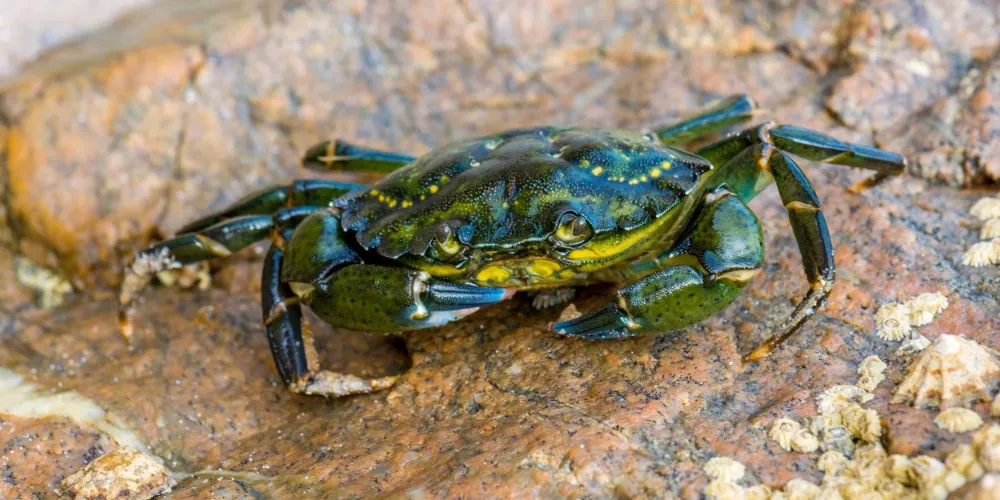
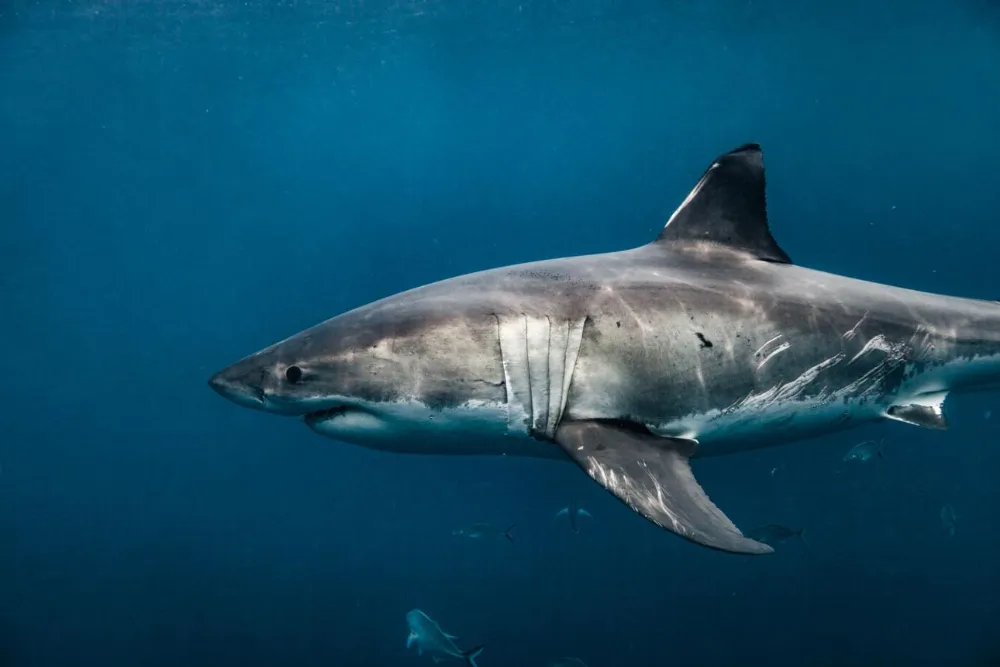
No, octopuses do not have bones. They are soft-bodied invertebrates without a backbone, bony skeleton, or rigid internal framework. Instead, their eight arms are supported by tightly arranged muscles and connective tissues that work together as a muscular hydrostat. This allows an octopus to bend, stretch, twist, and temporarily stiffen its arms without bones. The main rigid structure in an octopus's body is its hard, parrot-like beak, which is one reason these animals can squeeze through remarkably narrow openings.
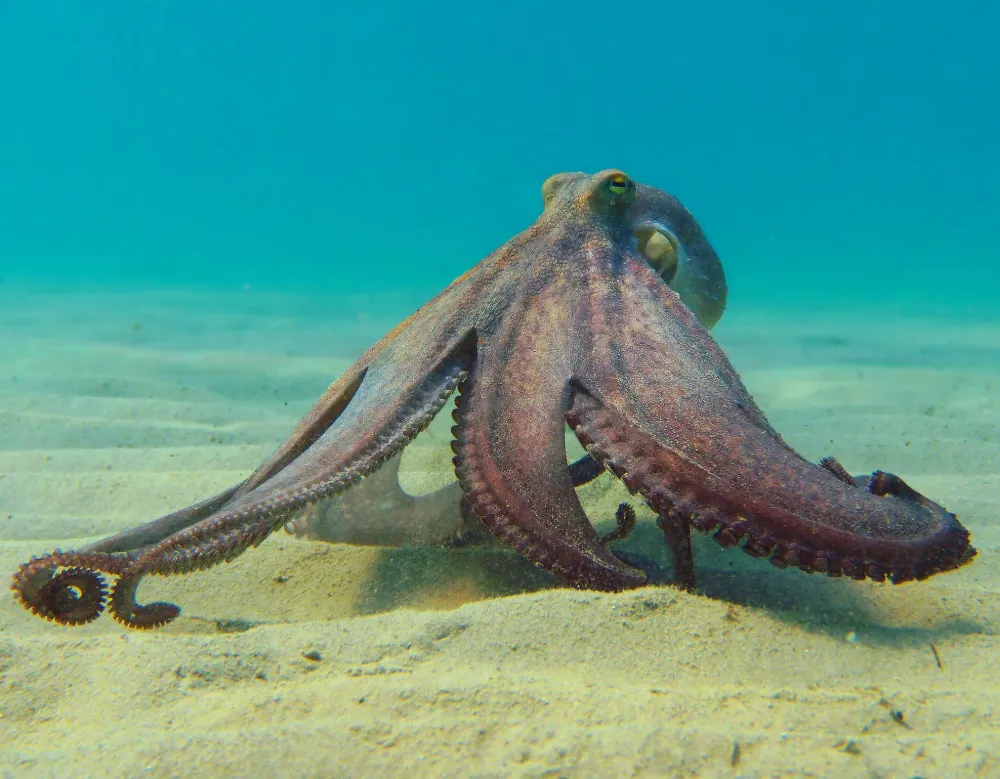
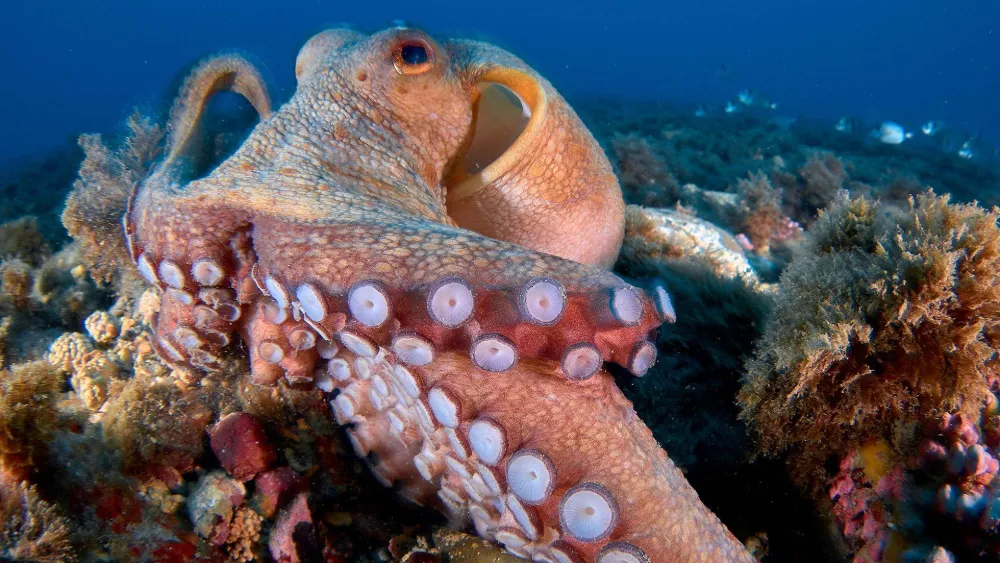
An octopus has no rigid skeleton, allowing its eight muscular arms to bend and move in many directions.
Why Don't Octopuses Have Bones?
Octopuses belong to the phylum Mollusca and the class Cephalopoda, a group that also includes squid, cuttlefish, and nautiluses.
Unlike vertebrates, octopuses do not possess an internal skeleton made of bone or cartilage.
They belong to an evolutionary lineage with a different body organization, relying heavily on muscles, connective tissues, and fluid-filled structures for support and movement.
Modern octopuses also lack the large external shells found in many other mollusks.
The absence of a rigid skeleton provides several functional advantages:
Flexibility: The body and arms can change shape dramatically.
Access to narrow spaces: Octopuses can enter crevices that exclude many similarly sized animals.
Fine motor control: Their arms can bend, twist, extend, shorten, and grip objects.
Hunting: Flexible arms help them explore holes and capture hidden prey.
Camouflage: Their soft bodies can change posture and surface appearance to resemble surrounding objects.
However, having no skeleton also means octopuses lack the physical armor and rigid support that bones or shells provide in other animals.
Their soft tissues can be vulnerable to injury and predators.
Do Octopuses Have Skeletons?
Octopuses do not have conventional internal or external skeletons.
Instead, their arms use a biological support mechanism called a muscular hydrostat.
A muscular hydrostat is a structure made largely of muscle and other nearly incompressible tissues.
When certain muscle groups contract, they change the shape of the structure while other tissues resist deformation.
This allows the structure to generate movement and support without rigid bones.
Other examples of muscular hydrostats include the human tongue and elephant trunk.
Octopus arms are especially complex examples because they combine remarkable flexibility with precise control of movement.
How Do Octopus Arms Work Without Bones?
Octopus arms contain several groups of muscles arranged in different directions.
Research into octopus biomechanics has identified three important muscle orientations:
Longitudinal muscles: Run along the length of the arm and contribute to shortening and bending.
Transverse muscles: Extend across the arm and help produce elongation when they contract.
Oblique muscles: Follow angled or helical paths and contribute to twisting and rotational movements.
These muscles work together with connective tissues to control arm shape.
Because muscle tissue is nearly incompressible, changes in one dimension are balanced by changes in another.
For example, an arm can become longer and thinner or shorter and thicker depending on which muscles contract.
By contracting opposing muscle groups simultaneously, an octopus can also increase the stiffness of part of an arm.
This is why an octopus arm can appear soft and flexible one moment and surprisingly firm the next.
Can Octopuses Make Their Arms Stiff?
Yes. Octopuses can temporarily stiffen sections of their arms through coordinated muscle contractions.
This ability is essential for reaching, manipulating objects, handling prey, and moving through complex environments.
Researchers describe this mechanism as part of the arm's muscular-hydrostat function.
Instead of relying on rigid joints and bones, the octopus produces structural support through muscular activity.
The stiffness can change along different parts of the same arm.
As a result, one region may remain relatively firm while another bends or twists.
This combination of flexibility and adjustable stiffness makes octopus arms an important model for research into soft robotics.
What Is the Hardest Part of an Octopus?
The most important rigid structure in an octopus is its beak.
The beak is a hard, curved feeding structure located at the center of the eight arms, where the mouth opens.
It resembles a parrot's beak in general shape, although its composition and evolutionary origin are different.
The octopus uses its beak to bite and break apart prey.
Octopus beaks are made primarily from specialized organic materials, including chitin-associated proteins, rather than vertebrate bone.
Although the beak is relatively small compared with the rest of the body, it is extremely important for feeding.
It also places a practical limit on the size of openings an octopus can pass through.
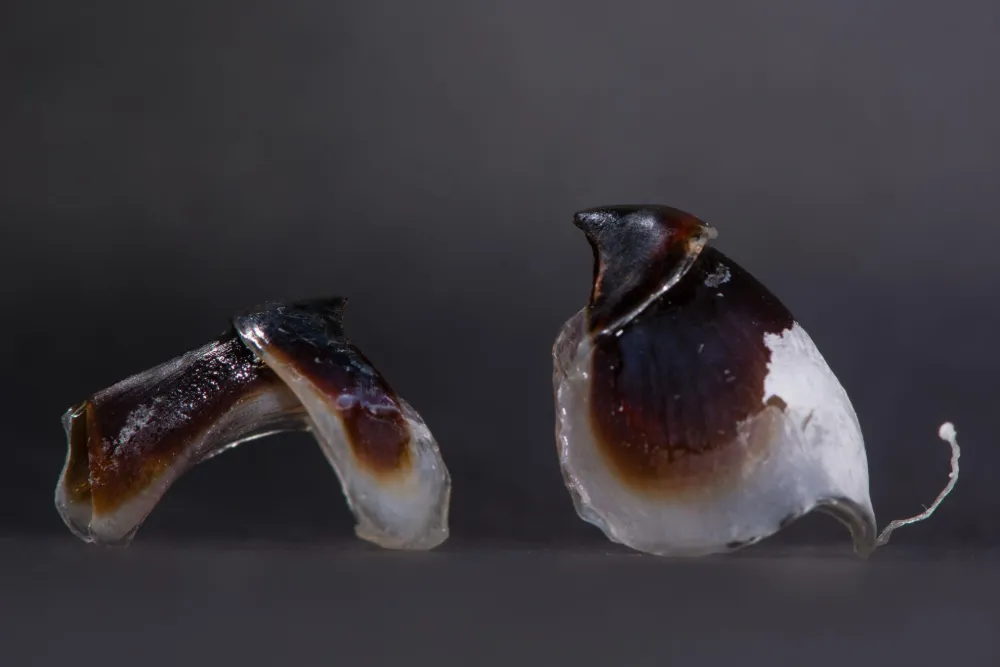
An octopus possesses a hard, chitin-rich beak for biting prey, even though it has no skeletal bones.
Can Octopuses Squeeze Through Tiny Holes?
Yes. Octopuses can pass through openings that seem remarkably small relative to their body size.
Because their arms, mantle, and other major body regions lack rigid skeletal support, they can deform extensively.
The hard beak is generally the most important rigid structure limiting how small an opening can be.
For example, Shedd Aquarium explains that giant Pacific octopuses can move through openings only a few inches across.
However, the exact minimum opening size depends on the animal's size, the dimensions of its beak, body condition, and the shape of the passage.
The common claim that an octopus can fit through any hole larger than its beak is a useful general rule, but it should not be treated as an absolute guarantee under every condition.
Why Can Octopuses Escape Through Small Gaps?
Octopuses are known for exploring confined spaces and manipulating objects with their arms.
In the wild, this helps them enter rocky crevices, search for prey, and find protected shelters.
In aquariums, the same abilities can make them challenging animals to contain.
An octopus may investigate gaps, openings, and movable structures using its arms and suckers.
If an opening is sufficiently large and accessible, the octopus may attempt to pass through it.
This behavior combines body flexibility with sensory exploration and motor coordination.
The Aquarium of the Pacific specifically notes that the absence of bones allows giant Pacific octopuses to fit through very narrow spaces.
Do Octopuses Have Backbones?
No. Octopuses are invertebrates, meaning they do not possess a vertebral column.
Unlike fish and mammals, they have no vertebrae surrounding a spinal cord.
However, they do have a sophisticated nervous system.
An octopus possesses a centralized brain and extensive neural networks running through its arms.
These networks allow the arms to process sensory information and coordinate many movements.
The lack of a backbone does not mean that an octopus lacks a brain, nerves, or complex behavior.
Do Octopuses Have Skulls?
Octopuses do not have bony skulls like vertebrates.
Their brains are surrounded by protective tissues, including a cartilaginous capsule.
This is an important anatomical distinction: although octopuses do not have bones or a conventional skeleton, they do possess some specialized cartilage.
Cartilage is not identical to bone, and the cephalopod cranial capsule does not function as a vertebrate skull.
The octopus nervous system is nevertheless highly developed for an invertebrate.
Its brain processes visual information and contributes to learning, behavior, and movement control.
Do Octopuses Have Joints?
Octopuses do not have the rigid, bone-based joints found in the limbs of humans and other vertebrates.
Their arms can bend almost anywhere along their length.
This produces a much greater range of possible movements than a typical articulated limb.
However, such flexibility creates challenges for motor control.
Rather than controlling a limited set of skeletal joints, the nervous system must coordinate continuous changes in arm shape.
Researchers have identified neural and muscular mechanisms that help manage this complexity.
Studies published in 2019 and 2025 have provided further information about the organization of the nerve pathways inside octopus arms.
How Does an Octopus Control Eight Arms?
Octopus arms have extensive nervous systems that support both sensory processing and movement.
The central brain contributes to controlling behavior, while neural circuits located within the arms perform important local functions.
This arrangement allows the nervous system to distribute some control tasks rather than relying on a single location to specify every muscle contraction.
A 2025 study published in Nature Communications found that octopus axial nerve cords contain a segmented organization.
The researchers identified repeated neural modules associated with the arrangement of arm structures and suckers.
These findings help explain how an octopus can coordinate complex movements in arms that lack rigid skeletons.
However, it is misleading to claim that every octopus arm contains a completely separate brain.
The arms have extensive neural processing abilities, but they remain connected to and coordinated with the central nervous system.
Do Octopuses Have Teeth?
Octopuses do not have rows of vertebrate-style teeth.
Instead, they use their hard beaks and a specialized feeding structure called a radula.
The radula is a ribbon-like organ bearing many tiny tooth-like structures.
It helps process food and can assist with scraping or drilling into certain prey.
At Monterey Bay Aquarium, giant Pacific octopuses are described as using their beaks, arms, and radulae to access hard-shelled prey.
The radula's small tooth-like structures should not be confused with human teeth or a bony jaw.
Are Octopuses Soft All Over?
Most of an octopus's body is highly flexible, but its different tissues do not all have the same mechanical properties.
The arms contain muscle groups that can become firm through contraction.
The mantle surrounds important internal organs and can change shape during respiration and jet propulsion.
The beak remains a rigid feeding structure.
The cartilaginous capsule around the brain provides localized protection.
Therefore, describing an octopus as entirely soft is a useful generalization, but the actual anatomy includes tissues with different degrees of flexibility and stiffness.
Do Squid and Cuttlefish Have Bones?
Squid and cuttlefish are close relatives of octopuses, but their internal support structures differ.
Most squid possess a flexible internal structure called a pen or gladius.
Cuttlefish have a more substantial internal structure called a cuttlebone.
Despite its name, the cuttlebone is not true vertebrate bone. It is a mineralized internal shell.
Octopuses lack these prominent internal shell structures in their typical modern forms.
| Animal | True Bones | Main Support Structure |
|---|---|---|
| Octopus | No | Muscular hydrostats and connective tissue |
| Squid | No | Muscles and internal pen |
| Cuttlefish | No | Muscles and internal cuttlebone |
| Shark | No true skeletal bone | Cartilaginous skeleton |
| Bony fish | Yes | Bony internal skeleton |
How Does Having No Bones Help an Octopus Hunt?
Boneless bodies allow octopuses to investigate complex habitats and reach prey in narrow spaces.
An octopus can extend an arm into a crevice while keeping most of its body outside.
Its suckers help detect and manipulate objects, and the arm can bend around irregular surfaces.
Many octopuses feed on crustaceans and mollusks.
They may use their arms to restrain prey before manipulating it with the beak and other feeding structures.
Their ability to change shape also helps them avoid predators by entering sheltered spaces.
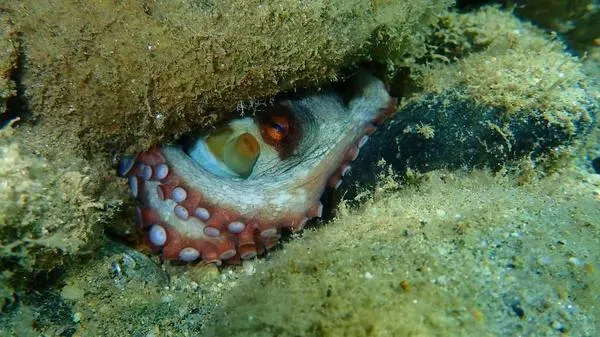
Flexible, boneless arms allow octopuses to explore narrow crevices and search for hidden prey.
Can an Octopus Break a Bone?
An octopus cannot break one of its own skeletal bones because it has no true bones.
However, it can still experience serious physical injuries.
Its muscles, connective tissues, nerves, and internal organs can be damaged by predators, mechanical forces, or environmental hazards.
Some octopuses can regenerate damaged or lost arms over time.
Regeneration depends on species, injury severity, and the animal's condition.
The ability to regenerate tissue does not mean that octopuses are immune to injury.
Why Do Scientists Study Boneless Octopus Arms?
Octopus arms provide an important biological model for understanding movement without rigid joints.
Researchers study how muscle arrangements, connective tissues, and neural control systems allow octopuses to produce complex shapes and movements.
This research is relevant to soft robotics, a field that develops flexible machines inspired by biological systems.
A soft robotic arm can potentially navigate narrow spaces or handle delicate objects that are difficult for rigid machinery.
However, engineered systems do not yet reproduce every aspect of octopus anatomy or motor control.
Understanding how these animals coordinate their muscles and nerves may contribute to future advances in robotics and biomechanics.
Frequently Asked Questions
How many bones does an octopus have?
An octopus has zero true skeletal bones. Its flexible arms rely on muscles and connective tissues for structural support.
Does an octopus have a skeleton?
No. Octopuses lack a conventional rigid skeleton. Their arms function as muscular hydrostats.
Do octopuses have spines?
No. Octopuses are invertebrates and do not have spinal columns or vertebrae.
What is the only hard part of an octopus?
The beak is the main rigid feeding structure and an important limitation on how narrow an opening an octopus can enter. Octopuses also have specialized protective cartilage around the brain.
How small of a hole can an octopus fit through?
An octopus can pass through surprisingly narrow openings if its rigid beak and other anatomical structures can pass safely. The minimum size depends on the species and individual.
Do octopus tentacles have bones?
No. Octopus arms do not contain bones. Strictly speaking, octopuses have eight arms rather than the specialized feeding tentacles found in squid.
Can octopuses make their arms hard?
Yes. Coordinated contractions of different muscle groups allow an octopus to increase the stiffness of portions of its arms.
Do baby octopuses have bones?
No. Young octopuses also lack true skeletal bones, although their body proportions and development differ from those of adults.
Do octopuses have cartilage?
Yes. Octopuses possess specialized cartilage, including protective tissue around the brain, but they do not have cartilaginous skeletons like sharks.
Are octopuses related to jellyfish?
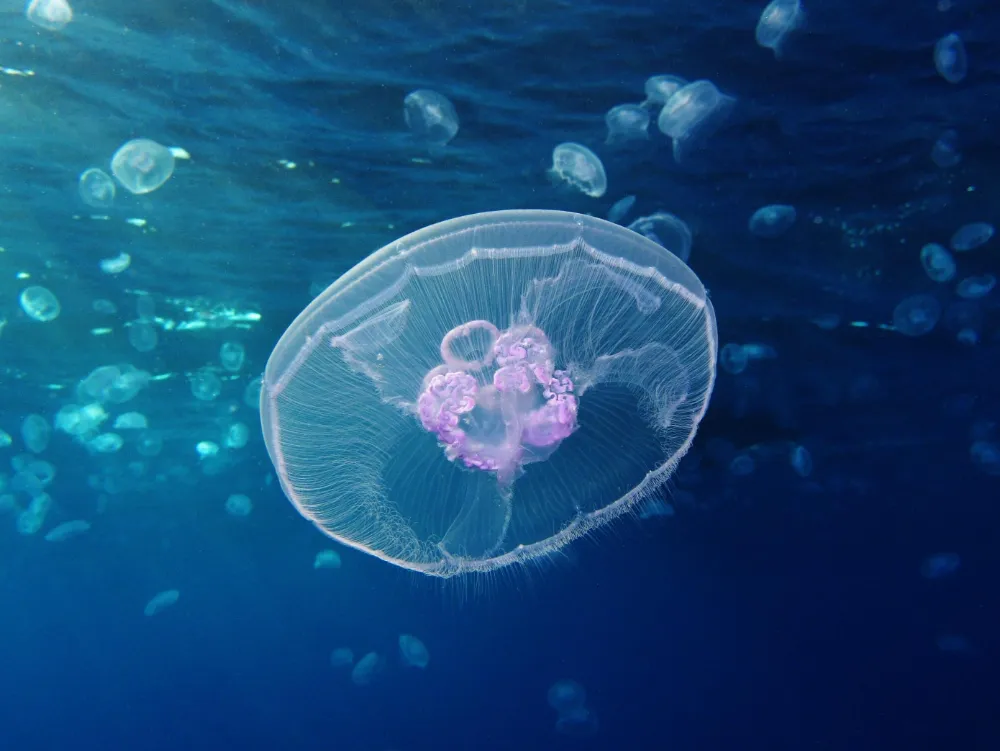
Both are invertebrates, but they belong to different evolutionary groups. Octopuses are mollusks, while jellyfish belong to the phylum Cnidaria.
The Bottom Line
Octopuses have no bones, backbone, or conventional rigid skeleton. Their remarkable flexibility comes from muscular hydrostats, which allow the arms to bend, stretch, twist, and become temporarily stiff.
Although octopuses possess a hard beak and some specialized cartilage, most of their bodies can change shape dramatically.
These adaptations help them explore narrow spaces, capture prey, escape predators, and perform complex movements without the bones and joints used by vertebrates.
Sources & Further Reading
The following aquarium resources and peer-reviewed research explain octopus anatomy, muscular hydrostats, beaks, and nervous-system control.
Shedd Aquarium — Giant Pacific Octopus. Explains the absence of bones, body flexibility, and the role of the hard beak in limiting passage through narrow openings.
Monterey Bay Aquarium — Giant Pacific Octopus. Describes octopus feeding anatomy, beak function, and soft-bodied adaptations.
Zullo et al. (2019) — Motor Control Pathways in the Nervous System of Octopus vulgaris Arm. Scientific study of neural organization and muscular-hydrostat movement.
Kier and Stella (2007) — The Arrangement and Function of Octopus Arm Musculature and Connective Tissue. Detailed anatomical research explaining arm muscles and movement.
Olson et al. (2025) — Neuronal Segmentation in Cephalopod Arms. Research on the segmented organization of nerve cords in octopus arms.