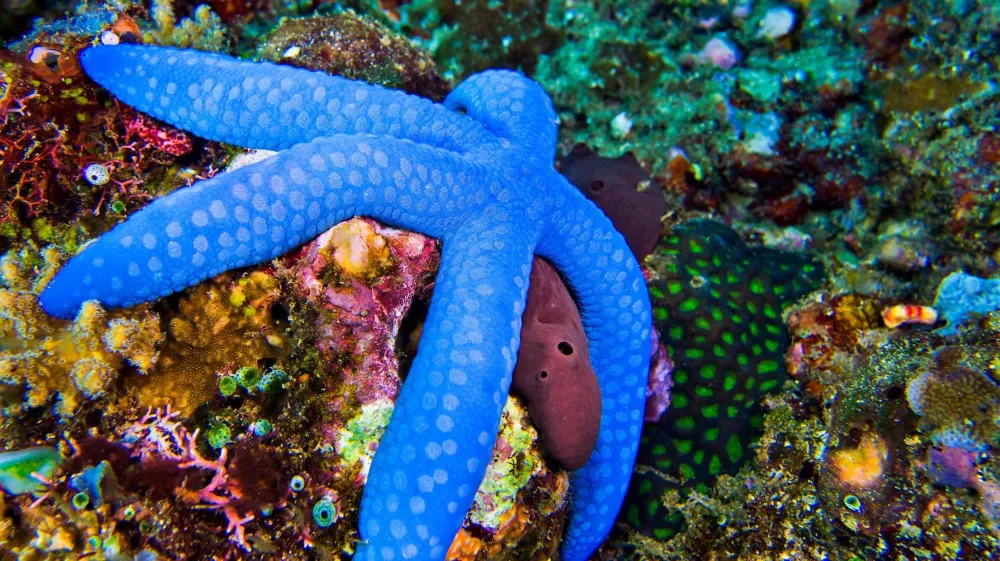
Yes, many starfish have eyes, but their eyes are very different from human eyes. Most studied sea star species have a small light-sensitive eye at or near the tip of each arm. A typical five-armed starfish may therefore have five eyes. These eyes cannot see fine details like human eyes, but some species can detect light, dark shapes, and large objects in their surroundings. Research has even shown that certain starfish use their eyes to navigate toward coral reefs, despite having no centralized brain.
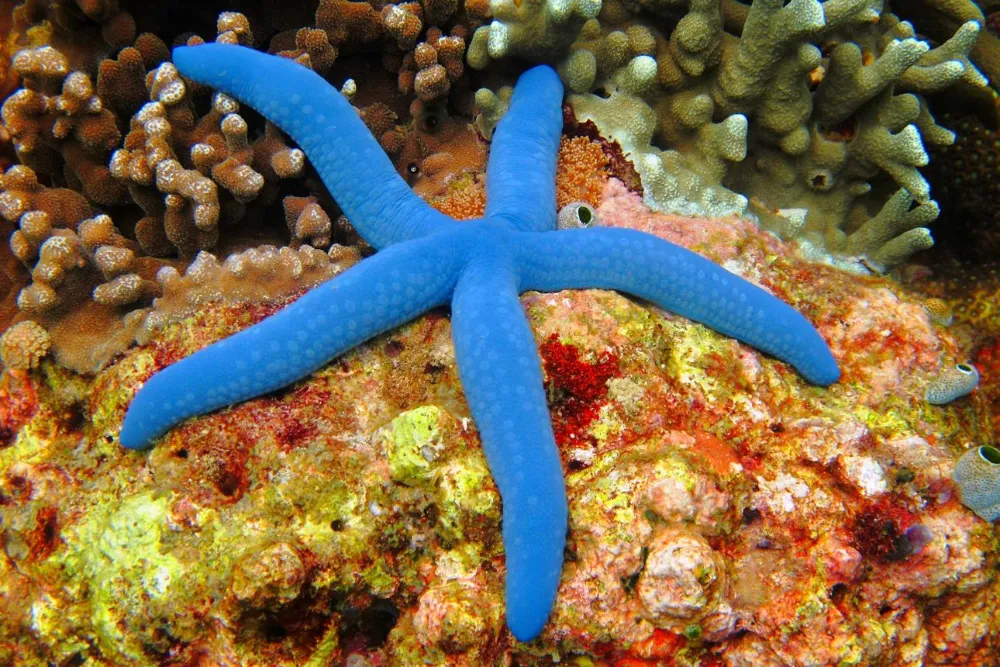
Many sea stars possess small eyes near the tips of their arms, although these structures are difficult to see without magnification.
Where Are a Starfish's Eyes Located?
In many starfish species, the eyes are located near the tips of their arms.
These small sensory structures are commonly called eyespots or terminal eyes.
They are usually associated with specialized tube feet at the ends of the arms.
Unlike human eyes, which are positioned on the face, sea star eyes are distributed around the animal's body.
This arrangement reflects the radial body organization of echinoderms.
Many sea stars have five arms arranged around a central disc, although some species have considerably more.
An eye at each arm tip allows the animal to collect visual information from multiple directions.
However, the eyes are often extremely small and may be partly obscured by surrounding structures.
They are generally not visible in ordinary photographs of sea stars.
How Many Eyes Does a Starfish Have?
A typical five-armed starfish may have five eyes, with one located near the tip of each arm.
However, not every starfish has exactly five arms, and not every species has the same visual structures.
Some sea stars have more than five arms, while certain species have reduced or absent eyes.
For example, research on Arctic sea stars found that 12 of 13 examined species possessed eyes, while one species, Ctenodiscus crispatus, lacked the terminal eyes observed in the others.
This demonstrates that eye anatomy varies among species.
The familiar statement that every starfish has five eyes is therefore an oversimplification.
What Do Starfish Eyes Look Like?
Sea star eyes are typically small clusters of light-sensitive structures located at the arm tips.
In species such as the blue sea star (Linckia laevigata), the eye contains many small optical units.
These structures resemble certain features of arthropod compound eyes, although sea star eyes have their own distinctive anatomy.
Researchers have described numerous individual visual units, called ommatidia, within these terminal eyes.
Each unit contains photoreceptor cells that respond to light.
The arrangement allows some sea stars to detect broad visual patterns rather than producing detailed images.
Starfish eyes should not be imagined as tiny human eyeballs with large pupils, movable eyelids, or obvious facial expressions.
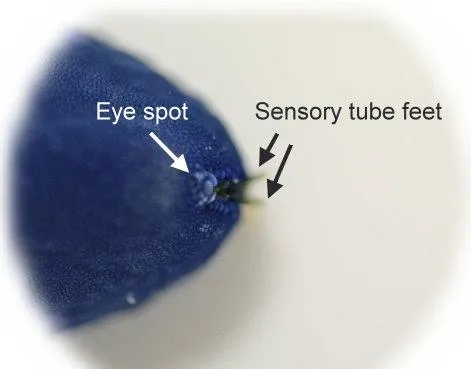
The eye of a sea star is a tiny sensory organ associated with the tip of an arm, not a large eyeball like those found in vertebrates.
Can Starfish Actually See?
Yes. Scientific research has demonstrated that at least some starfish species can use vision to guide their movements.
However, their visual abilities are much more limited than those of humans and many other animals.
A 2014 study published in Proceedings of the Royal Society B investigated the visual abilities of the blue sea star, Linckia laevigata.
The researchers found that these sea stars could form low-resolution visual images.
They also discovered that individuals with intact eyes could navigate toward their coral reef habitat after being moved away from it.
Sea stars whose eyes had been experimentally disabled did not show the same visually guided navigation.
This provided important evidence that sea star eyes can have practical functions beyond merely detecting changes in brightness.
What Can Starfish See?
Some sea stars can distinguish broad differences between light and dark areas and may detect large shapes in their surroundings.
For example, a coral reef may appear as a large dark structure against the brighter background of open water.
This contrast can provide useful information for navigation.
However, sea star vision is generally low in spatial resolution.
That means a starfish cannot be assumed to recognize detailed patterns, small objects, or facial features in the way humans do.
Its visual system is better understood as an adaptation for detecting information relevant to its environment.
The exact visual capabilities depend on the species.
Can Starfish See Colors?
Color vision has not been demonstrated across starfish as a group.
In the 2014 study of Linckia laevigata, researchers found that the visual system was effectively color-blind under the tested conditions.
The eyes were sensitive to particular wavelengths of light, but this did not provide evidence for distinguishing colors as humans do.
Instead, the animals appeared capable of detecting differences in brightness and contrast.
These abilities were sufficient to help them navigate toward suitable reef habitats.
Scientists should not assume that every sea star species has exactly the same sensitivity or visual capabilities.
Do Starfish Have Brains?
No. Starfish do not possess a centralized brain comparable to those of vertebrates.
Instead, they have a decentralized nervous system that includes a nerve ring around the mouth and radial nerves extending along the arms.
This arrangement helps coordinate movement, sensory responses, and other physiological activities.
Information from sensory structures can influence behavior without being processed by a single central brain.
The absence of a centralized brain does not mean a starfish is unable to respond to its environment.
Sea stars can detect chemical signals, respond to touch, coordinate their tube feet, and, in some species, use vision.
Their nervous systems demonstrate that animals can process sensory information using very different anatomical arrangements.
How Do Starfish Navigate Without Brains?
Sea stars use several forms of sensory information to navigate their environments.
Depending on the species, these may include:
Vision: Detecting broad shapes and contrasts.
Chemical sensing: Responding to substances dissolved in seawater.
Touch: Detecting contact with surfaces and obstacles.
Environmental signals: Responding to conditions such as light and water movement.
Movement is carried out by numerous tube feet controlled through the water vascular and nervous systems.
The tube feet attach to surfaces and produce coordinated locomotion.
Sea stars do not need to see every individual obstacle clearly to move through their environment.
Instead, different sensory pathways contribute to their behavior.
How Do Starfish Use Their Eyes to Find Coral Reefs?
Some reef-dwelling sea stars can use the visual contrast between coral reefs and surrounding open water to orient themselves.
The blue sea star (Linckia laevigata) provides one of the best-studied examples.
Researchers found that the animals could move toward their reef habitat when visual information was available.
Their low-resolution eyes did not need to identify individual coral species.
Instead, detecting the overall shape and contrast of the reef could provide enough information for navigation.
This demonstrates that even relatively simple eyes can provide an important evolutionary advantage.
Do Deep-Sea Starfish Have Eyes?
Some deep-sea starfish possess well-developed eyes, even in environments where sunlight is extremely limited.
A 2018 study examined 13 sea star species collected from waters around Greenland.
Researchers discovered substantial variation in eye structure and potential visual sensitivity.
One deep-sea species, Novodinia americana, possessed eyes with surprisingly high spatial resolution compared with other known sea star eyes.
The researchers also found bioluminescence in certain examined species.
They proposed that light production might have a role in communication in some deep-sea sea stars.
However, the idea that these animals use bioluminescent signals for communication remains a hypothesis rather than a conclusively demonstrated behavior.
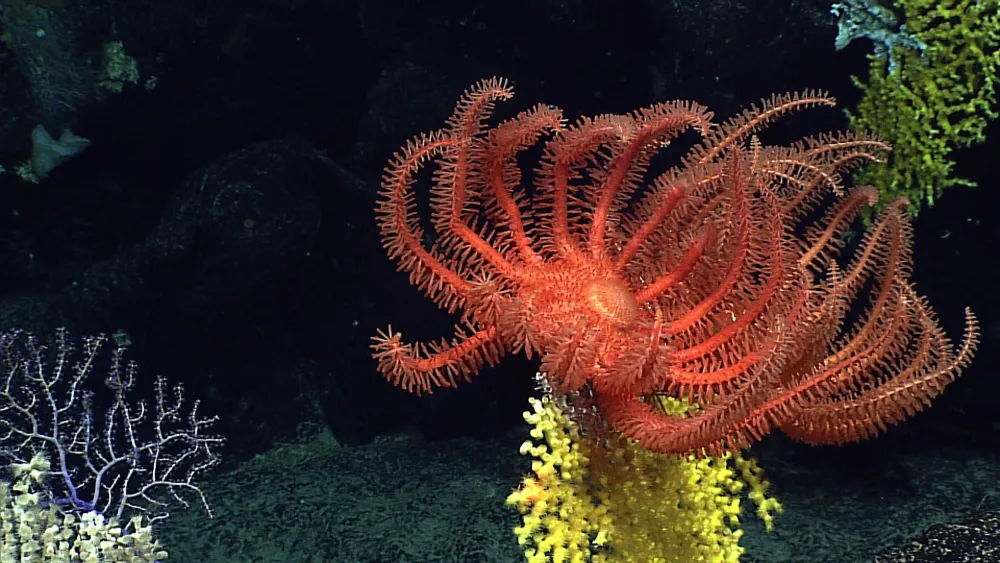
Some deep-sea sea stars have specialized eyes, although their visual abilities vary greatly between species.
Are Starfish Eyes Similar to Insect Eyes?
There are some interesting structural similarities between certain sea star eyes and arthropod compound eyes.
Both can contain multiple small visual units that contribute to the detection of light and spatial information.
However, the underlying evolutionary histories and optical structures differ.
Many insects possess highly developed compound eyes capable of detecting rapid movement and detailed visual patterns.
Sea star eyes generally provide much lower spatial resolution.
The comparison is useful for understanding how different animal lineages have evolved visual systems, but the structures should not be treated as identical.
Can Starfish See in the Dark?
Some sea stars have visual systems adapted to relatively low-light environments.
However, the phrase "see in the dark" can be misleading.
Eyes need some form of light to produce visual information.
In shallow water, this light may come from sunlight penetrating the ocean.
In deep-sea habitats, ambient sunlight becomes extremely weak or disappears entirely.
Bioluminescence from marine organisms can provide a possible source of visual signals.
Research on deep-sea sea stars suggests that some species possess unusually sensitive eyes, but their actual visually guided behaviors remain incompletely understood.
Do All Starfish Have Eyes?
No. Although eyes are widespread among studied sea stars, their presence is not universal.
Some species have reduced or absent terminal eyes.
Eye structure and visual sensitivity also vary among those species that possess eyes.
These differences likely reflect the animals' habitats, behavior, and evolutionary history.
A sea star living on an exposed coral reef may experience very different visual conditions from one buried in sediment or living in the deep ocean.
The presence of eyes alone does not establish how well a species can see.
Starfish Vision vs. Human Vision
| Feature | Sea Stars | Humans |
|---|---|---|
| Eyes | Present in many species | Two eyes |
| Eye location | Often at arm tips | Front of head |
| Centralized brain | Absent | Present |
| Visual detail | Usually low resolution | High resolution |
| Color vision | Not established across species | Well developed |
| Visual navigation | Demonstrated in some species | Well developed |
| Eye movement | No human-like eye movements | Extensive |
These differences reflect two very different approaches to detecting and responding to visual information.
Why Are Starfish Eyes Important to Science?
Sea star eyes provide valuable information about the evolution of animal vision.
They demonstrate that eyes do not need to produce detailed images to influence behavior.
Even a visual system capable of detecting large shapes and contrasts may provide important ecological benefits.
By comparing sea star eyes with those of other animals, researchers can investigate how different levels of visual complexity relate to behavior.
Sea stars are also useful for studying sensory processing in decentralized nervous systems.
Their anatomy shows that visual behavior can emerge without a large central brain.
Frequently Asked Questions
Does a starfish have five eyes?
Many five-armed sea stars have one small eye near the tip of each arm, giving them five eyes. However, some species have different arm numbers or lack typical terminal eyes.
Where are the eyes on a starfish?
In many species, the eyes are located at or near the tips of the arms, associated with specialized terminal tube feet.
Can starfish see humans?
Some sea stars can detect broad visual shapes, but there is no evidence that they can recognize human faces or fine details as humans do.
Do starfish have eyeballs?
Sea stars do not have human-like eyeballs. Many species possess small terminal eyes containing specialized light-sensitive structures.
Are starfish blind?
Not all starfish are blind. Some possess functional eyes and can use vision to navigate, while the visual capabilities of different species vary.
Can starfish see colors?
Color vision has not been established across sea stars. Experiments on the blue sea star indicate low-resolution, color-blind vision.
Do starfish have eyes and brains?
Many sea stars have eyes but no centralized brain. Their decentralized nervous systems process sensory information and coordinate behavior.
Can a starfish see with its arms?
In species with terminal eyes, the eyes are located near the arm tips. They collect visual information, while the arms also support movement and other sensory functions.
Do deep-sea starfish have eyes?
Some deep-sea species have specialized eyes. Studies have identified substantial differences in eye sensitivity and resolution among deep-sea sea stars.
The Bottom Line
Many starfish have eyes located near the tips of their arms, even though they lack centralized brains.
These small visual structures generally provide low-resolution information, allowing certain species to detect contrasts, large shapes, and suitable habitats.
Research on reef-dwelling and deep-sea sea stars demonstrates that their visual systems are more diverse and capable than their simple appearance might suggest.
Starfish vision shows that even a small eye can be useful when it provides the information an animal needs to survive.
Sources & Further Reading
The following scientific institutions and peer-reviewed research papers provide information about sea star eyes, visual navigation, and the evolution of vision.
Smithsonian Ocean — Echinoderms: Sea Stars, Urchins, Sand Dollars, and Relatives. Explains sea star eyespots, nervous systems, and differences in visual abilities.
Garm and Nilsson (2014) — Visual Navigation in Starfish: First Evidence for the Use of Vision and Eyes in Starfish. Experimental research demonstrating visually guided navigation in the blue sea star.
Birk et al. (2018) — Deep-Sea Starfish from the Arctic Have Well-Developed Eyes in the Dark. Research examining eyes, visual sensitivity, and bioluminescence in Arctic sea stars.
University of Copenhagen — Visual Navigation in Starfish. Academic publication record for the study of sea star vision and reef navigation.