Wombats produce cube-shaped poop because their intestines have regions with different mechanical properties. As digested material moves through the final part of the intestine, it becomes drier and is shaped by repeated muscular contractions. Researchers found that alternating stiffer and more flexible sections of the intestinal wall help produce the flat sides and corners of wombat droppings. The cubes form inside the intestine, not because wombats have square anuses. Wombats often deposit their droppings on prominent surfaces, where the unusual shape may help them remain grouped. However, scientists have not conclusively established why the cube shape evolved.
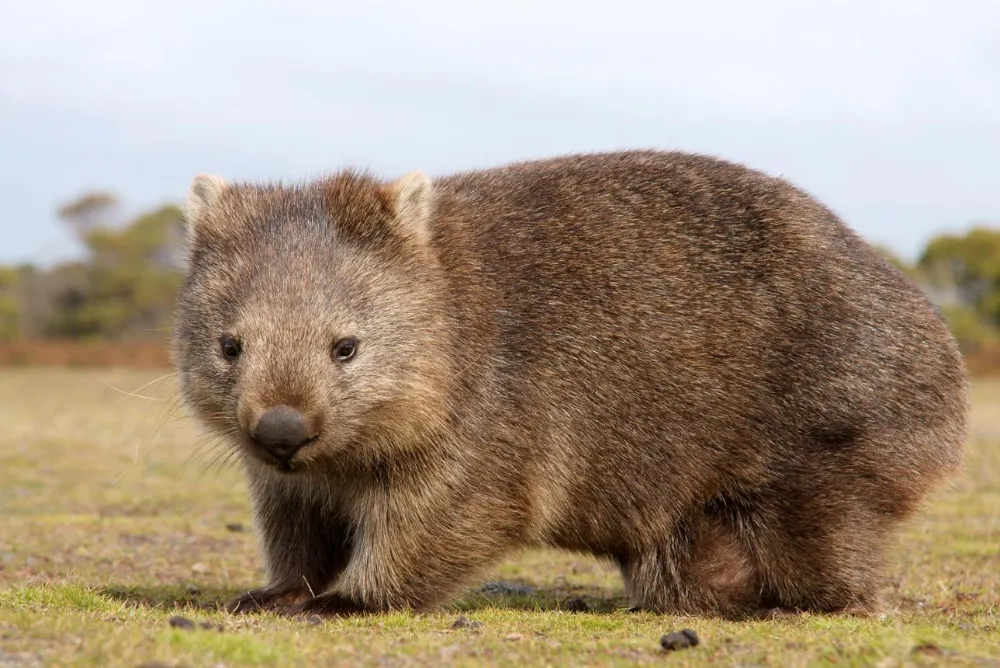
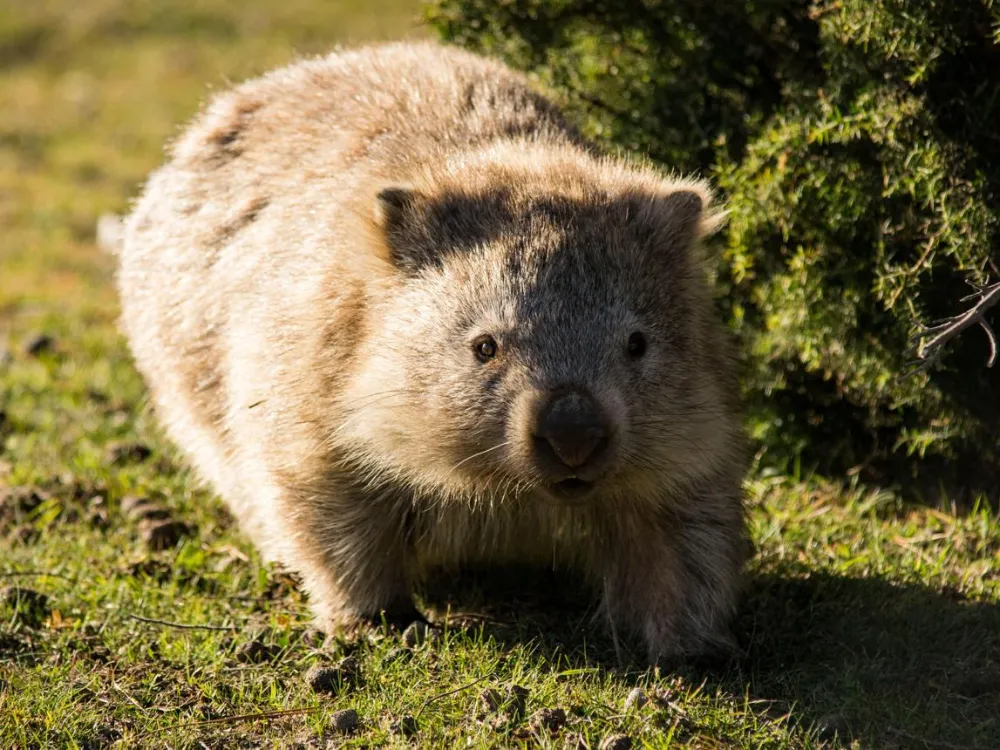
The common wombat is an Australian marsupial famous for producing unusually cube-shaped droppings.
Why Do Wombats Poop Cubes?
Wombats are among the most unusual mammals in Australia.
These stocky, burrowing marsupials are famous for an unexpected biological feature: their droppings often have flat sides and distinct corners.
Unlike the rounded pellets or cylindrical droppings produced by many other mammals, wombat feces commonly resemble small cubes.
Scientists have investigated how these shapes form.
The answer involves a combination of intestinal anatomy, differences in tissue stiffness, muscle contractions, and the drying of digested material.
Research published in 2021 demonstrated that the unusual shape develops inside the last portion of the intestine.
However, the exact evolutionary benefit of producing cubes remains less certain than the physical mechanism responsible for their formation.
Do Wombats Really Poop Cubes?
Yes. Cube-shaped feces are a well-documented characteristic of wombats.
However, the droppings are not always perfect mathematical cubes.
Individual pieces can have uneven surfaces, rounded corners, and variations in shape.
The term cube-shaped describes their characteristic blocky appearance.
The common wombat, also known as the bare-nosed wombat, is particularly well studied in this regard.
Researchers have collected and examined its droppings and the digestive tissues responsible for forming them.
The unusual shape is a genuine biological feature, not a visual trick or an internet fabrication.
How Do Wombats Make Cube-Shaped Poop?
The process begins with ordinary digestion.
Wombats eat plant material, which passes through their digestive systems.
As the material moves through the intestine, water is absorbed and the contents gradually become more solid.
Near the end of the digestive tract, the intestinal wall contains regions that differ in thickness and mechanical stiffness.
Muscular contractions move and compress the contents.
Because different regions of the intestinal wall respond differently to these forces, the material can develop corners and relatively flat surfaces.
By the time the feces reach the final stage of the digestive tract, they have already acquired much of their characteristic shape.
What Did Scientists Discover in 2021?
In 2021, researchers published a study titled Intestines of Non-Uniform Stiffness Mold the Corners of Wombat Feces in the scientific journal Soft Matter.
The project involved researchers from Georgia Institute of Technology, the University of Tasmania, and other institutions.
Scientists examined wombat intestinal tissues and used mechanical testing to measure their properties.
They also developed mathematical models to investigate how a flexible tube could shape soft material into a block-like form.
The researchers found that the intestines were not mechanically uniform around their circumference.
Some regions were thicker and stiffer than others.
The models showed how contractions of a tube containing alternating stiff and flexible sections could create flattened surfaces and corners.
The findings provided a physical explanation for a question that had puzzled biologists and engineers.
Where Do the Cubes Form?
The 2021 study found that wombat droppings develop their cube-like shape within the final approximately 17 percent of the intestine.
This region is part of the distal digestive tract, where digested material has become relatively dry.
Earlier in digestion, the contents do not yet possess the final characteristic shape.
The researchers concluded that repeated muscular contractions and differences in intestinal wall stiffness contribute to the formation of corners.
Importantly, the shape is already present before the material exits the body.
This means the cubes are not created by a square-shaped opening at the end of the digestive system.
Do Wombats Have Square Anuses?
No. Wombats do not have square anuses.
This is a popular explanation, but it is incorrect.
The 2021 research demonstrated that the cube shape develops inside the intestine.
By examining the internal digestive tract and measuring its mechanical properties, scientists identified the process responsible for forming the corners.
Therefore, the animal does not need an unusually shaped anus to produce cubical droppings.
The unusual feature is the way different parts of its intestine respond to muscular forces.
Why Is Intestinal Stiffness Important?
Stiffness describes how strongly a material resists deformation.
A stiff material generally changes shape less than a flexible material under similar conditions.
The 2021 wombat study found that different regions of the intestinal wall had different mechanical properties.
In the examined tissues, some regions were approximately twice as thick and four times as stiff as others.
This difference is important because the intestinal wall does not deform uniformly during contraction.
Instead, regions with different stiffness respond differently to the same mechanical forces.
The researchers showed that these differences could help create the corners of the droppings.
How Can a Soft Intestine Make Corners?
Most people associate cubes with rigid molds, cutting tools, or sharp-edged containers.
Wombats create a similar shape using soft biological tissue.
The key is that the tissue does not stretch and contract uniformly.
Imagine a flexible ring with some sections that resist deformation more than others.
When the ring is compressed, its shape may not remain circular.
Under certain conditions, the differences in stiffness can produce flatter regions and more pronounced corners.
The 2021 study demonstrated this effect using mathematical simulations.
However, the researchers were modeling an important mechanism rather than reconstructing every cellular event inside a living wombat.
Does the Intestine Squeeze the Poop Into Cubes?
Muscular contractions help move and shape the contents of a wombat's intestine.
However, it would be too simple to imagine four rigid walls squeezing the material into a perfect cube.
The real intestine is a living, flexible tube.
Its walls contain muscles and other tissues with varying mechanical properties.
As the contents move through the final section, repeated contractions interact with those differences.
The resulting forces help form the block-like shape.
Drying also contributes because the feces need to maintain their shape after leaving the body.
Why Does Drying Matter?
Wombat droppings are often relatively dry.
As food material passes through the digestive tract, water is absorbed.
Drier material can retain defined surfaces and edges more effectively than very wet material.
The University of Tasmania explains that the drying of feces in the distal intestine works together with muscular contractions.
However, dryness alone does not explain the cube shape.
Many mammals produce dry droppings without making cubes.
The distinguishing feature of wombats is the combination of material consistency and their unusual intestinal mechanics.
What Makes Wombat Digestion Different?
Wombats are herbivorous marsupials adapted to feeding on fibrous plant material.
Their digestive systems allow them to process grasses and other vegetation.
They can retain digested material for extended periods, allowing microbial fermentation and the absorption of nutrients and water.
The long digestive process contributes to the production of relatively firm feces.
However, the cube shape is not simply caused by eating grass.
Many grazing mammals eat fibrous vegetation but produce rounded pellets or other shapes.
Wombat-specific intestinal anatomy provides the additional mechanical explanation.
Do Wombats Have Long Intestines?
Wombats possess long digestive tracts relative to their body size.
The University of Tasmania describes the common wombat intestine as approximately ten meters long.
However, anatomical measurements vary among animals and depend on exactly which sections are measured.
The digestive tract supports prolonged processing of plant material.
The cube-forming mechanism is concentrated near its final section rather than occurring uniformly along the entire intestine.
How Do Wombat Intestines Compare With Human Intestines?
Humans and wombats both have muscular intestines that move digested material through the body.
However, the two species differ in diet, gut anatomy, and the mechanical properties of their digestive tissues.
The 2021 research identified distinct stiffness differences around sections of the wombat intestine.
These differences were important to the modeled formation of corners.
Human feces generally do not acquire the same regular block-like form.
However, the study does not imply that human intestinal tissues are mechanically uniform in every respect.
The relevant finding concerns a particular wombat adaptation.
Wombat Poop vs. Other Mammal Poop
| Animal | Common Dropping Shape | Important Qualification |
|---|---|---|
| Common wombat | Block-like or cube-shaped | Not mathematically perfect cubes |
| Rabbit | Often round pellets | Produces different kinds of fecal material |
| Deer | Often oval pellets | Shape varies with diet and conditions |
| Horse | Rounded masses or balls | May break apart |
| Human | Often cylindrical or irregular | Shape varies considerably |
The distinctive feature of wombats is the relatively regular formation of flat-sided droppings through soft intestinal tissues.
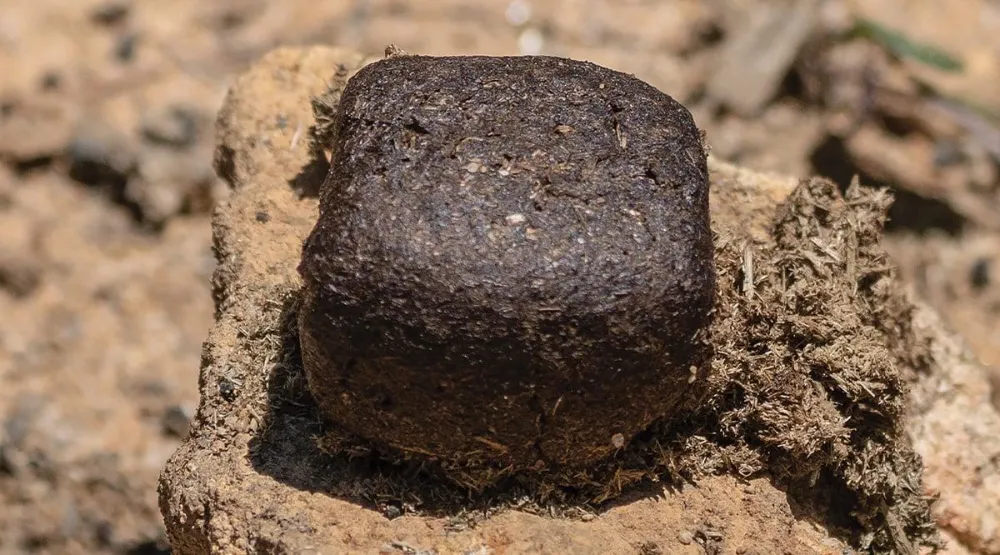
Wombat droppings have distinctive flat faces and corners, although individual pieces are not perfect geometric cubes.
Why Do Wombats Poop on Rocks?
Wombats frequently deposit droppings at noticeable locations within their home ranges.
These may include rocks, logs, raised areas, or places near burrows.
Scientists interpret such deposits as potential sources of information for other wombats.
Droppings contain chemical cues that may be investigated by other individuals.
However, the exact messages conveyed by fecal deposits are still being studied.
It is too simplistic to assume that every dropping marks an aggressively defended territorial boundary.
Wombat space use and interactions are more complicated than that popular explanation suggests.
Do Wombats Use Poop to Mark Territory?
Wombat droppings are often described as territorial markers.
However, scientific reviews suggest that this wording needs qualification.
Wombats deposit feces at prominent points in their home ranges.
Other individuals may investigate these deposits through smell.
Nevertheless, scientists have not fully established the exact meaning of every fecal signal.
Information could potentially concern individual identity, reproductive state, or local activity.
The 2024 review in Annual Review of Animal Biosciences identifies several of these possibilities as hypotheses.
The presence of a scent deposit should therefore not automatically be interpreted as proof of a fixed territorial border.
Do Cube-Shaped Droppings Help Wombats Communicate?
The unusual shape may help droppings remain grouped or visible on certain surfaces.
Researchers have discussed how block-like pieces may accumulate differently from rounded ones.
However, scientists have not conclusively demonstrated that this benefit was the specific evolutionary reason the shape developed.
The communication function of the deposits and the mechanical mechanism producing them are separate scientific questions.
One concerns how the intestine shapes feces.
The other concerns how the resulting deposits influence wombat behavior and evolution.
Do Wombat Poop Cubes Stop Rolling Away?
Flat-sided objects can be less likely to roll across some surfaces than rounded objects.
This makes the popular explanation appealing.
However, the evolutionary claim that wombats developed cube-shaped poop specifically to prevent rolling has not been established conclusively.
Researchers have discussed the possibility that the shape helps droppings remain on rocks or other elevated surfaces.
But the presence of a possible advantage does not automatically prove why a trait evolved.
Additional ecological and evolutionary evidence would be needed to establish that explanation.
Why Do Scientists Study Wombat Poop?
At first, cube-shaped droppings may seem like a humorous scientific topic.
However, the phenomenon raises a serious question about the mechanics of soft tissues.
How can a flexible biological tube create sharp corners without rigid molds?
The 2021 study demonstrated that differences in stiffness and repeated contractions provide part of the explanation.
Such findings are relevant to biomechanics and the study of digestive systems.
Researchers have also suggested that the principles may inspire future investigations into manufacturing or medical applications.
However, these possible applications remain separate from the biological findings themselves.
Can Wombat Research Help Engineering?
The wombat intestine provides an unusual example of geometric shape formation using soft materials.
Conventional manufacturing often creates cubes by cutting a solid material or shaping it inside a rigid mold.
The wombat's digestive tract uses a different physical process.
Its flexible walls contain regions with different mechanical properties.
Repeated contractions act on soft material while it gradually becomes firm enough to hold a shape.
Researchers have suggested that studying this mechanism may provide insights into soft-material processing.
However, these ideas should be treated as potential research directions rather than already commercialized technologies.
What Species of Wombat Makes Cube-Shaped Poop?
The best-known and most extensively studied example is the common wombat, Vombatus ursinus.
It is also called the bare-nosed wombat.
Australia has three living wombat species.
The other two are the southern hairy-nosed wombat, Lasiorhinus latifrons, and the northern hairy-nosed wombat, Lasiorhinus krefftii.
Wombats are generally associated with distinctive block-like feces.
However, the detailed mechanical experiments published in 2021 focused on the bare-nosed wombat.
Results from this species should not automatically be treated as equally precise measurements for the other two.
Are Wombats Marsupials?
Yes. Wombats are marsupial mammals native to Australia.
Marsupials include animals such as kangaroos, wallabies, and koalas.
They share reproductive and developmental characteristics, although their lifestyles differ greatly.
Wombats are powerful digging animals with short legs and sturdy bodies.
They build burrows and feed mainly on vegetation.
Their cube-shaped droppings are one of their distinctive adaptations.
Are Wombats Related to Koalas?
Yes. Wombats and koalas are close evolutionary relatives within the marsupial group Vombatiformes.
However, their lifestyles are very different.
Koalas spend much of their time in trees.
Wombats are specialized for digging and living in burrows.
They also differ in diet, body structure, and digestive physiology.
The fact that koalas are related to wombats does not mean they also produce cube-shaped droppings.
What Do Wombats Eat?
Wombats are herbivores.
They feed largely on grasses and other fibrous vegetation.
Their digestive systems help process this material and extract usable nutrients.
However, the particular foods available vary by habitat and species.
Wombats may graze for several hours, often during cooler periods.
Their diets provide an important background for understanding why their digestive systems are specialized.
Do Wombats Poop Every Day?
Wombats can produce numerous individual droppings during their normal activity periods.
A 2024 biological review describes bare-nosed wombats producing roughly 80 to 100 separate fecal pieces per night.
However, this is a reported range rather than a fixed count for every animal every day.
Individual output depends on factors such as food intake and physiological conditions.
Because each dropping is relatively small, the total number can be much larger than people expect.
How Many Poop Cubes Does a Wombat Produce?
Scientists have reported that bare-nosed wombats can produce approximately 80 to 100 individual fecal pieces during a night.
However, the number is not identical for all wombats.
It also matters whether a researcher counts individual cubes or groups of droppings.
The important fact is that wombats produce multiple small pieces rather than one large cube.
These pieces can accumulate near prominent objects within their home ranges.
Are Wombat Poop Cubes All the Same Size?
No. Individual pieces vary in size and shape.
The 2021 research investigated the mechanisms responsible for relatively consistent geometric features.
However, natural biological processes are not as precise as industrial manufacturing.
Some droppings are more block-like than others.
Moisture content, digestive conditions, and individual physiology may influence their appearance.
Therefore, images showing perfectly identical cubes should be treated cautiously.
Can Wombat Poop Be Round?
Wombat droppings are commonly cube-like, but the shape can vary.
Not every piece has six sharp, flat faces.
Some may be irregular or have rounded edges.
The degree of squareness may be influenced by the physical condition of the material and the digestive process.
However, researchers have not established a simple clinical rule that every less-cubic dropping indicates disease.
Variation should be evaluated in context rather than used as a standalone diagnosis.
Why Is Wombat Poop So Dry?
Wombats live on fibrous plant diets and are adapted to environments where efficient water use can be valuable.
Their digestive systems absorb water from food material as it passes through the intestines.
This helps produce relatively firm droppings.
However, the degree of dryness varies with the animal's environment and physiology.
Drying is one contributor to cube formation, not the complete explanation.
Differences in the mechanical properties of the intestinal wall are also required to explain the characteristic corners.
How Is Wombat Poop Different From Rabbit Poop?
Wombats and rabbits are both herbivorous mammals, but they belong to different evolutionary groups.
Rabbit droppings are commonly small and rounded.
Wombat droppings often have relatively flat surfaces and corners.
Their digestive strategies also differ.
Rabbits produce special soft fecal material called cecotropes, which they reingest to obtain nutrients.
Wombats have their own specialized digestive anatomy.
Therefore, superficially similar plant-based diets do not produce identical fecal shapes or digestive behavior.
Do Other Animals Make Cube-Shaped Poop?
Wombats are widely described as the only known animals that naturally and regularly produce distinctly cube-shaped feces.
However, other animals can occasionally produce irregular or flattened droppings.
That is not the same as having a specialized biological mechanism that consistently forms block-like pieces.
The unusual regularity of wombat feces is what makes the phenomenon scientifically remarkable.
Researchers continue investigating how variations in anatomy and digestion shape feces in different animals.
Can Wombats Use Poop to Recognize Each Other?
Wombats can investigate fecal deposits through smell.
Researchers have proposed that chemical signals may convey information about individuals or reproductive condition.
However, the exact information carried by the deposits remains incompletely understood.
The 2024 wombat biology review discusses several possibilities.
It also cautions against oversimplified descriptions of wombat territorial behavior.
Therefore, the role of fecal signals should be described as an active area of research.
What Is the Difference Between a Home Range and a Territory?
A home range is the area an animal regularly uses during its activities.
A territory is an area that an animal actively defends against others.
These concepts are related but not identical.
Wombats may place droppings at prominent points within their home ranges.
However, that does not mean each deposit marks a sharply defended boundary.
Scientific reviews have noted that describing wombats as strictly territorial can oversimplify their social and spatial behavior.
Understanding this distinction helps prevent exaggerated explanations of cube-shaped poop.
How Did Scientists Discover the Cube-Making Mechanism?
Researchers first investigated the question through anatomical observation and measurements of intestinal tissue.
Early findings were presented in 2018.
The team received an Ig Nobel Prize in Physics in 2019, recognizing scientific research with an unusual and thought-provoking subject.
The researchers later expanded their investigation.
The 2021 study combined tissue dissection, histology, tensile testing, and mathematical modeling.
This allowed them to propose a detailed mechanical explanation for corner formation.
The work demonstrates how an apparently humorous observation can lead to serious scientific discoveries.
What Is an Ig Nobel Prize?
The Ig Nobel Prizes recognize research that is unusual, entertaining, or surprising while encouraging people to think more deeply.
The wombat research team received the 2019 Ig Nobel Prize in Physics.
However, an Ig Nobel Prize is not the same as a Nobel Prize.
The recognition highlighted the unusual nature of the question.
The subsequent peer-reviewed study provided the main scientific evidence for the intestinal mechanics involved.
Can Wombat Research Help Human Digestive Health?
Researchers have suggested that the study of wombat intestinal mechanics could contribute to broader understanding of soft tissues and digestive physiology.
The findings may also inspire future investigations into how intestinal stiffness affects the shape of material moving through the digestive tract.
However, this does not mean wombat research has already produced a clinical diagnostic test or medical treatment.
Such applications would require additional research.
The established achievement is the explanation of an unusual biological phenomenon.
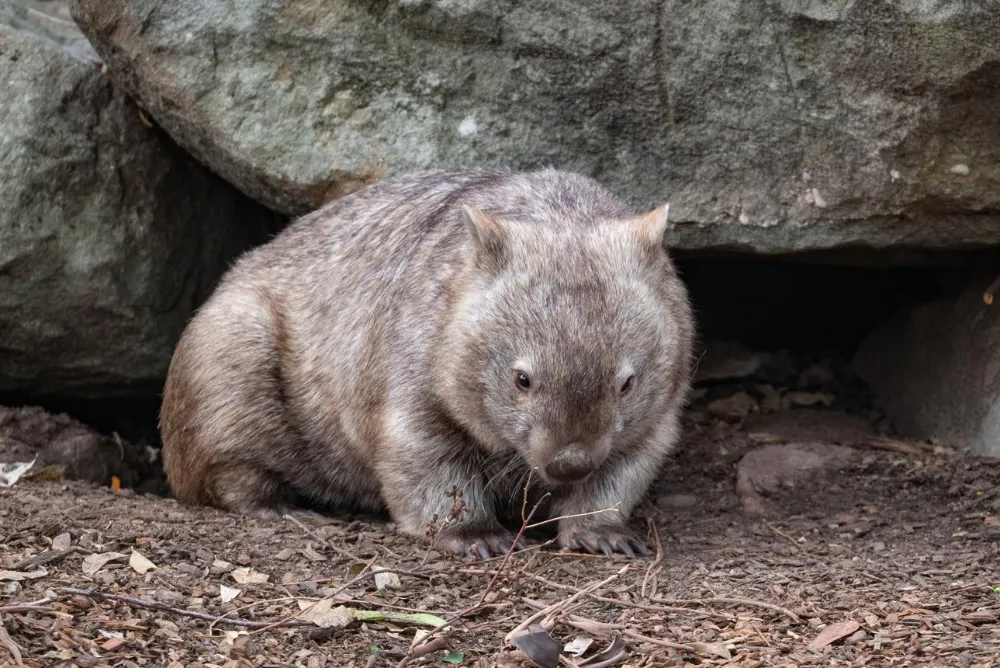
Wombats use burrows and surrounding grassland habitats, and often leave droppings near prominent features within their home ranges.
Frequently Asked Questions
Why do wombats poop cubes?
Different regions of their intestines have different stiffness and flexibility. Repeated contractions and drying help form flat-sided, cube-like droppings.
Do wombats really poop cubes?
Yes. Wombats naturally produce block-like feces, although individual pieces are not perfect geometric cubes.
How do wombats make square poop?
The shape develops inside the final portion of the intestine as muscular contractions interact with regions of different stiffness.
Do wombats have square anuses?
No. Research shows that cube formation occurs within the intestine, not at the opening where feces exit.
Where does wombat poop become cube-shaped?
A 2021 study found that the distinctive shape develops mainly within the final approximately 17 percent of the intestine.
Why does intestinal stiffness matter?
Regions with different mechanical stiffness deform differently during muscular contractions, helping create corners and flattened surfaces.
Why do wombats poop on rocks?
Wombats often place droppings at prominent locations. These deposits may help communicate information to other wombats.
Does cube-shaped poop stop it from rolling away?
Flat-sided pieces may remain in place more easily on some surfaces, but scientists have not conclusively established that this explains why the trait evolved.
How many poop cubes does a wombat make?
A biological review reports roughly 80 to 100 separate fecal pieces per night in bare-nosed wombats, with natural variation.
Is every wombat poop cube perfect?
No. Real droppings vary in shape and may have rounded edges or irregular surfaces.
Do all wombat species poop cubes?
Cube-like droppings are characteristic of wombats, but the detailed 2021 mechanical investigation focused on the bare-nosed wombat.
Are wombats the only animals with cube-shaped poop?
They are widely regarded as the only known animals that regularly produce naturally formed, distinctly cube-shaped droppings.
Do wombats use poop to mark territory?
Wombats use fecal deposits in areas they occupy, but describing every deposit as marking a defended territorial border is an oversimplification.
Are wombats related to koalas?
Yes. Wombats and koalas are closely related Australian marsupials, although their lifestyles and digestive adaptations differ.
Why did scientists study wombat poop?
The unusual cube shape raised a biomechanics question: how can a soft biological tube form corners without a rigid mold?
The Bottom Line
Wombats produce cube-shaped poop because their intestines have unusual mechanical properties.
In the final portion of the digestive tract, regions with different stiffness interact with muscular contractions as the feces become drier.
This process forms relatively flat surfaces and corners before the material leaves the body.
The discovery was supported by anatomical experiments and mathematical modeling published in 2021.
Wombats often deposit their droppings on rocks, logs, and other prominent surfaces, where they may serve as communication signals.
However, scientists have not established one definitive evolutionary reason for the cube shape.
The phenomenon shows how even an ordinary biological process can produce an extraordinary result through specialized anatomy and the physics of soft materials.
Sources & Further Reading
Yang et al. (2021) — Intestines of Non-Uniform Stiffness Mold the Corners of Wombat Feces. Soft Matter. Primary experimental and mathematical research on intestinal stiffness and cube formation.
PubMed — Intestines of Non-Uniform Stiffness Mold the Corners of Wombat Feces. Indexed scientific record and abstract for the 2021 study.
University of Tasmania — Scientists Get to the Bottom of Wombat Cubed Poo Mystery. University explanation of the research findings and tissue mechanics.
The Distinctive Biology and Characteristics of the Bare-Nosed Wombat (Vombatus ursinus). Annual Review of Animal Biosciences. Scientific review covering wombat biology, scat communication, and common misconceptions.
Science News — Wombats Are the Only Animals Whose Poop Is a Cube. Here's How They Do It. Background on the early research and biomechanics.
National Geographic — Wombats Have Buns of Steel—and They Poop in Cubes. Here's Why. Background and expert perspectives on the possible biological purpose of the shape.