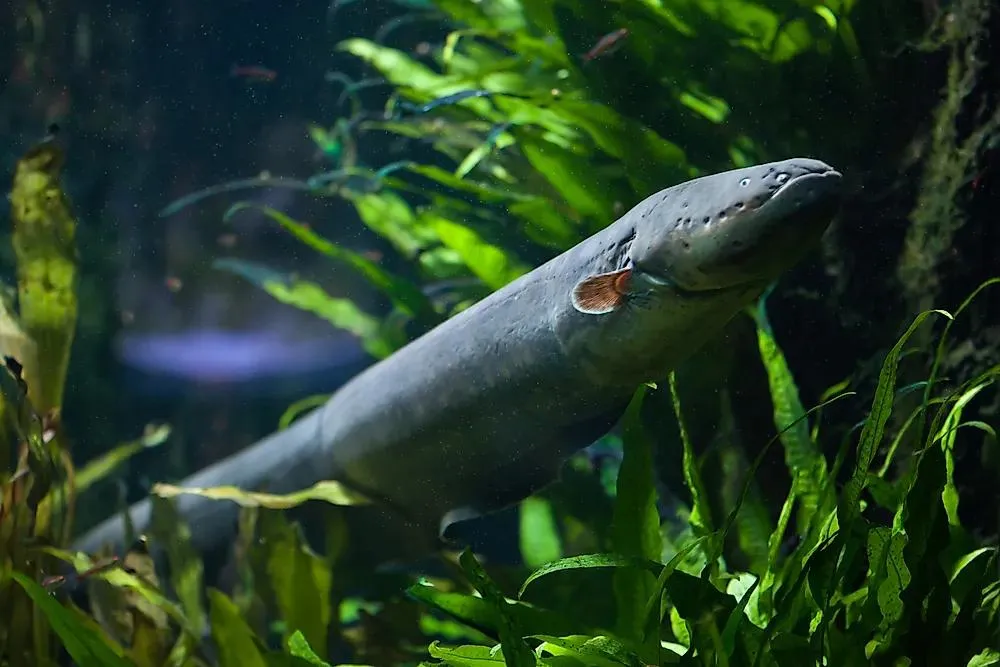
Electric eels produce electricity using specialized cells called electrocytes, which are arranged in large stacks inside their electric organs. When nerve signals activate these cells, charged ions move across their membranes, creating small electrical differences. Thousands of electrocytes working together can produce powerful electrical discharges. Electric eels use weaker signals to sense their surroundings and communicate, while stronger pulses help them detect, capture, and defend against other animals. In a 2019 study, scientists measured a discharge of 860 volts from one specimen of Electrophorus voltai. However, that number is a recorded measurement, not the constant output of every electric eel.
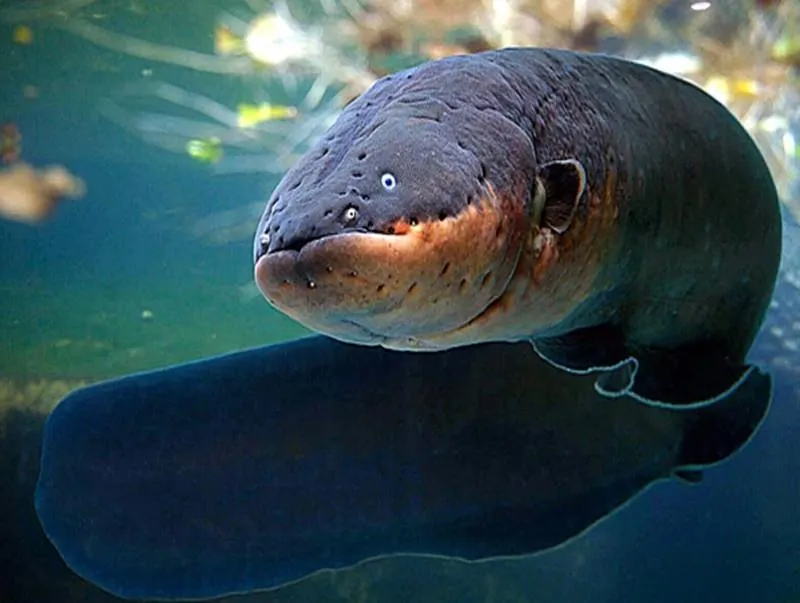
Electric eels use specialized organs to generate electrical signals for hunting, navigation, communication, and defense.
How Do Electric Eels Produce Electricity?
Electric eels generate electricity through an adaptation of living animal cells.
Like other animals, they use electrical signals within their nervous systems and muscle tissues.
However, electric eels possess large specialized electric organs that can generate unusually powerful discharges.
These organs contain many cells called electrocytes.
An individual electrocyte produces only a relatively small electrical difference.
When many electrocytes are activated together, their electrical contributions combine.
This allows the fish to generate a much greater voltage than one cell could produce alone.
The system is an example of biological electricity produced through cell physiology rather than through metal wires or chemical batteries.
What Are Electrocytes?
Electrocytes are specialized cells that contribute to the production of electric organ discharges.
In electric eels, these cells evolved from muscle-related tissues.
However, instead of functioning primarily to produce physical movement through contraction, they are specialized for generating electrical signals.
Their membranes contain proteins that regulate the movement of charged ions.
These include ion channels and ion transport proteins.
When activated by nerves, electrocytes change their electrical state very rapidly.
The resulting electrical differences can combine across many cells.
How Do Electrocytes Make Voltage?
Living cells maintain differences in electrical charge across their membranes.
These differences arise partly because ions are distributed unequally inside and outside the cell.
Ion pumps and channels help maintain and change those distributions.
In electrocytes, the membrane is specialized so that nervous-system activation produces a rapid change in electrical potential.
When many cells undergo coordinated electrical changes, the organ produces a measurable voltage.
However, the mechanism is not equivalent to electrons flowing through a copper wire inside the fish.
Biological electricity primarily involves the movement of ions in cells and surrounding fluids.
Why Are Sodium Ions Important?
Sodium ions are involved in the rapid electrical responses of many animal cells.
They are positively charged particles.
Specialized sodium channels allow sodium ions to cross cell membranes when those channels open.
This can change the voltage across the membrane.
In electrocytes, coordinated activation of ion channels contributes to an electrical discharge.
However, sodium ions are not the only components involved.
Potassium ions, membrane proteins, cellular energy use, and nervous-system signals are also important.
What Is Membrane Potential?
Membrane potential is the difference in electrical potential across a cell's membrane.
It arises because positively and negatively charged particles are not distributed equally on the two sides.
Many cells maintain a resting membrane potential.
When particular ion channels open, the membrane potential can change.
Electrical activity in neurons and muscles depends on this process.
Electric eels use a highly specialized version of related physiological mechanisms.
However, the electrical output of an entire electric organ is much greater than that of one typical cell.
How Can Tiny Cells Produce Hundreds of Volts?
The secret is coordinated electrical addition.
An individual electrocyte generates a small voltage.
Large numbers of electrocytes are arranged in stacks.
When they are activated in a coordinated way, voltage differences from cells arranged in series can add together.
This is similar in principle to arranging multiple battery cells in series.
However, the analogy is not exact.
Electrocytes are living tissues that require metabolic energy and nervous-system control.
Their output also depends on organ anatomy and the electrical conditions of the surrounding environment.
Are Electric Eel Organs Like Batteries?
Electric eel organs are often compared with biological batteries.
This is useful because they contain many small electrical units whose effects combine.
However, unlike a conventional disposable battery, the electric organ is maintained by living cells.
Its electrical gradients depend on ongoing metabolism.
Nerves control when groups of electrocytes become active.
The resulting discharges are brief physiological events rather than a constant electrical output.
The electric organ is therefore best understood as a specialized biological generator of controlled electrical pulses.
What Are the Three Electric Organs?
Electric eels possess three major electric organ systems.
They are generally called the main electric organ, Hunter's organ, and Sachs' organ.
Together, these organs occupy a very large portion of the fish's elongated body.
The Smithsonian National Zoo describes them as accounting for approximately 80 percent of the animal's body.
The main organ and the anterior portion of Hunter's organ are particularly important for powerful discharges.
Sachs' organ and the posterior region of Hunter's organ contribute to weaker electrical signals.
However, the exact structure and output vary across species.
Electric Eel Organ Functions
| Organ | Typical Electrical Role | Important Function |
|---|---|---|
| Main electric organ | High-voltage discharge | Prey capture and defense |
| Hunter's organ | High- and low-voltage contributions from different regions | Hunting and sensory signaling |
| Sachs' organ | Primarily low-voltage discharge | Electrolocation and communication |
These are broad functional descriptions. Different regions of an organ may contribute differently, and the coordinated electrical system works as a whole.
How Many Volts Can an Electric Eel Produce?
Some electric eels can generate discharges measuring hundreds of volts.
Historically, electric eel discharges were often described as reaching about 600 to 650 volts.
However, a 2019 investigation identified a new electric eel species, Electrophorus voltai, and recorded an 860-volt discharge from one specimen.
This was the highest documented voltage reported for a living biological electricity generator in that study.
However, the figure does not describe every individual or species.
Measured output varies with species, body size, and experimental conditions.
Can Electric Eels Produce 860 Volts?
Yes. Scientists documented an 860-volt electric organ discharge from Electrophorus voltai.
The result was published in Nature Communications in September 2019.
The fish measured approximately 1.22 meters in total length.
However, this was a particular recorded discharge.
It would be inaccurate to claim that all electric eels consistently deliver 860 volts.
Other species and individuals have produced lower measured voltages.
What Did the 2019 Electric Eel Study Discover?
For more than two centuries, electric eels were commonly treated as one species, Electrophorus electricus.
In 2019, researchers examined genetic, anatomical, and ecological differences among specimens across northern South America.
They recognized three species rather than one.
The species were Electrophorus electricus, Electrophorus voltai, and Electrophorus varii.
They also compared the electrical discharge characteristics of the species.
The strongest recorded discharge was 860 volts from E. voltai.
The study demonstrated that electric eel diversity had previously been underestimated.
Are There Three Species of Electric Eels?
Yes. Three recognized electric eel species were described in the 2019 taxonomic study.
They occupy different geographic and ecological regions within northern South America.
However, their distributions are not completely explained by one simple river boundary.
The study documented differences in their evolutionary histories and electrical characteristics.
Therefore, electric eel should not always be used as though it refers to a single species with one fixed maximum voltage.
The Three Electric Eel Species
| Species | Geographic Association | Electrical Finding |
|---|---|---|
| Electrophorus electricus | Guiana Shield region | A 480 V discharge was documented in a studied specimen |
| Electrophorus voltai | Brazilian Shield region | A discharge of 860 V was recorded |
| Electrophorus varii | Lowland Amazon basin | Measured specimens ranged from 151 to 572 V |
These values describe measurements reported in the study. They are not definitive maximum limits for each species.
Why Do Electric Eels Generate Electricity?
Electric eels produce electricity for several biological purposes.
High-voltage discharges help them capture prey and defend themselves.
Lower-voltage signals help them investigate the environment.
They can also use electrical communication during interactions with other electric eels.
However, not every discharge has the same purpose.
The meaning and effect depend on its strength, pulse pattern, and behavioral context.
What Is the Difference Between Low-Voltage and High-Voltage Discharges?
Electric eels use different patterns of electrical output.
Low-voltage discharges are associated with electrolocation and communication.
High-voltage discharges can affect nearby animals, including prey.
However, the division is not completely rigid.
A 2015 study demonstrated that electric eels also use feedback from high-voltage discharges to track moving prey.
Thus, the high-voltage system can function as both a weapon and a source of sensory information.
What Is Electrolocation?
Electrolocation is the ability to detect information about the environment using electric fields.
An electric fish may generate a weak electrical field around its body.
Nearby objects can influence that field.
Specialized sensory receptors detect changes in electrical conditions.
The nervous system uses these signals to help identify surrounding objects.
This ability is especially useful in water with limited visibility.
However, electrolocation is different from ordinary eyesight or sound-based echolocation.
Can Electric Eels Sense Electricity?
Yes. Electric eels possess electroreceptive sensory systems.
These allow them to detect electrical signals in their surroundings.
The signals may come from their own electric organ discharges or from other electrical sources.
Such information helps with navigation, prey detection, and communication.
However, the ability is specialized for a particular aquatic sensory environment.
It does not mean electric eels can detect every electrical device at unlimited distances.
Do Electric Eels Use Electricity to Communicate?
Yes. Weak electric discharges can play a role in communication between electric eels.
The Smithsonian National Zoo notes that low-voltage pulse patterns vary among individuals and between sexes.
Such signals may provide information relevant to reproduction and social interactions.
However, the signals should not be interpreted as an exact electrical equivalent of human language.
They are species-specific sensory and behavioral cues.
How Do Electric Eels Hunt?
Electric eels are predatory freshwater fish.
They use sensory information to detect prey in environments that can be dark or muddy.
When attacking, they can produce rapid bursts of high-voltage electrical pulses.
These pulses can trigger involuntary contractions in nearby prey muscles.
This interferes with the prey's ability to escape.
The eel can then approach and capture the animal.
However, hunting involves coordinated sensing, movement, and feeding behavior rather than an electric shock alone.
What Did the 2014 Science Study Show?
In 2014, biologist Kenneth Catania published a study titled The Shocking Predatory Strike of the Electric Eel in Science.
The experiments investigated how electric eel discharges affect prey.
The study found that high-voltage pulses could activate the motor neurons controlling the prey's muscles.
This caused involuntary muscular contraction.
The eel could therefore interfere directly with the prey's movements.
The research also showed that brief pulses could produce a twitch in hidden prey, revealing its location.
These findings changed how scientists understood electric eel hunting.
Can Electric Eels Control Their Prey's Muscles?
Electric eels can induce involuntary muscle contractions through electrical stimulation.
However, this is not the same as controlling an animal's decisions or thoughts.
The electrical pulses affect excitable tissues involved in movement.
Strong bursts can interfere with normal muscle control.
Shorter signals may produce detectable movements that help reveal hidden prey.
The effect is physiological rather than a form of conscious behavioral control.
Why Do Electric Eels Make Hidden Fish Twitch?
A hidden prey fish may be difficult to locate visually.
However, an electric eel can emit short high-voltage pulses that stimulate nearby muscles.
If the hidden animal twitches, it may create water movement.
The eel can detect that movement using its sensory systems.
The 2014 experiments demonstrated this response.
The behavior helps explain how electric eels find prey in muddy environments filled with hiding places.
What Did the 2015 Nature Communications Study Discover?
In 2015, Catania reported that electric eels use their high-voltage discharges for more than prey incapacitation.
The study demonstrated that the pulses could provide precise sensory information while prey moved.
Researchers designed experiments to separate electrical feedback from other possible sensory cues.
The eel used electrical information to track targets quickly and accurately.
This revealed a dual role for the high-voltage system.
It functions as a weapon and as part of an active sensing mechanism.
Is Electric Eel Sensing Like Bat Echolocation?
There is a useful similarity: both animals can actively generate signals and use feedback to detect their surroundings.
Bats emit sound and interpret echoes.
Electric eels produce electrical fields and detect changes in those fields.
However, the physical mechanisms are different.
Sound-based echolocation uses acoustic waves.
Electrolocation uses electrical interactions in water.
They are examples of active sensing that evolved in different animal groups.
Do Electric Eels Always Shock Their Prey?
Electric eels can use powerful discharges while hunting.
However, the intensity and pattern of the response depend on the circumstances.
Strong discharges are physiologically costly.
Electric eels also use weaker electrical signals during ordinary navigation and communication.
Therefore, they do not continuously produce maximum-voltage shocks throughout their lives.
Can Electric Eels Shock Humans?
Yes. Electric eels can deliver dangerous electric shocks.
Direct contact or close proximity in water can expose a person to electrical discharge.
However, the medical effects depend on several factors, including electrical current, duration, contact conditions, and the individual's health.
Voltage alone does not determine the severity of an injury.
Anyone observing electric eels should avoid entering water where they are present or attempting to handle them.
Can an Electric Eel Kill a Human?
An electric eel encounter can be dangerous, particularly if a shock causes loss of control, injury, or drowning.
However, the risk cannot be predicted using voltage alone.
The amount of current passing through the body, the duration of exposure, and the circumstances are important.
Therefore, it would be inaccurate to claim that every electric eel shock is fatal or that a high measured voltage automatically establishes a particular outcome.
Electric eels should be treated as hazardous wildlife and observed only from a safe distance.
Why Doesn't an Electric Eel Shock Itself?
Electric eels are adapted to generate and tolerate electrical discharges as part of normal physiology.
Their specialized organs, body structure, and electrical pathways influence how current is distributed.
However, the complete explanation is more complicated than saying they are perfectly insulated.
Electric eels are living tissues, not objects made entirely from nonconductive material.
They should not be described as completely immune to electricity.
The more accurate point is that their electrical system evolved to produce functional discharges without routinely incapacitating the animal itself.
Are Electric Eels Immune to Electricity?
No animal should be assumed to be absolutely immune to all electrical exposure.
Electric eels are specialized to produce and manage their own electric organ discharges.
However, their exact protective physiology remains a subject of scientific investigation.
It is misleading to claim that electricity can never affect them under any circumstances.
Can Electric Eels Jump Out of Water to Shock?
Yes. Electric eels have been observed rising partly out of the water during defensive encounters.
This can allow more direct electrical contact with a nearby threat.
The Smithsonian National Zoo describes this behavior in electric eel defense.
However, it should not be interpreted as the animal leaping toward people in every encounter.
The behavior is context-dependent and should never be deliberately provoked.
Do Electric Eels Need Water to Produce Electricity?
The electrical activity originates inside the eel's specialized living tissues.
Therefore, the basic cellular ability to generate a membrane potential does not come from the surrounding water itself.
However, water strongly influences how an electric discharge spreads through the environment.
Water also provides the conditions required for the fish's normal respiration and survival.
Electric eels are freshwater fish and are not adapted to remain out of water for extended periods.
Does Electricity Travel Through Water?
Water containing dissolved ions conducts electricity.
The conductivity depends on the concentration and type of dissolved substances.
Freshwater and seawater generally differ in conductivity.
However, the way an eel's electrical field spreads also depends on the geometry of the fish, the location of objects, and the surrounding environment.
The discharge cannot be represented accurately as a perfectly circular shockwave traveling uniformly in every direction.
Can Electric Eels Generate Electricity Continuously?
Electric eels can produce repeated discharges, but they do not generate unlimited electrical energy.
Their electric organs depend on the body's metabolism and maintained ion gradients.
Restoring those gradients requires energy.
Strong discharges are energetically demanding.
Therefore, the electric eel is not a perpetual-motion machine or an unlimited biological power supply.
Do Electric Eels Need to Recharge?
The battery analogy is useful in a limited sense.
After electrical activity, electrocytes must restore the ion distributions necessary for further signaling.
Cellular energy supports this process.
However, electric eels are not recharged by connecting their bodies to an external electrical outlet.
They maintain their electrical systems through normal biological metabolism.
Are Electric Eels True Eels?
No. Despite their common name, electric eels are not members of the true eel order Anguilliformes.
They belong to the group of South American knifefishes, within the order Gymnotiformes.
Their elongated bodies resemble true eels, which helps explain the name.
However, body shape alone does not establish close evolutionary relationship.
Electric eels are more closely related to other South American knifefishes than to European or Japanese freshwater eels.
Where Do Electric Eels Live?
Electric eels are native to freshwater systems in northern South America.
They occur in habitats associated with the Amazon and Orinoco drainage regions.
These include slow-moving rivers, pools, lakes, and flooded forests.
However, the three recognized electric eel species have different distributions.
Water conditions and seasonal flooding influence the habitats available to them.
Can Electric Eels Breathe Air?
Yes. Electric eels are obligate air breathers.
They regularly rise to the surface to obtain oxygen.
The Smithsonian National Zoo explains that electric eels obtain most of their oxygen through specialized tissues inside the mouth.
However, they remain aquatic animals and cannot live indefinitely on land.
Their ability to breathe air is particularly useful in warm freshwater habitats with low dissolved oxygen.
Why Do Electric Eels Surface to Breathe?
Some slow-moving tropical waters contain relatively little dissolved oxygen.
Electric eels have evolved the ability to absorb oxygen from atmospheric air.
They periodically reach the surface and gulp air.
Specialized tissues in the mouth allow oxygen to enter the bloodstream.
However, this adaptation should not be confused with having lungs identical to those of mammals.
What Do Electric Eels Eat?
Electric eels are carnivorous.
They feed on fish and other animal prey.
Diet changes with age and opportunity.
Their high-voltage discharges provide an effective method for capturing moving prey in environments with limited visibility.
However, the exact prey composition varies by species, habitat, and individual size.
How Big Can Electric Eels Grow?
Electric eels can grow to lengths of around two meters or more.
The Smithsonian National Zoo describes typical large individuals reaching approximately two to 2.5 meters.
However, maximum size varies among species and individuals.
The 2019 study included specimens of different sizes when comparing electric discharges.
Body size is relevant to electrical output, but voltage is not determined by length alone.
How Did Electric Organs Evolve?
Electric organs evolved through modifications of excitable tissues.
In electric eels, specialized electrocytes are related evolutionarily to muscle cells.
Over time, changes in development and gene expression supported the production of electrical organs suited for signaling and defense.
Electric organs also evolved independently in several other groups of fish.
This is an important example of convergent evolution.
Different lineages developed similar electrical functions through their own evolutionary histories.
Do Other Fish Produce Electricity?
Yes. Electric eels are not the only electric fish.
Some knifefishes and elephantfishes produce relatively weak electrical signals for navigation and communication.
Electric rays can produce powerful discharges.
Electric catfish also possess electric organs.
However, the anatomy and electrical performance differ among these groups.
Electric Eel vs. Electric Ray vs. Electric Catfish
| Animal Group | Typical Habitat | Electrical Ability |
|---|---|---|
| Electric eels | South American freshwater | High- and low-voltage discharges |
| Electric rays | Marine environments | Powerful defensive and hunting shocks |
| Electric catfish | African freshwater | Strong electrical discharges |
| Weakly electric knifefishes | Freshwater | Low-power signals for sensing and communication |
These groups do not all share the same electric organ anatomy or maximum voltage.
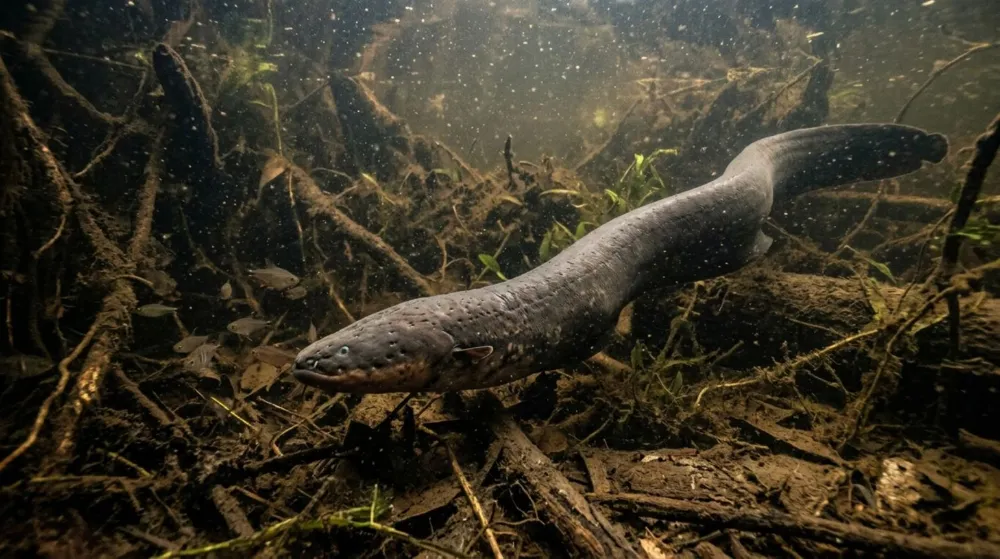
Electric eels inhabit complex freshwater environments where electrical sensing can help them locate objects and prey.
Can Electric Eels Power a Light Bulb?
Electric eel discharges can be measured and demonstrated using specially designed scientific equipment.
However, their pulses are brief and variable rather than a stable household electricity supply.
Connecting an animal directly to electrical equipment is not an appropriate demonstration.
Live electric eels should not be disturbed or exposed to unsafe conditions to generate electricity for entertainment.
Educational displays should use professional animal-care and electrical safety controls.
Could Electric Eels Inspire Better Batteries?
Scientists study electric eel physiology partly because it demonstrates a biological way to produce electrical differences through stacked cells.
Researchers have investigated synthetic systems inspired by electric organ architecture.
However, an eel's electrical organ differs from commercial electrochemical batteries.
The biological system relies on ion gradients and membrane proteins.
Engineered devices may borrow aspects of this structure without reproducing the entire biological mechanism.
These investigations are examples of biomimicry.
Why Are Electric Eels Important to Science?
Electric eels provide valuable opportunities to study several biological processes.
These include ion-channel function, nervous-system signaling, electrolocation, predator behavior, and the evolution of specialized tissues.
Research has demonstrated that electric discharges can have both sensory and offensive roles.
The 2019 recognition of three electric eel species also revealed previously overlooked biodiversity.
However, many details of their physiology and ecology remain under investigation.
Common Electric Eel Myths vs. Facts
| Claim | Scientific Answer |
|---|---|
| Electric eels create electricity using special cells | True |
| Every electric eel produces exactly 860 volts | False |
| Electric eels use weaker signals for sensing | True |
| Electric eels are true eels | False |
| High-voltage pulses can cause prey muscles to contract | True |
| Electric eels have unlimited electrical energy | False |
| Electric eels can breathe atmospheric air | True |
| Electric eels are completely immune to all electricity | Not established |
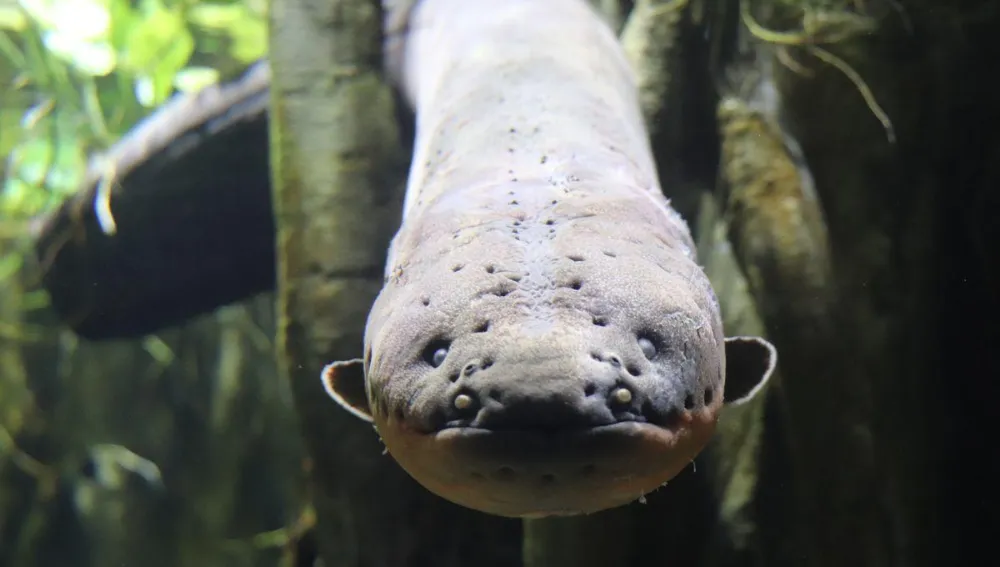
Electric eels are specialized freshwater predators that also surface regularly to breathe atmospheric air.
Frequently Asked Questions
How do electric eels produce electricity?
They use specialized cells called electrocytes, which create electrical differences through controlled ion movement. Many cells working together generate powerful discharges.
What are electrocytes?
Electrocytes are specialized electrical cells that evolved from muscle-related tissues.
How many volts can an electric eel produce?
Scientists recorded 860 volts from one specimen of Electrophorus voltai in a study published in 2019.
Do electric eels have batteries in their bodies?
They have biological electric organs composed of stacked electrocytes, which are similar to batteries in some ways but function through living cell physiology.
Why do electric eels shock other animals?
They use powerful discharges primarily for prey capture and defense.
Can electric eels sense electricity?
Yes. Electroreception allows them to detect electrical information and use it for navigation and prey detection.
Do electric eels use electricity to communicate?
Yes. Weaker electric discharges can provide information during social and reproductive interactions.
Can electric eels control prey muscles?
Their high-voltage discharges can stimulate prey motor neurons and cause involuntary muscle contractions.
Can electric eels shock humans?
Yes. Electric eel shocks can be dangerous, particularly in water where loss of control can lead to injury or drowning.
Why don't electric eels shock themselves?
They have specialized anatomy and electrical physiology adapted for generating discharges, but they should not be described as completely immune to electricity.
Are electric eels real eels?
No. They are South American knifefishes rather than members of the true eel order.
How many electric eel species are there?
Three species were recognized in a major taxonomic study published in 2019.
Can electric eels breathe air?
Yes. They are obligate air breathers and periodically surface to obtain oxygen.
Do electric eels need to recharge?
Their electrocytes require metabolic energy to maintain and restore ion gradients after electrical activity.
Are electric eels the only electric fish?
No. Electric rays, electric catfish, and several other fish groups also possess specialized electrical systems.
The Bottom Line
Electric eels generate electricity through specialized cells called electrocytes.
These cells use controlled ion movement to create small electrical differences that combine across large electric organs.
The resulting discharges can help the fish detect its surroundings, communicate, capture prey, and defend itself.
Scientists have recorded an 860-volt discharge from Electrophorus voltai, although electrical output varies among species and individuals.
Experiments have also shown that electric eels use their high-voltage systems to stimulate prey muscles and track moving targets.
The electric eel is therefore not simply a fish that delivers shocks. It is an extraordinary example of how evolution can transform ordinary cellular electrical activity into a sophisticated biological sensory and defensive system.
Sources & Further Reading
Smithsonian National Zoo — Electric Eel. Species biology, electric organs, hunting, electrolocation, and air breathing.
Smithsonian National Zoo — It's Electric (Fishes)! Introduction to electric organ discharge and electrical signaling.
de Santana et al. (2019) — Unexpected Species Diversity in Electric Eels With a Description of the Strongest Living Bioelectricity Generator. Nature Communications. Discovery of three species and a recorded 860-volt discharge.
Catania (2014) — The Shocking Predatory Strike of the Electric Eel. Science. Experiments demonstrating electrically induced prey muscle contractions.
Catania (2015) — Electric Eels Use High-Voltage to Track Fast-Moving Prey. Nature Communications. Original study of high-voltage sensing during predation.
Catania (2015) — Electric Eels Concentrate Their Electric Field to Induce Involuntary Fatigue in Struggling Prey. Current Biology. Research on prey capture and concentrated electric fields.
Vanderbilt University — Electric Eel: Most Remarkable Predator in Animal Kingdom. Research summary of prey detection and electrical hunting behavior.