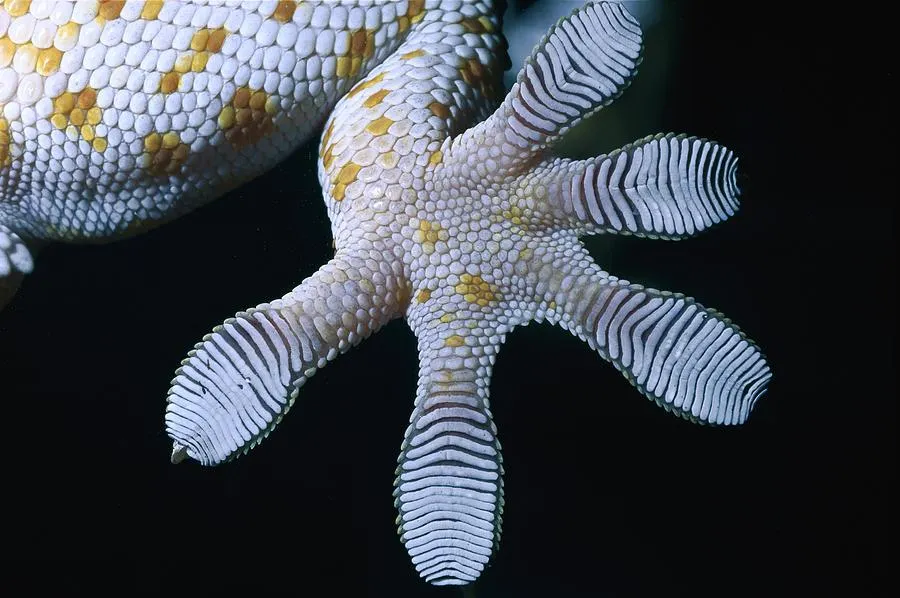
Geckos stick to walls using millions of microscopic hair-like structures called setae on specialized toe pads. Each seta branches into much smaller flattened tips called spatulae. When these tips make close contact with a surface, weak intermolecular attractions known as van der Waals forces combine to create surprisingly strong adhesion. Geckos do not need glue, suction cups, or permanently sticky feet. They control attachment through the direction and movement of their toes, allowing them to climb walls, walk across ceilings, and release each foot quickly. However, not all gecko species have the same adhesive abilities.
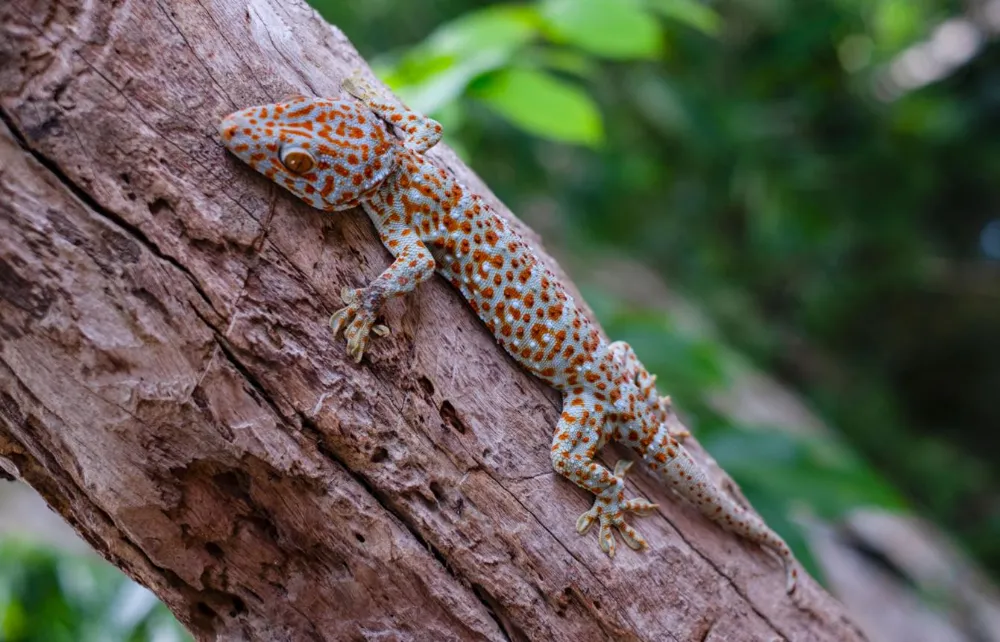
Many geckos use microscopic structures on their toe pads to grip vertical surfaces without glue or suction.
How Do Geckos Stick to Walls?
Many geckos can climb vertical surfaces that other animals would struggle to grip.
They may walk up tree trunks, cross smooth glass, or move along ceilings.
This ability comes from the specialized structure of their toe pads.
Under a microscope, the pads are covered with enormous numbers of tiny hair-like structures called setae.
Each seta divides into even smaller terminal branches ending in flattened structures known as spatulae.
These small contact points can approach a surface closely enough for molecular forces to act.
A single interaction is weak, but the combined effect of many contacts can produce substantial adhesion.
Research published in 2002 provided direct experimental support for this dry-adhesion mechanism.
What Makes Gecko Feet Sticky?
The apparent stickiness comes from the physical structure of the feet rather than a wet adhesive.
When the tiny tips of gecko setae approach a surface, intermolecular attractions help hold them in place.
The large number of contacts increases the total force.
However, this does not mean a gecko's entire foot behaves like a permanent piece of sticky tape.
The animal can adjust the direction of its setae and the movement of its toes.
These adjustments allow it to attach and detach repeatedly.
What Are Setae on Gecko Feet?
Setae are microscopic hair-like structures found on the toe pads of many geckos.
They are composed mainly of keratin, a structural protein also found in reptile scales.
Many individual setae are arranged across the adhesive surfaces of the toes.
However, their size and distribution vary among species.
The setae increase the number of small contact points that can interact with a surface.
This is important because real surfaces are rarely perfectly flat at microscopic scales.
What Are Gecko Spatulae?
Spatulae are extremely small flattened structures at the ends of branches of individual setae.
Their shape increases the ability of the terminal fibers to make close contact with a surface.
A 2005 study described individual Tokay gecko setae branching into hundreds of approximately 200-nanometer spatulae.
However, this measurement is not identical for every gecko species.
Because the contact points are so small, even slight molecular attractions can collectively produce significant force.
The term spatula refers to their flattened shape rather than to an actual cooking utensil.
Setae vs. Spatulae: What Is the Difference?
| Structure | Description | Function |
|---|---|---|
| Toe pad | Specialized surface beneath a toe | Organizes adhesive structures |
| Seta | Microscopic hair-like structure | Supports multiple contact tips |
| Spatula | Nanoscale flattened terminal tip | Makes close contact with the surface |
| Toe muscles and joints | Movement-control structures | Adjust attachment and release |
The system works through the combined action of all these structures rather than any one component acting independently.
What Are Van der Waals Forces?
Van der Waals forces are intermolecular attractions arising from electrical interactions between atoms and molecules.
Individual attractions are usually very weak.
However, when enormous numbers of tiny contact points approach a surface closely, the combined effect can be substantial.
Gecko toe pads use their fine branching structures to create this close contact.
The process does not require a chemical glue to bond permanently with the surface.
It also does not require the gecko to create a vacuum under its feet.
What Did the 2002 Gecko Adhesion Study Prove?
In 2002, researchers published Evidence for Van der Waals Adhesion in Gecko Setae in the Proceedings of the National Academy of Sciences.
They studied Tokay geckos and isolated individual setae.
The researchers compared attachment on surfaces with different wetting characteristics.
They found that strong adhesion could occur on both hydrophilic and hydrophobic surfaces when those surfaces had suitable physical properties.
These findings supported van der Waals interactions as the principal mechanism of dry gecko adhesion.
The study also showed that the size and shape of terminal contact structures help determine performance.
Do Geckos Have Glue on Their Feet?
No. The adhesive toe pads of many geckos do not rely on secreted glue.
Their adhesion is often described as dry adhesion.
Unlike many insects that use fluid-assisted attachment, the well-studied gecko system relies mainly on specialized solid microstructures.
However, environmental moisture and surface chemistry can still influence performance under certain conditions.
Dry adhesion does not mean water is irrelevant to every gecko on every surface.
Do Gecko Feet Work Like Suction Cups?
No. Gecko toes do not need to form a sealed vacuum chamber.
Suction cups function by creating pressure differences.
Gecko adhesion instead depends largely on molecular interactions at numerous tiny contact points.
This allows many geckos to attach to surfaces that would be difficult for a suction cup to grip.
However, extremely rough or unfavorable surfaces can reduce the effectiveness of the adhesive system.
Can Geckos Walk on Glass?
Yes. Many adhesive-toed geckos can climb clean glass.
Glass provides a smooth surface that allows many spatulae to make close contact.
However, the ability depends on the species, surface conditions, and condition of the toe pads.
Some geckos lack specialized adhesive pads and rely mainly on claws.
It is therefore inaccurate to say that every gecko can effortlessly climb every glass surface.
How Do Geckos Walk on Ceilings?
A ceiling presents an unusual challenge because gravity pulls the animal away from the surface.
Adhesive toe pads provide attachment forces that can counteract this pull.
When a gecko moves, several toes can remain attached while another foot is repositioned.
Coordinated leg and body movement maintain stability.
However, the animal must still control its body weight and movement forces.
Ceiling walking is a result of both specialized adhesion and precise locomotion.
How Do Geckos Remove Their Feet From Walls?
Geckos do not need to pull their entire foot straight away with enormous force.
Instead, they adjust the orientation of their toes and peel the adhesive structures away.
This reduces effective contact and allows rapid detachment.
A special toe movement called digital hyperextension plays an important role in many studied geckos.
The ability to attach strongly but release easily makes their feet very different from permanently sticky materials.
What Is Digital Hyperextension?
Digital hyperextension is a movement in which the toes bend or peel in a way that helps detach the adhesive pads.
It is particularly important when a gecko lifts its foot during walking.
The movement changes how individual adhesive hairs contact the surface.
Researchers have also shown that this action contributes to cleaning the toe pads.
However, the exact movement pattern varies with species and anatomy.
Why Don't Geckos Get Stuck Permanently?
Their adhesive system is directionally controllable.
When the setae are oriented appropriately, close contact produces strong attachment.
Changing that orientation and peeling the toes releases the contact.
The gecko can therefore take many steps without becoming permanently bonded to the wall.
However, this requires coordinated movement rather than simply turning molecular attraction on and off.
How Strong Is Gecko Adhesion?
Gecko attachment can support forces much greater than an individual seta could generate alone.
The combined effect of many setae allows certain species to support their bodies while climbing vertically or upside down.
However, there is no single universal attachment force for every gecko.
Measurements vary with species, toe-pad area, surface, temperature, moisture, and testing method.
Laboratory force measurements should not be treated as proof that an individual gecko can carry the same proportional weight under every natural condition.
Can Gecko Feet Stick to Any Surface?
No. Gecko adhesion is versatile but not unlimited.
Surface roughness, chemistry, moisture, and contamination can affect contact.
The 2002 research found that even very hydrophobic surfaces did not all behave identically.
Some weakly polarizable materials are less favorable for attachment.
Therefore, the popular claim that geckos can stick to absolutely anything is inaccurate.
Do Geckos Stick to Wet Walls?
Wet conditions can complicate gecko adhesion.
Water may separate adhesive structures from a surface or change their physical interaction.
A 2014 study found that geckos with wet toe pads experienced reduced adhesive performance under tested conditions.
However, recovery was possible as the animals walked on dry surfaces.
The exact effect varies with the material being climbed and the condition of the toes.
Can Geckos Climb Underwater?
Some species can maintain attachment to certain surfaces underwater, but this is highly dependent on the animal and material.
Research has shown that surface wetting properties influence underwater attachment.
However, results from one laboratory surface should not be generalized to every submerged rock or wall.
Gecko feet are adapted primarily for terrestrial locomotion, and their performance depends on contact conditions.
Can Geckos Clean Their Own Feet?
Yes. Studies have demonstrated that gecko toe pads possess a self-cleaning ability.
Dust and other small particles can reduce attachment by interfering with surface contact.
However, repeated contact with cleaner surfaces can help remove these particles.
A 2005 study established self-cleaning in gecko setae.
Later work identified how the peeling movements of the toes contribute to this process.
What Did the 2012 Self-Cleaning Study Discover?
Researchers investigated how digital hyperextension affects dirty gecko toe pads.
They compared natural toe movement with movement restricted by experimental devices.
Geckos using their normal toe-peeling motion removed dirt more quickly.
In one experiment, the animals regained nearly 80 percent of their original grip after only four steps.
However, this was a particular laboratory result.
It does not mean all geckos recover exactly 80 percent of adhesion every time they walk four steps outdoors.
Why Is Self-Cleaning Important?
Natural surfaces are often covered with dust, soil, or other particles.
If gecko toe pads became permanently clogged, their climbing ability would decline.
Self-cleaning helps maintain useful adhesion across repeated steps.
This is particularly valuable for animals living on tree bark, rocks, walls, and vegetation.
However, cleaning effectiveness depends on the type and amount of contamination.
Can a Gecko Lose Its Stickiness?
Yes. Wet, dirty, damaged, or otherwise compromised toe pads may provide less adhesion.
However, a temporary decline does not necessarily mean the animal has permanently lost its climbing ability.
Self-cleaning and drying may help restore performance.
Persistent locomotor difficulties in a captive gecko can also have multiple causes, including health or husbandry problems.
Such problems require appropriate professional assessment rather than assumptions based on one study of adhesion.
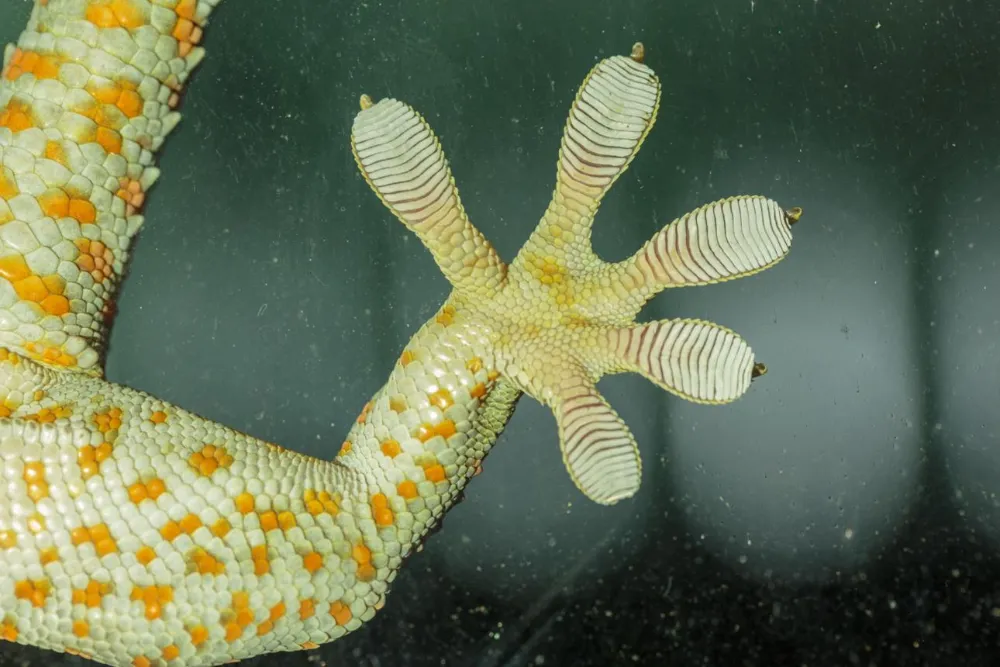
Broad toe pads carry microscopic adhesive structures that work together with controlled toe movements.
Do All Geckos Have Sticky Toe Pads?
No. Gecko species vary considerably in their feet.
Many species have expanded adhesive pads.
Other geckos rely more on claws or different locomotor adaptations.
Ground-dwelling species may have reduced adhesive structures or lack the typical expanded pads.
This variation reflects differences in habitat and evolutionary history.
Can Leopard Geckos Climb Glass?
Leopard geckos do not possess the broad adhesive toe pads characteristic of Tokay geckos.
They are mainly ground-dwelling lizards.
They can climb certain rough objects using their feet and claws, but they are not adapted to walk up clean vertical glass in the same way as a Tokay gecko.
This provides a useful example of why gecko climbing ability cannot be generalized across the entire group.
Can Tokay Geckos Climb Ceilings?
Yes. Tokay geckos, Gekko gecko, possess well-developed adhesive toe pads.
They have been studied extensively in research on molecular adhesion and toe biomechanics.
Their feet allow them to move on many vertical and inverted surfaces.
However, individual performance depends on the surface and environmental conditions.
Do Geckos Use Their Claws?
Yes. Many geckos possess claws as well as adhesive toe structures.
Claws can be useful for gripping rough surfaces.
Adhesive pads can provide an advantage on smoother materials where claws have fewer irregularities to hook onto.
These systems can complement one another.
However, the relative importance of claws and pads differs among species.
Gecko Feet vs. Suction Cups vs. Glue
| Feature | Gecko Adhesion | Suction Cup | Ordinary Glue |
|---|---|---|---|
| Main mechanism | Numerous microscopic solid contacts and intermolecular forces | Pressure difference | Material bonding or adhesive interactions |
| Requires sealed suction | No | Usually yes | No |
| Requires applied liquid adhesive | No | No | Often, depending on type |
| Rapid controlled release | Yes | Possible by breaking seal | Depends on formulation |
| Reusable attachment | Yes | Yes | Depends on formulation |
Why Are Gecko Toes So Wide?
Many adhesive geckos have broad toes containing specialized adhesive regions.
A broader pad can provide space for numerous rows of setae.
However, toe width alone does not determine grip strength.
The density, orientation, and condition of the setae also matter.
Different gecko species have evolved different toe-pad shapes suited to their environments.
Can Geckos Walk on Smooth Metal?
Some adhesive geckos can attach to suitable smooth metal surfaces.
However, successful attachment depends on the metal's actual surface condition.
Coatings, dirt, moisture, and surface texture can change performance.
The 2002 study demonstrated that the molecular properties of a surface matter alongside the microscopic structure of the toes.
Therefore, smooth metal is not automatically equally adhesive to every gecko.
Can Geckos Climb Rough Tree Bark?
Many geckos naturally climb trees.
Tree bark has a complex texture, so toe pads and claws may both contribute.
The branching structure of setae helps create contacts with smaller surface features.
However, very large irregularities can prevent some spatulae from making close contact.
Gecko locomotion therefore depends on a combination of surface structure and anatomy.
Are Gecko Feet Magnetic?
No. Geckos do not use magnetic attraction to attach to walls.
Their adhesion works on many nonmagnetic materials.
Scientific experiments support intermolecular forces associated with their microscopic toe structures.
There is no evidence that magnetic feet explain normal gecko climbing.
Can Geckos Climb Without Gravity?
Gecko adhesion does not depend on gravity pushing the animal against the surface.
The molecular interactions arise when the specialized toe structures make close contact.
However, actual climbing behavior involves body movement and mechanical forces, including gravity in ordinary environments.
Claims about exactly how geckos would move in microgravity require experiments rather than assumptions based only on adhesion theory.
How Do Scientists Study Gecko Feet?
Researchers use electron microscopy to examine setae and spatulae.
They measure attachment forces using sensitive mechanical sensors.
Some experiments compare surfaces with different chemistry or roughness.
Others observe live geckos walking with high-speed cameras.
These methods allow scientists to connect microscopic structure with real locomotor performance.
Studies published in 2002, 2005, 2012, and 2014 have helped establish different parts of the system.
Why Are Gecko Feet Important to Engineering?
Gecko feet have inspired the development of reusable dry adhesives.
Engineers investigate how small artificial fibers can imitate the contact properties of natural setae.
The goal is to create materials that attach strongly but can be removed without leaving sticky residue.
Potential applications include robotic gripping, temporary attachment systems, and specialized manufacturing tools.
However, laboratory prototypes do not automatically reproduce every property of living gecko feet.
Natural toes combine adhesion, locomotion, self-cleaning, flexibility, and rapid release.
What Are Gecko-Inspired Adhesives?
Gecko-inspired adhesives are engineered materials designed to imitate aspects of gecko attachment.
They often use arrays of microscopic fibers or specially shaped surface structures.
These structures increase contact with other materials.
However, their performance varies with design and surface conditions.
Some may need special loading directions or carefully prepared surfaces.
The development of reliable reusable adhesives remains an active engineering challenge.
Can Robots Climb Walls Like Geckos?
Researchers have developed experimental wall-climbing robots inspired by gecko adhesion.
Such systems use specialized adhesive surfaces and controlled movement.
However, robot performance depends on weight, power, materials, and surface conditions.
A robot that climbs clean glass in a laboratory is not necessarily capable of climbing every outdoor wall.
Geckos remain impressive because they combine specialized adhesive structures with living sensory and motor systems.
Do Geckos Need to Replace Their Toe Pads?
Geckos shed their outer skin layers as they grow.
The adhesive toe structures are associated with the skin and are renewed through biological processes.
However, routine shedding differs from replacing an entire foot or suddenly generating completely new adhesive organs.
Problems with retained shed around the toes can affect captive reptiles.
Species-appropriate care is important for maintaining healthy feet.
What Can Gecko Feet Teach Us About Evolution?
Gecko feet show how small changes in anatomical structure can create major functional advantages.
Fine hair-like structures increase the number of contact points with environmental surfaces.
Changes in toe shape and movement improve attachment control.
However, adhesive toe systems have not evolved identically in every gecko lineage.
Similar dry-adhesion structures have also evolved independently in other lizards and some invertebrates.
These examples illustrate how evolution can produce related mechanical solutions in different animal groups.
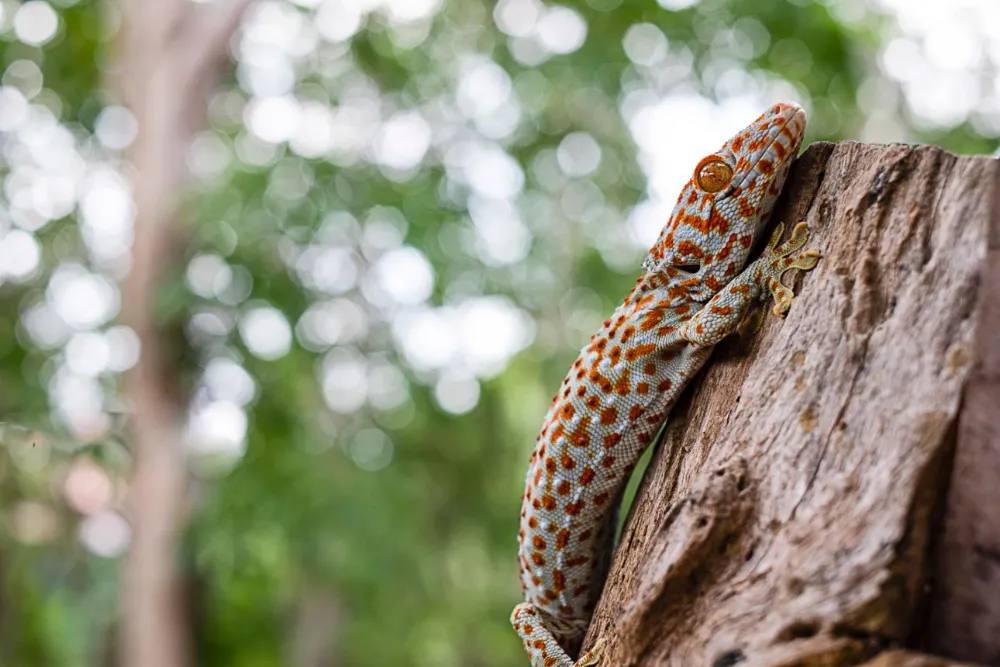
Geckos combine specialized toes, coordinated movements, and surface contact to climb in complex natural habitats.
Frequently Asked Questions
How do geckos stick to walls?
Many geckos use microscopic toe hairs called setae, which branch into tiny spatulae that generate combined intermolecular adhesion through close surface contact.
Do geckos have sticky feet?
They have specialized adhesive feet, but these do not need liquid glue or permanently sticky secretions.
What are gecko setae?
Setae are microscopic hair-like structures on the toe pads of many geckos.
What are gecko spatulae?
Spatulae are nanoscale flattened tips at the ends of branches of setae.
Do geckos use van der Waals forces?
Yes. Laboratory experiments provide strong evidence that these intermolecular forces are central to dry gecko adhesion.
Do gecko feet work like suction cups?
No. Gecko adhesion does not require a sealed vacuum.
Can geckos walk upside down?
Many adhesive-toed species can move along ceilings by using specialized pads and coordinated locomotion.
Why don't geckos get stuck?
They control attachment through toe orientation and peeling movements that reduce contact during release.
Can geckos climb glass?
Many can, although performance depends on species and surface conditions.
Can geckos climb wet glass?
Wet conditions can reduce adhesion, and performance varies with the surface and condition of the toes.
Do gecko feet clean themselves?
Yes. Research demonstrates that repeated contact and toe-peeling movements can help remove dirt particles.
Do all geckos have sticky feet?
No. Some species lack the expanded adhesive pads found in well-known climbing geckos.
Can leopard geckos climb walls?
Leopard geckos lack the broad adhesive pads required for typical smooth-glass climbing.
Are gecko feet magnetic?
No. Magnetic attraction is not the normal mechanism of gecko adhesion.
Can scientists make gecko-inspired glue?
Researchers have developed synthetic dry adhesive materials inspired by gecko toe structures, although artificial systems have important limitations.
The Bottom Line
Geckos stick to walls through an extraordinary combination of microscopic anatomy and molecular physics.
Their toe pads contain enormous numbers of setae, which branch into tiny spatulae.
These structures make close contact with surfaces, allowing many weak van der Waals interactions to create substantial adhesion.
Geckos also control attachment by adjusting their toes and peeling them away during each step.
Research has demonstrated self-cleaning and self-drying abilities, although wet or contaminated conditions can reduce grip.
Not every gecko species has the same adhesive feet.
The system provides an elegant example of how evolution can turn very small structures into a remarkable whole-animal ability.
Sources & Further Reading
Autumn et al. (2002) — Evidence for Van der Waals Adhesion in Gecko Setae. PNAS. Original experimental evidence for intermolecular dry adhesion.
Hansen and Autumn (2005) — Evidence for Self-Cleaning in Gecko Setae. PNAS. Experimental study of naturally reusable adhesive structures.
Hu et al. (2012) — Dynamic Self-Cleaning in Gecko Setae via Digital Hyperextension. Experimental research on toe peeling and removal of dirt.
Stark et al. (2014) — Self-Drying: A Gecko's Innate Ability to Remove Water From Wet Toe Pads. Research on water exposure and recovery of adhesive ability.
The Role of Surface Chemistry in Adhesion and Wetting of Gecko Toe Pads (2014). Study of surface properties and adhesive performance.
Robust Self-Cleaning and Micromanipulation Capabilities of Gecko Spatulae and Their Bio-Mimics. Nature Communications (2015). Research connecting nanoscale contact with reusable artificial attachment systems.