Flying fish leap out of the ocean and glide through the air, primarily as a way to escape predators such as tuna and dolphinfish. They do not fly like birds by flapping wings. Instead, they accelerate underwater, burst through the surface, and spread their enlarged pectoral fins to generate aerodynamic lift. Some species also spread enlarged pelvic fins, creating a four-winged gliding arrangement. Their specialized tails can help them regain speed by briefly touching and beating against the water's surface. Flying fish can travel remarkable distances above the ocean, but their aerial movement is gliding rather than sustained powered flight.
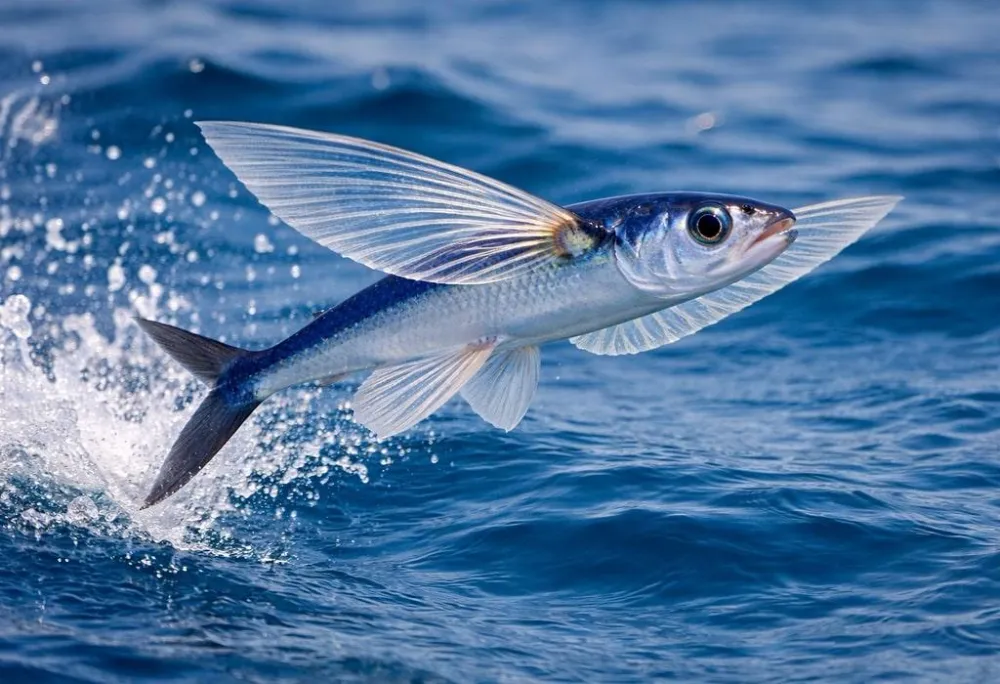
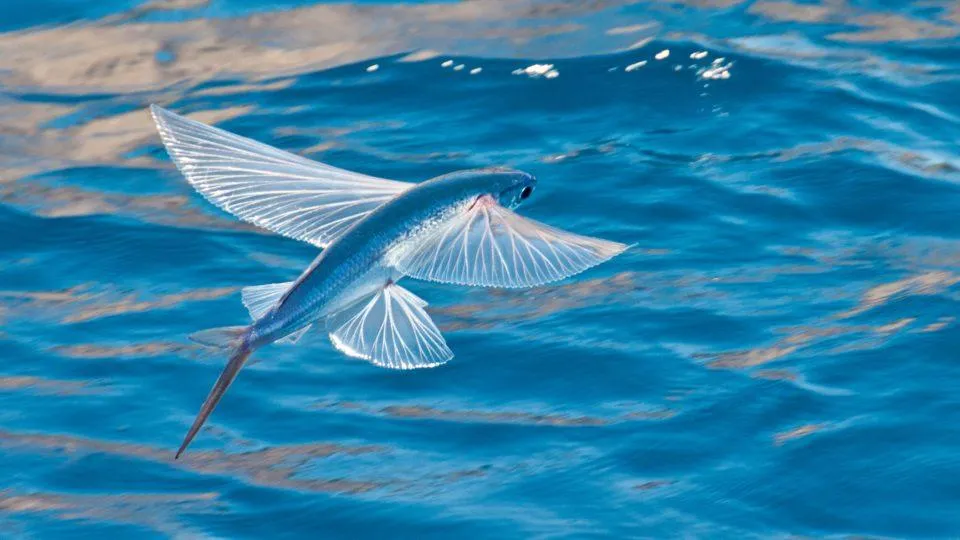
Flying fish spread their enlarged fins to glide through the air after launching themselves from the ocean.
Why Do Flying Fish Fly?
Flying fish are marine animals famous for launching themselves above the ocean surface.
The main explanation for this unusual behavior is predator avoidance.
Many flying fish live in open-water environments where there are relatively few places to hide.
When threatened by fast-swimming predators, leaving the water can provide an immediate escape opportunity.
Instead of trying to outrun a predator entirely underwater, a flying fish may accelerate and leap into the air.
Its extended fins then help it glide away from the original danger.
However, the precise evolutionary reasons for the development of gliding are still being investigated.
Researchers have also considered whether aerial movement may offer advantages for efficient transportation.
Predator escape remains the most widely discussed explanation.
Can Flying Fish Really Fly?
Flying fish can travel through the air, but they do not perform sustained powered flight like birds or bats.
They glide.
Powered flight requires an animal to generate thrust continuously while airborne.
Birds accomplish this through wing movements.
Flying fish instead obtain most of their initial speed while swimming.
Once airborne, their enlarged fins act as aerodynamic surfaces.
These surfaces help generate lift and slow the rate at which the fish loses altitude.
The fish eventually returns to the water unless it gains additional momentum by contacting the surface with its tail.
NOAA explicitly distinguishes this gliding behavior from the powered flight of birds.
How Do Flying Fish Fly?
The aerial movement of a flying fish begins underwater.
The fish swims rapidly toward the surface.
Strong movements of the tail accelerate the body.
As the fish leaves the water, it spreads its enlarged pectoral fins.
These fins interact with the surrounding air and generate aerodynamic lift.
The fish then glides above the surface.
Some species can extend their pelvic fins as well, increasing the area available for aerodynamic support.
The details of the launch and glide differ among species and environmental conditions.
How Does a Flying Fish Take Off?
Takeoff depends on speed generated in the water.
Flying fish are adapted for fast swimming and rapid acceleration.
They beat their tails to gain enough momentum to break through the sea surface.
After the body emerges, the enlarged fins can be spread for gliding.
The transition from water to air is mechanically challenging because water is much denser than air.
However, flying fish have evolved streamlined bodies and specialized fins that allow them to use both environments.
The 2010 aerodynamic study examined how fin arrangement contributes to the subsequent glide.
Do Flying Fish Have Wings?
Flying fish do not have feathered wings like birds.
Their wing-like structures are enlarged fins.
In many species, the pectoral fins are particularly long.
These are the paired fins located on the sides of the body.
When spread, they provide broad surfaces that interact with the air.
Some flying fish also have enlarged pelvic fins.
These create an appearance similar to an additional pair of wings.
However, the fins remain anatomically fish fins, not limbs equivalent to bird wings.
What Are Pectoral Fins?
Pectoral fins are paired appendages found on the sides of many fish.
In ordinary swimming, they can contribute to steering, stabilization, and maneuvering.
Flying fish possess particularly enlarged pectoral fins.
These can spread outward to form the main lifting surfaces during gliding.
Their shape and area influence aerodynamic performance.
However, different flying fish species have different fin proportions.
Researchers study these differences to understand how the animals balance swimming and gliding abilities.
What Are Pelvic Fins?
Pelvic fins are another pair of fins located farther back on a fish's body.
In some flying fish, these fins are greatly enlarged.
When extended during a glide, they provide additional aerodynamic surfaces.
The 2010 study by Park and Choi found that spreading the pelvic fins improved lift-related performance and longitudinal stability in the tested models.
However, not every flying fish has equally enlarged pelvic fins.
This variation forms the basis of the familiar two-wing and four-wing classification.
What Is the Difference Between Two-Wing and Four-Wing Flying Fish?
Flying fish are often divided into two broad gliding types.
Two-winged forms rely mainly on their enlarged pectoral fins.
Four-winged forms also possess enlarged pelvic fins.
The additional fin surfaces can contribute to lift and flight stability.
However, the terms do not mean the fish have real wings or that all members of each category behave identically.
Different species may use different launch and gliding strategies.
Phylogenetic research suggests that the four-wing arrangement evolved from ancestors with a more two-wing-like condition.
Two-Wing vs. Four-Wing Flying Fish
| Feature | Two-Wing Type | Four-Wing Type |
|---|---|---|
| Main gliding surfaces | Enlarged pectoral fins | Enlarged pectoral and pelvic fins |
| Pelvic fin contribution | Relatively limited | More substantial |
| Gliding performance | Species-dependent | Additional surfaces can improve lift and stability |
| Takeoff behavior | Rapid underwater acceleration | Rapid acceleration, sometimes followed by surface taxiing |
| Evolutionary pattern | Earlier condition in proposed evolutionary sequence | Derived condition supported by phylogenetic research |
How Far Can Flying Fish Fly?
Flying fish can glide impressive distances above the ocean.
NOAA describes flights exceeding 600 feet in favorable circumstances.
The 2010 research paper discusses observations of cumulative gliding distances reaching approximately 400 meters when successive glides and surface-assisted acceleration are included.
However, this does not mean every flying fish regularly completes a single uninterrupted 400-meter glide.
Distance depends on species, initial speed, wind, waves, and whether the fish makes additional contact with the water.
The longest observations should be described as exceptional performance rather than normal flight distance.
Can Flying Fish Glide 400 Meters?
Scientific literature describes cumulative aerial travel reaching approximately 400 meters under favorable conditions.
However, such distances may involve multiple connected gliding phases.
Some fish regain speed by moving the lower part of the tail against the water surface.
This allows them to begin another glide without fully returning to ordinary underwater swimming.
Therefore, reported long-distance flights should be interpreted carefully.
The distance of one uninterrupted glide is not necessarily the same as the total distance covered by a repeated gliding sequence.
How Long Can Flying Fish Stay in the Air?
The time a flying fish spends airborne depends on its speed, aerodynamic performance, and surrounding conditions.
The 2010 research paper describes reports of prolonged aerial movement reaching around 30 seconds through successive gliding and surface-assisted acceleration.
However, that figure should not be treated as the typical duration of one simple glide.
Most observed flights are considerably shorter.
Wind and surface conditions also influence how long a fish can maintain its height.
Flying fish eventually need to return to the water.
How Fast Can Flying Fish Glide?
Flying fish can travel quickly above the surface after accelerating underwater.
The 2010 study reviewed observations reporting flight speeds around 10 to 20 meters per second.
However, actual speeds vary with species and circumstances.
These values describe reported flight performance, not a fixed speed maintained by every flying fish.
Gliding speed also changes as the fish loses or regains momentum.
The animal cannot sustain acceleration indefinitely using its fins alone.
Do Flying Fish Flap Their Fins?
Flying fish do not flap their enlarged pectoral fins to generate continuous powered flight like birds.
During a glide, the fins are primarily spread as lifting surfaces.
Some movements may occur as the fish adjusts its posture or transitions between water and air.
However, these movements are not equivalent to repeated wingbeats generating the main propulsion.
The energy for takeoff is supplied through underwater swimming and, in some cases, renewed tail contact with the surface.
This distinction is central to understanding why flying fish are considered gliders.
Why Do Flying Fish Have Long Fins?
Long, enlarged fins provide a larger aerodynamic surface.
When the fish moves through the air, the spread fins help produce lift.
Their shape also affects drag and stability.
These properties influence the distance and duration of a glide.
However, longer fins are not automatically better in every situation.
A flying fish must also swim and maneuver underwater.
Its body therefore represents a compromise between the mechanical demands of two very different environments.
How Do Flying Fish Generate Lift?
Lift is an aerodynamic force produced when a moving surface interacts with air.
Flying fish spread their fins and travel forward at substantial speed.
The airflow around the fins creates pressure differences and changes in the motion of the surrounding air.
Together, these effects produce an upward force.
However, lift does not eliminate gravity.
The fish gradually loses energy and altitude during an ordinary glide.
Its fins slow the descent and allow it to travel a much greater horizontal distance than a simple jump would permit.
What Is the Lift-to-Drag Ratio?
The lift-to-drag ratio compares the aerodynamic force supporting an object with the force resisting its forward motion.
A higher ratio generally indicates more efficient gliding under comparable conditions.
The 2010 wind-tunnel study measured the aerodynamic performance of flying fish models with different fin configurations.
The researchers found that extending the pelvic fins could improve the lift-to-drag ratio.
However, performance depended on the angle of attack and model configuration.
These measurements help explain why additional fin surfaces can benefit some flying fish species.
What Is the Angle of Attack?
The angle of attack describes the orientation of a lifting surface relative to the approaching airflow.
Changing this angle can alter lift and drag.
The 2010 flying fish study tested models at different angles.
The investigators found maximum lift-to-drag ratios near an angle of approximately zero degrees in the tested configurations.
Higher lift coefficients occurred at larger angles associated with emergence from the water.
However, these findings are specific to the measured models and conditions.
They do not imply that every flying fish maintains one fixed angle throughout an entire glide.
What Did the 2010 Flying Fish Study Discover?
In 2010, researchers Hyungmin Park and Haecheon Choi published a study titled Aerodynamic Characteristics of Flying Fish in Gliding Flight in the Journal of Experimental Biology.
They measured aerodynamic forces using models of the darkedged-wing flying fish, identified in the study as Cypselurus hiraii.
The models were tested with different fin arrangements.
One configuration had both the pectoral and pelvic fins spread.
Another had only the pectoral fins spread.
A third had the fins folded.
The researchers found that extending the pelvic fins improved aerodynamic performance and longitudinal stability.
They also investigated the influence of flying close to a surface.
The results provided direct measurements supporting the remarkable gliding capabilities of flying fish.
Why Do Flying Fish Stay Close to the Ocean Surface?
Flying fish frequently glide near the sea surface.
One reason this can be beneficial is a phenomenon called ground effect.
When a lifting surface moves close to another surface, its aerodynamic environment changes.
Under suitable conditions, the effect can reduce induced drag and improve gliding efficiency.
The 2010 flying fish experiments found improved aerodynamic performance when the tested models were positioned near a surface.
However, the effect depends on height, fin geometry, and other conditions.
Remaining close to the water is not automatically optimal for every moment of every flight.
What Is Ground Effect in Flying Fish?
Ground effect is an aerodynamic phenomenon that occurs when a lifting surface operates close to a boundary.
For aircraft, the boundary is often the ground.
For flying fish, it is the ocean surface.
Being near the surface can change the airflow associated with wingtip vortices and induced drag.
The result may improve the ratio of lift to drag.
The 2010 study provided experimental evidence of this effect in flying fish models.
However, real ocean conditions include waves and moving water that are more complex than a controlled wind-tunnel experiment.
Do Flying Fish Use Their Tails in the Air?
Flying fish use their tails primarily to generate swimming propulsion.
During the transition to flight, the tail provides much of the acceleration.
Some flying fish can also beat the lower lobe of the tail against the water while most of the body is airborne.
This allows renewed forward acceleration.
However, the tail does not function like a propeller spinning freely in the air.
The important action occurs when part of the tail contacts the water.
What Is Flying Fish Taxiing?
Taxiing is a behavior in which a flying fish gains speed while its body is largely above the water and the lower part of its tail contacts the surface.
The fish beats its tail against the water.
This creates thrust and allows the animal to accelerate again.
It may then continue gliding.
The 2010 study describes taxiing as an important component of some extended flying fish gliding sequences.
However, not all species use taxiing in the same way.
The behavior is especially associated with some four-winged flying fish.
Why Is the Lower Tail Lobe Important?
Flying fish often have a tail with an elongated lower lobe.
This structure contributes to propulsion during rapid swimming.
It also helps some species maintain tail contact with the water during taxiing.
When the fish's body is above the surface, the lower lobe can remain submerged briefly.
Tail movement against the water then provides additional thrust.
However, the usefulness of this adaptation depends on the animal's position and speed.
The tail cannot provide the same propulsion when it is entirely out of contact with the water.
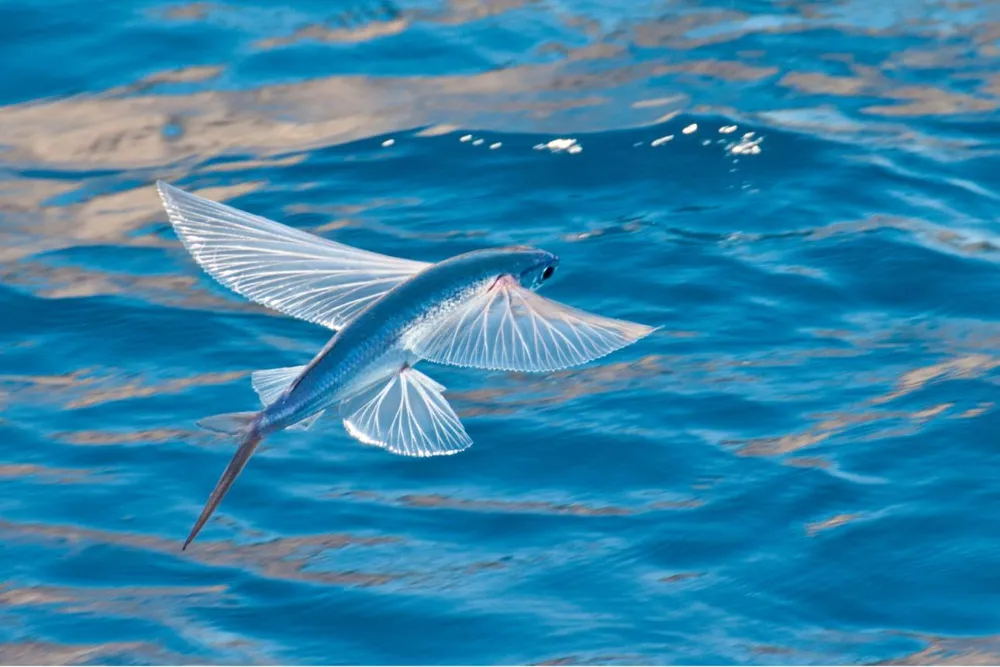
Enlarged paired fins support gliding, while the elongated lower tail lobe can help some flying fish regain speed at the water surface.
What Predators Chase Flying Fish?
Flying fish are prey for a variety of marine predators.
These can include tuna, dolphinfish, and other fast-swimming predatory fish.
Some marine mammals may also feed on them.
However, the relationship between flying fish and individual predators varies among ocean habitats.
The 2011 phylogenetic study discussed how different gliding strategies might help flying fish evade different types of predatory pursuit.
These ideas are biologically plausible, although the exact evolutionary history of escape strategies is difficult to test directly.
Does Flying Help Fish Escape Tuna?
Flying can help a fish leave the water and temporarily escape an underwater pursuit.
Tuna are fast predators capable of chasing prey through open water.
For a flying fish, crossing into the air changes the environment of the chase.
However, flying does not guarantee safety.
The fish may be vulnerable when it returns to the ocean.
Furthermore, aerial predators can sometimes take advantage of flying fish above the surface.
Gliding is therefore a useful defensive adaptation, not a perfect escape method.
Can Birds Catch Flying Fish in the Air?
Yes. Seabirds can capture flying fish while the fish are above the water.
This creates an unusual ecological trade-off.
Leaving the water can help a fish escape aquatic predators.
However, it may expose the animal to birds hunting above the sea.
Some seabirds are especially capable of catching prey near the surface.
Therefore, flying is not completely risk-free.
The effectiveness of escape depends on the presence of different predators and the surrounding conditions.
Do Flying Fish Fly Only When Scared?
Predator escape is the leading explanation for flying fish gliding.
However, not every aerial movement can be conclusively attributed to an observed predator.
Flying fish may launch when disturbed by nearby activity.
Researchers have also considered whether gliding can influence transportation efficiency.
The 2010 aerodynamic paper noted that the exact evolutionary reason for flying fish flight remains incompletely understood.
Therefore, it is more accurate to say that escape is a major explanation rather than claiming every glide begins only because a predator is visible.
Do Flying Fish Need Wind to Glide?
Flying fish can launch and glide using speed generated by swimming.
They do not need a strong wind to leave the water.
However, atmospheric conditions can affect the trajectory and duration of a glide.
Wind direction and speed change the airflow experienced by the fins.
Waves also influence the local environment near the surface.
These factors help explain why glide distance and height vary.
Can Flying Fish Fly Over Waves?
Flying fish can glide above waves and uneven water surfaces.
However, the height and trajectory of a glide depend on the fish's initial speed and aerodynamic conditions.
Large waves may alter the fish's takeoff environment or create obstacles.
Researchers have investigated flying fish gliding over different surface arrangements through models.
The 2010 wind-tunnel study particularly examined aerodynamic changes near surfaces.
Real ocean conditions are more complex because the waves themselves move.
Can Flying Fish Breathe Air?
Flying fish are fish that breathe primarily through gills.
They are not adapted to breathe atmospheric air in the way that mammals do.
During a glide, they continue to depend on the oxygen obtained from water before leaving it.
However, they can remain airborne for short periods without continuously extracting oxygen from the surrounding air.
They eventually return to the water to resume ordinary gill-based respiration.
Flying fish should not be confused with amphibious fish species that possess different adaptations for life outside water.
Do Flying Fish Have Lungs?
No. Flying fish do not possess lungs like mammals or birds.
They are ray-finned fish and use gills for respiration.
Their ability to glide above water is a movement adaptation rather than a respiratory adaptation.
However, this does not mean the animal breathes atmospheric air during its flight.
It must return to the water for normal respiration.
How Long Can Flying Fish Survive Out of Water?
Flying fish can remain out of water during short gliding episodes.
However, they are not specialized for prolonged terrestrial survival.
Their gills require an aquatic environment for normal function.
Leaving a fish outside water for extended periods can damage its gills and other tissues.
Therefore, the duration of a glide should not be confused with the length of time the animal could safely survive on land.
Are Flying Fish Related to Birds?
No. Flying fish and birds belong to very different vertebrate lineages.
Flying fish are ray-finned fish in the family Exocoetidae.
Birds are feathered vertebrates descended from theropod dinosaurs.
Both groups can move through air, but their flight structures evolved independently.
The resemblance between extended fish fins and bird wings is an example of functional similarity rather than close evolutionary relationship.
Are Flying Fish Related to Flying Squirrels?
No. Flying squirrels are mammals, while flying fish are fish.
Both use gliding as a form of aerial movement.
However, their anatomy is very different.
Flying squirrels use a membrane of skin stretched between their limbs.
Flying fish use enlarged fins.
The similar function evolved in unrelated animal lineages.
This is an example of convergent evolution.
Are Flying Fish Found in Freshwater?
True flying fish in the family Exocoetidae are marine animals.
They live in warm ocean waters rather than ordinary freshwater rivers and lakes.
However, other fish species have evolved jumping, gliding, or aerial behaviors.
These fish should not automatically be classified as members of the flying fish family.
Common names can sometimes cause confusion.
Scientific classification helps distinguish true flying fish from other fish that leap out of water.
Where Do Flying Fish Live?
Flying fish occur in tropical and subtropical oceans around the world.
They are associated with open-water habitats, often near the sea surface.
The family contains multiple genera and species.
However, their geographic distributions differ.
Some are especially common in particular ocean basins.
Species identity and habitat information are important when discussing their ecology.
What Do Flying Fish Eat?
Flying fish feed on small marine organisms.
Depending on species and life stage, their diet can include planktonic animals and other small prey.
They are part of marine food webs that connect smaller organisms with larger predatory fish and seabirds.
However, there is no single diet that applies identically to every flying fish species.
Their feeding ecology changes with environmental conditions and available food.
How Big Are Flying Fish?
Flying fish vary in body size among species.
Many are relatively small to medium-sized oceanic fish.
Some species reach several tens of centimeters in length.
However, body size influences gliding mechanics.
Fin area, weight, and speed all contribute to flight performance.
Researchers therefore consider body size alongside wing-like fin morphology when comparing species.
Do Baby Flying Fish Fly?
Young flying fish develop the anatomical structures needed for later gliding.
However, their movement and morphology can differ from those of mature adults.
Fin growth and body proportions change during development.
The ability to perform an effective glide depends on the animal reaching suitable size, strength, and fin development.
Therefore, not every newly hatched flying fish should be assumed to glide like an adult.
How Did Flying Fish Evolve?
Flying fish belong to an evolutionary lineage of marine ray-finned fish.
Over time, some of their fins became enlarged and specialized for aerial gliding.
Researchers have studied how two-winged and four-winged forms are related.
A 2011 molecular phylogenetic investigation used genetic information to reconstruct relationships among flying fish.
The results supported an evolutionary transition from two-wing to four-wing gliding arrangements.
However, reconstructing the behavior of extinct ancestors remains difficult.
Genetic relationships provide important evidence but do not reveal every historical event.
Why Did Four-Wing Flying Fish Evolve?
The development of enlarged pelvic fins may have improved certain aspects of gliding performance.
The 2010 aerodynamic study demonstrated benefits for lift, drag, and stability in the tested configurations.
The 2011 phylogenetic study supported a historical sequence in which four-wing forms evolved from earlier two-wing conditions.
However, it is difficult to prove that one particular aerodynamic advantage alone caused the evolutionary transition.
Predator pressure, habitat conditions, and other ecological factors may have contributed.
What Can Flying Fish Teach Engineers?
Flying fish demonstrate how an animal can use specialized body structures to move through both water and air.
Their fins provide an example of lightweight gliding surfaces.
Their tails illustrate how propulsion in one medium can assist movement in another.
Researchers have studied flying fish aerodynamics for possible applications in bio-inspired engineering.
A 2026 study in Biomimetic Intelligence and Robotics investigated the effects of different fin geometries on flying fish-inspired gliding models.
The researchers compared physical tests with computational fluid dynamics simulations.
However, robotic experiments should not be confused with direct measurements of live fish behavior.
What Did the 2026 Flying Fish Robot Study Find?
A study published in 2026 examined flying fish-inspired pectoral fin designs.
Researchers created several physical models based on different biological wing and fin shapes.
They evaluated gliding performance using launch experiments and computer simulations.
In the tested conditions, a design based on flying fish fins achieved a longer glide distance than several alternative designs.
However, these findings applied to specific robotic models, launch speeds, and angles.
They do not demonstrate that real flying fish outperform every bird or flying animal.
The study illustrates how the geometry of natural fins can inform engineering design.
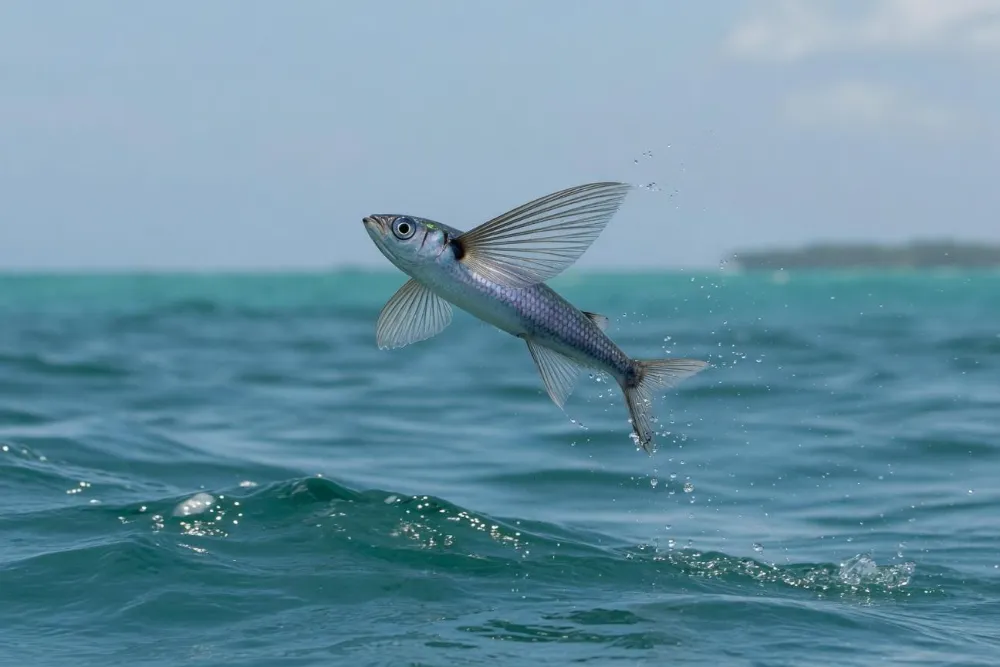
Flying fish are adapted to the open ocean, where rapid transitions between swimming and gliding can provide an escape advantage.
Frequently Asked Questions
Why do flying fish fly?
Escaping predators is the leading explanation. Gliding allows flying fish to leave the water during a dangerous underwater pursuit.
Can flying fish really fly?
They glide through the air using enlarged fins rather than performing sustained powered flight like birds.
How do flying fish fly?
They accelerate underwater, leap through the surface, spread their fins, and use aerodynamic lift to glide.
Do flying fish have wings?
They have enlarged pectoral fins, and some species also spread enlarged pelvic fins. These are fish fins rather than bird wings.
How far can flying fish fly?
Some can glide over 600 feet, while research literature discusses longer cumulative distances through repeated gliding and surface-assisted acceleration.
How long can flying fish stay in the air?
Duration varies. Exceptional observations include extended sequences lasting many seconds, sometimes involving repeated tail-assisted acceleration.
Do flying fish flap their fins?
They do not use repeated powered wingbeats like birds. Their spread fins mainly provide lift during gliding.
Can flying fish breathe air?
No. They are gill-breathing fish and must return to water for normal respiration.
Why do flying fish stay near the sea surface?
Gliding close to the surface can improve aerodynamic efficiency through ground effect under suitable conditions.
What is flying fish taxiing?
Taxiing occurs when a flying fish uses its tail against the water surface to gain speed while much of its body remains airborne.
Are flying fish faster than birds?
There is no universal comparison. Speed varies among flying fish and bird species, and their aerial movement systems differ.
What eats flying fish?
Predators include tuna, dolphinfish, and various seabirds.
Where do flying fish live?
True flying fish occur in tropical and subtropical marine waters around the world.
Are flying fish freshwater fish?
No. True flying fish belong to a marine fish family, Exocoetidae.
Do all flying fish have four wings?
No. Some have a two-wing-like arrangement dominated by enlarged pectoral fins, while others possess enlarged pelvic fins as well.
The Bottom Line
Flying fish glide above the ocean mainly to escape underwater predators.
They accelerate rapidly in water and leap into the air, where enlarged fins generate lift.
Some species use additional pelvic fins and specialized tail movements to improve flight performance or begin another glide.
Scientific experiments have demonstrated that these fins can produce effective aerodynamic lift and that gliding near the sea surface may improve efficiency.
However, flying fish do not perform sustained powered flight like birds.
Their ability to move between water and air is an extraordinary evolutionary adaptation, showing how specialized anatomy and behavior can create an effective escape strategy in the open ocean.
Sources & Further Reading
NOAA — Episode 4: The Flying Fish. Official explanation of gliding, tail-assisted acceleration, and aerial travel.
Park and Choi (2010) — Aerodynamic Characteristics of Flying Fish in Gliding Flight. Journal of Experimental Biology. Primary wind-tunnel study of lift, drag, stability, fin position, and ground effect.
PubMed — Aerodynamic Characteristics of Flying Fish in Gliding Flight. Indexed abstract and DOI information for the 2010 study.
Nature (2010) — Zoology: Fish Fly Like Jets. Research highlight explaining the aerodynamics study.
Lewallen et al. (2011) — Molecular Systematics of Flyingfishes: Evolution in the Epipelagic Zone. Biological Journal of the Linnean Society. Phylogenetic evidence concerning two-wing and four-wing evolution.
Current Biology (2021) — Evolution and Development: From the Pet Shop to the Pelagic Zone. Background on the developmental evolution of enlarged flying fish fins.
Ran et al. (2026) — Impact of the Pectoral Fin Geometry on the Gliding Performance of Flying Fish Robot. Biomimetic Intelligence and Robotics. Recent bio-inspired gliding research.