Woodpeckers peck trees mainly to find food, create nesting or roosting cavities, and communicate with other woodpeckers. They use their strong, specialized bills to break into bark and wood in search of insects, excavate holes for shelter, or produce rapid drumming sounds that advertise territory and attract mates. Different types of pecking serve different purposes. Scientific research also shows that woodpeckers are mechanically adapted to repeated impacts, although their skulls do not work like the shock-absorbing helmets once widely imagined.
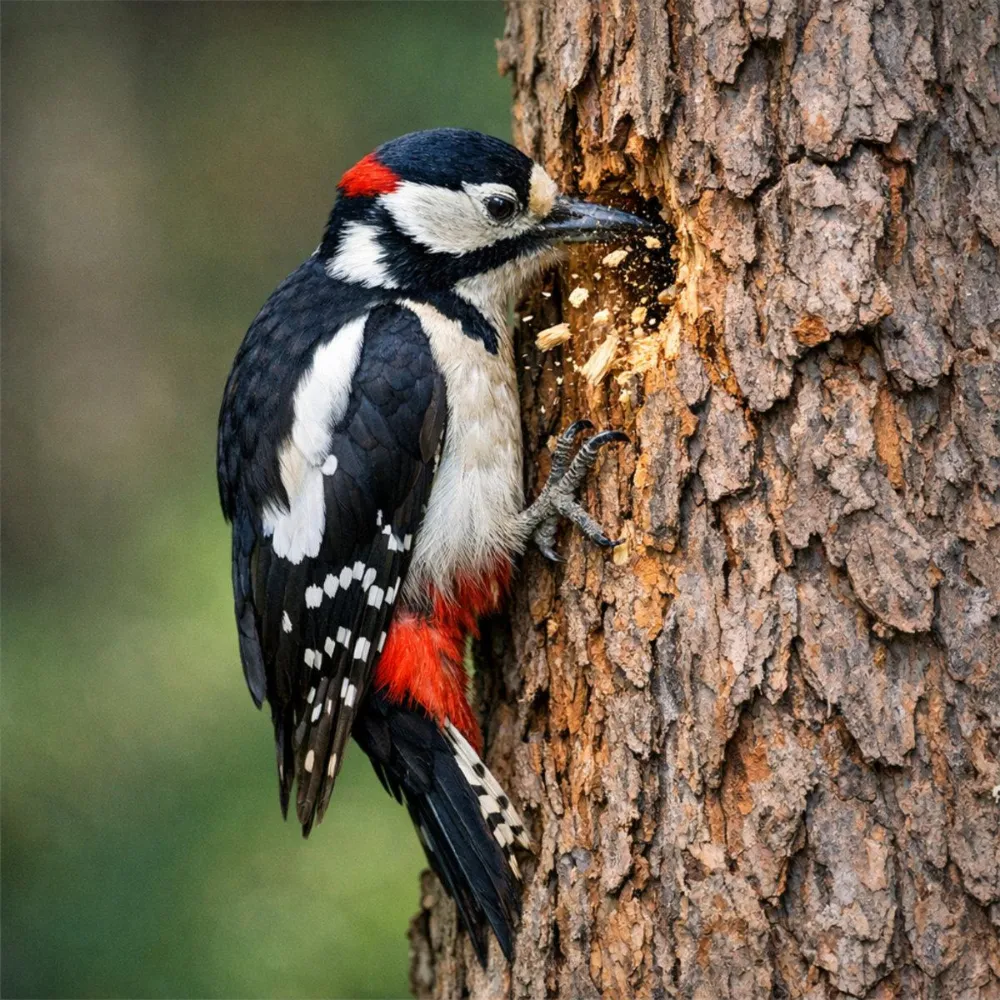
Woodpeckers peck trees for food, nesting, and communication, using specialized bills and climbing adaptations.
Why Do Woodpeckers Peck Trees?
Woodpeckers belong to a diverse group of birds adapted for climbing trees and using their bills to strike wood.
The familiar sound of a woodpecker tapping on a trunk can have several very different explanations.
Three of the most important are:
Finding food: Woodpeckers remove bark or excavate wood to reach insects and other prey.
Building cavities: Many species create holes used for nesting or sleeping.
Communication: Rapid drumming advertises territory and may help attract a mate.
Some woodpeckers also make holes to obtain tree sap or store food.
Although these behaviors all involve striking wood with the bill, they are not mechanically or biologically identical.
A bird making a loud, rapid drumroll may not be eating anything.
Likewise, a woodpecker excavating a deep hole may be searching for food rather than building a nest.
Understanding the purpose of pecking requires looking at the pattern of impacts, the resulting holes, the season, and the species involved.
Do Woodpeckers Peck Trees to Find Food?
Yes. Searching for food is one of the main reasons woodpeckers peck trees.
Many woodpeckers feed on insects that live in bark, dead wood, or tunnels inside trees.
These insects may be difficult for other birds to reach.
A woodpecker can strike the wood to remove pieces of bark or expose hidden tunnels.
It may then use its specialized tongue to capture the insects inside.
Common prey includes:
Wood-boring beetle larvae
Ants, including carpenter ants
Other insects living beneath bark
Various insect larvae and pupae
However, woodpeckers are not exclusively insect eaters.
Depending on the species and season, their diets can also include fruits, nuts, seeds, and tree sap.
How Do Woodpeckers Find Insects Inside Trees?
Woodpeckers use several sensory abilities and behavioral techniques to locate hidden prey.
They may inspect bark, probe crevices, listen for signs of activity, and investigate places where insects are likely to occur.
Some insects leave visible signs such as holes, tunnels, damaged bark, or accumulations of wood dust.
Woodpeckers can exploit these clues while searching for food.
Once a suitable location is identified, the bird may strike repeatedly to expose the prey.
Its tongue can then reach into cracks or tunnels that the bill cannot enter easily.
The relative importance of visual, auditory, and tactile information varies among species and feeding situations.
It is therefore inaccurate to claim that every woodpecker can precisely hear individual insects moving deep inside a tree.
Why Do Woodpeckers Make Holes in Trees?
Woodpeckers make holes for several purposes, and the shape of the hole can provide clues about the behavior.
Small, irregular excavations may indicate feeding.
Larger cavities with relatively smooth, rounded entrances may be associated with nesting or roosting.
Rows of small holes can be created by sapsuckers, which feed on tree sap.
Some large woodpeckers excavate deep, elongated feeding holes while searching for insects.
For example, the pileated woodpecker (Dryocopus pileatus) often creates large, roughly rectangular excavations while pursuing carpenter ants.
These excavations can extend into dead wood where ants and other invertebrates have established galleries.
By contrast, a nesting cavity generally leads into a chamber large enough to accommodate eggs and growing nestlings.
Hole shape is useful evidence, but it should not be treated as a guaranteed way to identify the bird or its exact purpose.
Do Woodpeckers Build Nests in Trees?
Yes. Many woodpecker species excavate nesting cavities inside trees.
These cavities provide protected spaces in which adults can lay eggs and raise their young.
Woodpeckers often select dead trees, dead limbs, or areas where the wood is softened by decay.
Some species also excavate cavities in living trees.
The bird typically uses its bill to remove wood and gradually create an internal chamber.
Excavation can take days or weeks depending on the species, the condition of the wood, and the size of the cavity.
The Cornell Lab of Ornithology reports that pileated woodpeckers usually spend several weeks constructing nesting cavities.
Many woodpecker nests contain little or no added nesting material beyond the wood chips left from excavation.
Why Are Woodpecker Nesting Holes Important?
Woodpeckers are important cavity creators in forest ecosystems.
After a woodpecker finishes using a nesting cavity, other animals may occupy it.
These are often called secondary cavity nesters because they use existing cavities instead of excavating their own.
Animals that may benefit from abandoned woodpecker holes include:
Some songbirds
Small owls
Certain ducks
Small mammals
Other cavity-dependent wildlife
Availability depends on cavity size, location, habitat, and geographic region.
Because suitable tree cavities can be limited, woodpecker excavation contributes to the availability of nesting and shelter sites for other species.
This makes woodpeckers ecologically important beyond their own feeding and reproductive behavior.
Why Do Woodpeckers Drum on Trees?
Woodpeckers drum on trees to communicate.
Drumming involves a rapid series of bill strikes that create an audible pattern.
Unlike feeding excavation, drumming is primarily intended to produce sound rather than remove wood.
The sound can advertise the bird's presence, establish or defend a territory, and contribute to mate attraction.
Drumming is especially noticeable during periods associated with breeding and territorial activity.
Woodpeckers often choose surfaces that produce loud, resonant sounds.
These may include hollow branches, dead tree trunks, and even human-made objects.
The Cornell Lab of Ornithology distinguishes drumming from the slower or more irregular strikes used for feeding and excavation.
Although drumming is sometimes called pecking, its primary function is acoustic communication.
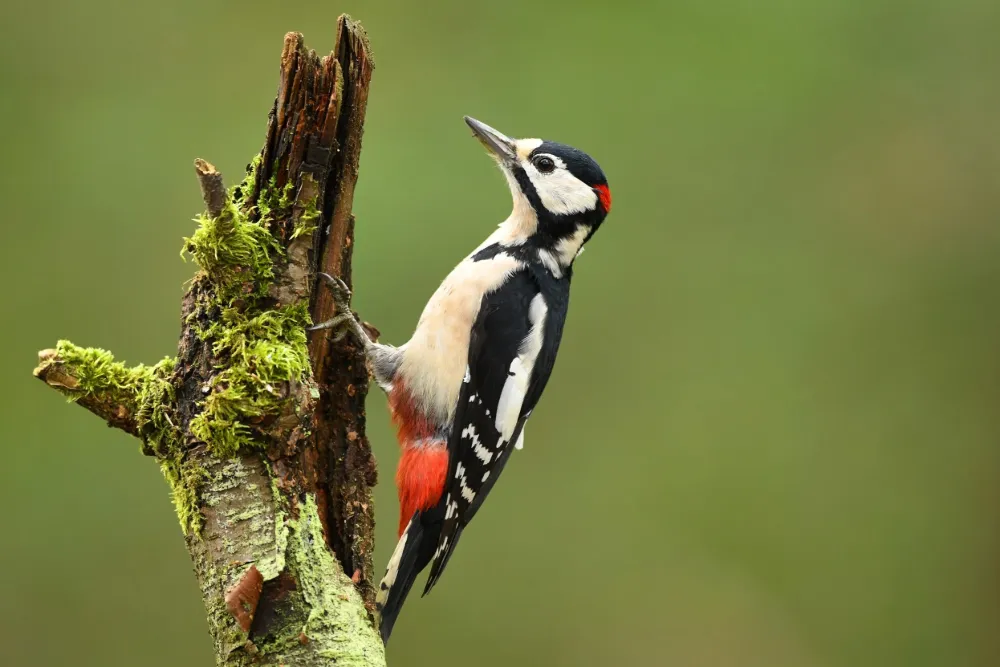
Woodpecker drumming is a communication behavior that differs from drilling for insects or excavating nesting cavities.
Is Woodpecker Drumming the Same as Pecking?
Drumming and excavating both involve striking a surface with the bill, but they serve different purposes.
Drumming is usually a rapid series of impacts designed to produce a recognizable sound.
Excavation uses repeated strikes to remove wood.
Foraging may involve a mixture of tapping, probing, prying, and stronger blows.
The differences can often be recognized by observing the sound and resulting damage.
| Behavior | Main Purpose | Typical Signs |
|---|---|---|
| Drumming | Communication | Rapid rhythmic sound, often little wood removed |
| Foraging | Finding food | Irregular holes, bark removal, insect probing |
| Nest excavation | Creating a breeding cavity | Large entrance leading to a chamber |
| Roost excavation | Creating shelter | Cavity used for resting |
| Sap feeding | Obtaining tree sap and associated food | Repeated rows or patterns of sap wells |
However, these categories are not always completely separate.
A bird may inspect the same tree for multiple purposes, and the exact patterns vary among species.
Why Do Woodpeckers Peck So Fast?
Woodpeckers can strike rapidly because their head, neck, bill, and muscular control are adapted to repeated impacts.
Rapid striking is useful for creating drumming signals and, in some situations, working through wood.
However, not all forms of pecking occur at the same speed.
Territorial drumming may involve very fast, rhythmic bursts.
Feeding and nesting excavation often involve slower or more variable strikes.
The exact striking rate depends on species, activity, and individual behavior.
Some woodpeckers can perform numerous impacts in a short period, but dramatic claims about the number of strikes per second should not be generalized to every species.
How Do Woodpeckers Avoid Brain Injury?
Woodpeckers regularly perform high-speed impacts that would be dangerous for a human attempting a comparable activity.
Scientists have long studied how these birds tolerate repeated pecking.
Older explanations commonly suggested that the woodpecker skull functioned primarily as a shock absorber.
However, more recent biomechanical research has challenged that idea.
In 2022, researchers published a study in Current Biology using high-speed recordings of pecking woodpeckers.
They measured the movement and deceleration of the bill and head during impacts.
The results suggested that the skull behaves more like a stiff hammer than a cushioning helmet.
This arrangement is mechanically useful because a stiff head transfers impact forces into the wood.
A large amount of shock absorption within the head would reduce the efficiency of striking.
Do Woodpeckers Have Shock-Absorbing Skulls?
The idea that woodpeckers are protected primarily by a skull that absorbs large amounts of shock is not supported by the 2022 biomechanical study.
Researchers examined three woodpecker species and compared the deceleration of the bill with that of the braincase.
They found little evidence that the cranial skeleton substantially reduced the deceleration transmitted to the braincase.
The findings support a different explanation: the woodpecker's head is mechanically suited to efficient hammering, while the size and geometry of the brain help keep modeled impact stresses within tolerable ranges.
However, this does not establish that every woodpecker can never suffer a head injury.
It also does not mean the skull has no structural role in protecting the brain.
The important finding is that the popular image of a heavily cushioned, shock-absorbing woodpecker skull is misleading.
Why Don't Woodpeckers Get Concussions Every Time They Peck?
Woodpeckers have small brains and specialized head structures associated with their striking behavior.
The 2022 study used numerical modeling to investigate pressures that could occur inside the braincase during pecking.
The calculated levels were below concussion thresholds established in the primate comparisons used by the researchers.
This suggests that normal pecking can occur without requiring a highly shock-absorbing skull.
However, the precise thresholds for injury in woodpecker brains are not necessarily identical to those of humans or other primates.
Researchers therefore distinguish between the mechanical evidence and stronger claims about the complete absence of injury or long-term neurological effects.
It is more accurate to say that woodpeckers are adapted to repeated pecking and that their head mechanics appear to keep ordinary impacts within manageable limits.
Does a Woodpecker's Tongue Protect Its Brain?
Woodpeckers have an unusual tongue-supporting structure called the hyoid apparatus.
In some species, parts of this apparatus extend around the back of the skull.
This arrangement supports the movement of the tongue, allowing it to reach into crevices and extract food.
Scientists have investigated whether the hyoid apparatus might also influence mechanical responses during pecking.
However, its well-established function is associated with tongue support and movement.
Claims that the tongue simply wraps around the brain and acts as a protective seat belt are oversimplified and should not be presented as proven facts.
The 2022 findings further demonstrate why it is important not to describe any single skull or tongue structure as a complete explanation for impact tolerance.
How Does a Woodpecker's Tongue Help It Eat?
Many woodpeckers have specialized tongues that help extract food from narrow spaces.
Depending on the species, the tongue may be long, pointed, sticky, or equipped with backward-facing structures that help retain prey.
After opening a hole in wood, the bird can extend its tongue into an insect tunnel.
The tongue may contact and retrieve insects that cannot be reached directly with the bill.
Pileated woodpeckers, for example, can use their tongues to extract insects from deep excavations.
However, woodpecker tongue anatomy varies substantially.
Species that specialize in different foods may possess different tongue shapes and feeding techniques.
Do Woodpeckers Eat the Wood They Peck?
Woodpeckers generally do not peck trees because they want to eat the wood itself.
Wood is typically a barrier that must be removed to obtain insects or create cavities.
During excavation, the bird may remove small chips and fragments.
These pieces usually fall away from the tree.
Woodpeckers cannot be assumed to digest wood as a primary nutritional resource.
Instead, they obtain energy and nutrients from insects, sap, fruit, seeds, nuts, and other suitable foods.
Why Do Woodpeckers Peck Dead Trees?
Dead trees often provide especially useful feeding and nesting opportunities.
Decaying wood may contain beetle larvae, ants, and other invertebrates.
It can also be easier to excavate than sound, dense hardwood.
Standing dead trees, commonly called snags, are important features of many forest habitats.
Woodpeckers may use them for:
Foraging
Nesting
Roosting
Drumming
Different species select different sizes and conditions of dead wood.
Some also excavate living trees, especially when parts of the trunk have been softened by fungal decay.
Because dead wood supports many organisms, safe retention of suitable snags can benefit forest wildlife.
Why Do Woodpeckers Peck Healthy Trees?
Woodpeckers do not restrict their activities to dead or diseased trees.
Some species feed or nest in living trees.
A living tree may contain insects beneath the bark or in decayed sections.
It may also provide a suitable resonant surface for drumming.
Red-cockaded woodpeckers are notable because they excavate nesting cavities in living pine trees, often in wood softened by internal fungal decay.
They also create small resin wells around cavities, which can help deter some predators.
The presence of a woodpecker on a healthy-looking tree therefore does not necessarily mean that the entire tree is dying.
Why Do Woodpeckers Peck Houses and Metal Gutters?
Woodpeckers sometimes strike siding, gutters, chimney caps, and other human-made surfaces.
There are several possible reasons.
A loud, resonant metal surface may be attractive for territorial drumming.
Wooden siding may contain insects, making it a potential feeding site.
Some birds may attempt to excavate nesting or roosting cavities in suitable building materials.
Acorn woodpeckers may also make storage holes for acorns.
According to the Cornell Lab of Ornithology, these behaviors should be distinguished because each requires a different interpretation.
A loud burst of rapid tapping on a metal gutter is more likely to be communication than food excavation.
Repeated holes in wooden siding may indicate feeding, cavity excavation, or food storage depending on the species.
Does Woodpecker Pecking Mean a Tree Is Diseased?
Not necessarily.
Woodpeckers may be attracted to trees containing insects or decayed wood, but they also use healthy trees for drumming and other activities.
A tree with extensive feeding excavations may warrant closer examination for insect activity or decay.
However, a few woodpecker marks do not provide a reliable diagnosis of tree health.
The significance depends on the species, type of holes, condition of the tree, and surrounding habitat.
If tree safety is a concern, an appropriately qualified arborist can assess structural problems independently of the bird's presence.
Do Woodpeckers Peck Trees All Year?
Woodpeckers may peck trees throughout the year, but the balance between activities changes seasonally.
Territorial drumming often increases during the breeding season.
Nest excavation commonly occurs before eggs are laid.
Foraging takes place whenever birds need to obtain food.
Some woodpeckers also excavate or use cavities for resting outside the nesting season.
Climate, food availability, species, and geographic location influence these patterns.
Therefore, the sound of a woodpecker in winter does not necessarily have the same purpose as a rapid drumroll in spring.
Do All Woodpeckers Peck Trees?
Many woodpecker species regularly strike trees or other woody surfaces, but their feeding and foraging techniques vary widely.
Some specialize in excavating wood to capture insects.
Others spend more time probing bark, feeding on sap, searching the ground, or eating fruit.
Northern flickers, for example, frequently forage on the ground for ants.
Sapsuckers create rows of sap wells in trees.
Acorn woodpeckers are famous for storing acorns in drilled holes.
These differences show that woodpeckers are not a single uniform ecological group.
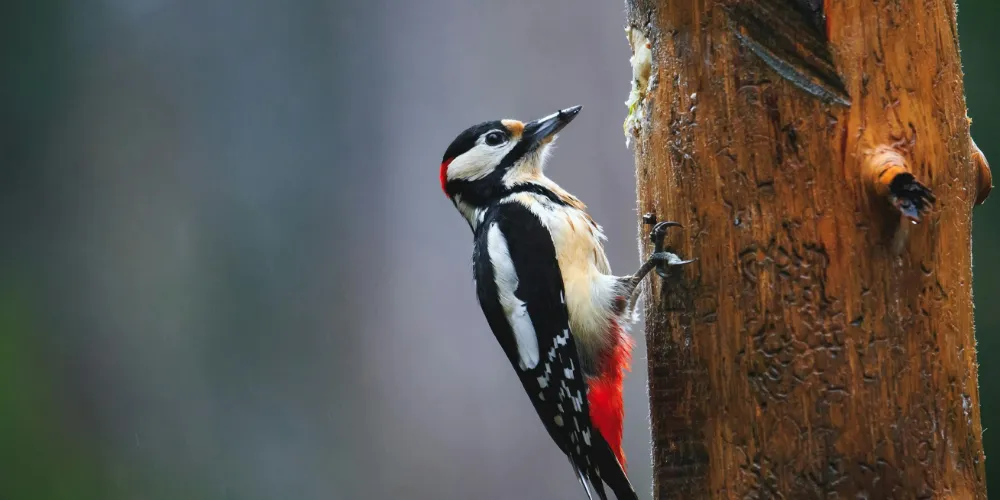
How Do Woodpeckers Stay Attached to Tree Trunks?
Woodpeckers possess climbing adaptations that help them maintain position on vertical surfaces.
Many species have strong feet with sharp claws suited to gripping bark.
The familiar toe arrangement in many woodpeckers is zygodactyl, with two toes directed forward and two backward.
However, not every woodpecker species has exactly the same functional toe arrangement.
Stiff tail feathers also provide support when the bird presses its body against a trunk.
The feet and tail work together to stabilize the body during climbing and pecking.
Strong neck muscles then help direct the bill toward the target.
These adaptations allow woodpeckers to work on vertical tree surfaces while keeping their bodies relatively stable.
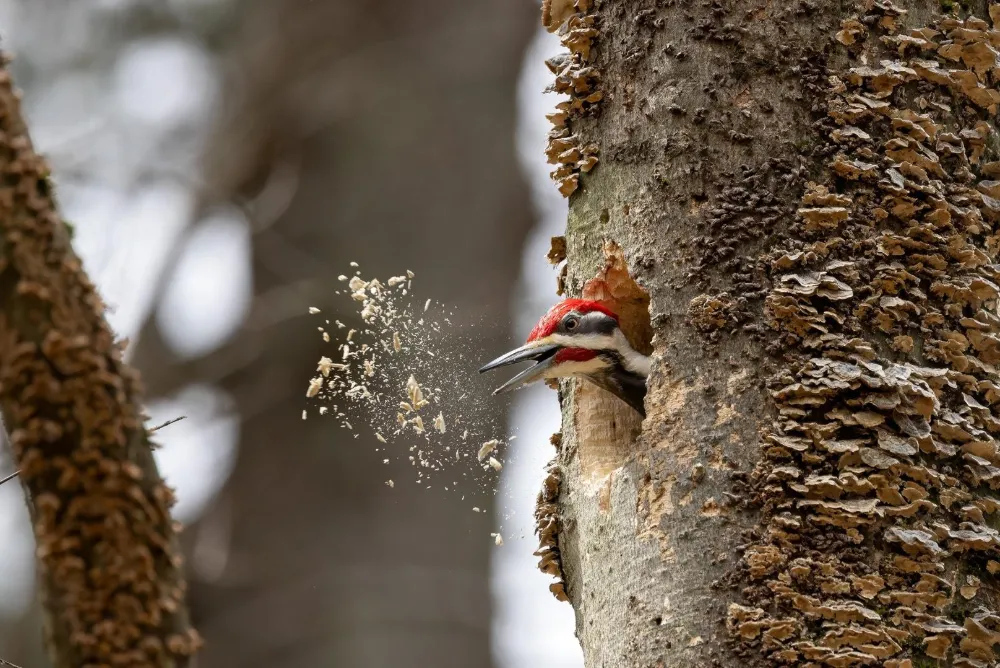
Pileated woodpeckers often make large excavations while searching dead wood for carpenter ants and other insects.
How Do Woodpeckers Help Forest Ecosystems?
Woodpeckers perform several important ecological functions.
By feeding on insects, they participate in forest food webs and influence populations of certain invertebrates.
By excavating nesting cavities, many species also create shelter that other animals can use.
These cavity-building activities can contribute to the availability of nesting and roosting sites in forests.
Woodpeckers are therefore often considered important cavity-excavating birds.
However, not every species has the same ecological role.
Their effects depend on habitat, food preferences, nesting behavior, and local communities of other organisms.
Frequently Asked Questions
Why do woodpeckers keep pecking trees?
Woodpeckers peck trees to find food, create nesting or roosting holes, and communicate through rapid drumming.
Do woodpeckers peck trees to eat bugs?
Yes. Many species excavate bark and wood to reach insects such as ants and beetle larvae.
Why do woodpeckers drum on trees?
Drumming produces a rapid sound signal used in territorial communication and mate attraction.
Do woodpeckers hurt trees?
Woodpecker excavation can damage portions of a tree, but the significance depends on the extent of the holes and the tree's existing condition. Some activities create valuable wildlife cavities.
Do woodpeckers eat wood?
Woodpeckers generally remove wood to reach food or create cavities rather than eating the wood as their primary food source.
How do woodpeckers avoid concussions?
Biomechanical research suggests that normal pecking impacts can remain below modeled injury thresholds partly because of the birds' small brain size and head mechanics. Their skulls do not primarily work as shock-absorbing helmets.
How fast can woodpeckers peck?
Some woodpeckers can perform rapid sequences of strikes, especially while drumming. The rate depends on the species and activity.
Why do woodpeckers peck metal gutters?
Metal surfaces can produce loud sounds, making them attractive for territorial drumming and communication.
Do woodpeckers make their own nests?
Many species excavate nesting cavities inside trees, using their strong bills to remove wood.
Why do woodpeckers peck dead trees?
Dead wood often contains insects and may be easier to excavate for nesting or shelter.
Do woodpeckers only peck in the morning?
No. Pecking and foraging can occur at different times of day, although territorial drumming may be particularly noticeable during some periods.
Are woodpeckers bad for forests?
No. Woodpeckers are natural components of forest ecosystems. Their feeding and cavity excavation can provide important ecological benefits.
The Bottom Line
Woodpeckers peck trees for several important reasons, including finding insects, creating nesting cavities, and communicating through drumming.
The rhythm and resulting holes often provide clues about what a bird is doing.
Scientific research has also changed how we understand the mechanics of pecking. Rather than functioning primarily as shock absorbers, woodpecker heads appear mechanically adapted for efficient striking while keeping ordinary impacts within manageable limits.
Woodpeckers are remarkable not simply because they can strike trees repeatedly, but because their anatomy and behavior allow them to use wood in many different ways.
Sources & Further Reading
The following ornithological institutions, university resources, and peer-reviewed studies explain woodpecker behavior, nesting, communication, feeding, and impact biomechanics.
Cornell Lab of Ornithology — Built to Peck: How Woodpeckers Avoid Brain Injury. Explains woodpecker anatomy, feeding, cavity excavation, and drumming. Note that some older anatomical interpretations are updated by the 2022 study below.
Cornell Lab of Ornithology — Why Do Woodpeckers Like to Hammer on Houses?. Distinguishes territorial drumming, feeding, nest excavation, and food storage.
Cornell Lab of Ornithology — Pileated Woodpecker Life History. Details carpenter-ant foraging, rectangular excavations, and nest construction.
Van Wassenbergh et al. (2022) — Woodpeckers Minimize Cranial Absorption of Shocks. Peer-reviewed research in Current Biology challenging the traditional shock-absorber explanation.
Iowa State University Extension — Woodpeckers: Damage Management. Explains the differences between drumming, feeding, and nesting behavior around trees and buildings.