Platypuses lay eggs because they belong to an ancient branch of mammals called monotremes, which retained the egg-laying reproductive system inherited from early mammalian ancestors. Unlike most living mammals, female platypuses do not give birth to live young. Instead, they lay one to three small, leathery eggs, usually two, inside a carefully prepared nesting burrow. The eggs hatch after approximately 10 to 11 days of incubation. The tiny hatchlings then feed on their mother's milk for several months. This unusual combination of egg laying and milk production makes the platypus an important species for understanding mammalian evolution.
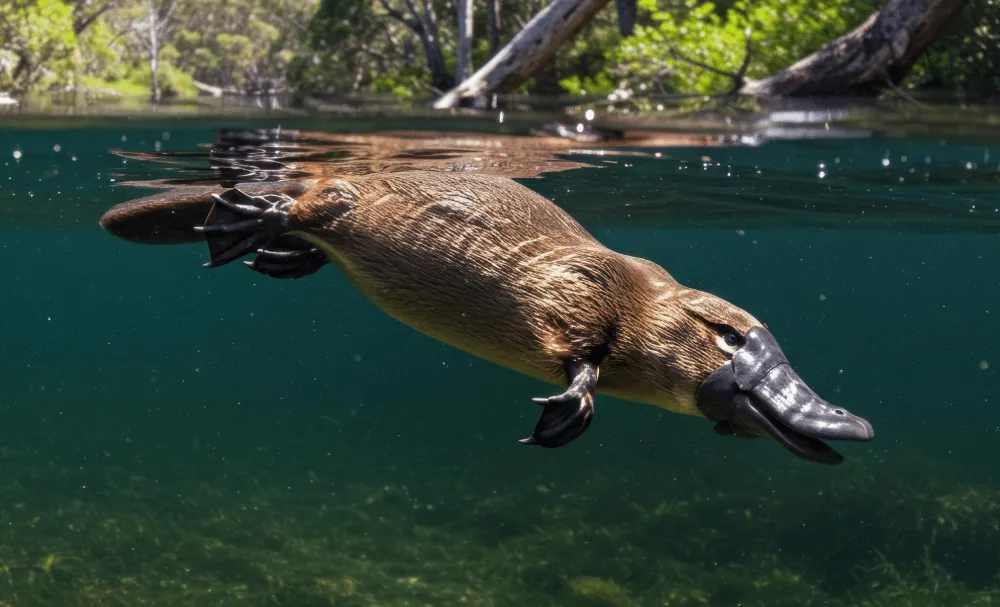
The platypus is a genuine mammal, even though females reproduce by laying eggs.
Why Do Platypuses Lay Eggs?
Platypuses lay eggs because their evolutionary lineage retained a reproductive strategy that was present in distant mammalian ancestors.
Most living mammals give birth to live young. However, platypuses and echidnas belong to the monotremes, a separate branch of mammals that reproduces by laying eggs.
This does not mean platypuses are reptiles or that they represent an unfinished stage of mammalian evolution. They are fully evolved modern mammals with a distinctive combination of inherited and specialized characteristics.
Egg laying is one of the ancestral traits retained in their lineage. Meanwhile, their fur, milk production, and other anatomical features demonstrate their mammalian identity.
Do Platypuses Really Lay Eggs?
Yes. Female platypuses lay eggs rather than giving birth to live babies.
After mating, a female prepares a nesting chamber inside a burrow near a freshwater habitat. She lays a small clutch of soft-shelled eggs and incubates them by curling her body around them.
The eggs eventually hatch into extremely small, immature young. These hatchlings remain dependent on their mother for warmth, protection, and milk.
Platypus egg laying has been documented scientifically since the nineteenth century and is well established through anatomical research and observations of breeding animals.
Are Platypuses Mammals if They Lay Eggs?
Yes. Platypuses are mammals, not birds or reptiles.
One of the defining features of mammals is the production of milk by mammary glands. Platypuses have functional mammary glands and nourish their young with milk.
They also possess fur, regulate their body temperature through internal physiological processes, and share important skeletal and genetic characteristics with other mammals.
Most mammals give birth to live young, but live birth is not a universal requirement for membership in the mammal group.
Monotremes demonstrate that mammalian evolution includes more than one reproductive strategy.
What Is a Monotreme?
A monotreme is a mammal belonging to the order Monotremata.
Living monotremes include the platypus and echidnas. They differ from other living mammals because females lay eggs and produce milk without having nipples.
The name monotreme comes from a Greek expression referring to a single opening. Like many birds and reptiles, monotremes possess a cloaca, a common opening associated with digestive, urinary, and reproductive functions.
However, a cloaca and egg laying do not make monotremes reptiles. Their evolutionary ancestry and many other features identify them as mammals.
How Many Egg-Laying Mammals Are Alive Today?
Five living monotreme species are generally recognized: one platypus species and four echidna species.
The platypus is Ornithorhynchus anatinus.
The short-beaked echidna is Tachyglossus aculeatus. Three recognized long-beaked echidna species belong to the genus Zaglossus.
However, the platypus and echidnas are the only surviving lineages of a once more diverse evolutionary group.
Fossils reveal that extinct monotremes existed long before the modern species appeared.
What Are the Five Living Egg-Laying Mammals?
| Animal | Scientific Name | Main Geographic Association |
|---|---|---|
| Platypus | Ornithorhynchus anatinus | Eastern Australia and Tasmania |
| Short-beaked echidna | Tachyglossus aculeatus | Australia and New Guinea |
| Western long-beaked echidna | Zaglossus bruijnii | New Guinea |
| Eastern long-beaked echidna | Zaglossus bartoni | New Guinea |
| Attenborough's long-beaked echidna | Zaglossus attenboroughi | New Guinea |
All five are mammals, and females of these species reproduce by laying eggs. Their habitats, diets, and reproductive behavior differ considerably.
Why Did Most Mammals Evolve Live Birth?
The ancestors of living mammals were egg-laying amniotes. Over evolutionary time, the lineage leading to marsupials and placental mammals developed different forms of live birth.
Live birth involves retaining the developing offspring inside the mother's reproductive tract until birth.
This evolutionary transition required changes in reproductive anatomy, embryonic nutrition, maternal physiology, and developmental regulation.
However, scientists do not attribute the origin of live birth to one universal advantage that applies under every ecological condition.
The 2021 comparative genome study of platypuses and echidnas helped identify genetic changes related to the evolutionary transition from egg laying to live birth.
Did Platypuses Evolve From Reptiles?
Platypuses did not descend from any modern lizard, snake, or crocodile species.
Instead, mammals and modern reptiles share ancient evolutionary ancestors.
Some ancestral features, including egg laying, were retained in the monotreme lineage while other mammalian lineages evolved live birth.
Therefore, it is more accurate to describe the platypus as a modern mammal that retains an ancestral reproductive trait than as a mixture of a living reptile and a living mammal.
How Old Is the Monotreme Lineage?
Monotremes represent an early-diverging branch of living mammals.
Genetic and fossil evidence indicates that the evolutionary separation between monotremes and the lineage leading to marsupials and placentals occurred deep in mammalian history, during the Mesozoic Era.
However, published estimates differ depending on the fossil evidence, genetic methods, and evolutionary models used.
The Australian Museum describes monotremes as having diverged from other mammals roughly 166 million years ago in one evolutionary reconstruction.
That date should be treated as an estimate of lineage divergence, not the age of the modern platypus species.
What Did Scientists Learn From the Platypus Genome?
Genomic studies have provided important evidence about the evolution of egg-laying mammals.
In 2008, researchers published a draft platypus genome in Nature. The study identified genes associated with mammalian milk production as well as genes connected to traits retained from earlier amniote ancestors.
A more complete genomic comparison published in 2021 examined both the platypus and the short-beaked echidna.
The researchers investigated genes involved in egg production, lactation, sex chromosomes, and sensory biology.
These findings helped explain how egg laying and milk production coexist in a modern mammalian lineage.
What Is a Vitellogenin Gene?
Vitellogenin genes are associated with the production of proteins that help supply nutrients to developing embryos inside eggs.
These proteins are important in many egg-laying vertebrates, including birds and reptiles.
As live birth and maternal nutrient transfer evolved in other mammals, the importance of traditional egg-yolk protein production changed.
The 2021 platypus and echidna genome study found that monotremes retain one functional major vitellogenin gene, called VTG2, and part of another.
This provides genetic evidence connecting their egg-laying reproductive system with the broader evolutionary history of mammals.
How Do Platypus Eggs Develop?
After mating and internal fertilization, developing eggs remain inside the female's reproductive tract for a period before being laid.
During this stage, the embryo receives nourishment from materials associated with the egg and from maternal reproductive secretions.
When the eggs are laid, their development is not yet complete.
The female then incubates them externally in a protected nesting chamber.
This makes platypus reproduction different both from the hard-shelled egg laying of many birds and from the internal development typical of placental mammals.
How Many Eggs Does a Platypus Lay?
A female platypus typically lays two eggs.
However, clutches of one or three eggs have also been documented.
The Australian Museum, San Diego Zoo, and Australian Platypus Conservancy all describe this small clutch size.
Not every female produces eggs successfully during every breeding season.
Reproductive success depends on factors such as age, environmental conditions, and the availability of suitable nesting habitat.
What Do Platypus Eggs Look Like?
Platypus eggs are small, pale, and nearly round or oval.
They have a soft, flexible, parchment-like shell rather than the thick, hard, brittle shell associated with a chicken egg.
Measurements reported by the Australian Platypus Conservancy are approximately 16–18 millimeters long and 14–15 millimeters wide.
The shell helps protect the developing embryo while allowing the biological exchanges necessary for development.
However, a platypus egg is delicate and must be kept in suitable conditions.
Are Platypus Eggs Like Chicken Eggs?
Platypus eggs and chicken eggs both contain developing embryos protected by external egg coverings.
However, they differ significantly in size, shell structure, and reproductive biology.
Chicken eggs have a hard calcified shell and generally contain substantial yolk reserves.
Platypus eggs have a smaller, more flexible shell, and development includes a period of maternal nutrient support before laying.
Furthermore, after hatching, a platypus receives milk from its mother, while a chick does not.
Platypus Eggs vs. Chicken Eggs
| Feature | Platypus | Chicken |
|---|---|---|
| Animal group | Mammal | Bird |
| Egg covering | Soft, leathery or parchment-like | Hard, calcified shell |
| Typical clutch | Usually two eggs | Varies by breed and reproductive conditions |
| External incubation | About 10–11 days | Typically about 21 days |
| Young receive milk | Yes | No |
| Usual nest | Underground riverbank burrow | Constructed nest or nesting site |
Where Do Platypuses Lay Their Eggs?
Female platypuses lay their eggs inside specially prepared nesting burrows near freshwater habitats.
These burrows are usually excavated into riverbanks or other suitable soil.
A nesting burrow can be longer and more elaborate than an ordinary resting burrow.
The female prepares a chamber containing vegetation that helps create a protected environment for eggs and hatchlings.
However, she does not normally place the eggs directly in the water.
Why Do Platypuses Build Nesting Burrows?
A nesting burrow provides shelter for the vulnerable eggs and newly hatched young.
The chamber can help protect them from predators, water fluctuations, and unfavorable environmental conditions.
Female platypuses transport nesting vegetation into the chamber using their bodies and tails.
Some nesting burrows contain soil plugs that separate the breeding chamber from the entrance.
However, scientists should not assume that every plug performs only one function. Protection from predators, flooding, and changes in temperature or humidity may all be relevant.
Do Platypuses Lay Eggs in Water?
No. Platypuses live and forage in freshwater, but their eggs are laid in underground nesting chambers.
The developing embryos require the protected conditions provided by the burrow.
A female may leave the burrow to feed, but she returns to care for the eggs and young.
The distinction is important: the platypus is a semiaquatic mammal, not an animal that releases its eggs directly into a river like many fish.
How Long Is a Platypus Pregnant?
The period between mating and laying eggs is estimated from a limited number of observations.
Published sources report somewhat different values.
For example, traditional accounts describe approximately 21 days, while the Australian Platypus Conservancy reports estimates ranging from about 13 to 23 days in captivity, with an average near 16 days.
These differences reflect the difficulty of documenting reproduction in a secretive animal.
Therefore, a single number should not be presented as an exact gestation period for every platypus.
How Long Do Platypus Eggs Take to Hatch?
Platypus eggs are incubated for approximately 10 to 11 days after laying.
During this period, the mother keeps them warm inside the nesting chamber.
She commonly curls her body around the eggs, holding them near her abdomen and tail.
However, the exact schedule may vary with conditions.
This short external incubation period follows the developmental stage that occurred inside the mother's reproductive tract.
How Does a Mother Platypus Incubate Her Eggs?
The female remains in her nesting chamber for much of the incubation period.
She curls into a protective posture with the eggs held between her abdomen and tail.
Her body supplies warmth, while nesting materials help maintain suitable environmental conditions.
However, not every moment of incubation has been directly observed in the wild.
Much of the detailed knowledge of platypus nesting behavior comes from scientific studies and carefully monitored captive breeding.
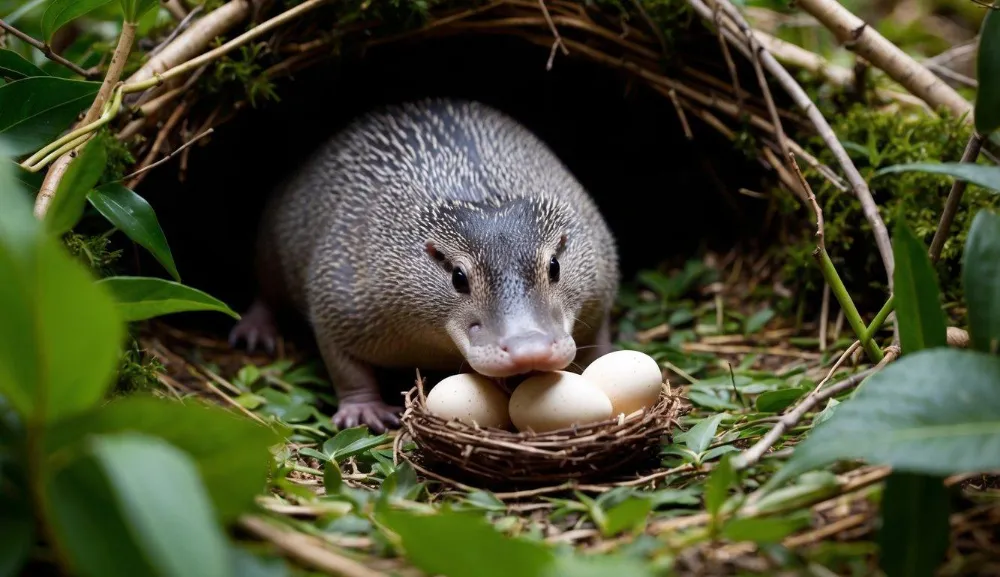
Illustration of a female platypus incubating a small clutch of eggs in a protected nesting chamber. This is a scientific reconstruction, not a photograph of a real nest.
How Do Baby Platypuses Hatch?
Platypus hatchlings possess specialized structures that help them escape from their egg coverings.
These include a temporary egg tooth and a small projection called a caruncle.
Using these structures, the developing animal can break through the flexible shell.
The egg tooth is lost soon after hatching, while other temporary developmental structures disappear later.
However, the hatchling remains extremely immature and requires prolonged maternal care.
What Is a Platypus Egg Tooth?
An egg tooth is a temporary structure used by some young animals to break through an eggshell.
Platypus hatchlings possess an egg tooth as well as a caruncle that assists with hatching.
Research on platypus tooth development shows that the egg tooth is lost shortly after hatching.
This should not be confused with the feeding teeth that young platypuses may temporarily develop during later growth.
What Is a Baby Platypus Called?
A baby platypus is often informally called a puggle.
However, puggle is a popular common name rather than a formal taxonomic term.
Researchers may use terms such as hatchling, nestling, juvenile, or young platypus when describing particular developmental stages.
Newly hatched platypuses are tiny, hairless, and highly dependent on their mothers.
What Do Newborn Platypuses Look Like?
Newly hatched platypuses are very small and immature.
They lack the dense fur and well-developed bill seen in adults.
Their eyes are not yet fully functional, and they are unable to forage independently.
As they grow, their bodies develop fur, the bill changes shape, and the limbs become more capable of supporting swimming and movement.
However, these changes occur over weeks and months rather than immediately after hatching.
How Do Platypuses Feed Their Babies?
Mother platypuses feed their babies with milk, even though they do not have nipples.
Milk is produced by mammary glands and passes through openings in specialized regions of skin on the mother's abdomen.
The milk collects on these areas and among the surrounding fur.
The young obtain it by contacting and licking or sucking at the milk-bearing surface.
This is a distinctive form of lactation found in monotremes.
Do Platypuses Have Nipples?
No. Female platypuses do not have nipples or teats.
However, they have fully functional mammary glands.
The milk passes through multiple small openings in the skin rather than through a projecting nipple.
It then becomes available to the young on the mother's abdominal surface.
The absence of nipples therefore does not mean platypuses are unable to nurse their offspring.
Where Does Platypus Milk Come From?
Milk is produced by mammary glands beneath the skin of the female platypus.
These glands contain specialized tissues that synthesize milk components.
The milk reaches the skin surface through ducts and openings associated with mammary patches.
Researchers have identified mammalian milk-protein genes in the platypus genome.
This provides genetic evidence that platypus lactation is related evolutionarily to milk production in other mammals.
Is Platypus Milk Different From Other Mammal Milk?
Platypus milk contains nutrients and proteins that support the development of its young.
However, its composition differs from that of cow or human milk.
Studies have also identified distinctive proteins associated with monotreme lactation.
The 2021 genome research examined genes related to milk composition and developmental nutrition.
However, the existence of unusual milk proteins should not be interpreted as evidence that platypus milk is a proven medical treatment.
How Long Do Baby Platypuses Drink Milk?
Young platypuses depend on milk for approximately three to four months.
They remain largely within the nesting burrow during this period.
As development progresses, the mother spends increasing amounts of time away from the nest while foraging.
Eventually, the young become capable of entering the water and searching for their own food.
The precise timing of emergence varies with conditions and the individual animal.
When Do Baby Platypuses Leave the Nest?
Juvenile platypuses commonly begin emerging from the nesting burrow at approximately three to four months of age.
By this stage, they have developed fur and improved swimming ability.
Their transition to independence is gradual.
However, different sources report slightly different ages depending on which developmental milestone is being measured.
Leaving the nesting chamber briefly is not necessarily equivalent to complete independence.
Do Platypuses Have Pouches?
No. Female platypuses do not possess the temporary egg-incubating pouch seen in echidnas.
They incubate eggs inside a nesting chamber and protect them by curling their bodies around the clutch.
Echidnas follow a different reproductive pattern, carrying an egg in a temporary pouch-like structure.
Both animals are monotremes, but they have developed different ways of protecting eggs and young.
How Do Echidnas Lay Eggs?
Echidnas also reproduce by laying eggs.
However, the short-beaked echidna usually produces one egg rather than the typical two-egg platypus clutch.
The female incubates the egg in a temporary abdominal pouch.
After hatching, the young echidna receives milk from mammary areas within the pouch region.
This differs from the platypus, which uses a specialized nesting burrow and has no permanent or temporary egg-incubating pouch of the same kind.
Platypus vs. Echidna Reproduction
| Feature | Platypus | Echidna |
|---|---|---|
| Animal group | Monotreme mammal | Monotreme mammal |
| Egg laying | Yes | Yes |
| Typical eggs | Two | One |
| Incubation setting | Nesting burrow | Temporary abdominal pouch in studied species |
| Milk production | Yes | Yes |
| Nipples | Absent | Absent |
| Typical lifestyle | Semiaquatic | Terrestrial |
These comparisons describe typical patterns. The platypus and different echidna species have their own reproductive and developmental details.
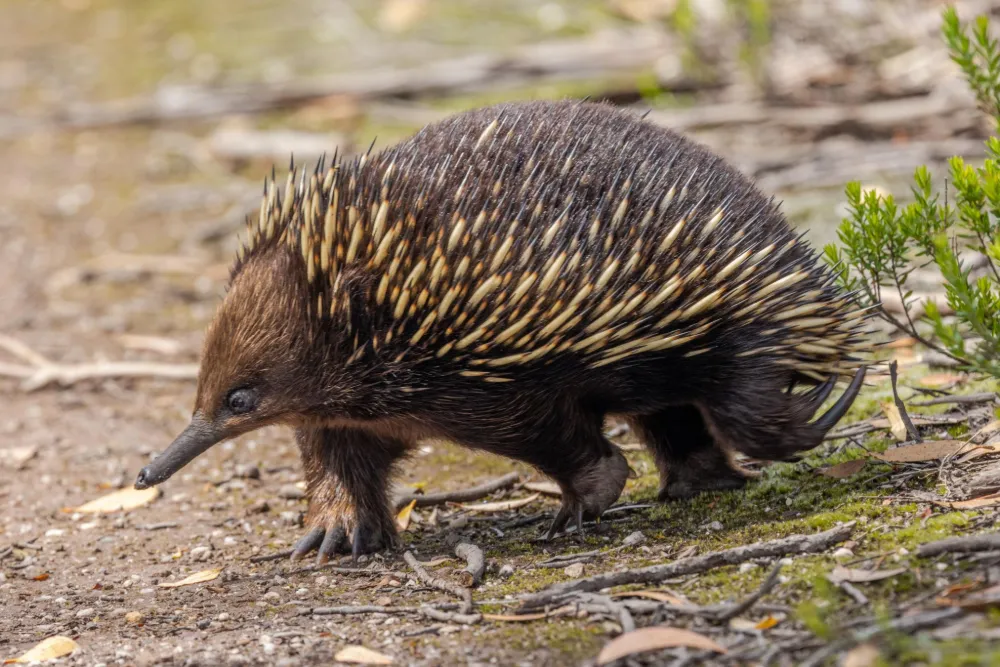
Echidnas are the platypus's living monotreme relatives. Like platypuses, they lay eggs and produce milk.
Do Wombats and Kangaroos Lay Eggs?
No. Wombats and kangaroos are marsupial mammals.
They give birth to live young rather than laying eggs.
Many marsupials carry their immature offspring in a pouch after birth.
However, pouch use varies among marsupial species.
The difference between marsupials and monotremes illustrates two major reproductive pathways within mammalian evolution.
What Is the Difference Between Monotremes, Marsupials, and Placental Mammals?
These are the three major living branches of mammals.
Monotremes reproduce by laying eggs.
Marsupials typically give birth to relatively immature young that continue developing with prolonged maternal care.
Placental mammals generally support more extensive embryonic development through a placenta before live birth.
However, all three lineages are mammals and produce milk for their offspring.
Three Major Mammal Groups
| Mammal Group | Reproductive Pattern | Examples |
|---|---|---|
| Monotremes | Egg laying followed by milk feeding | Platypus, echidnas |
| Marsupials | Live birth of relatively immature young | Kangaroo, wombat, koala |
| Placental mammals | Live birth following extensive placental development | Humans, dogs, bats, whales |
Do Platypuses Have a Placenta?
Platypus reproduction does not involve a placenta equivalent to the fully developed nutrient-transfer organ of typical placental mammals.
However, developing eggs receive maternal support while inside the reproductive tract.
Scientists have investigated uterine secretions and the balance between nutrients supplied before and after laying.
The 2021 monotreme genome study emphasized that egg-laying mammals are not dependent on egg yolk proteins to the same extent as many birds and reptiles.
The platypus represents an intermediate evolutionary comparison for understanding the diversification of reproductive systems, not an incomplete version of a placental mammal.
Why Did Platypuses Keep Egg Laying?
Evolution does not necessarily replace every older trait when a new trait appears in another lineage.
The monotreme lineage continued evolving successfully while retaining egg laying.
Its members also evolved specialized ways to incubate eggs, protect hatchlings, and nourish young through lactation.
However, scientists cannot point to one experimentally proven advantage that explains why modern platypuses still lay eggs.
The strongest explanation comes from their ancestry and the reproductive traits maintained through the evolutionary history of monotremes.
Is Egg Laying Less Advanced Than Live Birth?
No reproductive strategy is automatically more advanced in every environment.
Egg laying and live birth each involve different biological costs and benefits.
Both can be successful when supported by suitable physiology, behavior, and ecological conditions.
The platypus is not an evolutionary failure because it lays eggs. Its reproductive strategy belongs to a distinct living mammalian lineage that has persisted and diversified over a long evolutionary history.
Why Is the Platypus So Different From Other Mammals?
Platypuses combine inherited mammalian traits with highly specialized adaptations.
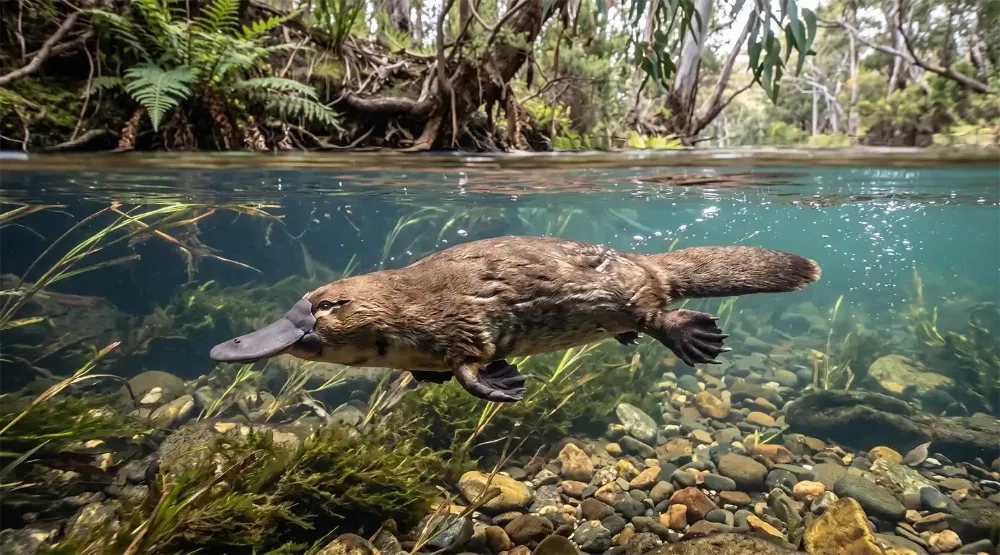
They have a sensitive, flexible bill containing electroreceptors, webbed feet for swimming, dense insulating fur, and a flattened tail.
Males also possess venom-associated spurs on their hind legs.
However, these structures did not evolve simply because the platypus lays eggs.
They reflect a combination of its evolutionary history and adaptations to freshwater environments.
Do Platypuses Have Teeth?
Adult platypuses do not have ordinary functional chewing teeth.
Young platypuses develop temporary teeth during early life, but these are lost as the animals mature.
Adults use specialized grinding pads to process food.
Hatchlings also have a separate temporary egg tooth involved in escaping the eggshell.
These different structures should not be confused with one another.
How Do Platypuses Find Food Underwater?
Platypuses use specialized receptors in their bills to detect weak electrical signals generated by prey.
This ability is called electroreception.
It helps the animal locate aquatic invertebrates even when visibility is poor.
However, electroreception is unrelated to the process of producing eggs.
It is an independently specialized adaptation to the platypus's freshwater feeding ecology.
Are Platypuses Venomous?
Adult male platypuses possess spurs on their hind legs connected with venom-producing glands.
These can deliver painful injuries during defensive or competitive encounters.
However, females do not normally possess the same functional adult venom apparatus.
Venom is not used to nourish eggs or milk-fed offspring.
Its role is associated mainly with interactions involving other animals, including possible competition between males.
Where Do Platypuses Live?
Platypuses are native to freshwater environments in eastern Australia and Tasmania.
They inhabit rivers, streams, and suitable connected aquatic habitats.
Riverbanks are especially important because females need places to excavate nesting burrows.
However, habitat suitability also depends on food availability, water conditions, vegetation, and seasonal environmental changes.
Are Platypuses Endangered?
The platypus is currently listed as Near Threatened on the IUCN Red List, according to Australian conservation organizations.
However, legal conservation categories differ among Australian states.
Some regional populations face greater threats than others.
Habitat fragmentation, waterway changes, pollution, and entanglement in discarded fishing materials can affect survival.
Protecting riverbanks and freshwater habitats is important for both adult platypuses and their nesting young.
Why Is Platypus Reproduction Difficult to Study?
Platypuses are secretive animals that spend much of their lives underwater or inside burrows.
Breeding occurs in enclosed nesting chambers that are difficult to observe without disturbing the animals.
As a result, some detailed reproductive information comes from the small number of successful captive breeding observations.
This helps explain why estimates of gestation length and early development can differ among scientific sources.
Researchers continue to combine field observations, veterinary records, and genetic studies to improve knowledge of platypus reproduction.
What Did the 2025 Monotreme Fossil Study Reveal?
A study published in PNAS in 2025 examined fossil bone microstructure to investigate the origins of monotreme lifestyles.
The researchers evaluated evidence relevant to the evolution of burrowing and semiaquatic behavior.
The results contributed to understanding how ancient monotremes lived.
However, fossil evidence about locomotion and habitat is not direct proof of the precise reproductive behavior of every extinct species.
Living platypuses and echidnas remain especially important for studying the biology of egg-laying mammals.
Why Are Platypuses Important to Evolutionary Biology?
Platypuses allow scientists to investigate mammalian traits that are rarely found together in other living animals.
They lay eggs, produce milk, possess fur, and have specialized sensory and reproductive systems.
Genomic comparisons with echidnas, marsupials, and placental mammals reveal which traits are shared and which evolved differently.
However, the platypus should not be described as a living ancestor of humans or other mammals.
It is a modern species with its own long evolutionary history.
Frequently Asked Questions
Why do platypuses lay eggs?
Platypuses belong to the monotremes, an early-diverging mammalian lineage that retained the ancestral trait of egg laying.
Do platypuses really lay eggs?
Yes. Female platypuses lay small, soft-shelled eggs inside underground nesting burrows.
Are platypuses mammals or reptiles?
Platypuses are mammals. They have fur, produce milk, and share mammalian anatomical and genetic traits.
How many eggs does a platypus lay?
Usually two, although clutches of one to three eggs have been documented.
How big are platypus eggs?
They are approximately 16–18 millimeters long, with soft, parchment-like shells.
How long do platypus eggs take to hatch?
Approximately 10 to 11 days after being laid.
Do platypuses lay eggs underwater?
No. The eggs are laid and incubated in protected nesting burrows near freshwater habitats.
How long is a platypus pregnant?
Estimates differ among sources, with captive observations suggesting approximately 13–23 days between mating and egg laying.
Do platypuses produce milk?
Yes. Female platypuses have mammary glands and nourish their hatchlings with milk.
Do platypuses have nipples?
No. Milk reaches the skin surface through openings in mammary patches on the female's abdomen.
Do platypuses have pouches?
No. Female platypuses use nesting burrows rather than the temporary egg-incubating pouch found in echidnas.
What is a baby platypus called?
A baby platypus is often informally called a puggle.
How long do baby platypuses drink milk?
They generally depend on maternal milk for approximately three to four months.
What other mammals lay eggs?
Echidnas also lay eggs. Platypuses and echidnas are the only living monotreme lineages.
Do kangaroos lay eggs?
No. Kangaroos are marsupials and give birth to live young.
Is a platypus a primitive mammal?
It retains certain ancestral characteristics, including egg laying, but it is a fully evolved modern mammal rather than an incomplete evolutionary form.
Why is the platypus important to science?
Its combination of egg laying, lactation, and unusual genetic traits helps researchers investigate the evolution of mammalian reproduction.
The Bottom Line
Platypuses lay eggs because their monotreme lineage retained a reproductive trait inherited from early mammalian ancestors.
Although most mammals give birth to live young, platypuses reproduce by laying small, soft-shelled eggs in underground nesting burrows.
The mother incubates the eggs for approximately 10 to 11 days and then feeds the hatchlings with milk secreted through specialized skin patches.
Genomic studies have shown that platypuses combine genes associated with egg production and mammalian lactation.
Their biology demonstrates that mammalian evolution produced several successful reproductive systems rather than one universal pattern.
The platypus is therefore not a reptile disguised as a mammal. It is a remarkable living representative of the evolutionary diversity of mammals.
Sources & Further Reading
Australian Museum — Platypus. Species reproduction, nesting behavior, egg incubation, development, and lactation.
Australian Museum — What Is a Monotreme? Classification and characteristics of egg-laying mammals.
San Diego Zoo Wildlife Alliance — Platypus. Egg numbers, soft shells, maternal care, milk feeding, and developmental timing.
Australian Platypus Conservancy — Platypus Reproduction. Detailed reproductive observations and references for egg development and incubation.
Australian Platypus Conservancy — Platypus Vital Statistics. Egg dimensions, estimated gestation, incubation, and weaning data.
Warren et al. (2008) — Genome Analysis of the Platypus Reveals Unique Signatures of Evolution. Nature. Original platypus genome study examining egg laying, milk proteins, and other mammalian features.
Zhou et al. (2021) — Platypus and Echidna Genomes Reveal Mammalian Biology and Evolution. Nature. Comparative genomic evidence concerning vitellogenin, lactation, and monotreme evolution.
Loss of Teeth and Enamel in Tetrapods: Fossil Record, Genetic Data and Morphological Adaptations. Background on platypus tooth development, egg tooth, and adult grinding pads.
Hand et al. (2025) — Bone Microstructure Supports a Mesozoic Origin for a Semiaquatic Burrowing Lifestyle in Monotremes. PNAS. Fossil-based research on ancient monotreme adaptations.
NSW Government — Platypus. State wildlife information on nesting, reproduction, and habitat threats.