Narwhals have tusks primarily because the elongated tooth is thought to play a role in sexual selection, especially in interactions among males. The tusk is not a horn: it is a modified tooth that usually grows from the left side of the upper jaw and projects forward through the upper lip. Scientific research also shows that the tusk can detect changes in its environment, and observations published in 2025 documented narwhals using their tusks to touch and manipulate fish. However, researchers are still investigating how these different functions contributed to the tusk's evolution.

The narwhal's famous tusk is an elongated tooth, not a horn. It is most commonly found in adult males.
Why Do Narwhals Have Tusks?
Narwhals are Arctic whales best known for the extraordinary spiral tusks that extend from the heads of many males.
The tusk is one of the most distinctive structures found in any living mammal.
For centuries, people have proposed different explanations for its existence.
Some suggested that narwhals used the tusk as a weapon. Others proposed that it helped them break ice, catch fish, or detect changes in seawater.
Modern evidence suggests that the tusk may have more than one function. Research on adult males provides strong support for a role in sexual selection, while other studies show that it has sensory abilities and can be used during interactions with prey.
However, not every suggested function is equally well established.
What Is a Narwhal Tusk?
A narwhal tusk is a greatly elongated tooth.
Most narwhals have two teeth in the upper jaw, but these teeth do not develop into ordinary chewing teeth.
In many males, the left tooth grows forward and eventually projects through the upper lip.
It continues to lengthen and develops its characteristic spiral appearance.
The tusk contains dental tissues and is supplied by nerves associated with the tooth organ system.
It is therefore anatomically different from a horn made primarily of keratin.
Is a Narwhal Tusk a Tooth or a Horn?
The narwhal tusk is a tooth.
It is often called a horn because it projects from the whale's head and resembles the horn of a mythical unicorn.
However, the structure develops from the upper jaw as an elongated canine-like tooth.
It contains dentin and other dental tissues rather than being a solid keratin horn.
Researchers have also documented nerves and microscopic channels that help explain its sensory properties.
Why Is the Narwhal Called the Unicorn of the Sea?
Male narwhals often have a single long, spiraled tusk that resembles the horn traditionally depicted on unicorns.
This resemblance gave rise to the nickname unicorn of the sea.
Historically, narwhal tusks were traded and sometimes presented as supposed unicorn horns.
However, narwhals are real marine mammals, while the traditional unicorn is a mythical creature.
The tusk is a specialized tooth that evolved within the narwhal lineage.
Do All Narwhals Have Tusks?
No. Not every narwhal develops a visible tusk.
Most adult males have one, but some males have no external tusk.
Females usually retain their teeth within the jaw, although a small number develop an external tusk.
Rare individuals may even have two visible tusks.
These variations are important because they help scientists investigate the tusk's biological function.
Why Do Male Narwhals Usually Have Tusks?
The tusk occurs far more commonly in males than in females.
This difference between the sexes is called sexual dimorphism.
It suggests that reproductive biology may have influenced the evolution of the structure.
A 2020 study published in Biology Letters found that male tusk length showed substantial variation and increased disproportionately with body size.
These findings support the interpretation that tusks evolved partly through sexual selection.
However, the precise ways in which females and males respond to different tusk sizes are still being studied.
Do Female Narwhals Have Tusks?
Most female narwhals do not have a visible external tusk.
Their upper teeth usually remain embedded within the jaw.
However, females with erupted tusks have been documented.
These exceptions demonstrate that tusk development is not biologically restricted to males under every circumstance.
Still, the strong difference between the sexes provides an important clue about the trait's evolutionary history.
Can a Narwhal Have Two Tusks?
Yes. Rare narwhals develop two external tusks.
This happens when both upper teeth grow outward.
However, the usual condition in a tusked adult male is one visible tusk.
Double-tusked narwhals are unusual and should not be portrayed as the normal appearance of the species.
How Long Can a Narwhal Tusk Grow?
Narwhal tusks can reach nearly three meters in length.
NOAA Fisheries describes exceptional tusks reaching approximately 9.8 feet.
However, tusk length varies considerably among individuals.
The longest recorded examples should not be treated as typical measurements for every adult male.
Tusk length is particularly interesting to researchers because it varies with body size and may provide information relevant to sexual selection.
Why Do Narwhal Tusks Spiral?
The narwhal tusk has a distinctive spiral surface.
It usually twists in a counterclockwise direction when viewed along its outward-growing axis.
The spiral develops during tooth growth.
However, the precise evolutionary significance of the spiral shape remains uncertain.
Scientists have proposed relationships with mechanical properties and growth patterns, but it is important not to assign one unverified function to the twisting structure.
Why Does the Left Tooth Become the Tusk?
In most tusked males, the left upper tooth develops into the external tusk.
The right tooth usually remains within the jaw.
This difference between the two sides of the body is a striking example of developmental asymmetry.
However, the detailed evolutionary reasons for this left-sided pattern are not completely established.
Rare double-tusked animals show that the right tooth can also erupt under unusual circumstances.
What Is Sexual Selection?
Sexual selection is an evolutionary process in which traits influence reproductive success.
Such traits may help an animal compete with members of the same sex or influence mate choice.
Examples include elaborate antlers, conspicuous feathers, and certain exaggerated weapons or signals.
Narwhal tusks may belong to this category.
However, establishing sexual selection requires evidence beyond simply observing that a trait is more common in males.
What Did the 2020 Narwhal Tusk Study Discover?
A 2020 study titled The Longer the Better: Evidence That Narwhal Tusks Are Sexually Selected examined morphological data from 245 adult male narwhals collected over approximately 35 years.
The researchers investigated the relationship between body size and tusk length.
They found that tusk length showed positive allometric growth and unusually large variation.
This pattern is consistent with an exaggerated trait shaped by sexual selection.
The authors proposed that tusks may function as signals during interactions between males.
However, the study did not directly observe every mating interaction or prove that females always prefer males with longer tusks.
Could Narwhal Tusks Signal Male Strength?
The length and appearance of a tusk may provide information about an adult male.
In species where males compete for reproductive opportunities, conspicuous structures sometimes function as signals of condition or competitive ability.
The 2020 narwhal study supports this interpretation.
However, exactly how narwhals assess one another and whether tusk size directly changes mating success require further research.
Do Male Narwhals Fight With Their Tusks?
Researchers have documented scars, damaged tusks, and rare injuries consistent with aggressive encounters.
However, the frequency and importance of direct tusk combat remain uncertain.
Some tusk interactions may involve assessment rather than violent fighting.
The tusk's unusual length and structure may be useful for communication or competition without needing to function primarily as a stabbing weapon.
What Is Narwhal Tusking?
Tusking is a behavior in which two or more narwhals bring their tusks together, sometimes crossing or rubbing them.
It has been observed among males.
Researchers have proposed that this behavior could contribute to social assessment or communication.
However, a single observation of tusking does not reveal exactly what information is exchanged.
The behavior is an important subject of ongoing field research.
Can Narwhal Tusks Detect Changes in Seawater?
Research suggests that narwhal tusks possess sensory abilities.
The tooth contains microscopic channels and nervous tissues that connect its structure with sensory pathways.
A 2014 study reported changes in narwhal heart rate when the external tusk surface was exposed to seawater of different salinities.
This provides experimental evidence that the tusk can respond to environmental stimuli.
However, it does not establish that sensing salinity is the tusk's primary evolutionary purpose.
What Did the 2014 Sensory Study Show?
The study, published in The Anatomical Record, examined the narwhal tooth organ system.
Researchers investigated the structure of dental tissues, including nerve-associated regions and microscopic channels.
They also tested physiological responses to different salt concentrations.
Alternating exposure to freshwater and high-salinity water produced measurable changes in heart rate.
The results supported the conclusion that the tusk has sensory capabilities.
However, researchers continued to recognize that the tusk may serve multiple functions.
Does the Narwhal Tusk Have Nerves?
Yes. The narwhal tooth organ system contains nervous tissue.
Researchers have documented nerve-related anatomical and molecular evidence within the tusk.
Microscopic tubules connect the external tooth structure with deeper tissues.
These features help explain how stimuli at the tusk's surface could affect the animal's physiology.
However, the exact sensitivity to different environmental variables remains an active research topic.
Can Narwhals Use Their Tusks to Find Fish?
Narwhals have been observed using tusks while interacting with fish.
In field observations published in 2025, researchers recorded narwhals approaching Arctic char and using their tusks to tap, push, or redirect them.
Some interactions appeared associated with attempts to capture prey.
Others appeared exploratory and may have involved play.
However, those observations do not demonstrate that all narwhals need tusks to locate or capture food.
What Did the 2025 Drone Study Discover?
Researchers used unmanned aerial vehicles to observe narwhals in Canada's High Arctic.
The observations were recorded near Somerset Island, Nunavut, during the summer of 2022 and published in 2025.
The footage showed narwhals interacting with Arctic char near the sea surface.
One animal repeatedly contacted a fish with its tusk.
Other sequences showed narwhals following or investigating fish, sometimes while gulls attempted to take advantage of the feeding opportunity.
The researchers concluded that tusks can be used for manipulating prey and exploring nearby objects.
However, the observations do not resolve every question about tusk evolution.
Do Narwhals Stun Fish With Their Tusks?
Some field observations suggest that narwhals can strike or manipulate fish with their tusks.
However, describing the tusk as a universal fish-stunning weapon would overstate the evidence.
The 2025 observations included gentle taps, pushes, and changes in the direction of fish movement.
Researchers suggested that sufficiently forceful contacts could potentially stun prey.
Additional observations are needed to establish how frequently this occurs during ordinary feeding.
Do Narwhals Need Tusks to Eat?
No. Many female narwhals have no external tusk and still feed successfully.
Males without visible tusks can also survive.
This is important evidence against the idea that the tusk is an absolutely necessary feeding instrument.
However, it may still provide useful opportunities during some encounters with prey.
What Do Narwhals Eat?
Narwhals feed on fish and other marine animals.
Their diet includes species such as Greenland halibut, Arctic cod, and other prey depending on location and season.
However, food composition varies among populations.
The Arctic char observed in the 2025 study represents a documented prey interaction rather than proof that char is the principal food of all narwhals.
Do Narwhals Use Their Tusks to Break Ice?
The idea that narwhals use their tusks primarily to break holes through sea ice is a popular myth.
However, scientific evidence does not establish this as the tusk's principal function.
Females without external tusks survive in the same Arctic environments.
The long, projecting tooth would also face mechanical risks if routinely used to strike thick ice.
The better-supported explanations involve sexual selection, sensory abilities, and certain observed interactions with prey.
Do Narwhals Use Their Tusks as Spears?
The tusk can function during physical interactions, including contact with fish and other narwhals.
However, its primary purpose should not simply be described as spearing prey.
Much of the evidence supports a reproductive signaling role.
Recent observations also show gentle and exploratory tusk movements rather than only violent strikes.
The structure likely has a more complex biological role than a simple hunting spear.
Proposed Narwhal Tusk Functions: What Is the Evidence?
| Proposed Function | Evidence | Current Interpretation |
|---|---|---|
| Sexual selection | Strong differences between sexes; 2020 morphological analysis | Well supported |
| Male social assessment | Tusking behavior and tusk-size patterns | Plausible, specific signals still under study |
| Environmental sensing | Dental anatomy and 2014 physiological experiment | Sensory ability supported; ecological importance uncertain |
| Fish manipulation | Direct drone observations published in 2025 | Observed behavior; frequency and importance uncertain |
| Breaking thick sea ice | No convincing evidence as a main function | Not established |
| Routine spearing of prey | Not supported as a universal hunting method | Oversimplified explanation |
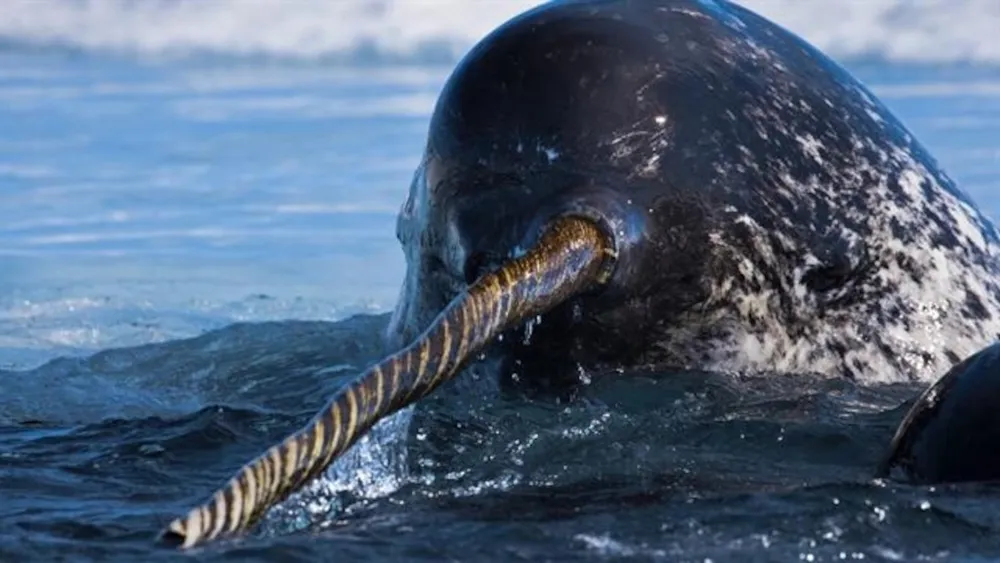
Researchers investigate whether tusk length, structure, and movement convey information during narwhal social interactions.
Are Narwhals Related to Beluga Whales?
Yes. Narwhals and beluga whales are members of the family Monodontidae.
Both live in northern marine environments.
However, their appearance and dentition differ significantly.
Belugas have multiple ordinary teeth and lack the elongated spiral tusk characteristic of adult male narwhals.
The two species provide an interesting evolutionary comparison.
Where Do Narwhals Live?
Narwhals inhabit Arctic waters associated with Greenland, Canada, and surrounding regions.
They use areas containing sea ice, deep channels, and productive marine feeding grounds.
Seasonal movements connect summer and winter habitats.
However, their distribution is not uniform across the entire Arctic Ocean.
Different populations have distinct movement patterns and ecological conditions.
How Do Narwhals Survive Under Sea Ice?
Narwhals are specialized for life in cold Arctic waters.
They use insulated bodies and other physiological adaptations to survive low temperatures.
They also navigate environments where sea ice changes seasonally.
However, narwhals remain air-breathing mammals.
They must reach suitable openings in the ice or open water to breathe.
The tusk is not an established substitute for access to air.
How Deep Can Narwhals Dive?
Narwhals are capable of deep diving.
Researchers have documented dives exceeding 1,000 meters in some individuals.
However, maximum dive depth depends on the animal, habitat, and circumstances.
Deep diving allows narwhals to reach prey in cold Arctic waters.
It does not require the tusk to act as a diving tool.
Can Narwhals Use Echolocation?
Yes. Narwhals are toothed whales and use echolocation.
They produce sounds and use returning echoes to detect aspects of their surroundings.
This is particularly useful in deep or dark Arctic water.
However, echolocation and tusk-based sensory abilities are separate systems.
It would be inaccurate to claim that the tusk functions as the whale's primary sonar antenna without specific evidence.
Can Narwhals Hear Underwater?
Yes. Narwhals possess auditory systems adapted to underwater sound.
Sound is important for navigation and social interactions in many toothed whales.
However, the detailed use of sounds varies among species and behavioral contexts.
Narwhal acoustics remain an important subject of Arctic marine research.
Can Narwhals Live Without Tusks?
Yes. Females normally live without external tusks.
Some males also lack a visible tusk.
This demonstrates that an elongated tooth is not essential for basic breathing or feeding.
However, it may influence reproductive interactions or specific behaviors in tusked individuals.
The absence of a tusk therefore does not mean the animal cannot survive.
Can a Narwhal Tusk Break?
Yes. Narwhal tusks can be damaged or broken.
Historical records and scientific observations include individuals with broken tusks.
However, the biological consequences depend on the location and severity of the injury.
Because a tusk is a living dental structure, damage may involve tissues that differ from those of an ordinary external horn.
It is not appropriate to assume that breaking a tusk is always harmless.
Do Narwhal Tusks Grow Back if Broken?
Narwhal tusks do not regenerate an entirely new replacement tooth in the way some animals regrow lost appendages.
The tusk is an elongated permanent tooth.
However, the response to damage depends on which tissues remain intact.
A broken tusk should not be assumed to return automatically to its original full length.
Why Are Narwhal Tusks Valuable to Researchers?
Narwhal tusks provide evidence about anatomy, evolution, and behavior.
Researchers can examine their dimensions, growth patterns, material structure, and sensory tissues.
Field observations add information about how living narwhals use them.
However, combining different kinds of evidence is essential.
A tusk's shape alone cannot establish every aspect of its function.
How Do Scientists Study Narwhals?
Research methods include aerial surveys, drones, underwater acoustic recording, satellite tagging, genetic analysis, and examination of biological samples.
Each method reveals different information.
For example, the 2020 study used body and tusk measurements to investigate sexual selection.
The 2014 study combined anatomy with physiological testing.
The 2025 study used drone observations to record natural interactions with fish.
Together, these approaches help researchers build a more complete picture of narwhal biology.
Why Are Narwhals Difficult to Study?
Narwhals spend much of their lives in remote Arctic waters.
Sea ice, weather, seasonal darkness, and limited access complicate observation.
Their behavior often occurs underwater, beyond direct human view.
This makes it difficult to observe mating, competitive encounters, and feeding in detail.
New technologies, including drones and acoustic instruments, are helping scientists investigate behaviors that were previously rarely recorded.
Are Narwhals Endangered?
Narwhals face environmental and human-related pressures.
Climate change is altering Arctic sea ice and marine habitats.
Other concerns include underwater noise, increasing vessel activity in some regions, and hunting pressures.
However, conservation status and population trends should be evaluated at both the species and population levels.
Different populations may face different degrees of risk.
Current conservation assessments should be consulted before making claims about a specific local population.
How Does Climate Change Affect Narwhals?
Changes in sea ice can influence habitat access, predator interactions, movement routes, and human activity in the Arctic.
Narwhals depend on environmental conditions that are changing rapidly in some regions.
However, the effects are complex and vary among populations.
Scientists continue to investigate how changing ice cover and other factors affect long-term survival.
Why Is Narwhal Tusk Research Important?
The narwhal tusk illustrates how one anatomical structure can potentially serve several biological functions.
Its unusual growth pattern provides clues about sexual selection.
Its nerve-associated tissues reveal sensory capabilities.
Recent observations show that living narwhals also use tusks during interactions with fish.
However, important questions remain about the relative importance of these functions.
Studying the tusk helps scientists understand how unusual traits evolve and how animals interact with challenging environments.

Narwhals inhabit remote Arctic waters, where sea ice and challenging conditions make their behavior difficult to study.
Frequently Asked Questions
Why do narwhals have tusks?
The strongest evidence supports a role in sexual selection, especially among males. Research also demonstrates sensory abilities and some uses during interactions with fish.
Is a narwhal tusk a tooth?
Yes. It is an elongated tooth that usually develops from the left side of the upper jaw.
Is a narwhal tusk a horn?
No. Despite its appearance, it is anatomically a tooth rather than a keratin horn.
Do female narwhals have tusks?
Most females do not have visible tusks, but some females develop one.
Can narwhals have two tusks?
Yes. Rare individuals develop two external tusks.
How long are narwhal tusks?
Exceptional tusks can grow to nearly three meters, although length varies considerably.
Why do narwhal tusks spiral?
The spiral develops during tooth growth. Its precise evolutionary significance remains uncertain.
Do narwhals use tusks to fight?
Evidence suggests tusks can be involved in competitive interactions, but their exact role in male combat is still being studied.
Can narwhal tusks sense seawater?
Experiments have documented physiological responses when the tusk surface is exposed to water of different salinities.
Do narwhals use tusks to catch fish?
Drone observations published in 2025 showed narwhals using their tusks to touch and manipulate Arctic char.
Do narwhals break ice with their tusks?
There is no convincing evidence that breaking thick sea ice is the tusk's primary function.
Can narwhals survive without a tusk?
Yes. Females normally lack external tusks, and some males do as well.
Can narwhal tusks grow back?
A broken tusk does not regenerate into a completely new replacement tooth.
Are narwhals related to belugas?
Yes. Both belong to the marine mammal family Monodontidae.
Why are narwhals called unicorns of the sea?
The nickname comes from the long spiral tooth that resembles the horn of a mythical unicorn.
The Bottom Line
Narwhal tusks are extraordinary elongated teeth rather than horns.
Most adult males develop one visible tusk, while females usually do not.
Research provides strong support for the idea that tusks evolved partly through sexual selection.
Experiments also show that tusks possess sensory abilities, and recent field observations have documented their use in interactions with fish.
However, scientists are still investigating how these different functions contributed to the evolution of this remarkable structure.
The narwhal tusk is therefore best understood as a complex biological adaptation rather than simply a spear, ice-breaking tool, or decorative horn.
Sources & Further Reading
NOAA Fisheries — Narwhal Conservation and Management. Authoritative background on tusk anatomy, sex differences, and Arctic biology.
Graham et al. (2020) — The Longer the Better: Evidence That Narwhal Tusks Are Sexually Selected. Biology Letters. Morphological analysis of 245 adult male narwhals.
Nweeia et al. (2014) — Sensory Ability in the Narwhal Tooth Organ System. The Anatomical Record. Anatomical and physiological evidence for sensory function.
Use of Tusks by Narwhals in Foraging, Exploratory, and Play Behavior (2025). Frontiers in Marine Science. Drone observations of tusk interactions with Arctic char.
Same-Sex Socio-Sexual Interactions Among Male Narwhal (2025). Behavioral Ecology and Sociobiology. Recent field observations relevant to tusk-related social behavior.