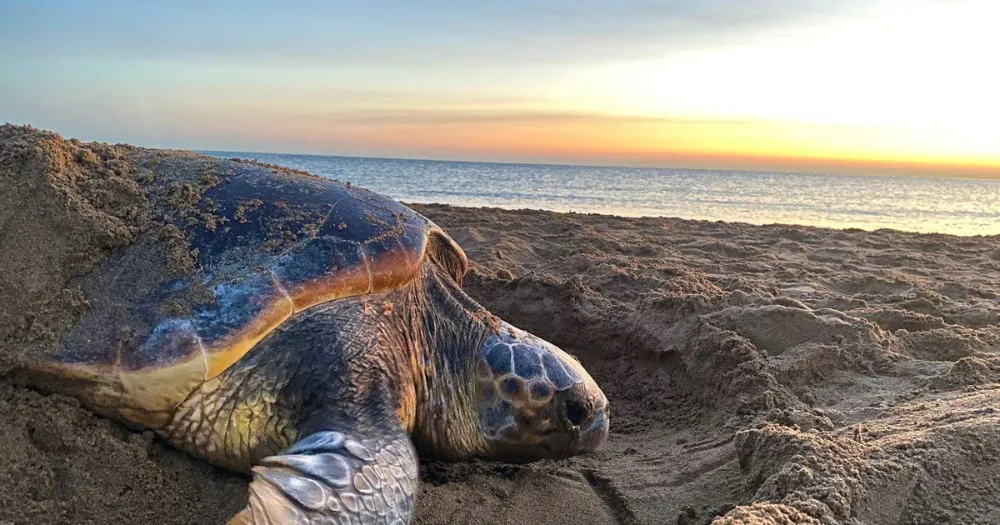
Many female sea turtles return to the same general coastal region where they hatched to lay their own eggs, even after spending decades traveling through the ocean. This remarkable behavior is called natal homing. Scientists believe that Earth's magnetic field plays an important role in helping sea turtles recognize the region of their birth. Young turtles may acquire information about the local magnetic field, then use magnetic cues as adults to navigate across long distances. However, they do not necessarily return to the exact spot where their eggs were buried, and the full navigation process is still being investigated.
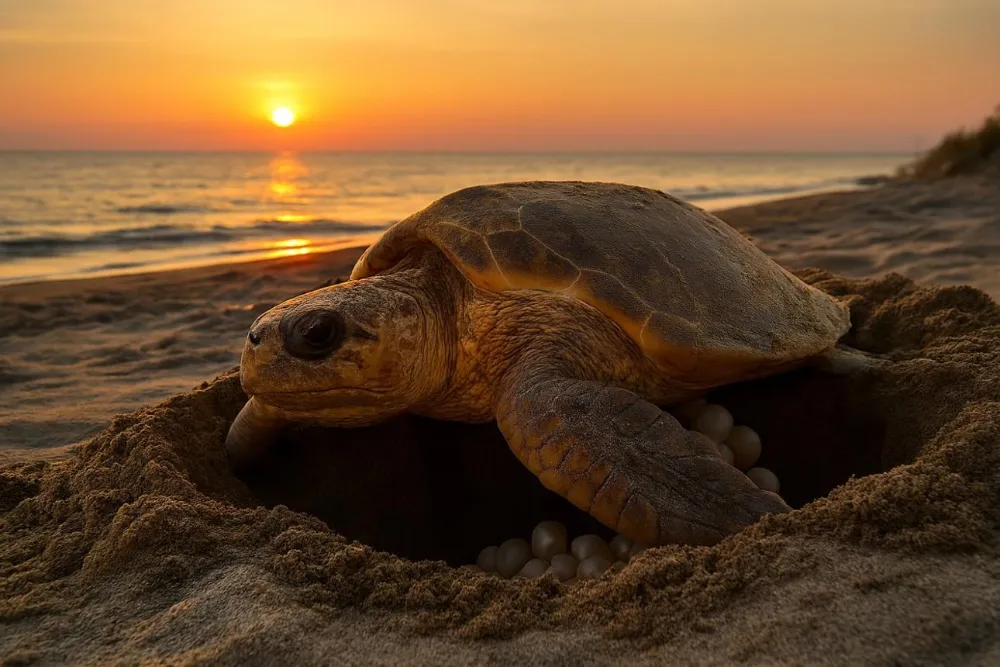
Female sea turtles often return to nesting beaches in the regions where they hatched, sometimes after traveling thousands of miles.
Why Do Sea Turtles Return to Their Birth Beaches?
Sea turtles commonly display a behavior called natal homing, in which adults return to reproduce in the geographic area where they began life.
Female sea turtles spend most of their lives in the ocean, often feeding in habitats far from their nesting beaches.
When they become reproductively mature, they undertake migrations toward suitable breeding and nesting areas.
Many females show strong fidelity to their natal regions.
This means that a turtle originating from one part of the coastline is more likely to return to that region than to select a distant, unrelated nesting area.
Returning to a familiar reproductive region may help maintain connections with suitable nesting environments that have supported earlier generations.
However, scientists have not established that sea turtles consciously recognize these beaches or remember them in the same way humans remember familiar places.
The behavior is better understood through inherited sensory abilities, environmental information, and navigation mechanisms.
What Is Natal Homing in Sea Turtles?
Natal homing is the tendency of an animal to return to its place or region of origin to reproduce.
The behavior occurs in several migratory animal groups, including sea turtles and salmon.
In sea turtles, it is especially well documented among nesting females.
For example, loggerhead sea turtles (Caretta caretta) may spend many years moving through oceanic and coastal feeding habitats before returning to reproductive areas.
The returning females frequently nest within the broader regions where they hatched.
Scientists use genetic analyses, satellite tracking, tagging studies, and long-term nesting records to investigate these patterns.
Natal homing should not be confused with nest-site fidelity.
Natal homing describes a return toward the region of birth, whereas nest-site fidelity describes repeated use of a nesting area by an individual across nesting events or seasons.
These behaviors are related but not identical.
How Do Sea Turtles Find Their Way Back Home?
Scientists have identified Earth's magnetic field as an important source of navigation information for sea turtles.
The planet's magnetic field varies geographically in measurable ways.
Two relevant properties are:
Magnetic inclination: The angle at which Earth's magnetic field intersects the surface.
Magnetic intensity: The overall strength of the magnetic field.
These properties differ across ocean regions and coastlines.
Sea turtles can detect magnetic information and respond to it in ways that influence orientation and navigation.
Research suggests that the combination of magnetic features associated with a coastal region may function as a recognizable geographic signature.
Adult turtles may use this information to help locate the region where they originated.
However, magnetic navigation does not necessarily provide the precise location of an individual nest.
Local environmental cues may become important after a turtle approaches the coastline.
Can Sea Turtles Sense Earth's Magnetic Field?
Yes. Experiments have demonstrated that sea turtles can detect and respond to changes in magnetic fields.
Researchers have studied magnetic orientation in hatchlings and young turtles by exposing them to controlled magnetic conditions.
Under certain experimental conditions, turtles adjust their swimming direction according to the magnetic field presented.
These findings indicate that the animals possess a form of magnetoreception.
Magnetoreception is the ability to detect information from magnetic fields.
It is found in several animal groups, although the underlying sensory mechanisms are not always fully understood.
In sea turtles, magnetoreception appears to support both directional orientation and geographically relevant navigation.
The exact sensory receptors and physiological processes responsible for magnetic detection remain subjects of scientific research.
What Is Geomagnetic Imprinting?
Geomagnetic imprinting is the hypothesis that young sea turtles acquire information about the magnetic field associated with their natal region.
Later in life, they may use that information to help find the same coastal area.
This hypothesis offers a possible explanation for how an animal can depart as a hatchling and return to reproduce many years later.
Unlike a visual memory of a particular rock or tree, a magnetic signature can provide information about a large geographic region.
That information may remain useful even when coastal landmarks or local conditions change.
However, Earth's magnetic field itself changes slowly over time.
Those changes have provided scientists with a way to test predictions of the geomagnetic imprinting hypothesis.
What Did Scientists Discover About Sea Turtle Navigation in 2015?
A major study published in Current Biology in 2015 provided strong evidence supporting geomagnetic imprinting in sea turtles.
Researchers J. Roger Brothers and Kenneth J. Lohmann examined a 19-year dataset of loggerhead turtle nesting along the eastern Florida coast.
Earth's magnetic field gradually changes, a process known as secular variation.
At some locations, magnetic signatures that previously corresponded to separated coastal sites move closer together.
At other locations, these signatures spread farther apart.
The researchers predicted that nesting density would increase in regions where magnetic signatures converged and decrease where they diverged.
The observed nesting patterns matched these predictions.
This relationship provided strong support for the idea that returning female turtles use geomagnetic information associated with their natal regions.
However, the study did not directly follow individual turtles from hatching to their first nesting event decades later.
Its evidence came from the relationship between changing magnetic conditions and the geographic distribution of nests.
Can Sea Turtles Use the Ocean Like a Magnetic Map?
Sea turtles appear capable of using geographic information contained in Earth's magnetic field.
A magnetic map differs from an ordinary compass.
A compass helps an animal maintain a direction of travel.
A map provides information about geographic position or location relative to an intended destination.
Magnetic intensity and inclination vary across the ocean, potentially supplying information relevant to both tasks.
Laboratory experiments with young sea turtles have shown that magnetic fields characteristic of different ocean regions can trigger different directional responses.
These results support the idea that sea turtles use magnetic information for more than simply identifying north and south.
However, a magnetic map does not necessarily operate like a complete human map containing precise coordinates and fixed boundaries.
The animals' navigation probably involves interactions among magnetic information, movement, experience, and environmental conditions.
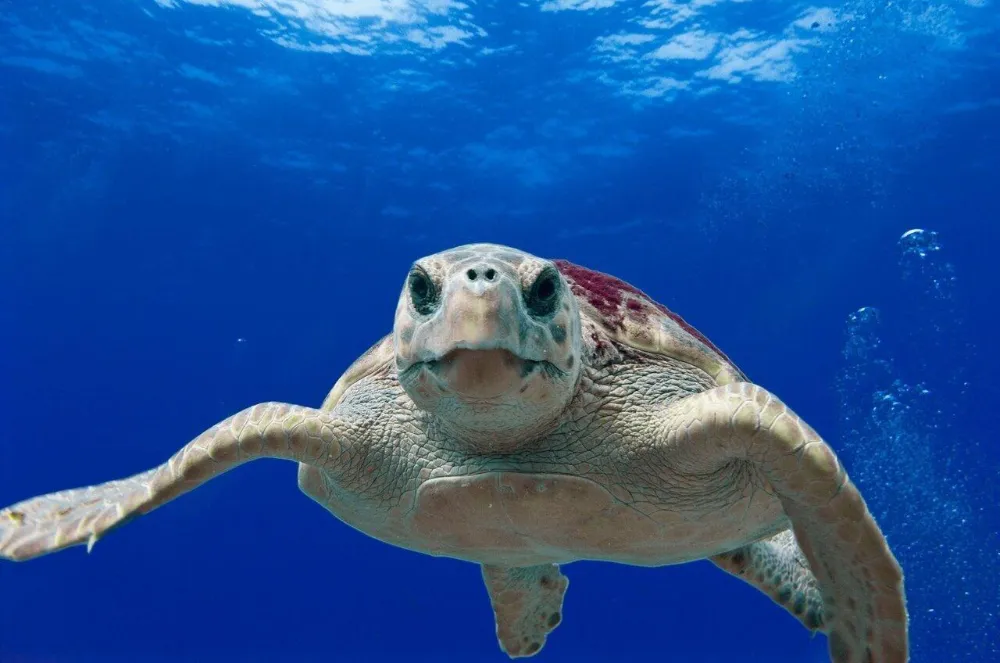
Sea turtles can detect Earth's magnetic field, which provides information useful for navigation during long ocean migrations.
Do Baby Sea Turtles Memorize Their Birth Beach?
The geomagnetic imprinting hypothesis suggests that young turtles acquire information about the magnetic environment of their natal region.
However, scientists have not established that hatchlings form a detailed visual memory of the exact beach where they emerge.
The term "imprinting" describes the acquisition of biologically meaningful information during an important developmental period.
Researchers are still investigating exactly when and how sea turtles acquire the magnetic information used during later homing.
Possible stages include the period around hatching, the initial movement toward the ocean, and early offshore life.
It is also possible that multiple stages and sensory experiences contribute.
The evidence for geomagnetic imprinting is substantial, but the precise timing and cellular mechanisms remain uncertain.
Do Sea Turtles Return to the Exact Same Beach?
Not always.
Many adult females show strong fidelity to the coastal region where they hatched, but this does not guarantee that each turtle nests on the exact original beach.
Some turtles nest within nearby stretches of coastline or use different beaches within a broader nesting region.
Beaches themselves can change over time because of storms, erosion, sediment movement, and sea-level changes.
Even if a turtle returns to a familiar magnetic region, its original nesting site may no longer be suitable.
The animal may then select another accessible beach.
NOAA Fisheries describes green turtles as generally returning to beaches in the same region where they hatched rather than promising an exact return to an individual nest location.
This distinction is important when describing sea turtle navigation accurately.
How Far Do Sea Turtles Travel Before Returning to Nest?
Some sea turtles migrate hundreds or thousands of miles between feeding areas and nesting regions.
The distance depends on the species, population, and geographic location.
Green sea turtles, for example, may undertake long migrations between productive coastal feeding habitats and distant nesting beaches.
Loggerheads also travel across large ocean regions during their lives.
Some individuals remain within relatively connected coastal systems, while others undertake transoceanic movements.
Migration distance is not identical for every turtle.
Researchers use satellite transmitters and other tracking technologies to document these journeys.
NOAA Fisheries has reported individual green turtles traveling between feeding grounds around the Hawaiian Islands and nesting areas in the Northwestern Hawaiian Islands.
How Long Does It Take a Sea Turtle to Return?
Sea turtles may spend many years or decades at sea before returning to nest as adults.
The time depends on how long individuals take to reach sexual maturity.
For green sea turtles, NOAA Fisheries describes maturity as occurring at approximately 25 to 35 years in some populations.
Age at maturity differs among species and populations.
Because the early lives of sea turtles are difficult to observe, precise estimates can be challenging.
Not every turtle survives long enough to reproduce.
Those that do may undertake multiple nesting migrations during adulthood.
Do Female Sea Turtles Return Every Year?
Not necessarily.
Many female sea turtles do not nest every year.
They may spend one or more years feeding and rebuilding energy reserves between reproductive migrations.
For example, NOAA Fisheries reports that adult female green sea turtles commonly undertake nesting migrations every two to five years.
The interval varies among individuals, species, and environmental conditions.
During a single nesting season, a female may lay multiple clutches of eggs separated by days or weeks.
Therefore, returning several times within one nesting season is different from returning for another reproductive season years later.
Do Male Sea Turtles Return to Their Birthplace?
Male sea turtles do not come ashore to lay eggs, but some evidence suggests that males may also return toward reproductive regions associated with their origins.
Their movements are more difficult to study because they do not provide the visible beach-nesting records available for females.
Genetic research and tracking studies have contributed to understanding male movements and breeding behavior.
However, natal homing is best documented among females because nesting beaches provide accessible locations for monitoring them.
Claims that every male sea turtle returns to its exact birth beach would be unsupported.
Adult males generally remain in the marine environment during breeding.
Why Do Sea Turtles Lay Their Eggs on Land?
Sea turtles are marine reptiles, but they lay their eggs in nests excavated in beach sand.
The eggs develop in an environment where embryos can exchange respiratory gases through their shells.
Adult females therefore must leave the water temporarily to reproduce.
A nesting female may crawl above the usual waterline and select a location where the sand is suitable.
She uses her flippers to excavate a chamber, deposits her eggs, covers the nest, and returns to the ocean.
Suitable nesting conditions depend on several factors, including sand characteristics, temperature, moisture, and risk of flooding.
Different sea turtle species use different nesting habitats and patterns.
How Do Sea Turtles Choose Where to Lay Eggs?
Female sea turtles select nesting sites using environmental information available after they reach a suitable coastline.
Possible influences include beach slope, sand conditions, physical obstacles, vegetation, and local environmental characteristics.
Not every location is equally suitable.
A beach may be too steep, too rocky, heavily disturbed, or at risk of frequent flooding.
Some females crawl ashore but return to the water without laying eggs.
This is sometimes called a false crawl.
In other cases, a female may successfully dig a nest and deposit eggs.
The final selection of a nesting location may therefore involve finer-scale information beyond the magnetic cues that guide long-distance migration.
Can Sea Turtles Smell Their Way Home?
Scientists have considered the possibility that chemical cues contribute to sea turtle navigation, particularly near coastlines and islands.
Sea turtles possess sensory systems that allow them to detect environmental information, including chemical substances.
Research models have examined how magnetic information and ocean-borne chemical cues might work together.
For example, a study of navigation toward Ascension Island explored the possibility of combined geomagnetic and chemical guidance.
However, the importance of chemical cues in natural sea turtle natal homing has not been established as firmly as the evidence for magnetic navigation.
It would therefore be misleading to claim that sea turtles simply follow the smell of their home beach across the ocean.
Local chemical or environmental signals remain plausible additional cues under certain conditions.
What Happens if Earth's Magnetic Field Changes?
Earth's magnetic field gradually changes over time.
These changes can shift the geographic locations associated with particular magnetic signatures.
If sea turtles use magnetic signatures to locate natal regions, such changes may influence where returning females nest.
The 2015 Florida loggerhead study found that nesting patterns were associated with these magnetic shifts.
In 2018, further research demonstrated a relationship between magnetic signatures and the genetic structure of sea turtle nesting populations.
These results are important because they connect navigation behavior with patterns of reproduction across generations.
However, sea turtles may also use additional environmental cues when magnetic information does not precisely identify a suitable nesting beach.
What Did the 2018 Sea Turtle Genetics Study Find?
A 2018 study in Current Biology investigated the relationship between geomagnetic navigation and genetic differences among loggerhead turtle nesting populations.
The researchers found that the magnetic characteristics of nesting beaches helped predict genetic differentiation.
This relationship remained important even when some conventional explanations involving geographic distance and environmental differences were considered.
The findings supported a process described as isolation by navigation.
Under this idea, animals using particular navigation cues may repeatedly return to different reproductive regions, contributing to genetic separation among populations.
The study did not mean that magnetic fields directly alter turtle DNA.
Instead, navigation behavior influences where animals reproduce, which can shape the movement of genes between populations over time.
Do All Sea Turtle Species Return to Their Birth Beaches?
Natal homing is an important reproductive pattern across several sea turtle species, although its strength and geographic precision vary.
Species with documented nesting-site fidelity and natal-region associations include loggerhead, green, hawksbill, and other sea turtles.
However, evidence and life-history details are not identical for every species or population.
Some nesting populations are concentrated around relatively limited stretches of coastline.
Others use broad nesting regions or show greater variation in where females lay eggs.
Scientists also distinguish between the geographic scale of natal homing and repeated nesting within an individual female's reproductive lifetime.
The following table summarizes several important differences.
| Sea Turtle | Nesting Behavior | Important Consideration |
|---|---|---|
| Loggerhead turtle | Strong natal-region homing documented | Important magnetic-navigation studies |
| Green sea turtle | Often returns to natal-region beaches | Long migrations between feeding and nesting areas |
| Hawksbill turtle | Shows nesting-region fidelity | Many populations use tropical nesting beaches |
| Leatherback turtle | Returns to reproductive regions | Highly migratory; nesting-site patterns vary |
| Olive ridley turtle | Some populations exhibit mass nesting | Arribada nesting occurs at particular beaches |
These are broad patterns, not rules that apply to every individual.
What Is an Arribada?
An arribada is a mass-nesting event in which many female sea turtles come ashore within a relatively short period.
This behavior is especially associated with some olive ridley populations and also occurs in Kemp's ridley turtles.
Large numbers of females may use the same nesting beach during these events.
Arribadas demonstrate how reproduction can become strongly concentrated in particular coastal areas.
However, not every olive ridley nests in an arribada, and not all sea turtle species use this reproductive strategy.
Mass nesting is also a separate behavioral phenomenon from the mechanisms that guide long-distance natal homing.
How Do Baby Sea Turtles Find the Ocean?
After emerging from their nests, sea turtle hatchlings must move toward the water.
They use visual cues associated with the natural seaward horizon.
On an undeveloped beach, the ocean-facing horizon is often brighter and more open than the landward horizon, which may be blocked by dunes or vegetation.
Hatchlings typically orient toward the brighter, lower horizon and begin crawling in that direction.
Once they reach the surf, wave information and other cues help guide their initial offshore swimming.
Artificial lights from buildings, roads, and beach facilities can interfere with this process.
Hatchlings may move inland toward these lights rather than reaching the ocean.
This immediate movement toward the sea is different from the long-distance natal homing behavior performed by returning adults.
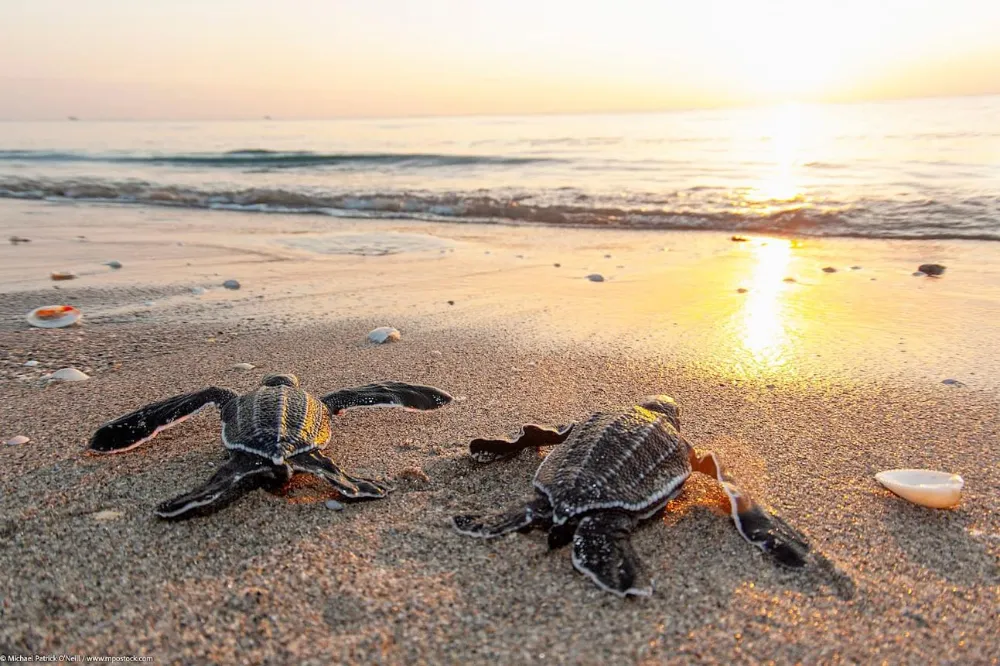
Newly hatched sea turtles use visual horizon cues to reach the ocean, beginning a life that may include extraordinary long-distance migrations.
Does the Journey From the Nest Help Turtles Remember Their Beach?
Some conservation discussions suggest that the hatchlings' journey from the nest to the ocean may contribute to important early-life sensory experiences.
However, scientists have not conclusively established that the short crawl itself is the precise moment when magnetic imprinting occurs.
The acquisition of natal-region magnetic information remains an active research topic.
Early navigation also involves distinct processes, including visual orientation on land and magnetic responses in the ocean.
These mechanisms should not be treated as if they are all the same biological behavior.
Sea turtle protection programs therefore focus on preserving natural hatchling movement and minimizing disturbance, while following established local conservation procedures.
What Happens if a Sea Turtle's Birth Beach Disappears?
Coastal erosion, storms, rising sea levels, and human development can alter or remove nesting habitat.
If a turtle returns to a natal region that no longer contains its original nesting beach, it may have to find another suitable site.
Geomagnetic navigation may guide the animal toward a coastal region, but it cannot guarantee that the original nesting habitat still exists.
Changes in sand temperature, beach width, lighting, and physical access can also influence reproductive success.
In some circumstances, females may use nearby beaches.
However, successful relocation cannot be assumed in every population.
Conservation efforts therefore seek to protect nesting beaches and maintain suitable coastal habitats over long periods.
How Does Artificial Light Affect Sea Turtle Nesting?
Artificial lighting can interfere with both nesting females and hatchlings.
Some nesting females may avoid brightly illuminated beaches or abandon nesting attempts when disturbed.
Hatchlings are particularly vulnerable because they normally rely on the natural seaward horizon to orient toward the ocean.
Bright lights from hotels, roads, and other developments may attract them in the wrong direction.
This can increase exposure to vehicles, predators, dehydration, and other dangers.
Conservation programs encourage people to follow local nesting-beach restrictions and use wildlife-compatible lighting where appropriate.
These actions protect the local conditions sea turtles need when they return to reproduce.
Why Is Natal Homing Important for Sea Turtle Conservation?
Natal homing can concentrate reproduction within particular coastal regions.
This makes certain beaches especially important for sustaining individual turtle populations.
If a major nesting beach is damaged or lost, the consequences may extend beyond a single nesting season.
Females returning from long-distance migrations may continue seeking the same general region.
Genetic research also indicates that navigation-associated reproductive patterns can contribute to differences among populations.
Protecting one beach cannot necessarily be replaced by protecting an unrelated beach elsewhere.
Effective conservation therefore requires attention to nesting regions, migration routes, feeding habitats, and population-specific threats.
Frequently Asked Questions
Why do sea turtles return to the beach where they were born?
Many females display natal homing, returning to the coastal region where they hatched to reproduce. Earth's magnetic field appears to provide important navigation information.
How do sea turtles find their birth beach?
Research suggests that sea turtles use magnetic cues to locate their natal regions. Other local environmental cues may help them find suitable nesting sites once they approach the coast.
Do sea turtles return to the exact same spot?
Not necessarily. Many return to the same general coastal region rather than the exact location of their original nest.
Can sea turtles sense Earth's magnetic field?
Yes. Experiments have shown that sea turtles can detect magnetic information and use it for orientation and navigation.
What is geomagnetic imprinting?
Geomagnetic imprinting is the hypothesis that young turtles acquire information about the magnetic signature of their natal region and later use it to return.
How far do sea turtles travel to lay eggs?
Migration distances vary by species and population. Some females travel hundreds or thousands of miles between feeding grounds and nesting regions.
How long do sea turtles stay away from their birth beach?
They may remain away for many years or decades before reaching reproductive maturity. Exact ages vary by species and population.
Do male sea turtles return to their birth beach?
Males do not come ashore to nest. Some evidence suggests that males may return toward reproductive regions, but female natal homing is better documented.
Do sea turtles lay eggs every year?
Not always. Many females have intervals of one or more years between reproductive seasons.
Do baby sea turtles know where the ocean is?
Hatchlings use natural visual cues from the seaward horizon to orient toward the water. Artificial lighting can disrupt this behavior.
Can sea turtles get lost?
Sea turtle navigation is remarkable but not necessarily perfect. Changing magnetic conditions, environmental disturbances, and habitat changes may influence where individuals travel or nest.
Do all sea turtles nest on the same beaches?
No. Different species and populations use different nesting regions. Some show strong site fidelity, while others use broader stretches of coastline.
The Bottom Line
Many female sea turtles return to their natal coastal regions to nest, sometimes after decades of life and thousands of miles of migration.
Scientific evidence strongly supports a role for Earth's magnetic field in their navigation. In particular, geomagnetic imprinting may allow turtles to recognize magnetic information associated with the region where they originated.
However, sea turtles do not necessarily return to the exact same patch of sand, and scientists are still investigating how magnetic and local environmental cues work together.
Understanding natal homing is important not only for explaining one of nature's most impressive migrations, but also for protecting the nesting beaches that sustain future generations.
Sources & Further Reading
The following NOAA resources and peer-reviewed studies explain sea turtle natal homing, magnetic navigation, reproductive migration, and nesting conservation.
NOAA Fisheries — Green Turtle. Explains reproductive migrations, natal-region nesting, maturity, and hatchling orientation.
Brothers and Lohmann (2015) — Evidence for Geomagnetic Imprinting and Magnetic Navigation in the Natal Homing of Sea Turtles. Current Biology research examining 19 years of loggerhead nesting data and changes in Earth's magnetic field.
Brothers and Lohmann (2018) — Evidence that Magnetic Navigation and Geomagnetic Imprinting Shape Spatial Genetic Variation in Sea Turtles. Current Biology research connecting geomagnetic navigation with genetic differences among nesting populations.
Lohmann et al. (2019) — There and Back Again: Natal Homing by Magnetic Navigation in Sea Turtles and Salmon. Scientific review of magnetic imprinting and long-distance navigation.
NOAA Fisheries — Fun Facts About Terrific Sea Turtles. Introduces sea turtle nesting behavior, reproduction, and the unresolved aspects of finding natal beaches.
SEE Turtles — Coastal Development and Sea Turtles. Explains how coastal lighting, beach development, and habitat changes affect nesting females and hatchlings.