How Does a Koi Pond Autofill Valve Work?
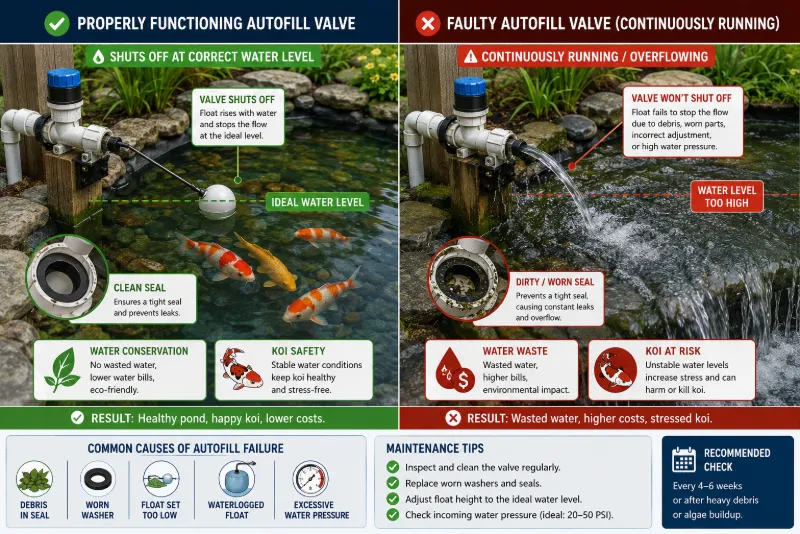
An autofill valve automatically maintains the pond's water level by opening when the water drops below a preset level and closing once the desired level is reached. Most systems rely on a floating mechanism connected to a valve.
As the water level falls due to evaporation, splash-out, or filter maintenance, the float drops and opens the valve. When the pond refills, the float rises and shuts off the incoming water.
If the valve never fully closes, fresh water continues entering the pond unnecessarily.
The Cost of Ignoring a Constantly Running Autofill Valve
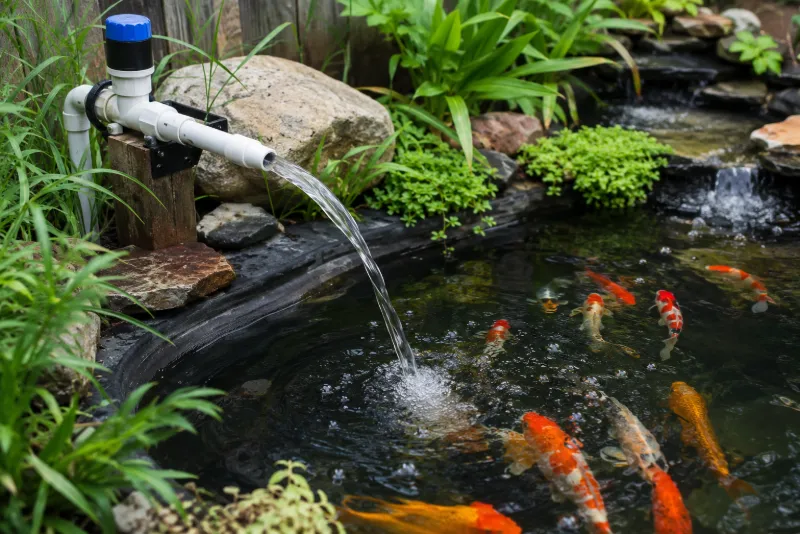
A continuously running autofill valve is more than an inconvenience.
Higher monthly water bills.
Unnecessary water waste.
Possible overflow around the pond.
Increased wear on plumbing components.
Continuous addition of tap water containing chlorine or chloramine if no suitable dechlorination system is used.
Chlorine is commonly added to municipal water supplies to control harmful microorganisms. While safe for human consumption at regulated levels, untreated chlorine can damage koi gills, irritate skin, and disrupt beneficial bacteria in biological filters. For this reason, any automatic refill system should be paired with an appropriate dechlorination method when required by the local water supply.
Signs Your Autofill Valve Is Stuck Open
| Symptom | Possible Cause |
|---|---|
| Water constantly entering pond | Valve not sealing |
| Overflow near pond edge | Float cannot shut off water |
| Higher water bills | Continuous refill |
| Pump chamber always full | Autofill running continuously |
| Constant trickling sound | Valve leaking internally |
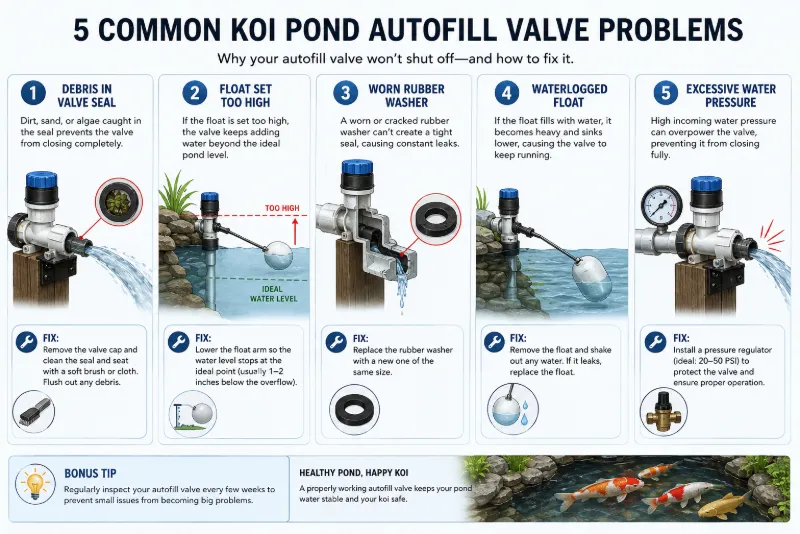
Quick Fix #1: Clean Debris from the Valve Seal
This is one of the most common causes of an autofill valve that will not stop running.
Small particles such as:
Algae
Sand
Silt
Small stones
Plant material
can become trapped between the valve seat and the rubber seal, preventing the valve from closing completely.
How to Fix It
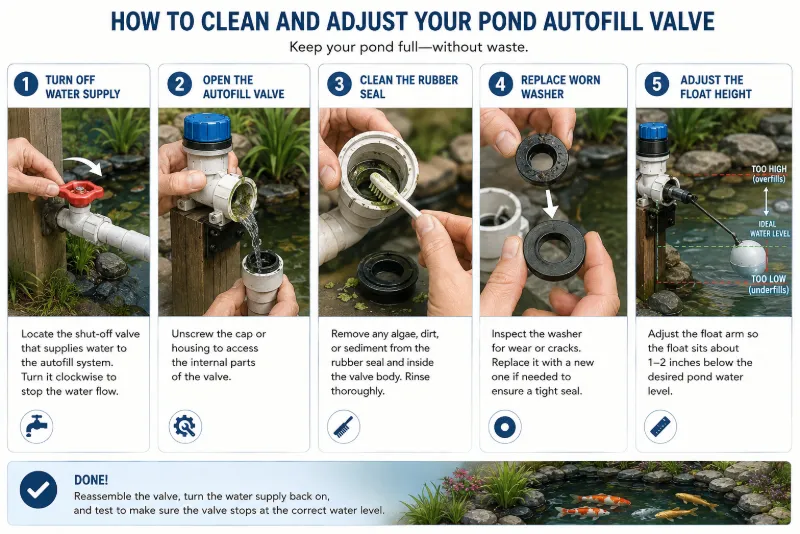
Turn off the water supply.
Open the valve housing according to the manufacturer's instructions.
Inspect the rubber seal and valve seat.
Remove visible debris with clean water or a soft cloth.
Reassemble and test the valve.
Avoid using sharp tools that could damage the sealing surface.
Quick Fix #2: Adjust the Float Height
If the float is positioned too high, it may never apply enough pressure to fully close the valve.
Incorrect float adjustment can also cause the pond to overfill before the valve shuts off.
How to Fix It
Locate the float adjustment screw or arm.
Lower the shut-off height slightly.
Test several fill cycles.
Fine-tune until the valve closes consistently at the desired water level.
Always make small adjustments rather than large changes.
Quick Fix #3: Replace a Worn Rubber Washer
Inside many autofill valves is a small rubber washer or diaphragm that creates a watertight seal.
Over time, rubber components naturally age and may:
Become brittle.
Crack.
Flatten.
Lose flexibility.
Even a small amount of wear can allow water to leak continuously through the valve.
How to Fix It
Purchase the correct replacement washer or rebuild kit recommended for your valve model.
Remove the old washer.
Inspect the valve seat for damage.
Install the new washer.
Reassemble and test.
Replacing inexpensive rubber components often restores normal operation without replacing the entire valve.
Quick Fix #4: Check for a Waterlogged or Damaged Float
Many floats are hollow. If the float develops a crack, water may enter the chamber, making it heavier than intended.
A heavy float may not rise high enough to shut off the valve completely.
Inspection Tips
Remove the float.
Shake it gently.
Listen for water inside.
Inspect for cracks or punctures.
If water has entered the float, replacement is generally the most reliable solution.
Quick Fix #5: Verify Water Pressure
Some autofill valves are designed to operate within a specific water pressure range.
If household water pressure is unusually high, the valve may struggle to seal properly.
Possible solutions include:
Installing a pressure regulator.
Checking for recent plumbing changes.
Consulting the valve manufacturer's pressure recommendations.
Other Possible Causes
| Problem | Possible Solution |
|---|---|
| Bent float arm | Straighten or replace |
| Loose mounting hardware | Tighten fasteners |
| Mineral buildup | Clean with an appropriate descaling solution if recommended |
| Cracked valve body | Replace valve |
| Incorrect installation angle | Reinstall according to manufacturer instructions |
Preventive Maintenance Tips
Routine inspection helps prevent most autofill valve problems before they become serious.
| Maintenance Task | Suggested Frequency |
|---|---|
| Inspect valve for leaks | Monthly |
| Clean float assembly | Monthly |
| Remove algae and debris | Every 2–4 weeks |
| Inspect washer condition | Every 6–12 months |
| Test shut-off operation | Monthly |
Should You Replace the Entire Valve?
If the valve body is cracked, severely corroded, or continues leaking after replacing the washer and cleaning the seal, replacing the complete autofill valve may be the most practical solution.
Modern valves often provide improved durability, smoother operation, and replacement parts that are easier to obtain.
Protecting Your Koi During Automatic Refilling
Even a properly functioning autofill valve should be part of a well-designed pond system. If your tap water contains chlorine or chloramine, consider using an appropriate dechlorination system before the water enters the pond. Regular testing of water quality—including chlorine (where applicable), ammonia, nitrite, nitrate, pH, and temperature—can help maintain a stable environment for koi and preserve the beneficial bacteria that support biological filtration.
FAQs
Why won't my koi pond autofill valve shut off?
The most common causes are debris trapped in the valve seal, an incorrectly adjusted float, a worn rubber washer, a damaged float, or excessive water pressure.
Can a leaking autofill valve harm koi?
Potentially, yes. If untreated tap water continuously enters the pond, chlorine or chloramine may accumulate unless the water is properly dechlorinated. The level of risk depends on the local water supply, refill rate, pond volume, and water treatment system.
How often should I clean my autofill valve?
A visual inspection once a month and cleaning whenever algae, sediment, or mineral deposits are present will help maintain reliable operation.
Should I replace the washer or the whole valve?
If only the rubber washer is worn, replacing it is often sufficient. However, a cracked valve body, severe corrosion, or repeated failures may justify replacing the entire valve.
Can high water pressure keep the valve open?
Yes. Some float valves may not seal correctly if the incoming water pressure exceeds their recommended operating range. A pressure regulator can help in such situations.