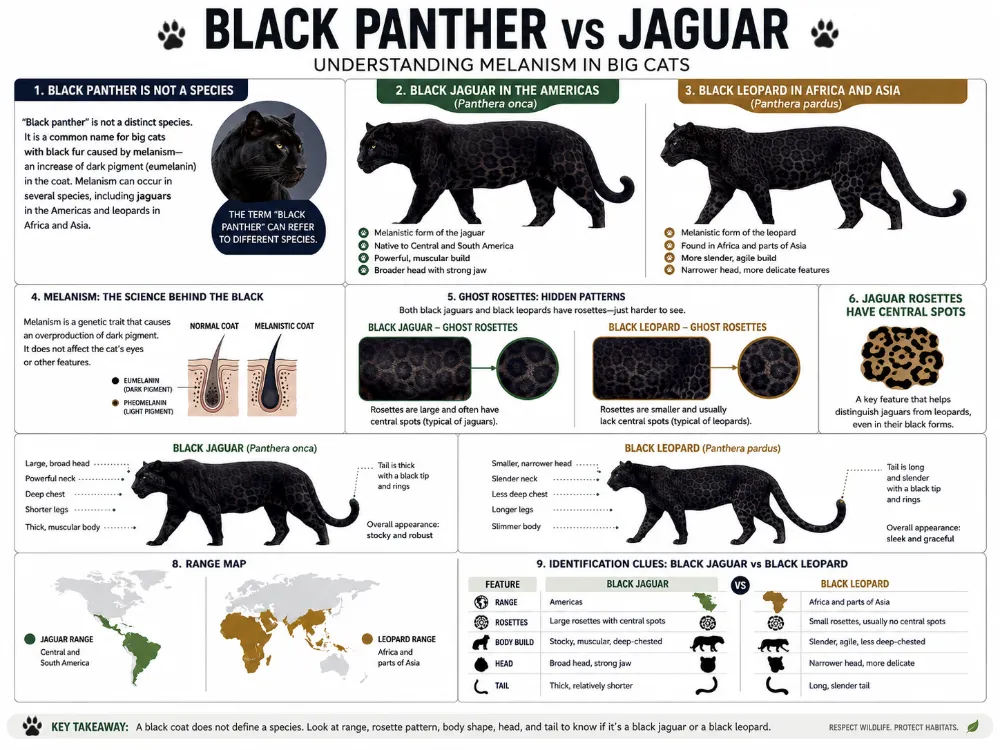
A black panther is not a separate species, while a jaguar is a real big cat species. In the Americas, a “black panther” usually means a melanistic jaguar: a jaguar with extra dark pigment. In Africa or Asia, a black panther usually means a melanistic leopard. So a black panther can be a jaguar, but not every black panther is a jaguar, and not every jaguar is black.
Quick Comparison Table
| Feature | Black Panther | Jaguar |
|---|---|---|
| Scientific meaning | Not a species; a common name for a melanistic big cat | A species: Panthera onca |
| Most common identity | Black jaguar in the Americas; black leopard in Africa or Asia | Large spotted cat native to the Americas |
| Coat color | Very dark brown to black due to melanism | Usually golden-yellow with black rosettes; sometimes black |
| Rosettes visible? | Yes, often visible in bright light as “ghost spots” | Yes, clearly visible on normal golden jaguars |
| Species status | Color form, not a separate species | True biological species |
| Native range | Depends on species: jaguar in the Americas, leopard in Africa/Asia | Mexico, Central America, South America, with rare presence near the U.S. border |
| Body shape | Depends on whether it is a black jaguar or black leopard | Stocky, muscular, broad-headed, powerful jaws |
| Main prey | Depends on species and habitat | Capybaras, peccaries, deer, caimans, turtles, fish, and other animals |
| Best identification clue | Dark coat with hidden rosettes; location matters | Large head, powerful body, rosettes with central spots, Americas range |
What Is a Black Panther?
The term “black panther” is a popular name, not a scientific species name. It is usually used for a big cat with a very dark coat caused by melanism. Melanism is a genetic condition that increases dark pigment in the fur, making the animal appear black or nearly black.
Most black panthers are actually either black jaguars or black leopards. In the Americas, a black panther is usually a melanistic jaguar. In Africa and Asia, a black panther is usually a melanistic leopard. This is why the phrase can be confusing: it describes color, not species.
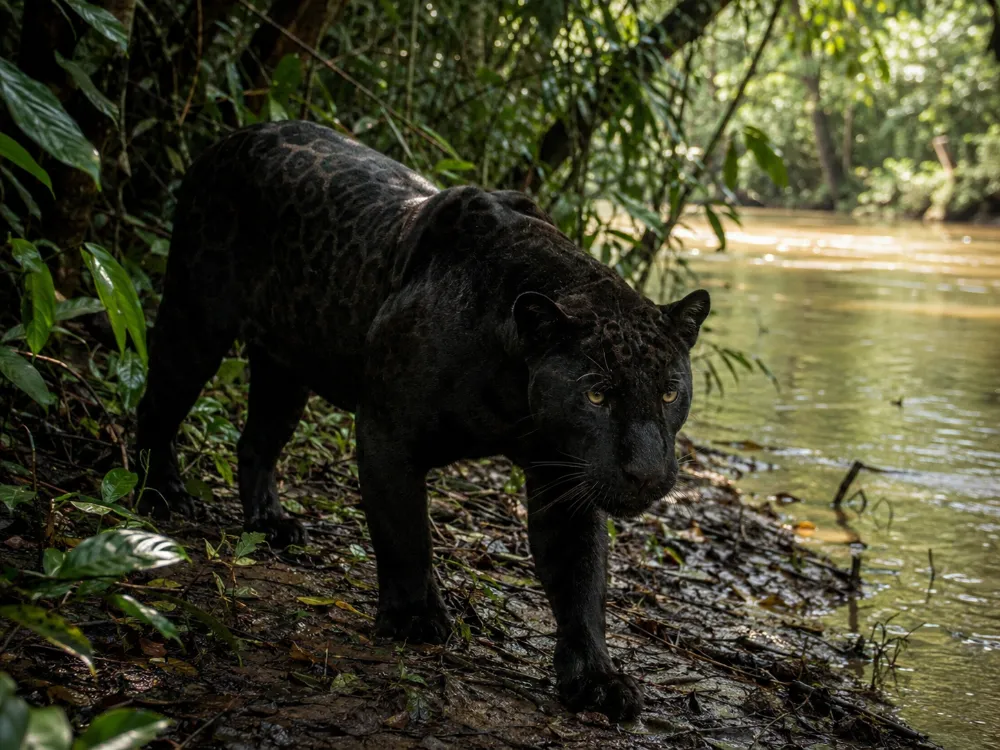
Even when a black panther looks completely black, its normal pattern is often still there. Under sunlight or camera flash, you may see faint rosettes on the body. These hidden markings are sometimes called “ghost spots.”
What Is a Jaguar?
The jaguar is a true big cat species with the scientific name Panthera onca. It is the largest native cat in the Americas and the third-largest big cat in the world after the tiger and the lion. Jaguars are famous for their muscular build, broad head, powerful jaws, and beautiful rosette-patterned coat.
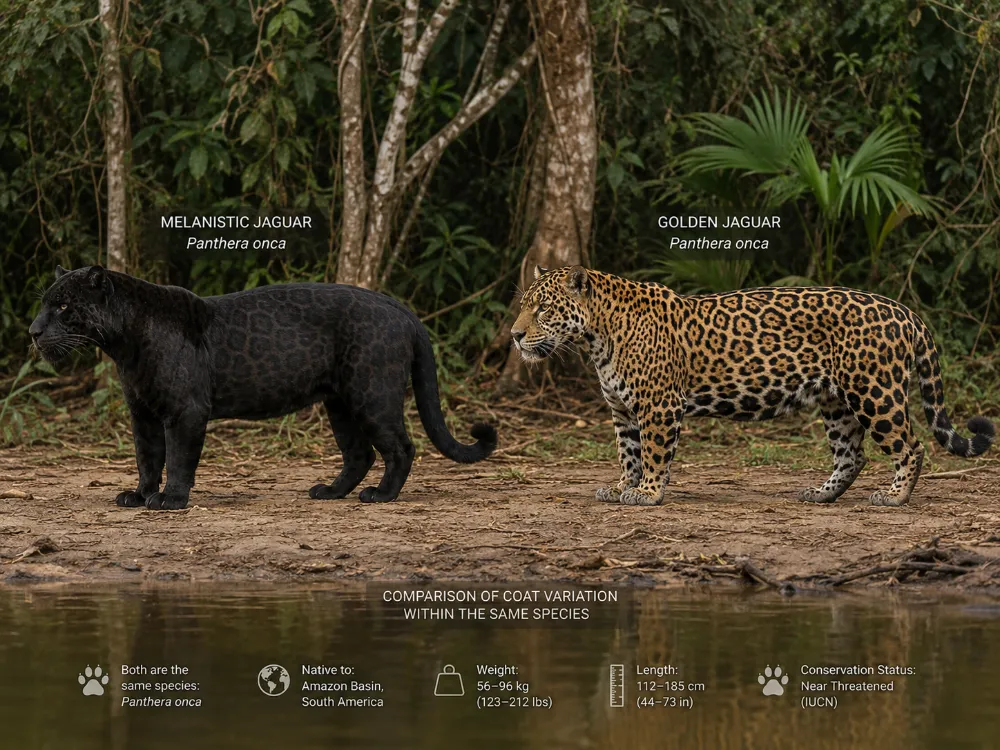
Most jaguars are golden-yellow, tan, or orange-brown with black rosettes. These rosettes often contain one or more smaller black spots inside them, which helps distinguish jaguars from leopards. However, some jaguars are melanistic and appear black. These black jaguars are the animals often called black panthers in the Americas.
Jaguars live in a variety of habitats, including tropical rainforests, wetlands, savannas, scrublands, and riverine forests. They are strongly associated with water and are excellent swimmers.
Is a Black Panther a Jaguar?
Sometimes, yes. A black panther can be a jaguar if it is a melanistic jaguar. This is especially likely if the animal is from Central America, South America, Mexico, or another part of the jaguar’s range.
However, a black panther can also be a leopard if it is from Africa or Asia. The word “panther” is used loosely in popular language, which creates confusion. Scientifically, you should identify the animal by species: jaguar, leopard, cougar, or another cat.
So the correct answer is: a black panther is not always a jaguar, but a black jaguar is often called a black panther.
Black Jaguar vs Normal Jaguar
If the black panther is a black jaguar, then it is the same species as a normal golden jaguar. The only major difference is coat color. A normal jaguar has a yellow, tan, or orange coat with bold black rosettes. A black jaguar has a dark coat caused by melanism, but the rosettes are still present and may be visible in strong light.
Black jaguars and golden jaguars can belong to the same population, mate with each other, and produce offspring. A black jaguar is not a separate species, subspecies, or hybrid. It is simply a color morph of Panthera onca.
In terms of hunting ability, diet, body shape, and behavior, a black jaguar is still a jaguar. It has the same powerful bite, strong swimming ability, and ambush-hunting style as other jaguars.
Melanism: Why Some Jaguars Are Black
Melanism is caused by genetic changes that increase the amount or distribution of dark pigment in the animal’s fur. In jaguars, melanism can make the coat look black, dark chocolate, or deep brown. The pattern does not disappear completely; it is just harder to see.
Melanism may provide some camouflage advantages in dense forests, especially in shadowy rainforest environments. A dark coat can help a jaguar blend into low light, thick vegetation, and nighttime conditions. However, melanism is not found in all jaguar populations at the same frequency.
It is also important to understand that melanism does not make a jaguar a different kind of animal. A black jaguar is biologically the same species as a golden jaguar.
Appearance: How to Tell Them Apart
A normal jaguar is usually easier to identify because its golden coat and black rosettes are obvious. The body is muscular and compact, the head is broad, the legs are short and powerful, and the tail is relatively shorter than a leopard’s tail.
A black panther is harder to identify because the dark coat hides many details. To identify it correctly, look at body shape and location. A black jaguar tends to look heavy, stocky, and broad-headed. A black leopard usually looks more slender, longer-tailed, and more agile in build.
If the animal is in the Americas and has a large head, powerful shoulders, and a thick body, it is likely a black jaguar. If it is in Africa or Asia and has a slimmer build and longer tail, it is more likely a black leopard.
Rosettes and Ghost Spots
Both golden jaguars and black jaguars have rosette markings. In normal jaguars, these rosettes are clearly visible. They are usually large, dark rings or broken circles, often with smaller spots inside. This central spotting is one of the best ways to separate a jaguar from a leopard.
In black jaguars, the rosettes are hidden by dark fur but may still appear in bright sunlight, close-up photos, or side lighting. These faint markings are sometimes described as ghost spots. They prove that the animal is not truly patternless.
A black panther’s hidden rosettes can be especially useful for identification. If the rosettes contain central spots and the cat has a stocky body, it is likely a black jaguar. If the rosettes are smaller and the cat is more slender, it may be a black leopard.
Size and Strength
Jaguars are powerful big cats. Adult males are usually larger than females and can be extremely muscular. Compared with leopards, jaguars tend to have a heavier body, broader skull, stronger neck, and more powerful jaws.
A black jaguar has the same general size range as a normal jaguar. Its dark coat does not make it larger or stronger by itself. However, because jaguars are naturally robust cats, a black jaguar can look especially imposing.
If the “black panther” in question is actually a black leopard, it will usually be smaller and more lightly built than a jaguar. Leopards are strong climbers with long tails and flexible bodies, while jaguars are more compact, heavy, and crushingly powerful.
Bite Force and Hunting Style
Jaguars are famous for their extremely powerful bite. Unlike many big cats that commonly kill prey with a throat bite, jaguars often use a skull or neck bite. They can pierce thick hides, turtle shells, and even the skulls of some prey animals.
This powerful bite allows jaguars to hunt a wide variety of animals, including capybaras, peccaries, deer, caimans, turtles, fish, monkeys, birds, and reptiles. Jaguars are also strong swimmers and may hunt near rivers, wetlands, and flooded forests.
A black jaguar hunts the same way as a normal jaguar. A black leopard, however, has a more leopard-like hunting style, often relying on stealth, climbing, and dragging prey into trees when possible. This is why species identity matters more than coat color.
Habitat and Range
Jaguars are native to the Americas. Their range includes parts of Mexico, Central America, and South America. The Amazon Basin is one of their most important strongholds, but jaguars can also live in wetlands, dry forests, grasslands, and scrublands when enough prey and cover are available.
Black jaguars are most often associated with dense tropical forests, although melanistic individuals can appear in other habitats. The dark coat may be especially useful in shaded forest environments.
Black leopards, often also called black panthers, are found in parts of Africa and Asia. They are especially famous from forested regions of Southeast Asia and parts of India. Therefore, geography is one of the most important clues: black panther in the Americas usually means black jaguar; black panther in Africa or Asia usually means black leopard.
Behavior and Personality
Jaguars are solitary predators. Adults usually live alone except during mating or when a mother is raising cubs. They mark territories with scent, scratch marks, vocalizations, and movement patterns.
Jaguars are secretive and often avoid humans. They are most active during dawn, dusk, night, or other quiet periods, although activity can vary by region and prey availability. They are confident around water and may swim across rivers or hunt aquatic prey.
A black jaguar behaves like any other jaguar. The dark coat does not make it more aggressive, more mysterious, or more supernatural. Many myths about black panthers come from their rare appearance and secretive habits, but biologically they are normal big cats with a dark color morph.
Black Panther vs Jaguar in Conservation
From a conservation point of view, the jaguar is the species that matters. A black jaguar is valuable because it is part of the jaguar population, not because it is a separate animal. Protecting black jaguars means protecting jaguars as a whole: their habitat, prey, genetic diversity, and movement corridors.
Jaguars face threats from habitat loss, deforestation, illegal killing, conflict with livestock owners, road development, and reduced prey populations. Large protected areas and connected habitat corridors are especially important because jaguars need space to move, hunt, and reproduce.
The phrase “black panther” can help attract public interest, but conservation should use accurate language. A black panther in the Americas should be understood as a melanistic jaguar, while black panthers in Africa or Asia are usually melanistic leopards.
Common Myths About Black Panthers
Myth: A black panther is a separate species
This is false. “Black panther” is not a separate species. It is a common name for a melanistic big cat, usually a jaguar or leopard.
Myth: Black panthers have no spots
This is false. Black jaguars and black leopards still have rosettes. The markings are just harder to see because of the dark coat.
Myth: Black jaguars are more dangerous than normal jaguars
This is not supported. A black jaguar is not more dangerous because of its color. It is a powerful predator because it is a jaguar, not because it is black.
Myth: All jaguars are black panthers
This is false. Most jaguars are golden-yellow or tan with black rosettes. Only some jaguars are melanistic.
Simple Identification Checklist
| Question | Likely Black Jaguar | Likely Golden Jaguar | Likely Black Leopard |
|---|---|---|---|
| Where is the animal found? | Americas | Americas | Africa or Asia |
| What is the coat color? | Black or very dark brown | Golden, tan, or orange-brown | Black or very dark brown |
| Are rosettes visible? | Faint ghost rosettes | Clear rosettes with central spots | Faint rosettes, usually smaller |
| Body shape | Stocky, broad-headed, muscular | Stocky, broad-headed, muscular | Slimmer, longer-tailed, more flexible |
| Best name to use | Melanistic jaguar | Jaguar | Melanistic leopard |
Final Verdict: Black Panther vs Jaguar
The main difference is that “jaguar” is a species, while “black panther” is a color-based nickname. A jaguar is Panthera onca, the largest native cat of the Americas. A black panther may be a melanistic jaguar in the Americas or a melanistic leopard in Africa and Asia.
If you are comparing a black panther with a jaguar in the Americas, the black panther is usually just a black jaguar. It has the same species identity, body structure, hunting ability, and behavior as a normal jaguar, but with a darker coat caused by melanism.
The easiest rule is this: not all jaguars are black panthers, but some black panthers are jaguars.
FAQs About Black Panthers and Jaguars
Is a black panther the same as a jaguar?
Sometimes. In the Americas, a black panther usually means a melanistic jaguar. However, in Africa or Asia, a black panther usually means a melanistic leopard.
Is a black panther a real species?
No. “Black panther” is not a separate species. It is a common name for a dark-colored big cat, most often a black jaguar or black leopard.
What is a black jaguar?
A black jaguar is a melanistic form of the jaguar species, Panthera onca. It has extra dark pigment, making its coat look black or very dark brown.
Can you still see spots on a black jaguar?
Yes. Black jaguars still have rosettes, but the markings are harder to see. In sunlight or flash photography, the hidden pattern may appear as faint ghost spots.
Are black jaguars rare?
Black jaguars are less common than normal golden jaguars, but they are not impossible to find. They are most often associated with dense forest regions where dark coloration may provide camouflage.
Are black panthers more aggressive than jaguars?
No. Coat color does not make a big cat more aggressive. A black jaguar behaves like a jaguar, and a black leopard behaves like a leopard.
How do you tell a black jaguar from a black leopard?
Look at location and body shape. A black jaguar is found in the Americas and has a heavier body, broader head, and shorter tail. A black leopard is found in Africa or Asia and is usually slimmer with a longer tail.
Do black panthers live in North America?
True black jaguars are not known as a normal part of modern North American wildlife. Jaguars historically ranged farther north, but today they are mainly found from Mexico through Central and South America, with rare individuals near the U.S. border.
Are all jaguars black?
No. Most jaguars are golden-yellow, tan, or orange-brown with black rosettes. Only some individuals are melanistic and appear black.
Which is stronger, a black panther or a jaguar?
If the black panther is a black jaguar, there is no species-level strength difference. It is simply a jaguar with a dark coat. If the black panther is a leopard, the jaguar is generally heavier and more powerfully built.