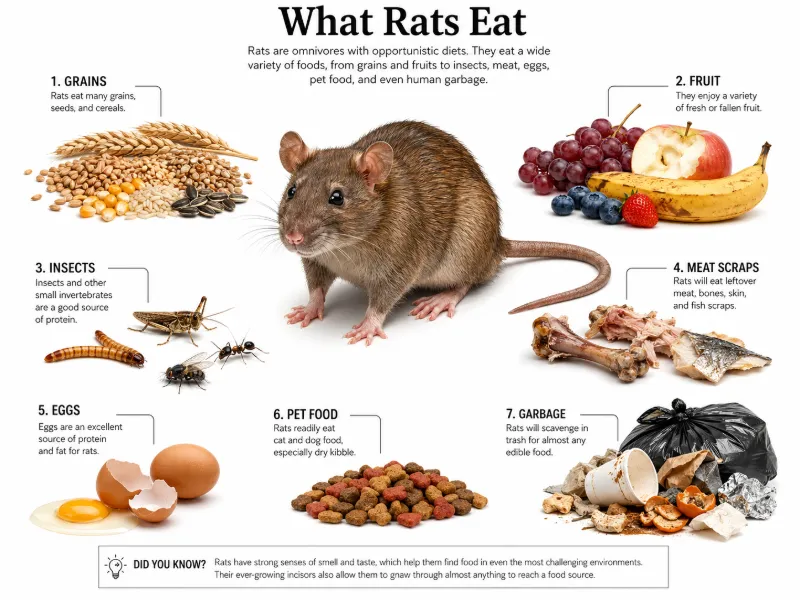
Rats eat almost anything they can find, which is why they are such successful survivors. They are omnivores, meaning they eat both plant and animal material, and their diet can include grains, seeds, fruit, vegetables, insects, eggs, meat scraps, pet food, garbage, and even carrion. In simple terms, rats eat whatever is available, safe enough to reach, and worth the effort. Their flexibility is one of the main reasons they thrive in cities, farms, sewers, warehouses, and wild habitats.

Although people often think of rats as dirty scavengers that live only on trash, the real picture is more interesting. Rats are opportunistic feeders with strong learning ability, sharp senses, and a remarkable talent for adapting to local food sources. A city rat, a farm rat, and a wild rat may all eat differently depending on what the environment offers.
In this guide, you will learn what rats eat, how their diet changes by habitat, why they are such effective foragers, and what their feeding habits reveal about their survival strategy.
Quick answer
| Topic | Answer |
|---|---|
| Main diet type | Omnivorous |
| Common foods | Grains, seeds, fruit, vegetables, insects, meat scraps, eggs, pet food, garbage |
| Urban rat diet | Human food waste, trash, pet food, stored food, grease, scraps |
| Wild rat diet | Seeds, roots, fruit, insects, small animals, eggs, plant material |
| Feeding style | Opportunistic and highly adaptable |
| Why rats succeed | They can eat many foods and quickly exploit new food sources |
| Do rats eat meat? | Yes |
| Do rats eat garbage? | Yes, especially in urban environments |
Rats are omnivores
Rats are true omnivores. That means they are not limited to one narrow food category such as seeds alone or insects alone. Instead, they can make use of a wide range of food types depending on what is present around them.
This flexibility is one of their greatest strengths. An animal that can eat both plant and animal matter has more options when conditions change. If seeds are scarce, a rat may shift toward insects or scraps. If fresh food is unavailable, it may survive on stored grain or waste.
From an ecological point of view, rats succeed not because they have one perfect food, but because they are willing and able to eat many different things.
What rats eat in the wild
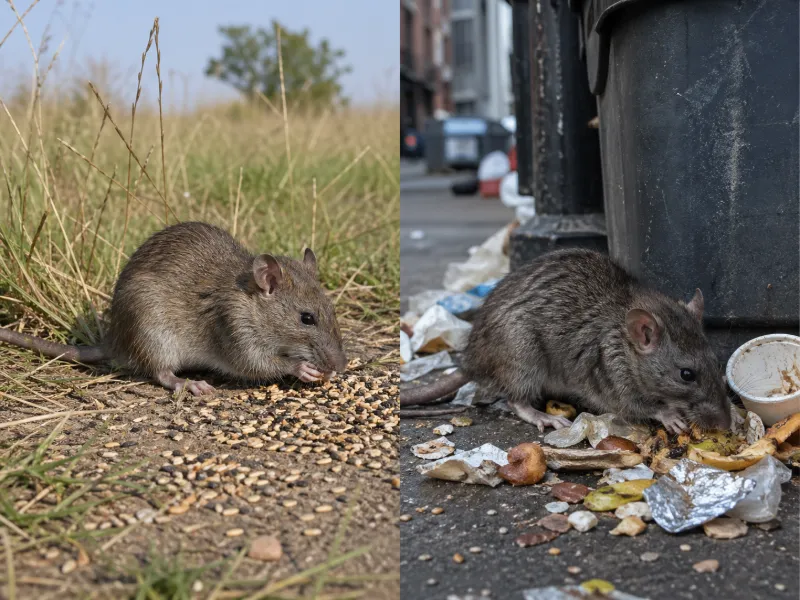
Wild rats often eat seeds, grains, roots, fruits, nuts, green plant material, and various invertebrates. Depending on habitat, they may also consume insects, snails, worms, eggs, and occasionally small animals or carrion.
In agricultural landscapes, rats may raid grain stores, crop fields, and livestock feed. In forests or scrub habitats, they may rely more on seasonal seeds, fallen fruit, and animal prey. Coastal populations may eat marine leftovers, shellfish remains, or whatever edible material washes ashore.
So even outside cities, rats are not picky specialists. They remain highly flexible foragers wherever they live.
What city rats eat
Urban rats often eat whatever humans leave behind. This includes discarded fast food, bread, rice, meat scraps, pet food, cooking grease, compost, garbage, and food waste around restaurants, markets, alleys, drains, and dumpsters.
Cities are rich in calories, and rats are excellent at finding those calories. A single poorly managed trash area can support a large number of rodents if food remains available night after night.
This is why urban rat control is closely tied to sanitation. Rats do not survive in cities by magic. They survive because food is available, predictable, and often poorly secured.
Do rats eat meat?
Yes, rats do eat meat. They are not strict herbivores, and many will consume meat scraps, fish remains, eggs, dead animals, and other protein-rich foods when available.
In urban environments, meat may come from garbage, leftovers, or food waste. In natural settings, meat may come from insects, nestlings, eggs, carrion, or very small animals. Rats are not major top predators, but they are absolutely capable of eating animal matter.
This is part of what makes them so adaptable. They can use protein sources that many plant-focused rodents would ignore or struggle to exploit.
Do rats eat insects and other small animals?
Yes. Rats often eat insects, larvae, worms, and other small invertebrates. These foods can be important especially when plant food is scarce or when easy animal protein is available.
Some rats will also raid nests for eggs or young animals, especially if the opportunity is safe and convenient. This does not mean every rat is actively hunting all the time, but it does show that rats are opportunistic enough to take advantage of vulnerable prey.
In this way, rats act not just as scavengers but also as small-scale predators when circumstances allow.
Do rats eat fruit and vegetables?
Yes. Rats will readily eat many kinds of fruit and vegetables, especially when they are soft, easy to chew, and rich in water or sugar. Fruit, tender leaves, roots, and vegetable scraps can all be part of a rat’s diet.
In natural or semi-natural habitats, fallen fruit can be an especially useful food source. In homes or cities, rats may chew through stored produce just as readily as packaged grain.
This broad plant diet helps them survive in many environments, from farms and gardens to forests and urban kitchens.
Grains and seeds are classic rat foods
Grains and seeds are among the most important traditional foods for many rats. Wheat, rice, corn, oats, and stored seed products are calorie-rich, abundant, and often easy to access in human-dominated environments.
This is one reason rats have long been associated with barns, granaries, warehouses, and ships. Stored grain provides a stable and concentrated food source that can support large populations.
When people imagine rats stealing grain, that image is grounded in reality. Grain-rich environments are ideal rat habitats if shelter is also available.
Do rats eat garbage because they prefer it?
Not exactly. Rats do not necessarily prefer garbage in the way humans think of preference. What they really prefer is accessible food with useful calories. Garbage happens to contain a huge mix of edible material.
To a rat, a trash bin may offer bread, fat, meat, fruit peels, spilled grains, pet food residue, and more, all in one place. That makes garbage highly practical from a foraging point of view.
So rats are not drawn to garbage because it is filthy. They are drawn to it because it is full of food.
How rats find food
Rats use smell, memory, exploration, and social learning to find food. Their sense of smell is especially important, and they can detect edible material in dark, cluttered, or hidden places where vision matters less.
They also learn routes and feeding sites quickly. If a rat finds food in one location and survives the experience, it may return repeatedly. Other rats may then begin using the same route or feeding area.
This combination of scent detection and learning ability is one reason rat infestations can become persistent once food access is established.
Rats are cautious eaters
Even though rats eat many things, they are not reckless. In fact, rats are often cautious around unfamiliar food, especially in dangerous environments. They may sample small amounts first and wait to see whether the food causes illness before eating more.
This behavior helps them survive around toxins and new risks. It is one reason rats can be difficult to control. A highly adaptable omnivore that is also cautious is much harder to outsmart than a simple scavenger with no hesitation.
So the rat’s success depends not just on appetite, but also on judgment.
Do rats store food?
Sometimes, yes. Rats may carry food away to safer places, especially if the original site feels exposed. They can transport pieces back to burrows, nest areas, or sheltered feeding points where they are less vulnerable.
Food carrying helps them reduce risk. Instead of remaining in an open location, a rat can grab a piece and eat it somewhere more secure. This behavior is especially useful in areas with predators or human disturbance.
It also means that signs of rat feeding may appear at a different location from the original food source.
Do all rat species eat the same things?
No. Different rat species have different tendencies, and even within a species, diet changes depending on habitat. Brown rats, black rats, and other rat species may use different spaces and therefore find different foods more often.
Brown rats are often associated with ground-level scavenging, sewers, burrows, and general urban waste. Black rats are often more agile climbers and may use roofs, trees, and elevated food sources more often. Local ecology shapes what each population actually eats day to day.
So the broad answer is that rats can eat many things, but the exact menu depends on species and setting.
What pet rats eat
Pet rats should not be fed exactly like wild city rats. In captivity, rats do best on nutritionally balanced diets designed for their needs, often including formulated rat foods, grains, vegetables, limited fruit, and controlled protein sources.
A healthy pet rat diet aims for balance, not survival-only scavenging. Pet rats still enjoy variety, but too much junk food, sugary snacks, or fatty leftovers can lead to obesity and health problems.
This is an important difference. A wild rat eats opportunistically because it must. A pet rat should eat carefully because its owner controls the diet.
Why rats can survive almost anywhere
Rats survive almost anywhere because food is rarely the only problem. They also need water, shelter, and breeding security. But once those needs are met, their flexible diet gives them a huge advantage over animals that depend on one narrow food source.
An omnivore that can eat grain, insects, meat scraps, fruit, garbage, pet food, and carrion can adjust rapidly to new conditions. That makes rats extremely resilient in changing environments.
This dietary flexibility is one of the main reasons rats have spread so successfully alongside human civilization.
Why rat diet matters ecologically
Rat diet matters because rats affect many other species. When they eat crops, stored food, eggs, nestlings, or waste, they alter food webs and human systems at the same time. On islands and in sensitive ecosystems, rats can be especially damaging because they prey on eggs and young animals that evolved without such persistent mammal predators.
In cities, their feeding behavior links directly to sanitation, public health, and infrastructure problems. In farms, it affects food storage and crop loss. In natural systems, it can affect bird colonies, reptiles, and small native animals.
So understanding what rats eat is not just interesting. It is also important for ecology and management.
Do rats eat “anything” literally?
Not literally everything, but close enough that the phrase captures an important truth. Rats do not eat non-food objects for nutrition, although they may gnaw many materials. What they really do is exploit a huge range of edible items that other animals might ignore.
That is why the phrase “whatever they can get their paws on” works so well. It reflects not randomness, but flexibility. Rats are not indiscriminate in the strictest sense. They are highly opportunistic and extremely good at turning available matter into survival.
In practical terms, that is close enough to “anything” to make them formidable survivors.
Final takeaway
Rats eat whatever they can get their paws on because they are highly adaptable omnivores. Their diet can include grains, seeds, fruit, vegetables, insects, eggs, meat scraps, pet food, carrion, and human garbage. Wild rats, farm rats, and city rats may eat different things, but they all share the same basic strategy: use whatever food source is available, safe enough to access, and rich enough to support survival. That flexibility is one of the main reasons rats are so successful around the world.
FAQs
Do rats eat meat?
Yes. Rats are omnivores and will eat meat scraps, eggs, insects, carrion, and other animal matter when available.
Do rats eat garbage?
Yes. Urban rats commonly feed on human food waste, trash, pet food, and other discarded edible material.
What do wild rats eat?
Wild rats often eat seeds, grains, fruit, roots, insects, eggs, and small animals depending on habitat.
Are rats picky eaters?
They are flexible eaters, but they are often cautious around unfamiliar food and may test it in small amounts first.