Squirrel poop and rat poop can look similar, but there are useful clues. Squirrel droppings are usually oval, rounded, slightly thicker, and often found in attics, near nests, or under entry points. Rat droppings are usually darker, more elongated, and may be pointed or capsule-shaped, often scattered along walls, cabinets, garages, or food sources. Location and other signs are often more reliable than poop shape alone.
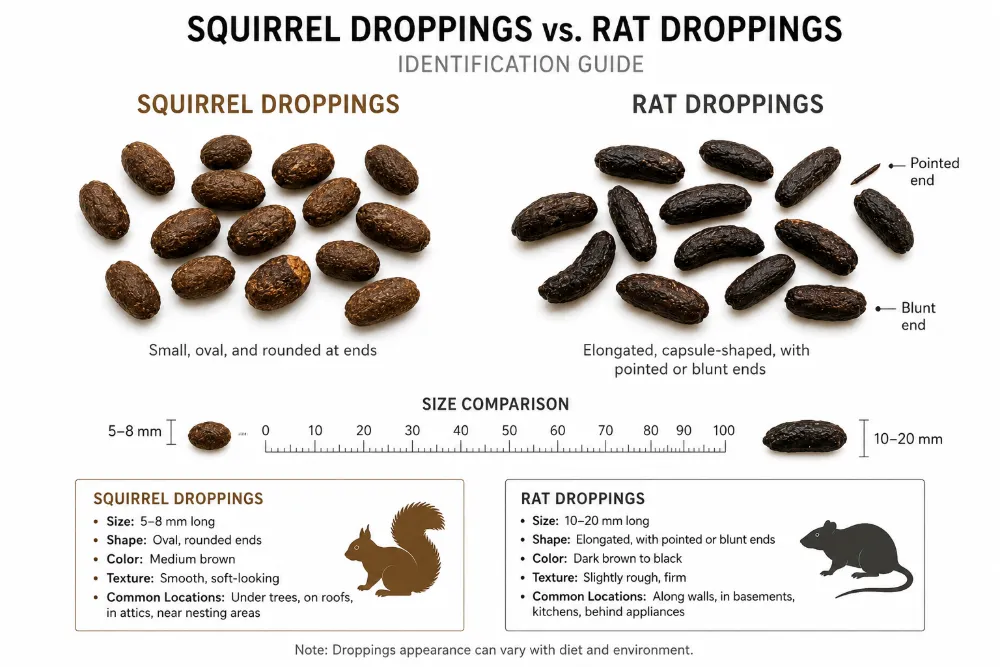
Quick Comparison Table
| Feature | Squirrel Poop | Rat Poop |
|---|---|---|
| General shape | Oval, rounded, barrel-like pellets | Elongated pellets, capsule-shaped or slightly pointed |
| Typical size | Often about 1/4 to 3/8 inch long | Often about 1/2 to 3/4 inch long, depending on rat species |
| Ends | Usually more rounded | May be pointed, tapered, or blunt depending on species |
| Color when fresh | Dark brown to brown-black | Dark brown to black |
| Color when old | May fade to brown, reddish-brown, or lighter tan | May dry out and turn grayish or dull black |
| Common location | Attics, roof spaces, tree cavities, under nests, near roof entry holes | Walls, cabinets, basements, garages, pantries, pipes, food storage areas |
| Dropping pattern | Often concentrated near nesting or resting areas | Often scattered along travel routes and feeding areas |
| Activity clue | Noises often heard during daytime | Noises often heard at night |
| Other signs | Chewed roof edges, attic nests, insulation disturbance, acorn shells | Grease marks, gnaw marks, strong odor, food damage, burrows |
| Health caution | Do not touch with bare hands; treat as contaminated waste | Do not touch with bare hands; higher concern near food areas |
Why Squirrel Poop and Rat Poop Are Easy to Confuse
Squirrel droppings and rat droppings are often confused because both animals are medium-sized rodents, both produce small dark pellets, and both may enter attics, garages, sheds, and walls. In poor lighting, old droppings from either animal may look almost identical.
Shape alone is not always enough. A squirrel pellet can look like a rat pellet, especially after it dries. Rat droppings also vary by species. Norway rat droppings are often larger and more blunt-ended, while roof rat droppings are often slimmer and more pointed. Because of this overlap, the best identification uses several clues together: size, shape, location, quantity, odor, food damage, footprints, chew marks, and activity time.
What Does Squirrel Poop Look Like?
Squirrel poop usually appears as small, firm, oval pellets. The pellets are often rounded at the ends and may look slightly thicker or more barrel-shaped than rat droppings. Fresh squirrel droppings are usually dark brown to nearly black. As they age, they may dry out and become lighter brown, reddish-brown, or tan.
In homes, squirrel droppings are commonly found in attics, roof voids, wall spaces, chimneys, sheds, garages, or near roof entry points. They may appear near nests made of leaves, twigs, shredded insulation, paper, or other soft materials.
Squirrels often enter buildings from above, especially through gaps near rooflines, soffits, vents, chimneys, and damaged fascia boards. If droppings are found high in the structure and you also hear daytime scampering, squirrels become more likely.
What Does Rat Poop Look Like?
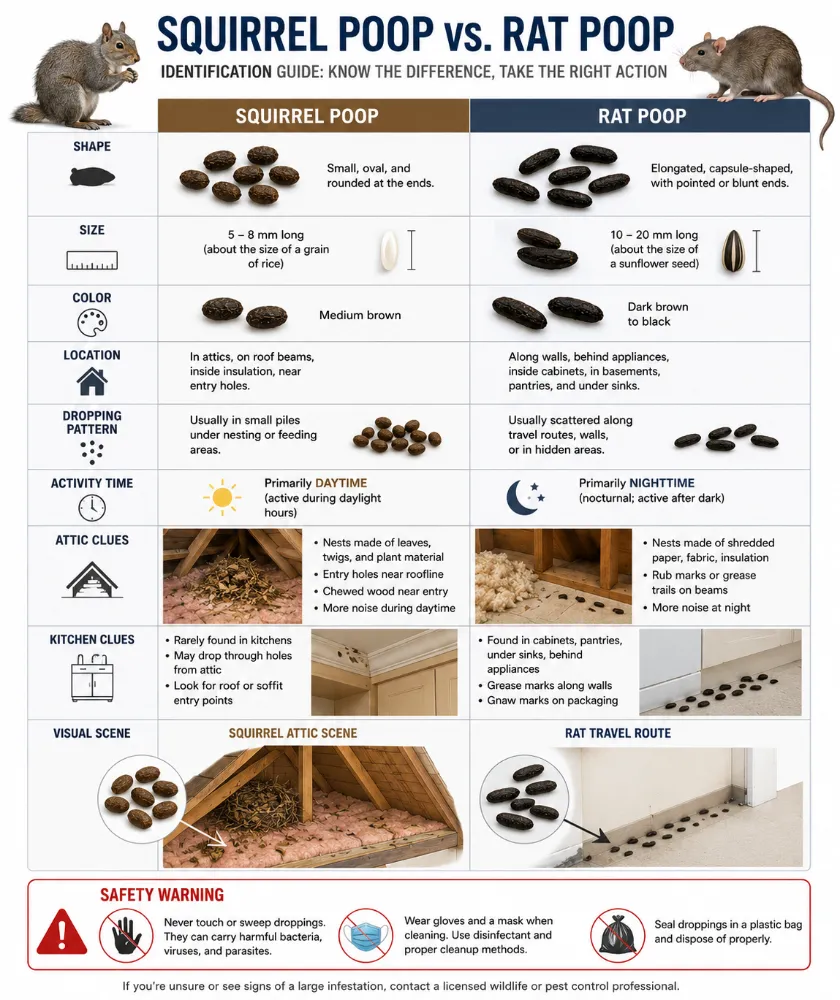
Rat poop is usually dark, elongated, and pellet-like. It may be black or dark brown when fresh and becomes duller or grayish as it dries. The exact shape depends on the rat species. Norway rat droppings are usually larger, thicker, and more capsule-shaped with blunt ends. Roof rat droppings are often slimmer, curved, and more pointed at the ends.
Rat droppings are often found along walls, behind appliances, inside cabinets, in garages, basements, crawl spaces, storage rooms, pantries, and near food sources. Rats tend to use repeated travel routes, so their droppings may appear along edges, pipes, beams, or hidden runways.
Rats may also leave greasy rub marks along walls, chew marks on wood or plastic, damaged food packaging, burrows, nesting material, and a strong musky odor. If droppings are found near stored food, pet food, trash, or water sources, rats are more likely than squirrels.
Shape Difference
Shape is one of the first clues, but it should not be used alone. Squirrel droppings are usually oval, rounded, and slightly plump. They may look like small brown pellets with smooth sides and rounded ends.
Rat droppings are usually more elongated. Norway rat droppings may look like dark capsules, while roof rat droppings may be narrower and pointed. Roof rat droppings can sometimes look very similar to squirrel droppings, which is why location and behavior clues are important.
A simple rule is: rounded, oval pellets near attic nesting material may suggest squirrels; longer, darker pellets scattered along walls or food routes may suggest rats.
Size Difference
Squirrel droppings are often around 1/4 to 3/8 inch long, though size can vary with species, age, and diet. They are usually smaller than the largest rat droppings but larger than mouse droppings.
Rat droppings are usually larger than mouse droppings and may be larger than squirrel droppings. Norway rat droppings can reach about 3/4 inch long, while roof rat droppings are often closer to 1/2 inch long. Because smaller rat droppings and larger squirrel droppings can overlap, size is helpful but not final proof.
If the droppings are tiny, rice-like, and about 1/8 to 1/4 inch long, they may be mouse droppings instead of squirrel or rat droppings.
Color Difference
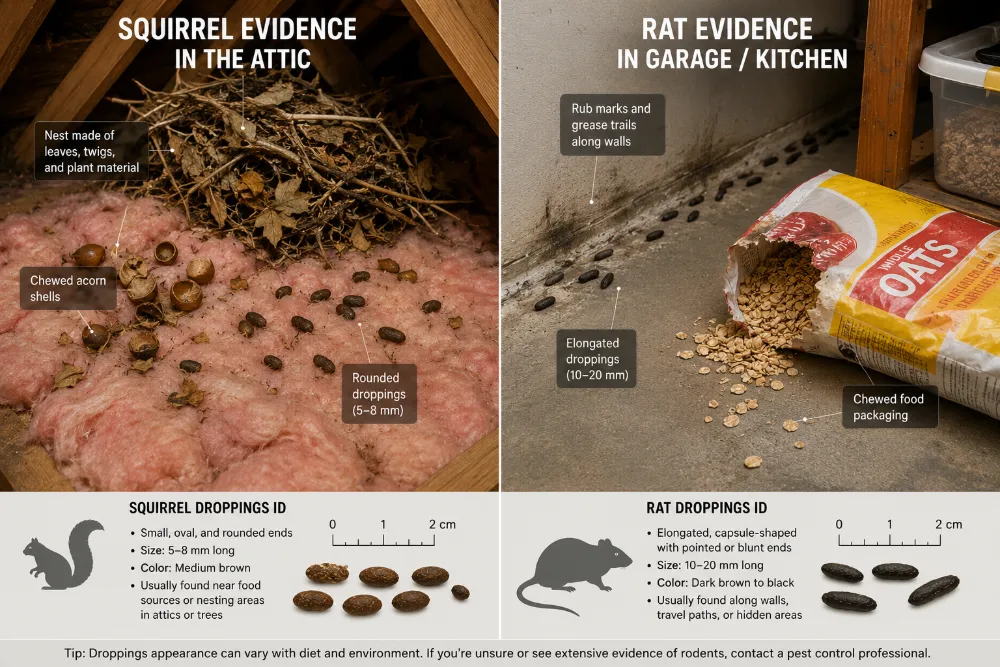
Fresh squirrel poop is often dark brown or brown-black. As it dries, it may become lighter brown, reddish-brown, or tan. Older squirrel droppings may look dry, crumbly, and less shiny.
Fresh rat poop is usually dark brown to black and may look shiny or moist when very fresh. As it ages, it becomes dull, dry, and sometimes grayish. Color alone is not reliable because droppings change with age, diet, humidity, and surface conditions.
Freshness matters. A shiny black dropping may simply be new, while a pale or gray dropping may be old. Do not assume species based only on color.
Location Is Often the Best Clue
Location is often more useful than shape. Squirrels are excellent climbers and usually enter buildings from above. Their droppings are commonly found in attics, roof spaces, chimneys, soffits, and near nests. You may also see acorn shells, chewed nuts, shredded insulation, or leafy nesting material.
Rats often use lower hidden routes, although roof rats can climb very well. Rat droppings are common along walls, behind refrigerators, inside cabinets, under sinks, near pet food, in garages, and around trash or stored goods. Rats often move along edges because they prefer cover.
If droppings are high in an attic with daytime noises, think squirrel. If droppings are near food, walls, pipes, or nighttime scratching, think rat.
Dropping Pattern and Quantity
Squirrel droppings may accumulate near nesting, resting, or feeding areas. In an attic, they may be concentrated in specific zones where squirrels spend time. You may find them mixed with shredded insulation, leaves, twigs, or food remains.
Rat droppings are often more widely scattered along travel routes. Rats may leave droppings as they move between nests, food, and water. A heavy rat infestation can produce many droppings in cabinets, basements, garages, or wall edges.
However, pattern is not always simple. A single squirrel may produce many droppings in one attic, and rats may also concentrate droppings near nests. Look for the whole evidence picture.
Smell and Other Signs
Rat infestations often produce a stronger odor than squirrel activity, especially in enclosed spaces. Rat urine and scent marking may create a musky smell. Grease marks along walls or beams can also point to rats because their oily fur rubs against repeated pathways.
Squirrels may create noise, nesting mess, and chewing damage, especially near rooflines and attic structures. They may chew wood, vents, wiring, or insulation. Squirrel nests may include leaves, twigs, shredded paper, and insulation.
Gnaw marks can also help. Rats often gnaw food packaging, plastic containers, wires, and structural materials. Squirrels may chew entry holes, roof edges, fascia, vents, and wooden trim.
Daytime vs Nighttime Activity
Behavioral timing is a major clue. Tree squirrels are mostly active during the day. If you hear running, rolling, chewing, or scratching in the attic during morning or afternoon, squirrels are a strong possibility.
Rats are usually more active at night. If the noises happen after dark, inside walls, under floors, or near kitchens and basements, rats may be more likely. Roof rats can also use upper parts of buildings, so nighttime attic noise may point to rats rather than squirrels.
Timing is not perfect, but it is useful. Daytime attic activity often suggests squirrels. Nighttime wall or kitchen activity often suggests rats.
Squirrel Poop vs Rat Poop vs Mouse Poop
| Animal | Typical Dropping Size | Shape | Common Location |
|---|---|---|---|
| Squirrel | About 1/4 to 3/8 inch | Oval, rounded, barrel-like | Attics, roof spaces, nest areas, tree cavities |
| Rat | About 1/2 to 3/4 inch, depending on species | Elongated, capsule-shaped, pointed or blunt | Walls, cabinets, basements, garages, food areas |
| Mouse | About 1/8 to 1/4 inch | Small, rice-like, pointed ends | Drawers, cabinets, pantries, wall edges, storage boxes |
Health Risks and Safety
Both squirrel and rat droppings should be treated as contaminated waste. Do not touch droppings with bare hands, do not sweep dry droppings into the air, and do not let pets or children contact them. Old droppings can break apart and release dust, which may irritate the respiratory system or expose people to pathogens.
Rat droppings are especially concerning around food storage areas because rats can contaminate surfaces, food packaging, and utensils. Rats may carry bacteria, parasites, and disease-causing organisms. Squirrel droppings can also carry harmful microbes and parasites, especially in enclosed spaces like attics.
For large infestations, heavy contamination, or droppings in insulation, it is safer to contact a pest control or wildlife removal professional. Correct identification also matters because squirrels and rats require different exclusion and control strategies.
How to Confirm the Animal Without Touching the Droppings
Look for entry points. Squirrels often enter through roof edges, vents, chimneys, soffits, and damaged fascia. Rats may enter through gaps around pipes, foundation cracks, garage doors, crawl spaces, vents, or roof gaps, depending on species.
Listen for activity times. Daytime attic running is more consistent with squirrels. Nighttime scratching, especially near kitchens, walls, or basements, is more consistent with rats.
Check for food clues. Acorn shells, nuts, leafy nests, and roofline damage suggest squirrels. Chewed food packages, greasy wall marks, strong odor, and droppings along hidden routes suggest rats.
Trail cameras, inspection cameras, or professional wildlife inspections can confirm the animal without guessing from droppings alone.
Why Correct Identification Matters
Squirrels and rats require different solutions. Squirrels are wildlife that often enter buildings from above and may have young in nests during breeding seasons. Removing adults without checking for young can create serious problems, including trapped animals and odor issues.
Rats are usually managed through sanitation, exclusion, trapping, and removal of food and water sources. Because rats reproduce quickly, fast action is important when droppings are found near food or living areas.
For both animals, sealing entry points is essential. Removing droppings without closing access holes usually leads to repeat problems.
Simple Identification Checklist
| Question | Likely Squirrel | Likely Rat |
|---|---|---|
| Where are the droppings? | Attic, roof space, near nest or roof entry | Walls, kitchen, garage, basement, food areas |
| What shape are they? | Oval, rounded, barrel-like | Longer, capsule-like, pointed or blunt |
| When do you hear noises? | Morning or daytime | Nighttime |
| Are there food signs? | Acorn shells, nuts, plant material | Chewed food packaging, pantry damage |
| Are there grease marks? | Usually less obvious | Often along repeated travel routes |
| Best next step | Inspect roofline and attic entry points | Inspect food areas, walls, pipes, and hidden runways |
Final Verdict: Squirrel Poop vs Rat Poop
Squirrel poop is usually oval, rounded, and often found in attics, roof spaces, or near nesting areas. Rat poop is usually darker, more elongated, and often found along walls, cabinets, garages, basements, or food sources. However, the two can overlap in appearance, especially when droppings are old.
The best way to tell them apart is to combine clues: shape, size, location, activity time, food damage, nesting material, entry points, and odor. If the evidence points upward to the roof and daytime activity, squirrels are likely. If the evidence points toward food, walls, and nighttime movement, rats are more likely.
FAQs About Squirrel Poop and Rat Poop
Does squirrel poop look like rat poop?
Yes, squirrel poop can look similar to rat poop. Both are small, dark pellets. Squirrel droppings are usually more oval and rounded, while rat droppings are often more elongated or pointed.
What is the easiest way to tell squirrel poop from rat poop?
Location is often the easiest clue. Droppings in attics near nests or roof entry points may be from squirrels. Droppings near food, walls, cabinets, basements, or garages may be from rats.
Is squirrel poop bigger than rat poop?
Not usually. Rat droppings, especially from Norway rats, are often larger than squirrel droppings. However, sizes can overlap, especially with roof rats and larger squirrels.
What color is squirrel poop?
Fresh squirrel poop is usually dark brown to black. As it dries, it may become lighter brown, reddish-brown, or tan.
What color is rat poop?
Fresh rat poop is usually dark brown or black and may look shiny. Older rat poop becomes dry, dull, and sometimes grayish.
Are squirrel droppings dangerous?
Squirrel droppings can contain bacteria, parasites, and other contaminants. They should not be touched with bare hands or swept dry into the air.
Are rat droppings dangerous?
Rat droppings can contaminate food areas and may carry harmful organisms. Treat them as a health concern, especially in kitchens, pantries, or enclosed spaces.
Do squirrels poop in attics?
Yes. Squirrels that nest or rest in attics may leave droppings, urine, nesting material, chewed insulation, and food remains.
Do rats poop in the same place every time?
Rats often leave droppings along repeated travel routes, near food, and near nesting areas. Their droppings may be scattered rather than placed in one exact spot.
Should I clean droppings myself?
Small amounts may be cleaned carefully with proper protection, but large infestations, attic contamination, or droppings in insulation are better handled by professionals. Avoid dry sweeping or vacuuming loose droppings.