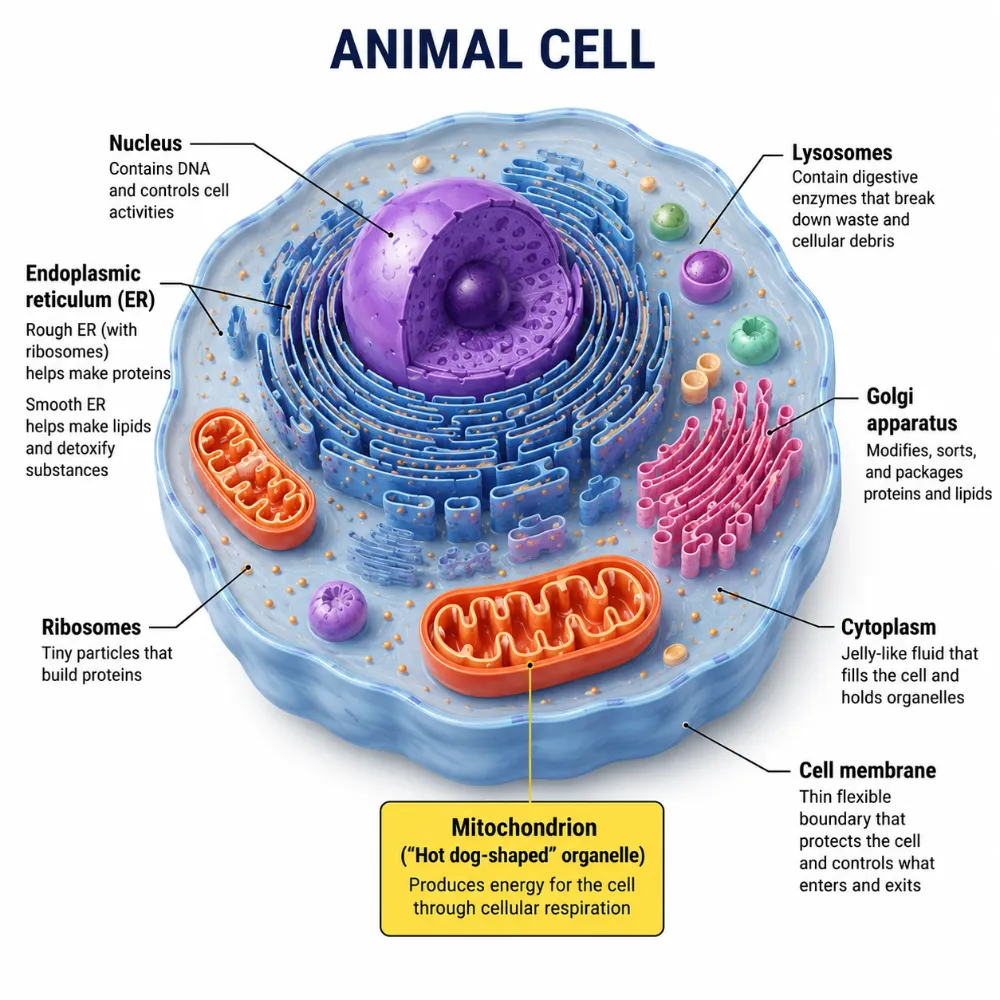
The “hot dog thing” in an animal cell is usually the mitochondrion. If there is more than one, they are called mitochondria. Mitochondria are bean-shaped or sausage-shaped organelles that help turn food molecules and oxygen into usable energy for the cell. They are often called the “powerhouses of the cell” because they produce ATP, the main energy currency used by animal cells.
| Cell Structure | What It Looks Like | Main Job | Is It the “Hot Dog Thing”? |
|---|---|---|---|
| Mitochondrion | Bean-shaped, oval, sausage-shaped, or hot dog-like | Produces ATP energy through cellular respiration | Yes, this is the most likely answer |
| Nucleus | Large round or oval structure | Stores DNA and controls many cell activities | No, usually looks more like a large ball |
| Golgi apparatus | Stack of flattened sacs | Packages and ships proteins and lipids | No, usually looks like folded pancakes |
| Endoplasmic reticulum | Folded maze or network of membranes | Makes and transports proteins and lipids | No, usually looks like folded ribbons or tunnels |
| Lysosome | Small round sac | Breaks down waste and worn-out cell parts | No, usually looks like a small bubble |
| Ribosome | Tiny dot | Builds proteins | No, too small to look like a hot dog |
What Is the Hot Dog-Shaped Organ in an Animal Cell?
The hot dog-shaped organelle in an animal cell is most commonly the mitochondrion. In diagrams, mitochondria are often drawn as small oval, bean-shaped, or sausage-shaped structures with folded lines inside. Those inner folds are important because they increase the surface area used for energy production.
A single one is called a mitochondrion. Several are called mitochondria. Most animal cells contain many mitochondria, although the number depends on how much energy the cell needs.
For example, muscle cells need a lot of energy, so they usually contain many mitochondria. Fat cells, skin cells, nerve cells, and liver cells also need mitochondria, but the exact number varies by cell type and function.
Why Does the Mitochondrion Look Like a Hot Dog?
Mitochondria are often shown as hot dog-shaped because many of them are elongated, oval, or bean-like. In real cells, however, mitochondria are more dynamic than a simple textbook drawing suggests. They can be short, long, branching, curved, or connected into networks.
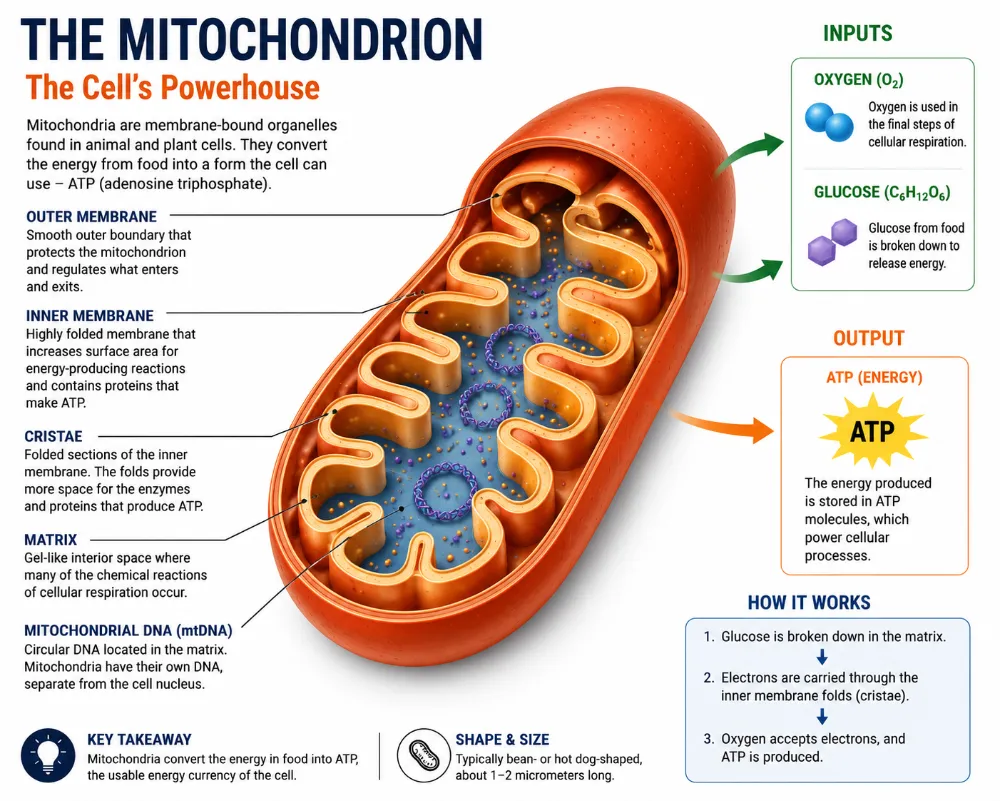
Textbook diagrams simplify mitochondria so students can recognize them easily. The “hot dog” shape is useful because it shows two important features:
The mitochondrion has an outer membrane.
It has folded inner membranes inside.
Those inner folds are called cristae. They are not decoration. They help the mitochondrion make energy efficiently.
What Does the Mitochondrion Do?
The mitochondrion helps animal cells make usable energy. Cells get energy from food molecules such as glucose and fatty acids. Mitochondria use oxygen and these fuel molecules to produce ATP, a small energy-carrying molecule.
ATP works like a rechargeable energy packet. Cells use ATP for many activities, including movement, repair, growth, communication, and chemical reactions.
Main jobs of mitochondria include:
Producing ATP energy
Helping cells use oxygen
Breaking down fuel molecules
Supporting muscle movement
Helping regulate cell survival
Playing a role in heat production in some tissues
Helping manage certain cell signals
Why Are Mitochondria Called the Powerhouses of the Cell?
Mitochondria are called the powerhouses of the cell because they produce much of the ATP that animal cells need. Without ATP, cells cannot perform most of their normal activities.
The phrase “powerhouse of the cell” is simple, but it is useful. A mitochondrion is not literally a tiny power plant, but it does convert stored chemical energy from food into a form the cell can use.
For an animal, this matters at every level. A running dog, flying bird, jumping frog, swimming fish, or beating heart all depend on cells that can produce energy. Mitochondria are central to that process.
What Is ATP?
ATP stands for adenosine triphosphate. It is the main energy currency used by cells. When a cell needs energy, it uses ATP to power chemical work, movement, transport, and repair.
You can think of ATP as a tiny rechargeable battery. Food contains stored energy, but the cell cannot use that energy directly in every situation. Mitochondria help convert food energy into ATP, which is easier for the cell to use.
| Term | Simple Meaning | Why It Matters |
|---|---|---|
| Glucose | A sugar molecule from food | One major fuel source for cells |
| Oxygen | Gas used in cellular respiration | Helps mitochondria release more energy from fuel |
| ATP | Cell energy currency | Powers many cell activities |
| Cellular respiration | Process that releases energy from food | Main energy-making pathway in mitochondria |
What Is Cellular Respiration?
Cellular respiration is the process cells use to turn food molecules into ATP. In animal cells, much of this process happens in the mitochondria.
A simple version looks like this:
Food molecules + oxygen → carbon dioxide + water + ATP energy
This does not mean the mitochondrion is “breathing” like lungs do. Lungs bring oxygen into the body, the blood carries oxygen to tissues, and mitochondria use that oxygen inside cells to help produce ATP.

Parts of a Mitochondrion
A mitochondrion has several important parts. In a diagram, these parts help explain why the organelle looks like a hot dog with squiggly lines inside.
| Part | What It Is | Function |
|---|---|---|
| Outer membrane | The outside boundary of the mitochondrion | Separates the mitochondrion from the rest of the cell |
| Inner membrane | A folded membrane inside the mitochondrion | Contains many proteins involved in ATP production |
| Cristae | Folds of the inner membrane | Increase surface area for energy production |
| Matrix | Fluid-filled inner space | Contains enzymes, mitochondrial DNA, and molecules used in respiration |
| Mitochondrial DNA | Small amount of DNA inside mitochondria | Helps make some mitochondrial proteins |
What Are the Squiggly Lines Inside the Hot Dog Shape?
The squiggly lines inside the mitochondrion represent the cristae. Cristae are folds of the inner membrane. These folds give the mitochondrion more working surface inside a small space.
More surface area means more room for the proteins involved in ATP production. This is one reason cells that need lots of energy often have mitochondria with many well-developed cristae.
In simple terms, the outside shape may look like a hot dog, but the folded inside is what makes the organelle so powerful.
Do Animal Cells Have Mitochondria?
Yes. Animal cells have mitochondria. Mitochondria are one of the most important organelles in animal cells because animals need a steady supply of energy for movement, growth, repair, digestion, nerve signals, and body temperature control.
Nearly all animal cells contain mitochondria. One important exception is mature mammalian red blood cells. These cells lose their mitochondria as they develop, which gives them more space to carry oxygen.
Most other animal cells depend heavily on mitochondria. Heart muscle cells, for example, are packed with mitochondria because the heart must contract continuously throughout life.
Do Plant Cells Have Mitochondria Too?
Yes. Plant cells also have mitochondria. Many students think only animal cells have mitochondria because plant cells have chloroplasts, but plants need mitochondria too.
Chloroplasts help plant cells capture energy from sunlight through photosynthesis. Mitochondria help plant cells convert stored food into ATP. Plant cells use ATP for growth, transport, repair, and other life processes.
The difference is that animal cells do not have chloroplasts, while plant cells usually do. Both animal and plant cells can have mitochondria.
Is the Hot Dog Thing the Nucleus?
No. The hot dog-shaped organelle is usually not the nucleus. The nucleus is usually drawn as a large round or oval structure near the center of the animal cell. It stores the cell’s DNA and helps control gene activity.
The nucleus is much larger than a mitochondrion in most diagrams. It often looks like a large ball with a smaller circle inside called the nucleolus.
Quick difference:
Mitochondrion: small, bean-shaped, energy production.
Nucleus: large, round or oval, DNA storage and cell control.
Is the Hot Dog Thing the Golgi Apparatus?
Usually no. The Golgi apparatus often looks like a stack of curved pancakes, flattened sacs, or folded ribbons. It packages, modifies, and ships proteins and lipids inside the cell.
Because the Golgi apparatus is curved, some students may mistake it for a strange folded sausage shape. However, it usually does not have the classic bean-like outline with folded inner membranes that mitochondria have.
If the structure looks like a small oval with squiggly folds inside, it is probably a mitochondrion. If it looks like a stack of flattened curved sacs, it is probably the Golgi apparatus.
Is the Hot Dog Thing the Endoplasmic Reticulum?
The endoplasmic reticulum, or ER, is usually not the “hot dog thing.” The ER is a network of folded membranes that spreads through the cell. It often appears as a maze, ribbon-like network, or folded pathway connected near the nucleus.
There are two main types:
Rough endoplasmic reticulum: has ribosomes attached and helps make proteins.
Smooth endoplasmic reticulum: helps make lipids and process certain chemicals.
The ER is more like a folded highway system. The mitochondrion is more like a small bean-shaped energy organelle.
Is the Hot Dog Thing a Lysosome?
Usually no. Lysosomes are small round sacs that contain enzymes for breaking down waste, old cell parts, and unwanted materials. In diagrams, they often look like tiny circles or bubbles.
A lysosome may be confused with a small organelle, but it usually does not have the long oval “hot dog” shape or internal folded lines of a mitochondrion.
Simple difference:
Mitochondrion: makes energy.
Lysosome: digests waste.
Why Do Animal Cells Need So Much Energy?
Animal cells are active. They do not just sit still. Even when an animal is sleeping, its cells are busy. Heart cells contract, nerve cells send signals, liver cells process nutrients, immune cells patrol the body, and muscle cells maintain readiness for movement.
Animal cells need energy for:
Muscle contraction
Nerve signals
Protein production
Cell repair
Transporting molecules across membranes
Maintaining body temperature in warm-blooded animals
Digesting and processing nutrients
Immune defense
Growth and reproduction
Mitochondria help supply the energy for these processes.
Which Animal Cells Have the Most Mitochondria?
Cells that use the most energy usually have the most mitochondria. This is why mitochondria are especially abundant in muscle cells, heart cells, nerve cells, and cells involved in active transport or metabolism.
| Cell Type | Why It Needs Mitochondria | Energy Demand |
|---|---|---|
| Heart muscle cell | Must contract continuously | Very high |
| Skeletal muscle cell | Powers movement, running, jumping, and posture | High |
| Nerve cell | Maintains electrical signals and communication | High |
| Liver cell | Processes nutrients, toxins, and stored energy | High |
| Kidney tubule cell | Moves ions and molecules during filtration | High |
| Fat cell | Stores and manages energy reserves | Variable |
Mitochondria in Animal Movement
Movement is one of the easiest ways to understand mitochondria. When a cheetah sprints, a hummingbird hovers, a dolphin swims, or a dog wags its tail, muscle cells need ATP. Mitochondria help provide that energy.
Muscles use ATP to contract. The faster or longer an animal moves, the more energy its muscle cells need. This is why endurance tissues, such as heart muscle and slow-twitch muscle fibers, are rich in mitochondria.
Without mitochondria, complex animal movement would not work the same way. They are essential for the energy demands of active animal life.
Mitochondria and Oxygen
Mitochondria are closely linked to oxygen use. Animals breathe to bring oxygen into the body. Blood carries that oxygen to cells. Mitochondria use oxygen in cellular respiration to help release energy from food molecules.
This is why breathing and circulation are connected to cellular energy. The lungs do not make ATP directly. The heart does not make ATP for every cell directly. Instead, they deliver oxygen and nutrients so mitochondria inside cells can produce ATP.
In simple terms:
Lungs bring in oxygen.
Blood transports oxygen.
Cells receive oxygen.
Mitochondria use oxygen to help make ATP.
Do Mitochondria Have Their Own DNA?
Yes. Mitochondria contain their own small amount of DNA, called mitochondrial DNA. This is one of the most fascinating facts about them.
Mitochondrial DNA is different from the DNA stored in the nucleus. It contains instructions for some proteins involved in mitochondrial function. However, most mitochondrial proteins are still made using instructions from nuclear DNA.
The presence of mitochondrial DNA supports the idea that mitochondria evolved from ancient bacteria-like organisms that became part of early complex cells. This idea is called the endosymbiotic theory.
Where Did Mitochondria Come From?
Mitochondria likely originated from ancient bacteria that entered into a partnership with early cells. Instead of being digested, these bacteria-like organisms stayed inside and helped the host cell use oxygen to produce energy more efficiently.
Over millions of years, this partnership became permanent. The ancient internal bacteria evolved into mitochondria, and the host cells evolved into more complex cells.
This event was one of the most important steps in the evolution of complex life. Animals, plants, fungi, and many other organisms depend on mitochondria or mitochondria-related organelles.
Why Do Diagrams Draw Mitochondria Differently?
Some diagrams show mitochondria as simple beans. Others show them as long sausages, rounded ovals, or branching tubes. These differences happen because real mitochondria are flexible and dynamic.
Mitochondria can change shape, divide, fuse, move through the cell, and form networks. A textbook drawing usually shows a simplified version so students can recognize the organelle easily.
Common diagram styles include:
Bean-shaped mitochondrion
Hot dog-shaped mitochondrion
Oval mitochondrion with squiggly inner folds
Long sausage-shaped mitochondrion
Branching mitochondrial network in advanced diagrams
How to Label the Hot Dog Thing in a Cell Diagram
If you are labeling a basic animal cell diagram and see a small hot dog-shaped structure with inner squiggly folds, label it mitochondrion. If there are several, label them mitochondria.
Use this checklist:
Small oval or sausage shape
Double membrane in some diagrams
Folded inner lines
Several copies scattered around the cytoplasm
Associated with energy production
If all of these match, the answer is mitochondrion.
Animal Cell Organelles Compared
| Organelle | Simple Nickname | Main Function | Easy Shape Clue |
|---|---|---|---|
| Mitochondrion | Powerhouse | Makes ATP energy | Hot dog or bean with folded lines |
| Nucleus | Control center | Stores DNA | Large round or oval structure |
| Ribosome | Protein builder | Makes proteins | Tiny dots |
| Golgi apparatus | Packaging center | Modifies and ships molecules | Stacked curved sacs |
| Endoplasmic reticulum | Cell highway | Makes and transports molecules | Folded membrane network |
| Lysosome | Recycling center | Breaks down waste | Small round sac |
| Cell membrane | Cell boundary | Controls what enters and leaves | Outer flexible edge |
| Cytoplasm | Cell fluid | Holds organelles in place | Jelly-like background |
Why the Mitochondrion Matters in Animal Biology
For an animal scientist, mitochondria are not just a school diagram label. They help explain how animals move, grow, regulate temperature, use food, recover from exercise, and survive in different environments.
Animals with high energy lifestyles often depend heavily on mitochondrial performance. Birds need enormous energy for flight. Mammals need energy for warm body temperatures. Fish need muscle energy for swimming. Insects use energy for wingbeats, although insect cell biology has its own special adaptations.
At the cellular level, animal behavior begins with energy. Mitochondria help provide that energy.
Mitochondria and Exercise
Exercise increases energy demand. When an animal runs, jumps, swims, flies, or climbs, muscle cells burn through ATP quickly. Mitochondria help produce more ATP to keep the muscles working.
Endurance training can increase mitochondrial capacity in muscle cells. This means the muscles become better at using oxygen and fuel to produce energy over time.
This is why mitochondria are important in animal physiology, sports science, veterinary medicine, and wildlife biology. A migrating bird, working sled dog, racing horse, or wild predator all depends on efficient cellular energy production.
Mitochondria and Heat
In some animal tissues, mitochondria help produce heat. This is especially important in certain mammals. Brown fat, for example, contains many mitochondria and can help generate heat without shivering.
This kind of heat production is useful for newborn mammals, hibernating animals, and species living in cold environments. Mitochondria are not just about movement; they also help animals maintain body function under different temperatures.
What Happens If Mitochondria Do Not Work Properly?
If mitochondria do not work properly, cells may not get enough ATP. This can affect tissues that need a lot of energy, such as muscles, nerves, heart tissue, and the brain.
In animals, mitochondrial problems can affect movement, growth, metabolism, endurance, and organ function. In veterinary and medical science, mitochondrial health is an important part of understanding some inherited and metabolic diseases.
For a basic school-level explanation, the key idea is simple: if the powerhouse fails, the cell struggles to get enough usable energy.
Common Mistakes About the Hot Dog Thing in an Animal Cell
Mistake: Calling it “the hot dog cell.”
Correct: It is an organelle called a mitochondrion.Mistake: Saying “mitochondria” for one structure.
Correct: One is a mitochondrion; many are mitochondria.Mistake: Thinking it stores DNA for the whole cell.
Correct: The nucleus stores most of the cell’s DNA.Mistake: Thinking only animal cells have mitochondria.
Correct: Plant cells and many other eukaryotic cells also have mitochondria.Mistake: Thinking mitochondria are always exactly bean-shaped.
Correct: Real mitochondria can change shape and form networks.
Simple Memory Trick
If the structure looks like a hot dog with squiggles inside, think:
“Mitochondria make energy.”
The word mitochondria may sound complicated, but the idea is easy. The hot dog-shaped organelle helps power the cell.
Another memory trick:
Mitochondrion: one power organelle.
Mitochondria: many power organelles.
Cristae: the folded lines inside.
ATP: the energy molecule produced.
Final Takeaway
The hot dog-shaped thing in an animal cell is almost always the mitochondrion. It is a small organelle with an outer membrane and folded inner membranes called cristae. Its main job is to help turn food and oxygen into ATP, the usable energy that powers cell activity.
Mitochondria are essential for animal life. They support movement, nerve signals, heartbeats, repair, growth, and many other energy-demanding processes.
If you see a small bean-shaped or sausage-shaped structure with squiggly lines inside on an animal cell diagram, label it mitochondrion. If there are many of them, label them mitochondria.
FAQs About the Hot Dog Thing in an Animal Cell
What is the hot dog thing in an animal cell called?
It is usually called a mitochondrion. If there are several, they are called mitochondria.
Why does the mitochondrion look like a hot dog?
Many mitochondria are oval, bean-shaped, or sausage-shaped in diagrams. The hot dog-like shape is a simplified way to show the organelle and its folded inner membranes.
What do mitochondria do?
Mitochondria help produce ATP, the main energy molecule used by cells. They use fuel molecules and oxygen during cellular respiration.
Why are mitochondria called the powerhouse of the cell?
They are called the powerhouse because they produce much of the usable energy, or ATP, that the cell needs to function.
What are the squiggly lines inside the mitochondrion?
The squiggly lines are cristae, which are folds of the inner mitochondrial membrane. They increase surface area for energy production.
Is it mitochondria or mitochondrion?
One is called a mitochondrion. More than one are called mitochondria.
Do animal cells have mitochondria?
Yes. Most animal cells have mitochondria. Cells with high energy needs, such as muscle and heart cells, often have many mitochondria.
Do plant cells have mitochondria?
Yes. Plant cells also have mitochondria. Plant cells have chloroplasts for photosynthesis, but they still use mitochondria to produce ATP from stored food.
Is the hot dog-shaped thing the nucleus?
No. The nucleus is usually a large round or oval structure that stores DNA. The hot dog-shaped structure with folded lines inside is usually the mitochondrion.
Is the hot dog-shaped thing the Golgi apparatus?
Usually no. The Golgi apparatus looks more like a stack of flattened curved sacs. The mitochondrion usually looks like a bean or hot dog with folded lines inside.
What is ATP?
ATP is the main energy-carrying molecule used by cells. It powers many cell activities, including movement, repair, transport, and chemical reactions.
Do mitochondria have DNA?
Yes. Mitochondria contain a small amount of their own DNA, called mitochondrial DNA.
Where are mitochondria found in the cell?
Mitochondria are found in the cytoplasm, the jelly-like material inside the cell membrane but outside the nucleus.
Which animal cells have many mitochondria?
Heart muscle cells, skeletal muscle cells, nerve cells, liver cells, and kidney cells often have many mitochondria because they need a lot of energy.
Can a cell live without mitochondria?
Most animal cells need mitochondria to produce enough energy. A few specialized cells, such as mature mammalian red blood cells, do not have mitochondria, but they are unusual exceptions.