Some animals really do have blue blood. The best-known examples include horseshoe crabs, octopuses, squids, cuttlefish, and some other marine invertebrates. Their blood looks blue because it uses a copper-based oxygen-carrying molecule called hemocyanin instead of the iron-based hemoglobin that makes human blood red. This unusual chemistry helps certain animals transport oxygen in cold, low-oxygen, or marine environments.

To many people, blue blood sounds like fantasy, but it is a real biological trait. These animals are not “royal” or magical. Their blood is blue for a chemical reason, and that difference tells us a great deal about how evolution solves the same problem in different ways.
In this guide, you will learn which animals have blue blood, why it is blue, how it works, and why this adaptation is especially common in certain ocean animals.
Quick answer
| Animal group | Blood color | Main oxygen-carrying molecule | Common examples |
|---|---|---|---|
| Humans and most vertebrates | Red | Hemoglobin | Humans, birds, reptiles, mammals, fish |
| Some marine invertebrates | Blue | Hemocyanin | Horseshoe crabs, octopuses, squids, cuttlefish |
| Reason for blue color | Oxygen-bound copper | Hemocyanin uses copper, not iron | Seen especially in arthropods and mollusks |
What does it mean for an animal to have blue blood?
When people say an animal has blue blood, they usually mean that its circulating oxygen-carrying fluid appears blue when oxygen is present. This is not just a trick of light. In certain animals, the chemistry of oxygen transport is genuinely different from that of humans and most vertebrates.
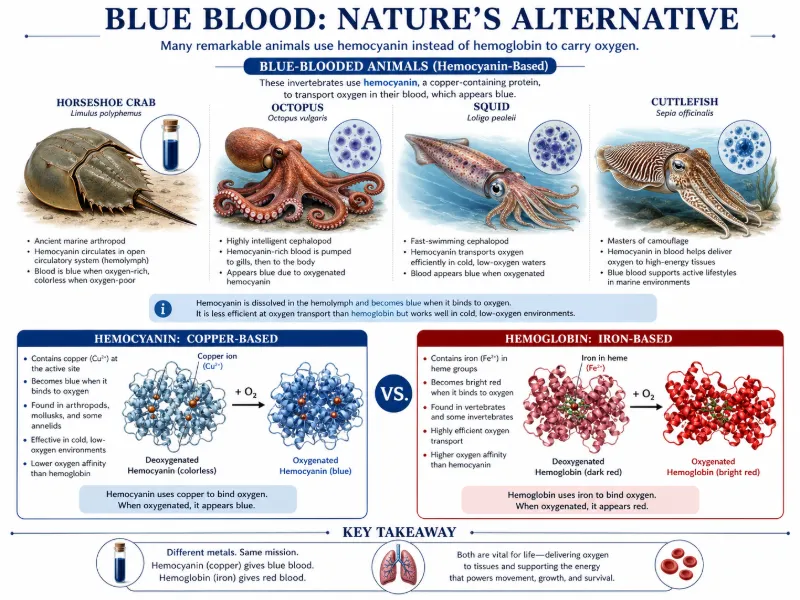
In red-blooded animals such as humans, oxygen is carried mainly by hemoglobin, a molecule that contains iron. In blue-blooded animals, oxygen is carried mainly by hemocyanin, which contains copper. When hemocyanin binds oxygen, it gives the blood or blood-like fluid a blue appearance.
So the color is not random. It comes directly from the metal and molecule used to move oxygen through the body.
Why is some blood blue instead of red?
The difference comes down to chemistry. Hemoglobin, which makes vertebrate blood red, uses iron at its core. Hemocyanin, which gives some animals blue blood, uses copper instead.
When hemoglobin binds oxygen, it produces the familiar bright red color of oxygen-rich blood. When hemocyanin binds oxygen, the oxygenated fluid appears blue. If it is carrying less oxygen, the color may look paler or less vivid.
This is why blue-blooded animals are not “bleeding blue” for symbolic reasons. Their blood is blue because evolution gave them a different oxygen transport system.
What is hemocyanin?
Hemocyanin is an oxygen-transport protein found in the blood or blood-like fluid of certain invertebrates. It performs a similar general job to hemoglobin by helping move oxygen from the environment to body tissues.
However, hemocyanin is not packaged the same way hemoglobin is in human red blood cells. In many blue-blooded animals, hemocyanin is dissolved more directly in the circulatory fluid rather than being carried inside specialized red blood cells.
This creates a different-looking and differently functioning circulatory system, but the overall goal is the same: getting oxygen to the body where it is needed.
Which animals have blue blood?
The most famous blue-blooded animals include horseshoe crabs and many cephalopods such as octopuses, squids, and cuttlefish. These animals are very different from one another in appearance and lifestyle, but they share the use of hemocyanin for oxygen transport.
Blue blood is also found in some other invertebrates, especially among certain arthropods and mollusks. It is not a trait of mammals, birds, reptiles, or ordinary bony fish.
So if someone asks for a simple answer, the safest response is this: some marine invertebrates, especially horseshoe crabs and cephalopods, are the best-known blue-blooded animals.
Horseshoe crabs are the most famous example
Horseshoe crabs are probably the most famous blue-blooded animals in the world. These ancient marine arthropods are often called living fossils because their body plan has changed relatively little over immense spans of time.
Their blood is especially well known not only because it is blue, but also because it has major scientific and medical importance. Horseshoe crab blood contains specialized cells involved in detecting certain bacterial contaminants, which is one reason these animals have become so important in biomedical work.
Even without that medical significance, the horseshoe crab would still be remarkable for its ancient history, unusual anatomy, and copper-based blood chemistry.
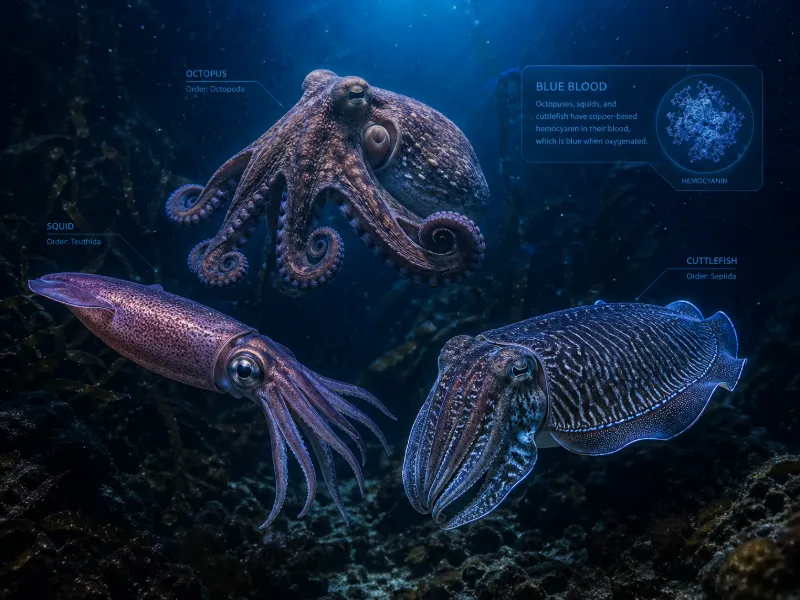
Octopuses and squids also have blue blood
Many people are surprised to learn that octopuses and squids have blue blood too. These animals belong to the cephalopods, a group of highly intelligent and active mollusks.
In cephalopods, blue blood helps support oxygen transport in marine conditions, and it is especially useful because some of these animals live in cold or oxygen-poor environments. Octopuses, for example, have complex bodies and active lifestyles, so efficient oxygen delivery is extremely important.
Their blue blood is one of many features that make cephalopods unusual, along with their large brains, excellent camouflage, and soft, flexible bodies.
Do all mollusks have blue blood?
No. Many mollusks use hemocyanin, but not every mollusk is equally famous for visibly blue blood, and different groups vary in their biology. The best-known examples are cephalopods such as octopuses, squids, and cuttlefish.
Mollusks are a huge animal group that includes clams, snails, slugs, and many others. Their internal biology is diverse, so it is better not to assume that every mollusk fits a single simple pattern.
In popular science discussions, cephalopods usually get the most attention because they are large, active, and already biologically fascinating for many other reasons.
Why is blue blood useful in the ocean?
Blue blood is especially associated with marine animals because hemocyanin can work well in cold, low-oxygen, or variable aquatic environments. In some species, this chemistry may be especially effective under the kinds of conditions they regularly experience.
This does not mean blue blood is universally “better” than red blood. It means it works well for the animals that evolved it. Evolution is not trying to create one perfect fluid for all life. It favors systems that work in particular bodies and environments.
For marine invertebrates that rely on hemocyanin, blue blood is part of a larger survival strategy shaped by water temperature, oxygen availability, activity level, and ancestry.
Is blue blood better than red blood?
Not in any simple overall sense. Red blood and blue blood are each solutions to the same biological problem: carrying oxygen. Human-style hemoglobin works extremely well in vertebrates. Hemocyanin works well in the animals that use it.
Each system has strengths and trade-offs. What matters most is whether the oxygen-carrying molecule fits the body plan, circulation style, and environment of the animal.
So blue blood is not more advanced or more primitive in a simple way. It is simply different.
Do blue-blooded animals really look blue when they bleed?
In many cases, yes, the fluid can appear blue, especially when oxygenated. However, the exact shade may vary depending on how much oxygen is present, how concentrated the pigment is, and how the fluid looks outside the body.
As with many biological colors, real life is often less dramatic than a cartoon. The blood may look pale blue, bluish, or gray-blue rather than a bright artificial color.
Still, the underlying fact remains true: the oxygen-carrying chemistry can genuinely produce a blue appearance.
Do any vertebrates have blue blood?
Not in the same sense as horseshoe crabs and octopuses. Vertebrates generally rely on hemoglobin, which is iron-based and red. Some vertebrates may appear to have bluish veins under the skin, but that does not mean their blood is actually blue.
The blue appearance of human veins is mainly an optical effect involving skin, light, and how color is perceived. Human blood is always some form of red, whether darker red when oxygen is lower or bright red when oxygen is high.
This is an important distinction, because many people first hear about blue blood through myths about human veins and then assume the same thing applies inside the body.
Are there animals with other blood colors?
Yes, the animal world includes more blood color variation than many people expect. Some animals have circulatory fluids that can appear greenish, pale, or nearly colorless depending on the molecules involved and how their bodies transport oxygen.
Different oxygen-carrying pigments and different body chemistries can produce different results. Blue blood is simply one of the most famous examples because it is so visually striking and because the animals that have it are already unusual.
This variety is a reminder that animal physiology is far more diverse than the human body alone would suggest.
Why blue-blooded animals fascinate people
Blue blood captures attention because it sounds like science fiction, yet it is completely real. Many people assume all animals must work roughly like humans, so discovering a creature with copper-based blood feels surprising and memorable.
It also helps that some of the best-known blue-blooded animals are already extraordinary in other ways. Horseshoe crabs look ancient and alien. Octopuses are intelligent and flexible. Squids are fast and elusive. Blue blood adds one more layer to their strangeness.
In popular science, these animals are a great example of how life can solve the same problem in multiple ways.
Final takeaway
Some animals really do have blue blood, including horseshoe crabs, octopuses, squids, cuttlefish, and certain other invertebrates. Their blood is blue because it uses hemocyanin, a copper-based oxygen-carrying molecule, instead of the iron-based hemoglobin that makes most vertebrate blood red. Blue blood is not a myth. It is a real and fascinating adaptation that shows how diverse animal biology can be.
FAQs
What animal has blue blood?
Some of the best-known blue-blooded animals are horseshoe crabs, octopuses, squids, and cuttlefish.
Why is their blood blue?
Their blood is blue because it uses hemocyanin, a copper-based oxygen-carrying protein.
Do humans have blue blood?
No. Human blood is always red. Blue-looking veins are caused by light and skin effects, not truly blue blood.
Is blue blood rare in animals?
It is unusual compared with red blood, but it is normal in some marine invertebrates, especially certain arthropods and mollusks.