A group of whales is commonly called a pod.
That is the answer most people learn, and it is widely used for social groups of whales, dolphins and other cetaceans.
But there is an important detail: not every whale species lives in a stable pod. Killer whales and sperm whales can have complex long-term social groups, while species such as blue whales are much more often seen alone or in pairs.
You may also encounter old collective nouns such as gam or herd, but pod is the most useful general answer in modern English.
Quick Answer: What Is a Group of Whales Called?
A group of whales is most commonly called a pod.
| Term | Meaning | Typical Use |
|---|---|---|
| Pod | A social group of whales or other cetaceans | Modern wildlife and everyday usage |
| Group | Several whales seen together | Scientific description, especially temporary associations |
| Gam | Old term for a herd or school of whales | Historical and nautical usage |
| Herd | General collective term sometimes applied to whales | Older or nontechnical usage |
| Superpod | Several pods temporarily gathering together | Especially used for highly social toothed whales |
Why Is a Group of Whales Called a Pod?
The word pod is widely used for social groups of cetaceans, the mammal group that includes whales, dolphins and porpoises.
NOAA educational material describes whale groups as pods, and the term is especially useful when the animals have a genuine social relationship rather than simply happening to be in the same area.
This distinction matters because two whales swimming near each other are not necessarily members of a permanent social unit.
For some species, however, a pod can be an extremely important family structure.
Killer Whale Pods Are Real Family Groups
Killer whales provide one of the clearest examples of what scientists mean by a pod.
NOAA describes killer whales as highly social animals that often remain closely associated with their maternal relatives.
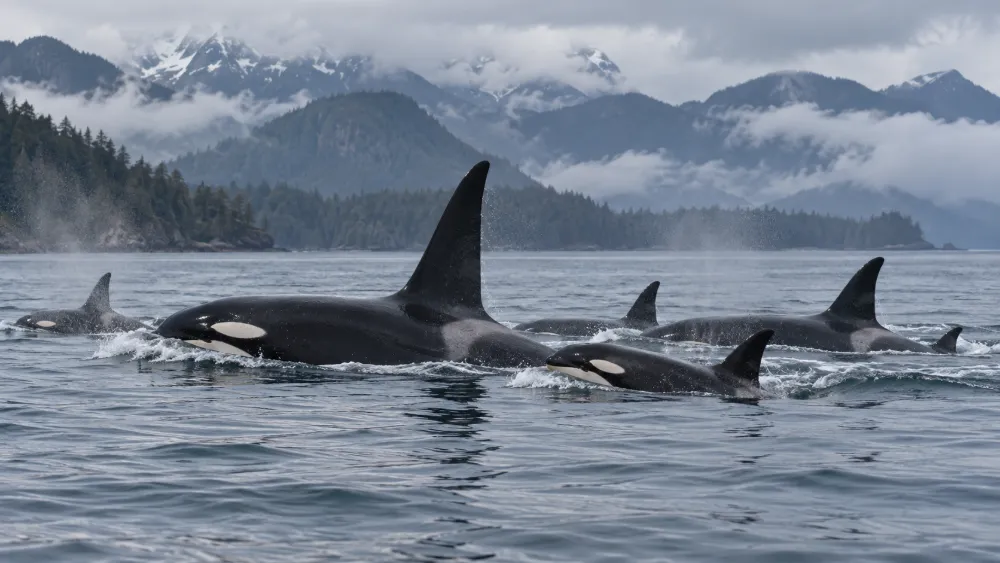
In some killer whale populations, a pod contains a mother, her offspring and other relatives descended through the maternal line.
NOAA reports that pods often contain anywhere from a few individuals to roughly 20 or more, depending on the population.
Members communicate using clicks, whistles and pulsed calls. Some populations even have learned group-specific call patterns that function almost like vocal traditions.
Pods can also cooperate while hunting.
So in killer whales, pod is much more than a fun collective noun—it describes a meaningful social organization.
Is a Killer Whale Actually a Whale?
Killer whales, or orcas, are cetaceans, but they belong to the dolphin family, Delphinidae.
They are the largest members of that family.
This is one reason collective terminology across whales and dolphins overlaps so much. Both groups are cetaceans, and pod is commonly used for social groups in both.
Do All Whales Live in Pods?
No.
This is the most important correction to the simple trivia answer.
Whale social behavior differs dramatically between species.
Some toothed whales form stable and sophisticated social groups. Other whales spend much more of their lives alone, in pairs or in temporary feeding aggregations.
Calling every collection of whales a permanent pod can therefore give the wrong impression about how the animals actually live.
Do Blue Whales Live in Pods?
Blue whales are a good example of a species that does not normally live in large permanent social groups.
NOAA states that blue whales sometimes occur in small groups but are more often found alone or in pairs.
Multiple blue whales may gather in productive feeding areas where food is concentrated, but this does not necessarily make them a permanent family pod.
This is very different from the long-term family associations seen in some killer whale populations.
Do Humpback Whales Live in Pods?
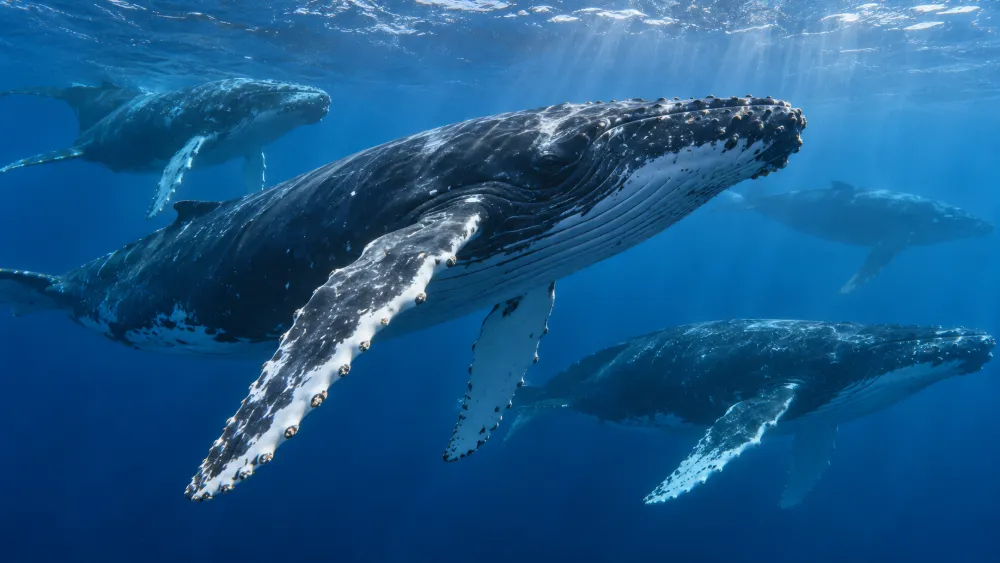
Humpback whales often form temporary associations rather than stable lifelong pods.
On breeding grounds, a common social unit is a mother and calf, sometimes accompanied by a male escort.
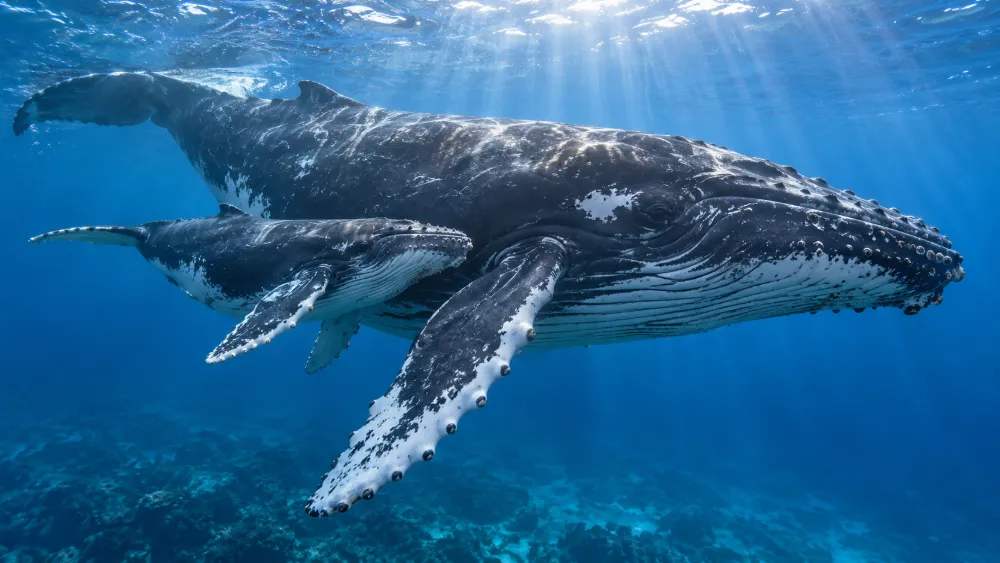
Multiple humpbacks may also gather where feeding conditions are especially good.
NOAA's Hawaiian Islands Humpback Whale National Marine Sanctuary has even pointed out that group is often more accurate than assigning a permanent pod structure to humpbacks.
So while people commonly say “a pod of humpback whales,” scientists may simply describe several animals as a group or feeding aggregation depending on the context.
Do Sperm Whales Live in Pods?
Sperm whales have much more complex social organization.
NOAA reports that females form lasting bonds with other females in their families.
A typical social unit can contain around a dozen females and their young.
Young males eventually leave these family groups and may form bachelor groups with other males of similar age and size.
As males grow older and larger, they become increasingly solitary.
This means even within one whale species, social structure can change dramatically with age and sex.
What Is a Superpod?
A superpod forms when several smaller social groups temporarily come together.
The term is particularly familiar from killer whales and dolphins.
NOAA notes that larger killer whale gatherings may form for:
social interaction;
mating;
or seasonal concentrations of prey.
These gatherings are temporary. The individual whales still belong to their usual smaller social units.
Is a Group of Whales Called a Gam?
Yes—but you are unlikely to hear the word in modern marine biology.
Dictionaries record gam as an old term meaning a herd or school of whales.
The word also developed a nautical meaning connected with social visits between crews of whaling ships at sea.
Today, gam is mainly interesting as historical vocabulary.
If you are writing about modern whale behavior, pod or simply group will normally be much clearer.
Is a Group of Whales Called a Herd?
You may encounter herd of whales, especially in dictionaries or older writing.
Herd is a general English word for a congregation of social animals.
However, it is not the term most strongly associated with modern cetacean research.
For whales, pod is usually the expected special collective noun.
Is a Group of Whales Called a School?
The word school has historically been applied to whales and appears in older dictionary definitions.
Today, school is more strongly associated with fish, although it is also sometimes used for groups of marine mammals.
For whales and dolphins, pod usually communicates the idea more clearly.
What Is a Baby Whale Called?
A baby whale is called a calf.
An adult female is commonly called a cow, while an adult male may be called a bull.
A mother and calf may remain closely associated for a long period while the young animal nurses, learns feeding strategies and develops the skills needed for independence.
The exact length of maternal care differs between whale species.
How Many Whales Are in a Pod?
There is no universal number.
Pod size depends entirely on the species and population.
For example:
killer whale pods may contain only a few animals or 20 or more;
sperm whale female social units average roughly a dozen females and young in some populations;
some whales are usually seen alone or in pairs;
and temporary feeding aggregations can contain far more animals than a normal social group.
So a “pod” should never be defined as exactly five, ten or twenty whales.
Why Do Whales Form Groups?
The benefits depend on the species.
Whales may associate with others for:
raising young;
cooperative hunting;
communication;
social bonding;
mating;
defense;
or access to concentrated feeding opportunities.
For some species, these relationships last for years or even decades.
For others, several whales may stay together only briefly before separating again.
Pod vs. Group vs. Gam
The easiest way to remember the terminology is:
Pod = the standard special name for a whale social group.
Group = safest general term when whales are simply seen together.
Gam = legitimate but old-fashioned collective noun.
Superpod = temporary gathering of several pods.
FAQ
What do you call a group of whales?
A group of whales is commonly called a pod.
Is a group of whales called a pod?
Yes. Pod is the standard collective term, particularly when whales have a social relationship. However, some whale species usually live alone or in pairs rather than in permanent pods.
Is a group of whales called a herd?
Herd can occasionally be used, particularly in older or general English, but pod is the more familiar modern term for whales.
What is a gam of whales?
Gam is an old word for a herd or school of whales. It is now uncommon outside historical or nautical contexts.
What is a superpod?
A superpod is a temporary large gathering formed when several smaller pods come together, often for social interaction, mating or concentrated food.
Do all whales live in pods?
No. Killer whales and sperm whales can have strong social groups, but blue whales are more often found alone or in pairs, and humpback associations are frequently temporary.
What is a baby whale called?
A baby whale is called a calf.
How many whales make a pod?
There is no fixed minimum or maximum. Group size varies greatly between whale species and populations.
Are dolphin groups also called pods?
Yes. Pod is widely used for social groups of dolphins as well as whales because both belong to the order Cetacea.
Final Answer
A group of whales is commonly called a pod.
But pod should not be interpreted to mean that every whale species lives in permanent family groups.
Killer whales and sperm whales can form strong, long-lasting social units, while blue whales are often solitary or found in pairs and humpback whale groups are frequently temporary.
The older term gam also means a group of whales, but it is rarely used today.
So the simple vocabulary answer is pod. The more accurate biological answer is that whale social organization depends greatly on the species.
Related Animal Group Names
Sources Used for Fact Checking
NOAA Ocean Service — Whale Sounds and Social Groups
NOAA Fisheries — Killer Whale
NOAA Fisheries — Blue Whale
NOAA Fisheries — Sperm Whale
Hawaiian Islands Humpback Whale National Marine Sanctuary
Dictionary.com — Gam