If you saw a monkey with a bright red or pink backside, the animal may have been a baboon—but that is not the only possibility.
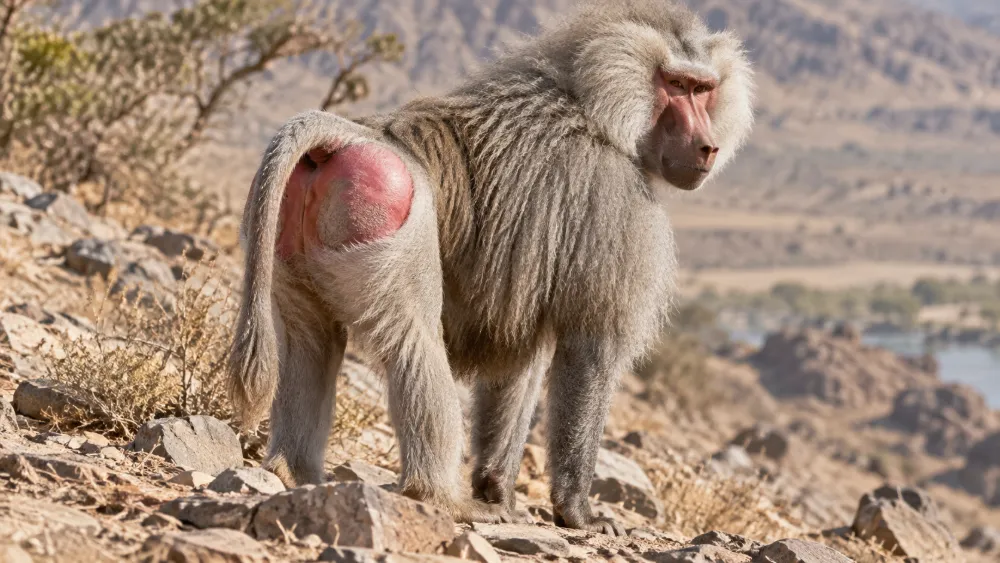
Hamadryas baboons are especially well known for their pink to bright-red hindquarters, while Japanese macaques also have naturally pinkish-red skin on the face and posterior.
Drills have striking red rumps, and mandrills have colorful bare hindquarters that are usually more blue or purple than red.
The phrase “red-butt monkey” is not a scientific name. Several different Old World monkey species have colorful, hairless skin around the rump or genital area.
What Monkey Has a Red Butt?
If someone simply describes a “monkey with a red butt,” a baboon is often the most likely answer.
Baboons belong to the genus Papio and are Old World monkeys native to Africa and parts of Arabia.
Many baboons have large areas of bare skin on the hindquarters called ischial callosities.
Depending on the species, the surrounding skin may appear:
pink;
red;
dark pink;
or black.
Female baboons may also develop conspicuous sexual swellings around the anogenital area during parts of the reproductive cycle.
1. Hamadryas Baboon
Scientific name: Papio hamadryas
The hamadryas baboon is one of the strongest matches for the phrase “red-butt monkey.”
Both males and females have hairless skin around the sitting pads that may be pink to bright red.
Adult males are especially distinctive because they also develop:
a large silvery-gray mantle;
a pinkish face and muzzle;
a large muscular body;
and conspicuous pink-red hindquarters.
Females are smaller and generally olive-brown, but they also have colorful skin around the rump.
Hamadryas baboons occur around the Horn of Africa and the southwestern Arabian Peninsula.
Why Is a Baboon's Butt Red?
The visible coloration comes from bare skin rather than red fur.
Baboons have large hardened sitting pads called ischial callosities.
These structures allow the animals to sit comfortably on rocks, branches and the ground for long periods.
The skin around these pads has little or no fur, making its natural color much more visible than it would be beneath a thick coat.
Blood flow and reproductive condition can also affect how brightly colored the surrounding skin appears.
Does a Red Baboon Butt Mean the Female Is Ready to Mate?
Not always.
This is an important distinction.
Some baboon species naturally have pink or red skin around the rump even outside the fertile phase.
However, adult females in several baboon species can also develop a much larger anogenital sexual swelling around ovulation.
As a female approaches the fertile period, the skin may become:
larger;
smoother;
rounder;
and more conspicuously pink or red.
So color alone should not be interpreted as proof that a baboon is currently fertile.
Why Do Female Baboons Swell?
Sexual swelling is a reproductive signal found in several Old World primates.
Hormonal changes during the menstrual cycle alter blood flow and fluid accumulation in the skin around the reproductive tract.
The swelling can provide males with information about the female's reproductive condition.
In Guinea baboons, for example, the normally pink anogenital skin becomes swollen and rounded as ovulation approaches.
Different baboon species vary in the size and timing of these signals.
2. Japanese Macaque
Scientific name: Macaca fuscata
Another excellent answer is the Japanese macaque, better known as the snow monkey.
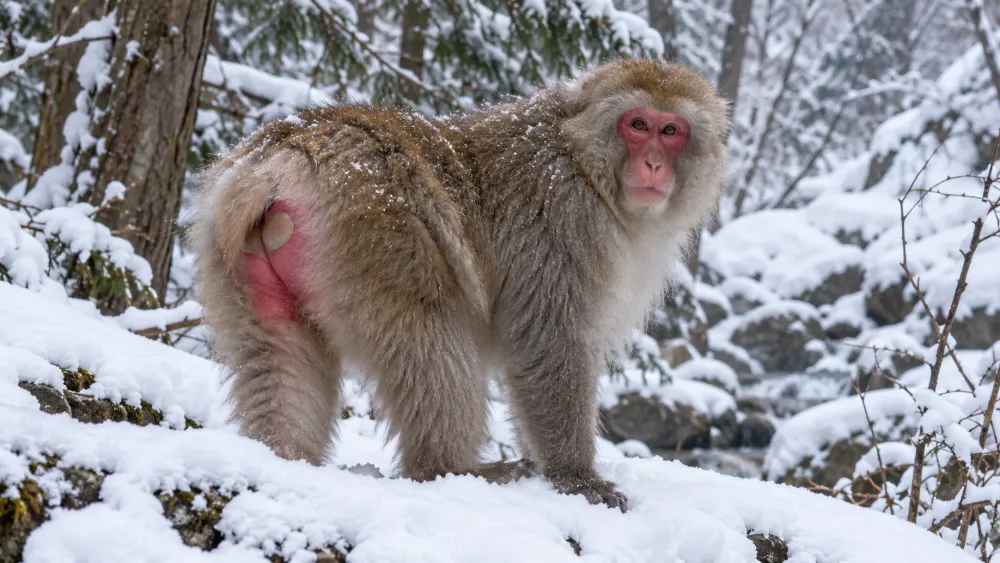
Japanese macaques have:
thick brown or grayish fur;
a nearly hairless pink-red face;
a short tail;
and pinkish-red bare skin around the posterior.
They are native to Japan and live farther north than any other nonhuman primate.
The contrast between their thick winter coat and bare red skin makes the coloration particularly obvious in snowy habitats.
Is the Japanese Macaque's Butt Always Red?
Japanese macaques naturally have colorful exposed skin on both the face and hindquarters.
The intensity can vary with the individual, age, blood flow and reproductive condition.
It should therefore not automatically be interpreted as an injury or skin irritation.
3. Drill
Scientific name: Mandrillus leucophaeus
The drill may be an even more literal “red-rumped monkey.”
Adult drills have bright red skin on the rump.
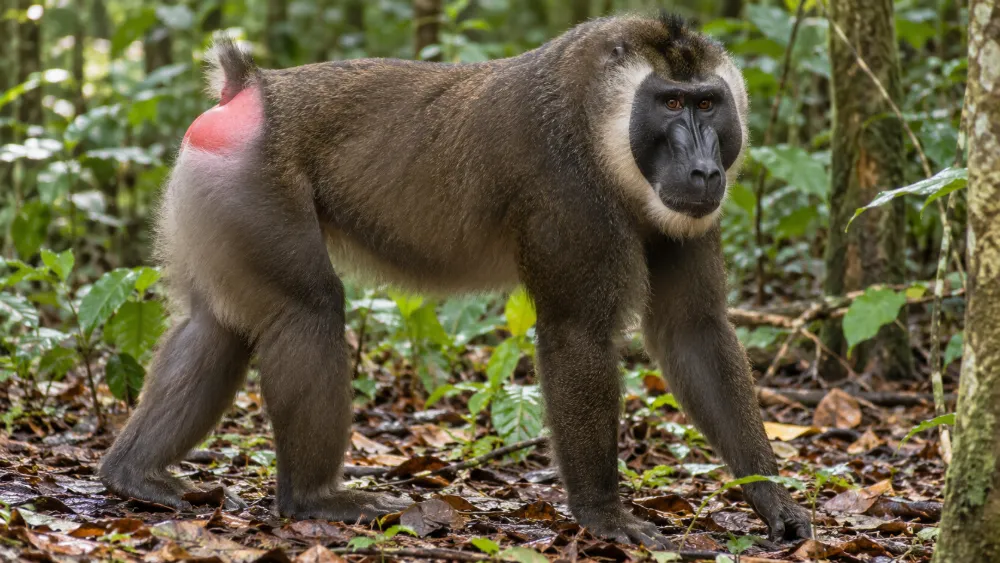
The red coloration is associated with a dense supply of blood vessels in the skin.
Adult males tend to show the coloration more strongly than females and juveniles.
Male drills may also show blue or violet coloration around the genital area.
Drills live in a relatively small region of Central and West Africa, including parts of:
Cameroon;
Nigeria;
and Equatorial Guinea's Bioko Island.
Is a Drill the Same as a Mandrill?
No.
They are close relatives in the genus Mandrillus, but they are different species.
The drill is Mandrillus leucophaeus.
The mandrill is Mandrillus sphinx.
Drills have much darker faces and lack the spectacular red-and-blue facial coloration of adult male mandrills.
But their rumps can be strikingly red.
4. Mandrill
Scientific name: Mandrillus sphinx
Mandrills are frequently included in internet pictures of “monkeys with red butts,” but their coloration deserves a closer look.
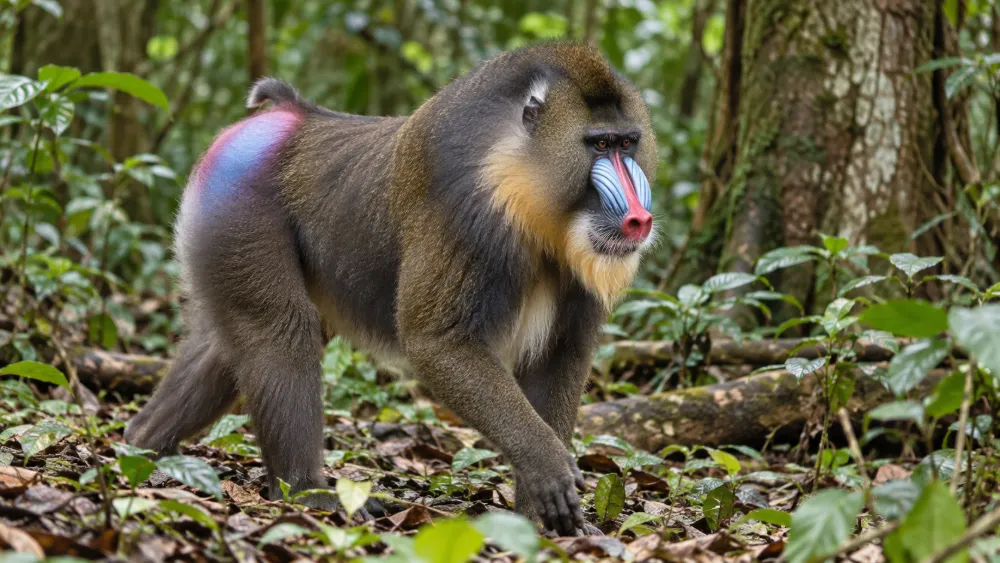
An adult male mandrill has one of the most colorful faces of any mammal:
a bright red stripe down the center of the muzzle;
blue ridges on either side;
a yellowish beard;
and highly colorful exposed skin.
The naked rump itself is often described as blue to purple rather than simply red.
So if the animal has a red-and-blue face and a blue-purple backside, it is much more likely to be a mandrill than a baboon.
Is a Mandrill a Baboon?
No.
Mandrills were historically grouped with baboons in some older classifications, which is one reason the names are still confused.
Modern taxonomy places mandrills in the genus Mandrillus and baboons in the genus Papio.
Both belong to the Old World monkey family Cercopithecidae, but they are not the same animal.
Which Monkey Has the Reddest Butt?
There is no scientific competition for the “reddest monkey,” but several species stand out visually.
| Monkey | Typical Rump Color | Best Identification Clue |
|---|---|---|
| Hamadryas baboon | Pink to bright red | Male has large silver mantle |
| Japanese macaque | Pinkish red | Red face, thick brown-gray fur |
| Drill | Bright red | Dark face and short tail |
| Mandrill | Blue to purple, with other bright colors | Red-and-blue face |
| Other baboons | Pink, red or dark depending on species and sex | Long muzzle and large sitting pads |
What Are the Hard Pads on a Baboon's Butt?
Those pads are called ischial callosities.
They are thickened areas of skin over the bones of the pelvis.
Many Old World monkeys have them.
They provide a durable sitting surface, which is useful for animals that spend considerable time:
sitting on branches;
resting on rocks;
feeding on the ground;
and grooming troop members.
They are normal anatomy—not scars caused by sitting too much.
Does a Monkey's Red Butt Hurt?
Normally, no.
A naturally pink or red rump is not the same as inflammation or an injury.
The skin is naturally exposed and often highly vascularized.
Likewise, reproductive swelling is a normal physiological process in species that develop it.
Wildlife should still never be diagnosed by color alone, especially if there is obvious bleeding, wounds or abnormal behavior.
Why Would Evolution Make a Monkey's Butt So Colorful?
Bright skin can serve more than one function.
Depending on species, coloration may contribute to:
sexual signaling;
communication of reproductive status;
social signaling;
individual recognition;
or simply species-specific appearance.
The explanation is therefore different for different monkeys.
A female baboon's temporary sexual swelling should not be treated as biologically identical to the permanent pink-red posterior of a Japanese macaque or the colorful rump of an adult male mandrill.
Are Baboons Monkeys?
Yes.
Baboons are Old World monkeys.
They belong to the family Cercopithecidae, which also includes:
macaques;
mandrills;
drills;
vervet monkeys;
guenons;
and several other groups.
Baboons are not apes.
What About Chimpanzees?
Some chimpanzee females develop prominent sexual swellings, but chimpanzees are apes, not monkeys.
That distinction matters when identifying a “red-butt monkey.”
Apes include chimpanzees, bonobos, gorillas, orangutans and humans.
They belong to different evolutionary branches from monkeys.
FAQ
What monkey has a red butt?
Baboons are the most familiar answer, especially hamadryas baboons, which have pink to bright-red skin around the hindquarters. Japanese macaques and drills can also have conspicuously red or pink rumps.
Why are baboon butts red?
Baboons have naturally hairless skin around hardened sitting pads called ischial callosities. Blood flow and reproductive hormones can make this skin appear pink or red, and females of several species develop pronounced sexual swellings.
Does a red butt mean a baboon is in heat?
Not necessarily. Some baboons naturally have pink or red hindquarters. Adult females may develop additional swelling and color changes near ovulation.
What monkey has a red face and red butt?
The Japanese macaque, or snow monkey, is a strong match because it naturally has pinkish-red bare skin on the face and posterior.
What monkey has a bright red butt and black face?
A drill is a likely possibility. Adult drills have dark faces and can have striking bright-red skin on the rump.
Do mandrills have red butts?
Mandrills have very colorful hindquarters, but the naked rump is often blue to purple. Adult males also have vivid red and blue facial coloration.
Are mandrills baboons?
No. Mandrills belong to the genus Mandrillus, while true baboons belong to Papio. Both are Old World monkeys.
What are the hard spots on a baboon's butt?
They are ischial callosities—thickened sitting pads over the pelvic bones that help the animal sit comfortably on hard surfaces.
Does a monkey's red butt hurt?
Normally no. Natural red or pink skin and reproductive swellings are normal biological features rather than injuries.
Are baboons actually monkeys?
Yes. Baboons are Old World monkeys in the family Cercopithecidae.
Final Answer
If you are trying to identify a monkey with a bright red or pink butt, a baboon is usually the first species group to consider.
Hamadryas baboons have particularly obvious pink to bright-red hindquarters, while female baboons of several species can develop large reproductive swellings that make the area even more conspicuous.
But baboons are not the only answer.
Japanese macaques naturally have pinkish-red faces and posterior skin, and drills can have a spectacular bright-red rump.
Mandrills are often included in the same discussion, although their naked rumps are usually more blue or purple, while the brightest red coloration appears on the face.
So “red-butt monkey” describes an appearance—not one single species.
Related Reading
Sources Used for Fact Checking
Animal Diversity Web — Papio (Baboons)
Animal Diversity Web — Hamadryas Baboon
Animal Diversity Web — Japanese Macaque
Animal Diversity Web — Drill
Animal Diversity Web — Mandrill