A scream coming from a dark forest can sound disturbingly human.
Mountain lions really are capable of producing loud, eerie vocalizations that people describe as a woman's scream, a child crying or someone in distress.
But cougars do not wander through the wilderness constantly screaming.
The best-known mountain lion scream—often called a caterwaul—is especially associated with reproductive and social communication.
Mountain lions also produce many quieter sounds, including chirps, whistles, growls, hisses, purrs and yowls.
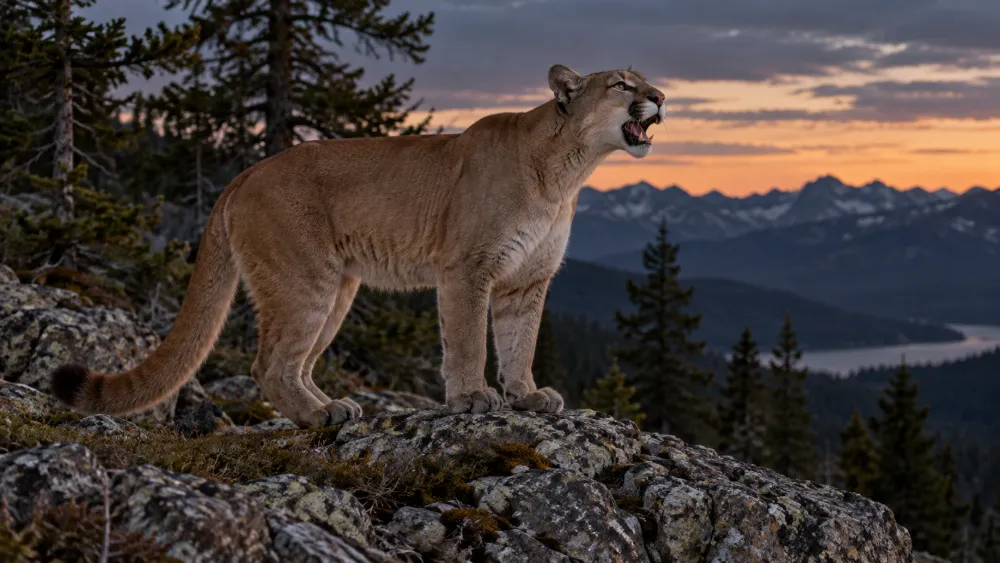
Why Do Mountain Lions Scream?
The famous mountain lion scream is most strongly associated with communication between adult cougars, especially during courtship and mating.
A receptive female may produce loud caterwauling calls that advertise her presence to nearby males.
Male and female cougars can also become highly vocal when interacting during mating.
Other vocalizations may occur during:
courtship;
territorial encounters;
defensive situations;
communication between mothers and kittens;
or close social interactions.
The meaning depends on the sound and the situation.
What Does a Mountain Lion Scream Sound Like?
People have compared a cougar caterwaul to:
a woman screaming;
a child crying;
a long wail;
a harsh yowl;
or a domestic cat call amplified to a frightening volume.
The sound may rise and fall in pitch and can carry across quiet terrain.
Hearing one unexpectedly at night can be alarming because the call contains frequencies and changes in pitch that resemble human distress sounds.
Do Female Mountain Lions Scream to Attract Males?
Yes.
One of the clearest functions of the classic cougar caterwaul is reproductive communication.
A female entering a receptive phase may vocalize loudly, helping nearby males locate her.
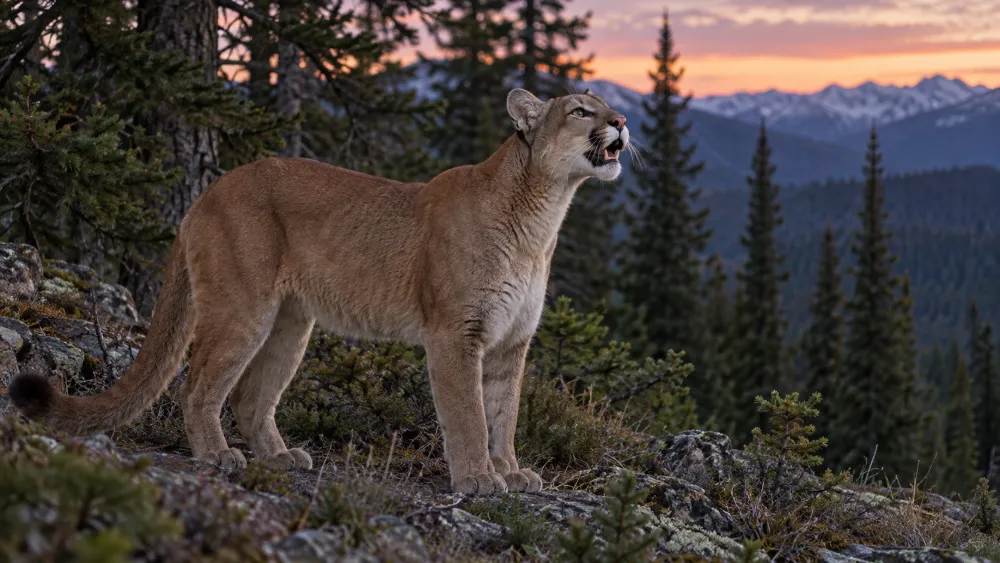
Mountain lions are normally solitary animals.
That creates a challenge when an adult is ready to mate: potential partners may be separated by many miles.
Vocal communication can therefore help animals that usually avoid one another make contact at the appropriate time.
Do Male Mountain Lions Scream Too?
Yes.
The scream is sometimes described as though it belongs exclusively to females, but male cougars are capable of loud vocalizations as well.
Observers have documented both males and females becoming highly vocal during mating encounters.
It is more accurate to say that the famous caterwaul is strongly associated with reproductive communication than to claim that only female cougars can produce it.
Do Mountain Lions Scream Before Attacking?
Not normally.
Mountain lions are ambush predators.
When hunting deer and other prey, remaining quiet provides an obvious advantage.
A loud scream before an attack would announce the predator's location and give potential prey an opportunity to escape.
For that reason, hearing a cougar scream should not automatically be interpreted as a sign that the animal is preparing to attack a person.
Do Mountain Lions Scream When Hunting?
Mountain lions generally hunt quietly.
They rely on:
stealth;
cover;
careful stalking;
short bursts of speed;
and a close-range ambush.
Loud vocalizations would be counterproductive during the final approach to prey.
The dramatic scream therefore belongs primarily to communication rather than normal hunting behavior.
Why Do Mountain Lions Scream at Night?
Cougars can vocalize at different times of day.
Nighttime calls simply attract more human attention because:
mountain lions are often active during low-light periods;
background noise is lower at night;
sound can be easier to notice across quiet landscapes;
and a human-like scream is especially memorable in darkness.
This does not mean mountain lions have a special biological need to scream only after sunset.
Do Mountain Lions Roar?
No.
Mountain lions do not produce the deep roaring vocalization associated with lions, tigers, jaguars and leopards.
Instead, their vocal repertoire is more similar in some ways to smaller cats.
Mountain lions can:
purr;
hiss;
growl;
chirp;
whistle;
yowl;
and caterwaul.
The fact that a cougar cannot roar certainly does not mean it is quiet.
What Other Sounds Do Mountain Lions Make?
| Sound | Possible Context |
|---|---|
| Caterwaul / scream | Often associated with mating communication |
| Growl | Threat, conflict or defensive warning |
| Hiss | Defensive or aggressive interaction |
| Chirp | Social communication |
| Whistle | Communication between cougars, including mothers and young |
| Purr | Close social or relaxed contexts |
Do Cougar Kittens Make Sounds?
Yes.
Young cougars use vocal communication with their mother.
They can produce:
chirps;
whistles;
mews;
and other quiet calls.
These softer sounds are much more typical of close mother-kitten communication than the dramatic scream that has made adult cougars famous.
Why Are Mountain Lions So Quiet Most of the Time?
Mountain lions are solitary ambush predators.
Silence offers several advantages.
It helps them:
approach prey without detection;
avoid unnecessary encounters with other large carnivores;
move through territory discreetly;
and remain difficult for both animals and people to detect.
For that reason, the famous scream is much less representative of everyday cougar behavior than movies and television might suggest.
Can a Mountain Lion Scream Sound Human?
Yes.
This is why mountain lion calls generate so many reports.
The combination of:
high intensity;
long wailing notes;
changing pitch;
and nighttime acoustics
can produce a sound that listeners interpret as a person screaming.
However, a human-like scream in the woods is not enough evidence to identify a cougar.
What Other Animals Sound Like a Screaming Woman?
Several animals can produce startling cries.
Possible sources include:
bobcats;
red foxes;
gray foxes;
some owls;
and domestic cats.
Some owl calls and juvenile owl vocalizations can sound especially unsettling when heard at close range after dark.
That means identifying wildlife from sound alone can be unreliable.
Mountain Lion vs. Bobcat Scream
Bobcats are much smaller than mountain lions, but they can produce extremely loud caterwauling sounds.
In fact, wildlife agencies warn that many reports of a supposed mountain lion scream are actually:
bobcats;
foxes;
or other wildlife.
A loud scream therefore should not be used as proof that mountain lions are present in an area.
Mountain Lion vs. Fox Scream
Red foxes are famous for high-pitched screams, particularly during social and reproductive interactions.
To an inexperienced listener, the sound can be shockingly human.
Because foxes commonly live near towns, farms and suburban areas, a nighttime scream near homes may be more likely to come from a fox than from a mountain lion in many regions.
Are Mountain Lion Screams Common?
No.
Mountain lions are capable of screaming, but loud caterwauling is not their constant everyday sound.
Missouri wildlife authorities describe mountain lions as animals that rarely make noise and note that the scream-like caterwaul is most strongly associated with breeding behavior.
Most people who live within cougar range will never hear a confirmed mountain lion scream.
Can You Hear a Cougar Without Seeing It?
Yes.
Mountain lions are extremely difficult to observe in the wild.
Their tawny coloration, quiet movement and preference for cover allow them to remain hidden even in places where they are regularly present.
A person may therefore occasionally hear a cougar without seeing the animal.
But because several other species produce similar sounds, visual or physical evidence is needed for confident identification.
What Should You Do If You Hear a Mountain Lion?
Simply hearing an unidentified call usually does not mean an animal is threatening you.
If you are in confirmed mountain lion habitat:
stay aware of your surroundings;
keep children close;
keep pets controlled;
do not approach wildlife or fresh carcasses;
and follow local wildlife-agency guidance.
If you actually encounter a mountain lion at close range, do not run.
Face the animal, remain upright, make yourself appear larger, back away slowly and give the cat an escape route.
Why Shouldn't You Run From a Mountain Lion?
Running can trigger pursuit behavior in a large predator.
National Park Service guidance recommends:
remaining upright;
facing the cougar;
making yourself look large;
keeping children close;
and backing away slowly.
If a mountain lion attacks, fight back rather than playing dead.
Mountain Lion, Cougar, Puma or Panther?
These names generally refer to the same species:
Puma concolor.
The animal has accumulated many regional names across its enormous range.
Common English names include:
mountain lion;
cougar;
puma;
catamount;
and, in some regional contexts, panther.
So a “cougar scream” and a “mountain lion scream” refer to vocalizations of the same species.
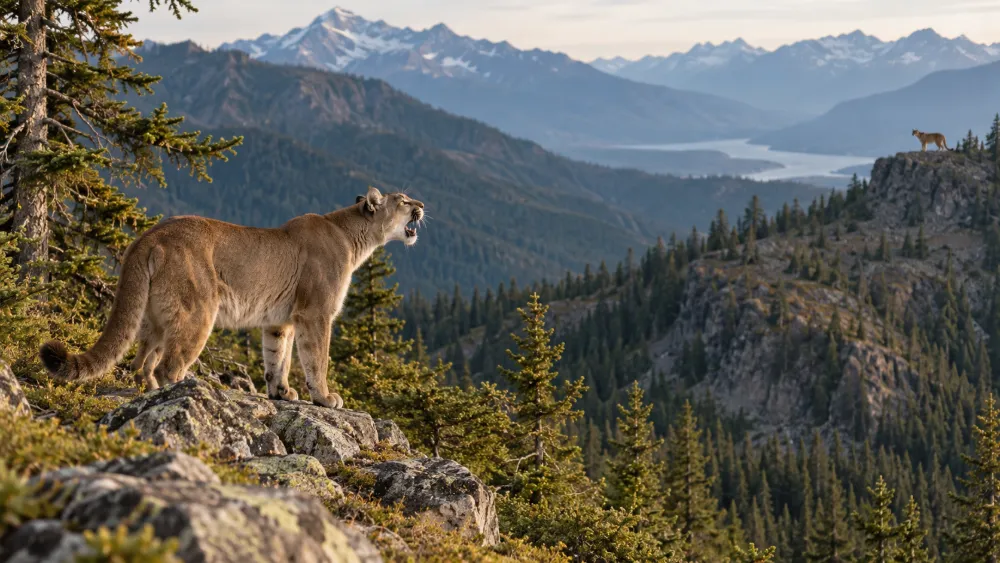
FAQ
Why do mountain lions scream?
The classic scream or caterwaul is strongly associated with social and reproductive communication, especially courtship and mating.
Do female mountain lions scream to attract males?
Yes. Receptive females can use loud caterwauling vocalizations that help advertise their presence to males.
Do male mountain lions scream?
Yes. Male cougars are capable of loud vocalizations, and both sexes can become highly vocal during mating encounters.
Do mountain lions scream before attacking?
Not normally. Mountain lions are stealthy ambush predators, so screaming before attacking prey would usually work against their hunting strategy.
Do mountain lions roar?
No. Mountain lions do not roar like lions or tigers. They can purr, hiss, growl, chirp, yowl and caterwaul.
What animal sounds like a woman screaming?
Mountain lions can produce a scream-like call, but bobcats, foxes, owls and domestic cats can also make surprisingly human-like cries.
Do mountain lions scream at night?
They can, but they are not restricted to nighttime vocalization. Night calls are simply more noticeable in quiet surroundings.
Are cougar screams common?
No. Cougars are generally quiet and secretive animals. Loud caterwauling is much less common than popular culture suggests.
Is a cougar the same as a mountain lion?
Yes. Cougar, mountain lion and puma are common names for Puma concolor.
What should I do if I see a mountain lion?
Do not run. Face the animal, remain upright, make yourself appear larger, back away slowly and follow local wildlife-agency guidance. If an attack occurs, fight back.
Final Answer
Mountain lions really can produce an eerie scream-like call, but the sound is primarily a form of communication rather than a hunting cry.
The famous caterwaul is especially associated with courtship and mating. Receptive females may use loud calls to advertise their presence, while both males and females can become vocal during mating interactions.
Cougars also hiss, growl, chirp, whistle, yowl and purr.
They do not roar like lions and tigers, and despite their Hollywood reputation, they are usually quiet, secretive predators.
Finally, hearing what sounds like a screaming woman in the woods does not prove a mountain lion is nearby. Bobcats, foxes and even some owls can produce surprisingly similar calls.
Sources Used for Fact Checking
U.S. National Park Service — Mountain Lions
California Department of Fish and Wildlife — Mountain Lion Biology & Ecology
Missouri Department of Conservation — Mountain Lion Signs and Sounds
Washington Department of Fish and Wildlife — Living with Wildlife: Cougars
Mountain Lion Foundation — Mountain Lion Biology and Vocalizations