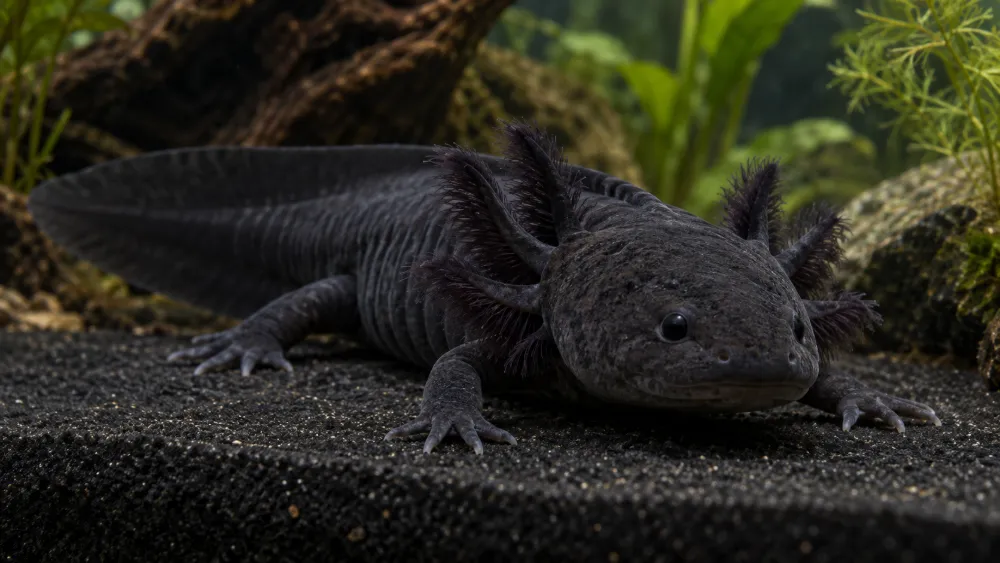
A black axolotl is usually not a different species of salamander.
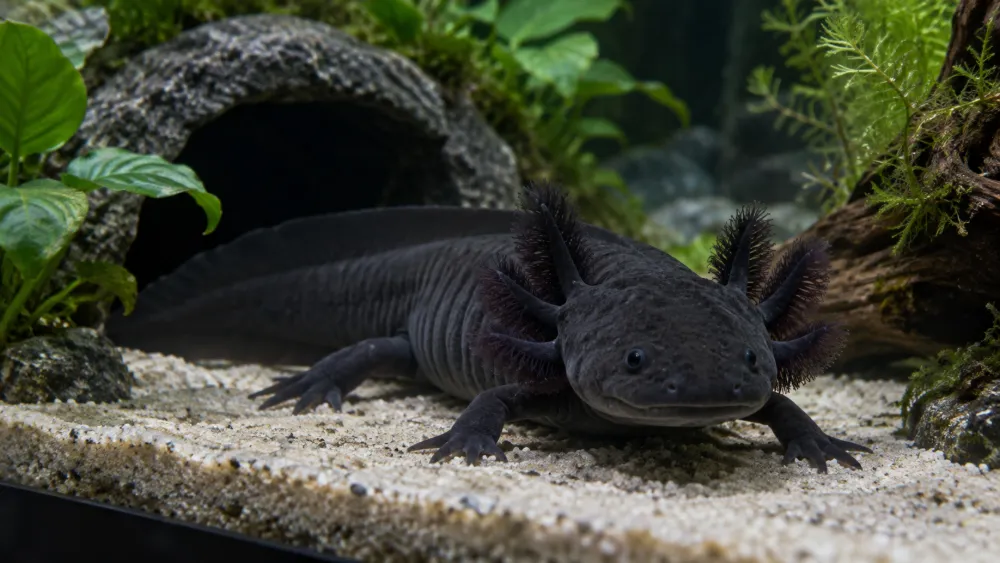
Most animals sold or described as “black axolotls” are melanoid axolotls, a dark pigmentation variant of the Mexican axolotl, Ambystoma mexicanum.
Melanoid axolotls develop unusually large numbers of dark pigment cells called melanophores, have proportionally fewer yellow xanthophores, and lack the reflective pigment cells known as iridophores.
The result is a much more uniform charcoal-gray, brown-black or nearly black animal than a normal wild-type axolotl.
They are genetically interesting, visually distinctive and common enough in captive breeding that “black axolotl” has become a familiar pet-trade search term.
What Is a Black Axolotl?
A black axolotl is usually a melanoid color morph of Ambystoma mexicanum.
It is still the same species as:
wild-type axolotls;
leucistic axolotls;
golden albino axolotls;
white albino axolotls;
and other captive pigmentation variants.
The word “melanoid” describes its pigmentation genetics rather than a separate species or subspecies.
Why Are Melanoid Axolotls Black?
Axolotl skin color is created largely by three types of pigment cells.
| Pigment Cell | Main Effect |
|---|---|
| Melanophores | Produce dark melanin pigmentation |
| Xanthophores | Contribute yellow pigmentation |
| Iridophores | Produce reflective, silvery or iridescent effects |
Wild-type axolotls contain all three.
Melanoid axolotls develop:
many melanophores;
fewer xanthophores;
and essentially no iridophores.
As the animal grows, dark melanophores spread through the skin and can mask much of the remaining yellow pigmentation.
This creates the characteristic uniform dark appearance.
Are Black Axolotls Completely Black?
Not always.
A melanoid axolotl may appear:
charcoal gray;
dark brown;
black-gray;
or nearly jet black.
Age, genetics, lighting and the presence of other pigmentation genes can all influence the final appearance.
Some individuals also show subtle lighter areas around the belly or gills.
“Black axolotl” is therefore a convenient common description rather than a guarantee that every scale of the animal appears pure black.
Melanoid Axolotl vs. Wild-Type Axolotl
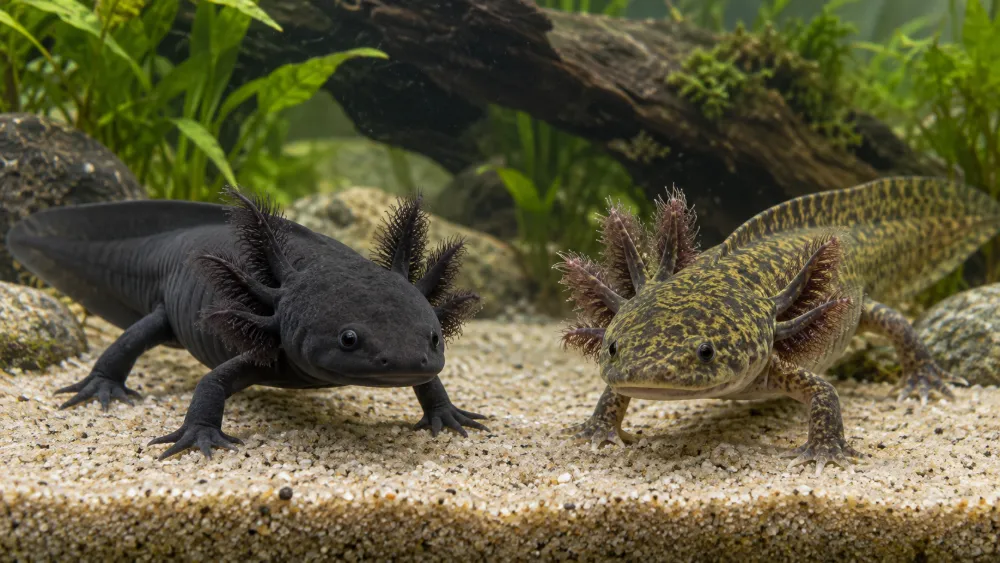
This is one of the most important distinctions.
A wild-type axolotl can also look very dark.
But wild-type animals usually have a more complex mottled appearance.
| Feature | Melanoid | Wild Type |
|---|---|---|
| Overall color | Uniform dark gray to black | Dark olive, brown or greenish mottling |
| Melanophores | Very abundant | Present |
| Xanthophores | Reduced proportionally | Present normally |
| Iridophores | Absent | Present |
| Metallic speckles | Usually absent | May be visible |
| Eye appearance | Very dark, lacking reflective iris ring | Dark with reflective iridophore contribution |
If a dark axolotl has noticeable golden or silvery speckles, it is more likely to be wild type than a true melanoid.
What Color Is a Wild Axolotl?
The natural wild-type coloration of Ambystoma mexicanum is generally dark and mottled.
Wild-type captive animals may appear:
olive green;
dark brown;
gray-brown;
or nearly black in some lighting.
Yellow and reflective pigment cells create the mottled, sometimes slightly metallic appearance that distinguishes wild type from melanoid.
This means a dark axolotl is not automatically melanoid.
What Causes the Melanoid Axolotl Morph?
Melanoid coloration is inherited genetically.
It has long been treated as a Mendelian pigmentation variant.
Modern genetic research has strongly implicated the gene Ltk — leukocyte tyrosine kinase as the key locus underlying the melanoid phenotype.
Ltk is involved in the development and fate of pigment cells.
When researchers disrupted Ltk experimentally, the resulting axolotls developed:
few or no iridophores;
more melanophores;
and dark pigmentation closely resembling naturally occurring melanoid axolotls.
Is the Melanoid Trait Recessive?
The classic melanoid phenotype behaves as a Mendelian recessive trait in laboratory breeding lines.
An axolotl may therefore carry a melanoid allele without visually appearing melanoid.
If appropriate carrier animals are bred together, melanoid offspring can appear.
However, captive axolotl color genetics can become complicated when several pigmentation mutations are combined in the same breeding line.
When Was the Melanoid Axolotl Discovered?
The melanoid color variant was first described in laboratory axolotl breeding stocks during the 1960s.
It emerged from breeding descendants of axolotls whose ancestry traced back to animals imported from Mexico.
Researchers have suggested that the variant may reflect naturally occurring genetic diversity rather than an entirely artificial pigmentation mutation created in captivity.
However, that does not mean black melanoid axolotls are known to be common in today's remaining wild population.
Are Black Axolotls Rare?
In captivity, melanoid axolotls are not exceptionally rare.
They are maintained by breeders and scientific colonies, and the Ambystoma Genetic Stock Center maintains melanoid research stocks.
In the wild, the situation is completely different.
Wild axolotls are highly threatened and restricted to a small native range around the Xochimilco wetland system of Mexico City.
There is not enough population-wide evidence to assign a meaningful “rarity percentage” specifically to black melanoid animals in nature.
So claims that black axolotls are “1 in 10,000” or another precise rarity figure should be treated cautiously.
Do Black Axolotls Have Black Eyes?
Melanoid axolotls generally have very dark eyes.
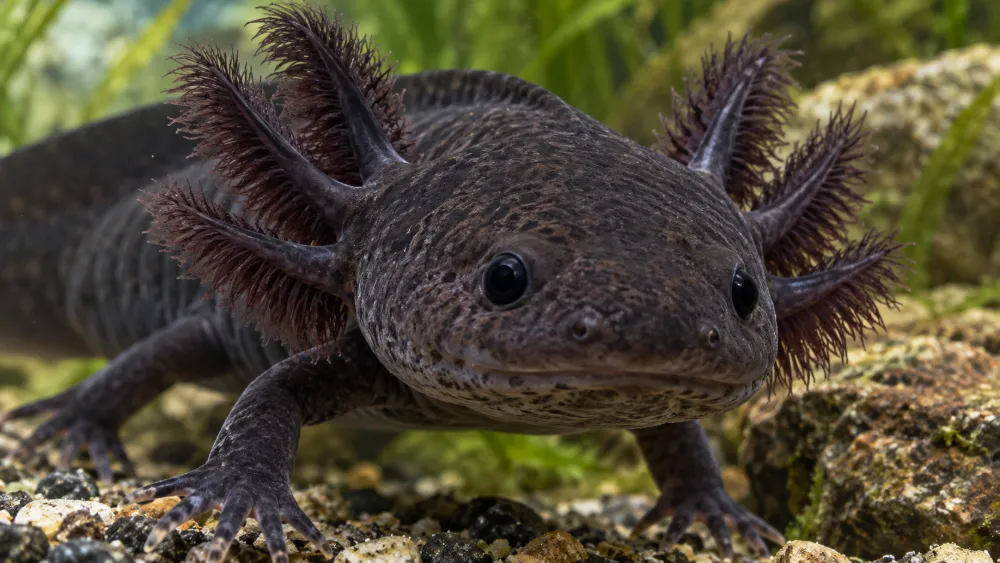
The lack of iridophores is important here.
Wild-type axolotls can show reflective pigment in the iris.
Melanoid animals lack those reflective cells, so the eyes appear darker and do not show the same metallic or golden ring.
This can be one of the useful clues when distinguishing a dark wild-type axolotl from a melanoid.
Do Black Axolotls Have Pink Gills?
They can, but gill appearance varies.
The feathery external gill filaments contain blood vessels, so reddish or purplish tones can be visible.
In very dark animals, the gill stalks and filaments may also carry significant dark pigmentation.
Gill color alone should therefore not be used to identify a melanoid morph.
Do Black Axolotls Glow?
Not because they are melanoid.
A normal melanoid axolotl does not naturally glow fluorescent green.
Some laboratory and captive axolotls carry transgenes such as GFP, or green fluorescent protein.
Those animals can fluoresce under appropriate lighting.
GFP status and melanoid coloration are separate traits, meaning an axolotl could potentially be both melanoid and GFP-positive if it inherited both characteristics.
Black Axolotl vs. Leucistic Axolotl
These morphs are almost visual opposites.
Melanoid:
dark gray to black body;
many melanophores;
no iridophores;
very dark eyes.
Leucistic:
white or pale pink body;
greatly reduced skin pigmentation;
dark eyes;
often pink-red external gills.
A leucistic axolotl is not the same as an albino.
Black Axolotl vs. Albino Axolotl
Albino axolotls cannot produce normal melanin.
They therefore lack the dark pigmentation that defines the melanoid morph.
Albino animals may be:
white;
cream;
yellow;
or golden.
The eyes are also pale or reddish rather than black.
Axolotl pigmentation mutations can also be combined genetically, creating more complicated phenotypes.
What Is a Golden Albino Axolotl?
A golden albino lacks melanin but retains yellow pigmentation.
This produces a yellow or golden body with pale or reddish eyes.
It demonstrates why pigment-cell genetics cannot be understood simply as “dark gene versus light gene.”
Different color morphs affect different pigment cells or biochemical pathways.
Black Axolotl vs. Blue Axolotl
“Blue axolotl” is often an informal color description rather than a universally defined single genetic morph.
Gray or melanoid axolotls can sometimes appear bluish under certain aquarium lighting, especially when dark pigmentation combines with cool-colored illumination.
Some captive lines may also have combinations of pigmentation traits that produce gray-blue appearances.
A naturally electric-blue axolotl like a tropical reef fish is not the normal appearance of Ambystoma mexicanum.
Do Black Axolotls Need Different Care?
No.
Melanoid coloration changes pigmentation, not the animal's fundamental husbandry needs.
A black axolotl requires the same core care as another healthy Ambystoma mexicanum.
The important factors include:
cool freshwater;
excellent water quality;
appropriate mineral balance;
suitable hiding places;
low-stress lighting;
and an appropriate carnivorous diet.
The Ambystoma Genetic Stock Center emphasizes that axolotl health is strongly dependent on water quality and temperature.
What Temperature Do Axolotls Need?
Axolotls are cool-water salamanders.
Research colonies generally maintain them at cool temperatures, commonly around the upper teens Celsius.
Extended exposure to excessive heat can cause stress and increase health risks.
The exact setup should be based on reliable axolotl husbandry guidance rather than tropical-fish aquarium recommendations.
What Do Black Axolotls Eat?
The melanoid morph does not require a special black-axolotl diet.
Axolotls are carnivorous.
In natural and captive contexts they consume or can be fed appropriate foods such as:
worms;
small aquatic invertebrates;
crustaceans;
and nutritionally appropriate axolotl or salamander pellets in managed care.
Diet should be selected according to the animal's size and husbandry conditions, not its color morph.
For a fuller discussion, see our Axolotl Diet Guide.
Can Black Axolotls Regenerate?
Yes.
The famous regenerative ability of axolotls is a species-level biological trait, not something limited to one color.
Melanoid axolotls can regenerate damaged tissues just like other Ambystoma mexicanum color variants.
Axolotls are studied extensively because they can regenerate structures including:
limbs;
tail tissues;
parts of the spinal cord;
and several other complex tissues.
This ability is one of the reasons axolotls are such important laboratory animals.
Are Black Axolotls a Different Species?
No.
A black melanoid axolotl is still:
Ambystoma mexicanum.
Color morphs do not create separate species.
A melanoid, leucistic, albino and wild-type axolotl can all belong to the same species despite looking dramatically different.
Are Black Axolotls Found in the Wild?
Dark wild-type axolotls are the natural form of the species.
The melanoid mutation itself originated from axolotl breeding material whose ancestry traces to Mexico and may represent naturally occurring variation.
However, it is safest not to claim that uniform black melanoids are common in today's wild population.
Wild axolotls are now restricted to a tiny native range, and captive color-morph abundance tells us very little about how frequently those mutations occur in nature.
Why Are Axolotls So Endangered in the Wild?
Wild axolotl populations have suffered from major changes to their native aquatic environment around Mexico City.
Threats include:
habitat degradation;
water-quality problems;
urbanization;
and introduced fish.
The abundance of colorful captive axolotls should therefore not be confused with the conservation status of the species in its natural habitat.
FAQ
What is a black axolotl called?
Most uniformly black captive axolotls are called melanoid axolotls.
Are black axolotls a separate species?
No. They are color variants of the Mexican axolotl, Ambystoma mexicanum.
What makes an axolotl black?
Melanoid axolotls have increased numbers of dark melanophores, fewer yellow xanthophores and no reflective iridophores.
What gene causes melanoid axolotls?
Modern genetic research strongly implicates the Ltk gene, which plays an important role in pigment-cell development.
Are black axolotls rare?
Melanoid axolotls are well established in captive breeding and research colonies, so they are not exceptionally rare in captivity. Their frequency in the remaining wild population is not well established.
How can you tell a melanoid from a wild-type axolotl?
Melanoids tend to be more uniformly dark and lack the reflective gold or silver iridophore speckles often visible in wild-type animals.
Do black axolotls have black eyes?
Melanoid axolotls generally have very dark eyes and lack the reflective iris pigmentation seen in wild-type animals.
Do black axolotls glow?
Not naturally because of the melanoid trait. Fluorescent axolotls carry separate transgenes such as GFP.
Do black axolotls need special care?
No. Their basic husbandry requirements are the same as other Mexican axolotls, including cool clean freshwater and appropriate feeding.
Is a black axolotl the same as a wild-type axolotl?
No. Wild-type animals contain melanophores, xanthophores and reflective iridophores, while melanoids have many melanophores, fewer xanthophores and no iridophores.
Can black axolotls regenerate limbs?
Yes. Regeneration is a species-level characteristic of axolotls and is not lost simply because an animal has the melanoid color morph.
Final Answer
A black axolotl is usually a melanoid axolotl—a dark pigmentation morph of the Mexican axolotl, Ambystoma mexicanum.
Melanoids contain unusually large numbers of black melanophores, fewer yellow xanthophores and essentially no reflective iridophores.
This makes them more uniformly charcoal-gray or black than wild-type axolotls, which usually show mottled olive-brown coloration and reflective speckles.
Modern genetic research strongly links the melanoid phenotype to Ltk, a gene involved in pigment-cell development.
Despite their unusual appearance, black axolotls are not a separate species and do not require a unique diet or aquarium simply because of their color.
The simplest rule is: melanoid describes pigmentation; axolotl describes the animal.
Related Reading
Sources Used for Fact Checking
Ambystoma Genetic Stock Center, University of Kentucky — Axolotl Strains
Ambystoma Genetic Stock Center — Mutant Genes
Voss et al. — Leukocyte Tyrosine Kinase Is the Mendelian Determinant of the Axolotl Melanoid Color Variant
Ambystoma Genetic Stock Center — Axolotl Husbandry Guide