A nutria can look like an oversized rat that learned how to swim, but it is not actually a rat.
Nutria, or Myocastor coypus, are large semi-aquatic rodents native to South America.
They are also called coypu and are sometimes nicknamed “river rats,” “swamp rats” or “giant rats” because of their long, round tails and rodent-like appearance.
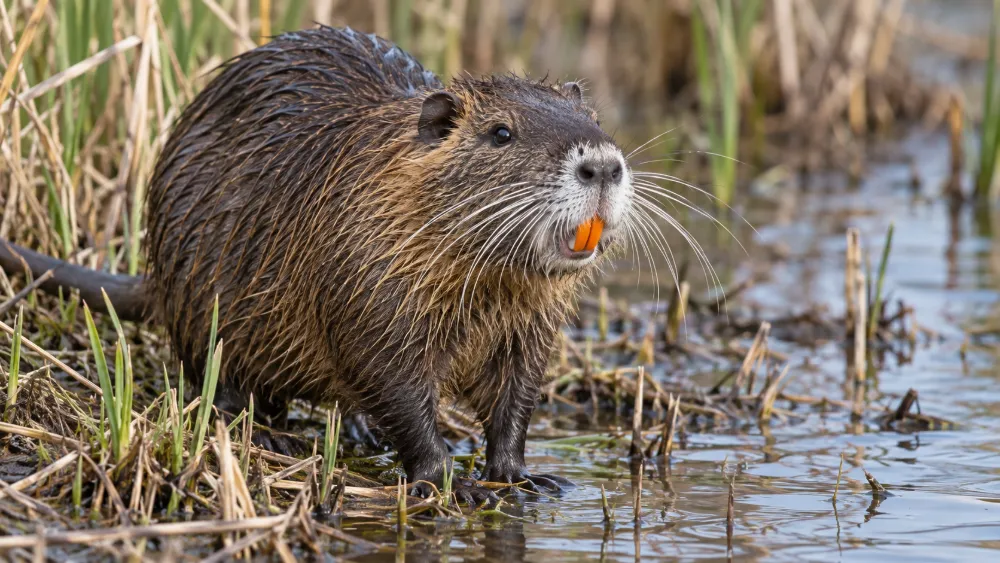
Adults commonly weigh about 15 to 20 pounds (7–9 kg), have bright orange front teeth, long white whiskers and partially webbed hind feet.
Nutria have been introduced to many parts of the world, and in the United States they are considered an invasive species because their feeding and burrowing can severely damage wetlands, agricultural land and water-control structures.
Nutria Quick Facts
| Feature | Nutria |
|---|---|
| Scientific name | Myocastor coypus |
| Other names | Coypu, river rat, swamp rat |
| Animal group | Rodent |
| Native range | South America |
| Typical adult weight | 15–20 lb (7–9 kg) |
| Body length | About 2 ft (60 cm), excluding tail |
| Tail | About 1–1.5 ft, long and round |
| Diet | Mainly aquatic and wetland plants |
| Lifestyle | Semi-aquatic |
What Is a Nutria?
A nutria is a large rodent specialized for life around water.
It belongs to the order Rodentia, the same broad mammal group that includes:
rats;
mice;
beavers;
porcupines;
and squirrels.
However, a nutria is not a true rat.
Its scientific name is Myocastor coypus, and “coypu” is another widely used common name for the same animal.
Why Are Nutria Called River Rats?
The nickname comes mainly from appearance.
Nutria have:
a bulky rodent body;
a long, rounded tail;
prominent front teeth;
and a habit of living around rivers, marshes and canals.
From a distance, the tail can make them look like enormous swimming rats.
But “river rat” is only a nickname and should not be confused with their biological classification.
How Big Is a Nutria?
Adult nutria commonly weigh approximately 15 to 20 pounds.
The body itself may reach about 2 feet long, with another 12 to 18 inches of tail.
This makes a nutria:
much larger than a typical rat;
several times heavier than a muskrat;
but usually considerably smaller than an adult beaver.
Very large individuals can exceed the typical 15-to-20-pound range.
Why Do Nutria Have Orange Teeth?
One of the easiest ways to recognize a nutria is by its bright orange-yellow incisors.
Like other rodents, nutria have continuously growing front teeth.
Rodent incisors contain specialized iron-rich enamel on the front surface that helps resist wear.
Recent microscopic research on rodents—including coypu—has shown that this enamel contains iron-rich structures that increase resistance to acid and mechanical damage.
The familiar orange-brown appearance is associated with the specialized surface layers of the incisor.
Orange teeth in an adult nutria are therefore normal, not a sign that the animal has dirty or diseased teeth.
How Can You Identify a Nutria?
Look for a combination of five features:
large orange incisors;
long white whiskers;
a white or pale muzzle;
a long round tail;
and partially webbed hind feet.
The white whiskers and round tail are especially useful when separating a nutria from a beaver or muskrat.
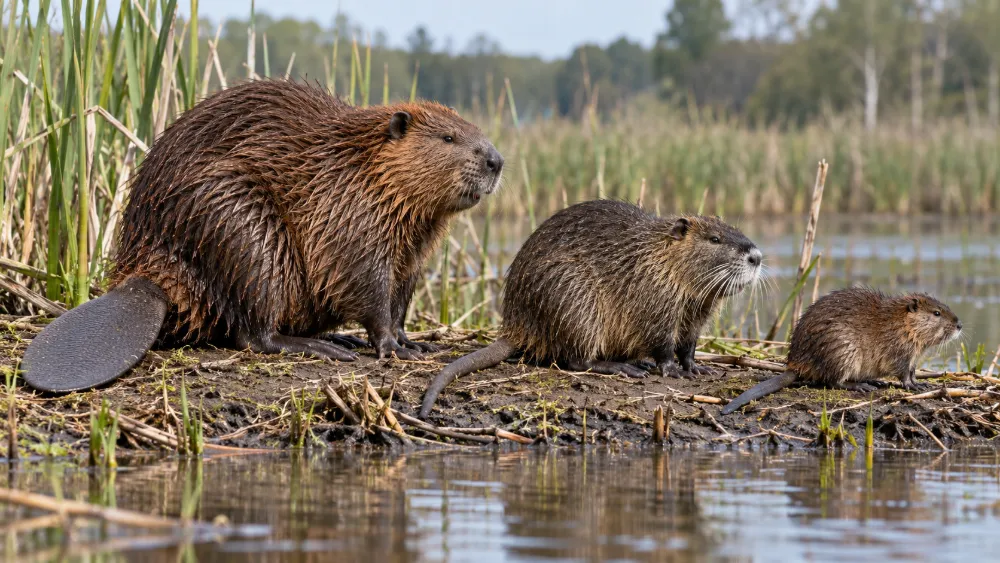
Nutria vs. Beaver
| Feature | Nutria | Beaver |
|---|---|---|
| Typical adult weight | 15–20 lb | Often 45 lb or more |
| Tail | Long, round and rat-like | Broad and flattened like a paddle |
| Whiskers | Long and conspicuously white | Darker |
| Front teeth | Bright orange | Also orange, but tail is diagnostic |
| Swimming profile | Round tail often trails behind | Broad flat tail |
The tail is usually the quickest clue.
If the animal has a broad, paddle-shaped tail, it is a beaver.
If it has a long cylindrical rat-like tail, nutria becomes much more likely.
Nutria vs. Muskrat
Muskrats can also be confusing because they are brown, aquatic rodents with long tails.
But muskrats are much smaller.
An adult muskrat may weigh only a few pounds, while an adult nutria commonly weighs 15 to 20 pounds.
Muskrats also have a tail that is flattened from side to side.
Nutria tails are round in cross section.
Another useful clue is the whiskers:
nutria have conspicuous white whiskers, while muskrat whiskers are dark.
Nutria vs. Capybara
Both animals are large South American rodents associated with water, but they are easy to separate.
Capybaras are dramatically larger and can weigh well over 100 pounds.
They have:
almost no visible external tail;
a very large barrel-shaped body;
a broad blunt head;
and long legs compared with a nutria.
Nutria are smaller and have an obvious long tail.
Where Are Nutria From?
Nutria are native to South America.
Their original range extends through portions of countries including:
Bolivia;
Brazil;
Chile;
Paraguay;
and Uruguay.
They naturally inhabit wetlands, lakes, slow-moving rivers and marshes.
How Did Nutria Get to the United States?
Nutria were brought to North America primarily for the fur industry beginning in the late 1800s and early 1900s.
Animals escaped from farms or were intentionally released when the fur industry declined.
Once free, nutria found suitable wetland habitats and established reproducing populations in multiple regions.
Today they are considered invasive wildlife in the United States.
Where Do Nutria Live in the United States?
Nutria are especially associated with wetland regions in:
the Gulf Coast;
parts of the southeastern United States;
the Atlantic region;
and parts of the Pacific coast.
USDA currently reports established nutria populations in multiple U.S. states.
Their exact distribution changes as eradication and control programs remove populations in some areas while others expand.
What Do Nutria Eat?
Nutria are primarily herbivorous.
They consume:
leaves;
stems;
roots;
rhizomes;
tubers;
and other aquatic vegetation.
Favorite wetland plants can include cattails, bulrushes and cordgrasses.
They may also feed on agricultural crops when farms occur near waterways.
Why Do Nutria Damage Wetlands?
The problem is not simply that nutria eat leaves.
They frequently dig up and consume the roots, rhizomes and tubers of marsh plants.
This can remove the underground structures needed for the plant to grow back.
Heavy feeding can leave exposed mud where dense vegetation once stabilized the soil.
Repeated damage may contribute to:
erosion;
conversion of marsh to open water;
loss of wildlife habitat;
and reduced wetland stability.
Do Nutria Dig Burrows?
Yes.
Nutria frequently dig into banks beside:
rivers;
canals;
ditches;
ponds;
and levees.
USDA reports that nutria burrows can sometimes extend as far as 150 feet.
Extensive burrowing can weaken:
stream banks;
roads;
irrigation systems;
dikes;
reservoir structures;
and flood-control levees.
Can Nutria Swim?

Yes.
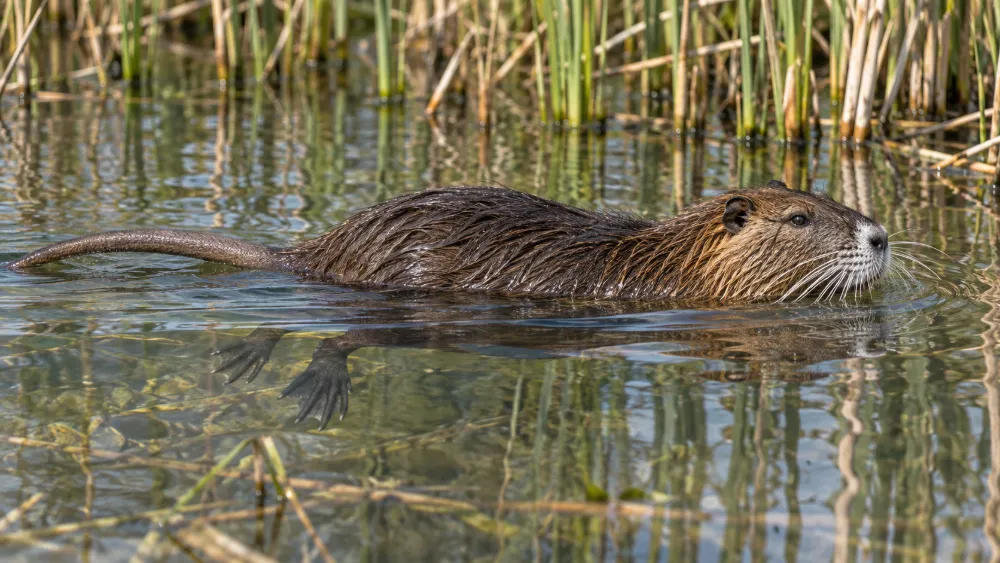
Nutria are highly adapted for swimming.
Their hind feet are partially webbed, while the eyes, ears and nostrils are positioned high on the head.
This arrangement allows much of the animal to remain underwater while the sensory organs stay above the surface.
Nutria can also dive and swim underwater when feeding or escaping danger.
Why Are Nutria Feet Webbed?
The webbing increases the surface area of the hind feet and makes them effective paddles.
An interesting detail is that not every toe is equally webbed.
The four inner toes of the hind foot are connected by webbing, while the outer fifth toe remains free.
This provides propulsion in water without completely sacrificing the ability to move on land.
Can Baby Nutria Nurse While Swimming?
Yes, and this is one of their most unusual aquatic adaptations.
Female nutria have mammary glands positioned unusually high along the sides of the body.
This allows young nutria to nurse while the mother is floating or partly submerged.
It is an excellent example of how strongly the species is adapted to a semi-aquatic life.
How Fast Do Nutria Reproduce?
Very quickly.
This is one reason invasive populations can be difficult to control.
Females may reach sexual maturity at only about 4 to 6 months of age.
They can breed throughout the year and may produce up to three litters per year.
A litter may contain roughly 2 to 13 young.
That means a small introduced population can expand quickly when food, habitat and climate are favorable.
Are Nutria Rats?
No.
Nutria and true rats are both rodents, but they belong to different evolutionary groups.
Calling a nutria a “giant rat” is similar to calling a beaver a giant rat: they share the rodent body plan and continuously growing incisors, but they are distinct animals.
Are Nutria Dangerous to Humans?
Nutria normally try to escape rather than confront people.
However, they are wild animals with large incisors and can bite if cornered or handled.
People should not attempt to catch one by hand.
Nutria can also carry pathogens and parasites that may affect wildlife, domestic animals and people.
That is another reason to avoid direct contact with live animals, carcasses, feces or contaminated water.
Are Nutria Aggressive?
They are not normally predators of humans or pets.
But a trapped, injured or cornered nutria may defend itself using its teeth.
A 15-to-20-pound rodent with large incisors can cause a serious wound.
Give the animal space and contact local wildlife authorities if removal is necessary.
Why Are Nutria an Invasive Species?
An invasive species is an introduced organism that establishes populations and causes ecological, economic or other harm.
Nutria meet that definition in many parts of the United States because they:
destroy wetland vegetation;
damage agricultural crops;
dig into banks and levees;
increase erosion;
and alter habitat used by native wildlife.
The U.S. Fish and Wildlife Service has documented major marsh damage caused by nutria, including historically severe impacts around Chesapeake Bay wetlands.
Can Nutria Be Pets?
Nutria are wild semi-aquatic rodents, not domesticated pets.
They become large, have strong continuously growing teeth and require aquatic habitat.
Ownership may also be restricted or prohibited because of their invasive status.
Anyone considering possession of an exotic or invasive animal should check local wildlife laws first.
What Should You Do If You See a Nutria?
If nutria are invasive or under eradication in your area:
Do not approach or feed the animal.
Photograph it from a safe distance if possible.
Include the tail, whiskers and feet in photographs.
Record the location.
Report the sighting to the appropriate state wildlife or invasive-species agency.
Do not assume that an animal is nutria solely because it is a brown rodent swimming in water.
Native beavers, muskrats and river otters can sometimes be mistaken for nutria.
FAQ
What is a nutria?
A nutria is a large semi-aquatic South American rodent, Myocastor coypus. It is also known as a coypu and is invasive in parts of North America, Europe and Asia.
Is a nutria a giant rat?
No. Nutria are rodents but are not true rats. “River rat” and “giant rat” are informal nicknames based on their appearance.
Why do nutria have orange teeth?
Their continuously growing incisors contain specialized iron-rich enamel and surface structures. Orange-yellow incisors are normal in healthy nutria.
How big do nutria get?
Adults commonly weigh about 15 to 20 pounds, with a body around 2 feet long plus a tail approximately 1 to 1.5 feet long.
How can you tell a nutria from a beaver?
Look at the tail. Nutria have a long round rat-like tail, while beavers have a broad, flat paddle-shaped tail. Nutria also have very obvious white whiskers.
How can you tell a nutria from a muskrat?
Nutria are much larger and have a round tail and white whiskers. Muskrats are smaller with a narrow tail flattened from side to side.
What do nutria eat?
They mainly eat vegetation, especially stems, roots, rhizomes and tubers of wetland plants.
Why are nutria bad for wetlands?
They often uproot and eat underground plant structures, which can prevent vegetation from regrowing and contribute to erosion and marsh loss.
Can nutria swim?
Yes. They are excellent swimmers with partially webbed hind feet and several other adaptations for semi-aquatic life.
Are nutria dangerous?
They usually avoid people but can bite if cornered. They can also carry pathogens and parasites, so wild nutria should not be handled.
Do nutria reproduce quickly?
Yes. Females can mature within months, breed year-round and may produce several litters annually.
Are nutria invasive in the United States?
Yes. Nutria are invasive in the U.S. and have established populations in multiple states, where control and eradication programs are used to protect wetlands and infrastructure.
Final Answer
Nutria are large semi-aquatic rodents from South America—not giant rats.
They are easy to recognize once you know the key features: bright orange incisors, long white whiskers, partially webbed hind feet and a long round tail that looks much more like a rat's tail than a beaver's paddle.
Nutria are impressive aquatic animals, but outside their native range they can become highly destructive.
They dig into riverbanks and levees and feed not only on marsh leaves but also on the roots, rhizomes and tubers that hold wetland vegetation together.
Combined with rapid reproduction, this feeding behavior has made Myocastor coypus one of the most troublesome invasive wetland mammals in parts of the United States.
Related Reading
Sources Used for Fact Checking
USDA APHIS Wildlife Services — Nutria
California Department of Fish and Wildlife — Nutria Identification and Biology
U.S. Fish and Wildlife Service — Nutria and Wetland Damage
Animal Diversity Web — Myocastor coypus
ACS Nano — Rodent Incisor Enamel Structure and Coloration