Brown birds can be surprisingly difficult to identify.
Many common North American birds are some combination of brown, tan, gray and rust, especially females and juveniles.
The fastest way to identify one is not to focus on “brown” alone.
Instead, look at five things:
body size;
breast pattern;
bill shape;
tail shape;
and habitat or behavior.
This guide covers 12 common brown birds you may see around yards, feeders, woods, fields and wetlands across North America.
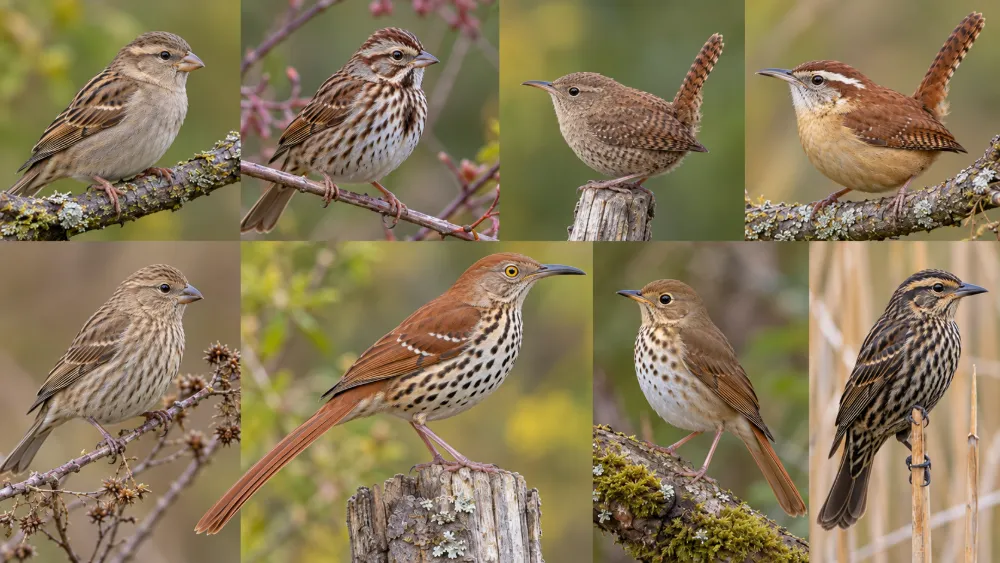
Quick Brown Bird Identification Chart
| Bird | Best Identification Clue | Typical Place to See It |
|---|---|---|
| Female House Sparrow | Plain buffy brown, pale eyebrow, stout bill | Yards, cities, feeders |
| Song Sparrow | Heavy brown breast streaks, often central spot | Brush, marsh edges, yards |
| Northern House Wren | Tiny plain brown bird with barred tail | Backyards, shrubs, nest boxes |
| Carolina Wren | Bold white eyebrow, rusty-brown back | Wooded yards and brush |
| Brown Thrasher | Large, long-tailed, yellow eye, streaked breast | Dense shrubs and thickets |
| Female House Finch | Blurry streaks, thick seed-eating bill | Feeders and neighborhoods |
| Female Red-winged Blackbird | Heavy crisp streaking, larger than a sparrow | Marshes and fields |
| Female Brown-headed Cowbird | Plain brown, short tail, thick pointed bill | Fields, lawns, livestock areas |
| Hermit Thrush | Brown body, reddish tail, spotted breast | Woodland floor |
| Brown Creeper | Mottled bark-like back, climbs tree trunks | Mature woodland |
| American Tree Sparrow | Rusty cap, breast spot, unstreaked belly | Winter fields and feeders |
| Eastern Phoebe | Brownish-gray, pale belly, constantly pumps tail | Yards, barns, bridges |
1. Female House Sparrow
Scientific name: Passer domesticus
Female House Sparrows are among the most common unidentified brown birds around homes and businesses.
Look for:
a stocky body;
a thick seed-eating bill;
plain buffy-brown coloration;
a broad pale eyebrow;
and a back striped with brown, black and tan.
The underparts are relatively plain rather than heavily streaked.
That is useful when separating a female House Sparrow from a female House Finch.
House Sparrows are especially common around:
parking lots;
shopping areas;
farms;
suburbs;
and bird feeders.
2. Song Sparrow
Scientific name: Melospiza melodia
If your brown bird has obvious dark streaking across a pale breast, check for a Song Sparrow.
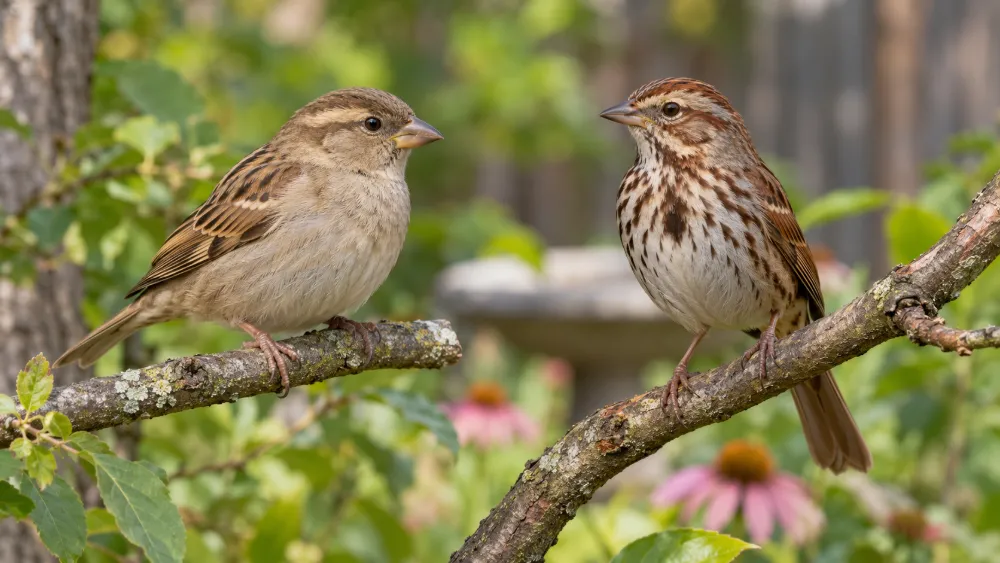
Typical identification clues include:
brown and gray head pattern;
heavy brown streaks on the chest and flanks;
streaks that often converge into a dark central breast spot;
and a relatively long, rounded tail.
Song Sparrows are extremely variable across North America, so not every bird looks identical.
They commonly occur in brushy habitat, marsh edges, backyards and overgrown fields.
3. Northern House Wren
Scientific name: Troglodytes aedon
The Northern House Wren is one of the classic “little brown birds.”
It is small, compact and relatively plain.
Look for:
brown overall plumage;
a thin bill;
dark barring on the wings and tail;
a relatively weak eyebrow stripe;
and a tail frequently held upward.
House Wrens often move rapidly through shrubs, low branches, fences and backyard vegetation.
Their loud bubbling song is often easier to notice than the bird itself.
4. Carolina Wren
Scientific name: Thryothorus ludovicianus
Carolina Wrens are warmer and more colorful than House Wrens.
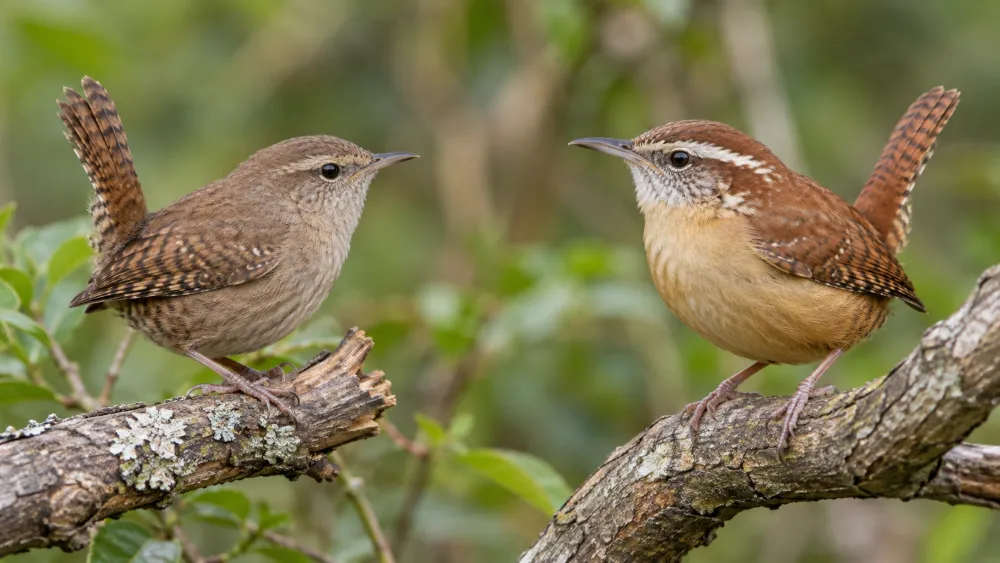
The easiest clue is the bold white eyebrow stripe.
Also look for:
rich reddish-brown upperparts;
warm buffy-orange underparts;
white throat;
a long thin slightly downcurved bill;
and a frequently cocked tail.
Carolina Wrens are common in dense vegetation, brush piles, wooded neighborhoods and tangled yards across much of the eastern United States.
5. Brown Thrasher
Scientific name: Toxostoma rufum
A Brown Thrasher is much larger than most brown sparrows and wrens.
Its combination of features is distinctive:
bright reddish-brown upperparts;
very long tail;
long slightly curved bill;
bright yellow eyes;
and bold dark streaks across whitish underparts.
The wings also show black-and-white wingbars.
Brown Thrashers often remain partly hidden in dense vegetation and scratch through leaf litter on the ground.
6. Female House Finch
Scientific name: Haemorhous mexicanus
Male House Finches are well known for their red heads and chests.
Females are completely different.
They are plain grayish brown with:
heavy but blurry streaking on the underparts;
a thick conical bill;
a relatively plain face;
and a slightly notched tail.
Female House Finches frequently visit feeders and can easily be mistaken for sparrows.
One useful distinction is that House Finch streaks often look more diffuse than the sharper breast pattern of many sparrows.
7. Female Red-winged Blackbird
Scientific name: Agelaius phoeniceus
Female Red-winged Blackbirds look so different from the black-and-red males that beginners often assume they belong to another species.
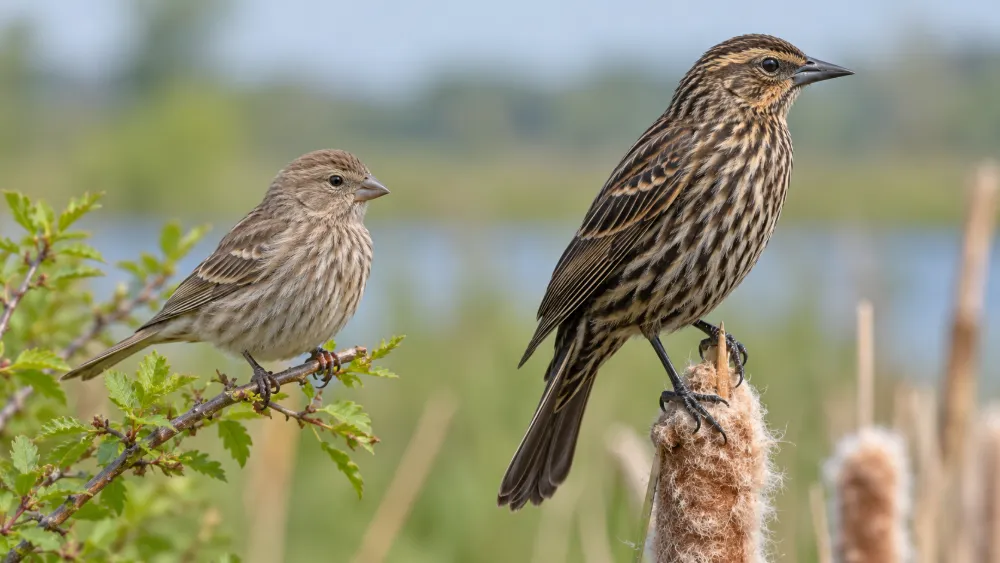
Females are:
dark brown;
heavily and crisply streaked;
larger and more robust than most sparrows;
and equipped with a relatively long, pointed bill.
They often show a pale eyebrow and sometimes yellowish coloration around the face.
Habitat provides another major clue.
If the streaky brown bird is moving through cattails or wetland vegetation, a female Red-winged Blackbird should be high on the list.
8. Female Brown-headed Cowbird
Scientific name: Molothrus ater
Male Brown-headed Cowbirds have black bodies with brown heads.
Females are much less obvious.
They are mostly plain brown with:
a stocky body;
a relatively short tail;
a thick, sharply pointed bill;
slightly paler head and underparts;
and only subtle streaking.
They often feed on lawns, fields and pastures with other blackbirds.
The plain plumage and short tail help separate them from heavily streaked female Red-winged Blackbirds.
9. Hermit Thrush
Scientific name: Catharus guttatus
A medium-sized brown bird hopping through woodland leaf litter may be a Hermit Thrush.
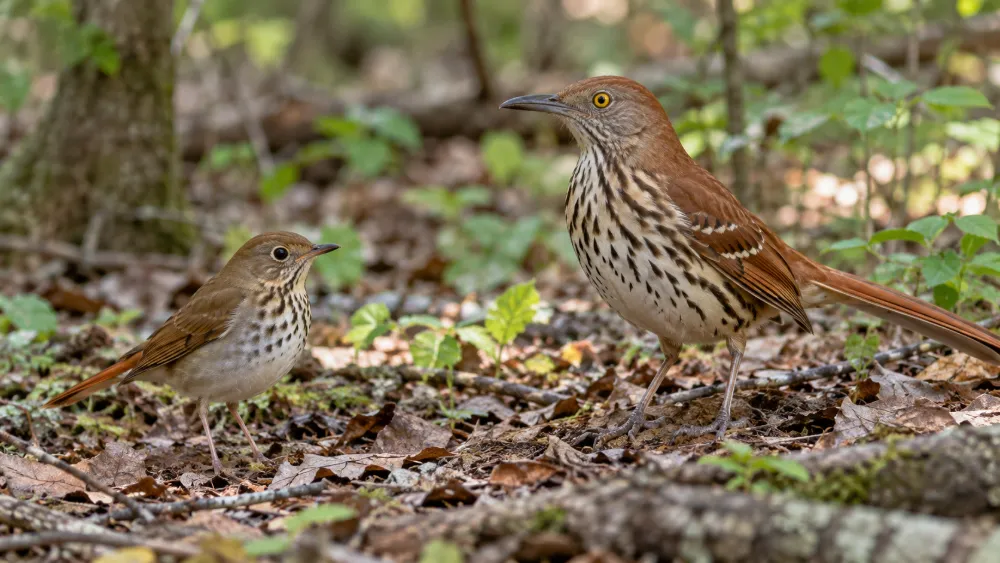
Look for:
a rich brown head and back;
a distinctly more reddish tail;
a pale belly;
dark spots on the throat and upper breast;
and a thin pale eye ring.
The contrasting reddish tail is especially helpful for distinguishing a Hermit Thrush from similar thrushes.
Hermit Thrushes frequently forage on the forest floor, hopping and turning through leaf litter.
10. Brown Creeper
Scientific name: Certhia americana
The easiest way to identify a Brown Creeper is often by behavior rather than plumage.
This tiny brown bird climbs up tree trunks while searching bark crevices for insects and spiders.
It has:
a mottled brown-and-buff back;
white underparts;
a long stiff tail;
and a narrow, curved bill.
The mottled upperparts provide excellent camouflage against tree bark.
A typical Brown Creeper spirals upward around a trunk, flies to the base of another tree, and begins climbing again.
11. American Tree Sparrow
Scientific name: Spizelloides arborea
American Tree Sparrows are mainly winter visitors across much of the United States.
Useful identification clues include:
a rusty-red cap;
a rusty eyeline;
a gray face;
a streaked brown back;
and a mostly unstreaked breast with a small dark central spot.
This last feature is useful when comparing one with a Song Sparrow.
A Song Sparrow normally has much heavier streaking across the entire chest.
12. Eastern Phoebe
Scientific name: Sayornis phoebe
The Eastern Phoebe is more brownish-gray than rich brown, but it is commonly described by backyard observers simply as a small brown bird.
Look for:
a brownish-gray back;
a darker head;
a pale whitish belly;
a thin insect-catching bill;
and almost no obvious wingbars.
The best behavioral clue is the tail.
Eastern Phoebes frequently pump or wag their tails while perched.
They often nest around buildings, barns, porches and bridges.
How to Identify a Small Brown Bird
If you cannot immediately recognize the species, use this sequence.
Step 1: Check the Breast
Plain breast:
Female House Sparrow
Female Brown-headed Cowbird
House Wren
Eastern Phoebe
Heavily streaked breast:
Song Sparrow
Female House Finch
Female Red-winged Blackbird
Brown Thrasher
Spotted breast:
Hermit Thrush
Step 2: Look at the Bill
A thick triangular or conical bill usually suggests a seed-eater such as:
House Sparrow;
House Finch;
or Brown-headed Cowbird.
A long thin bill suggests an insect-eating species such as:
wren;
phoebe;
thrasher;
or creeper.
Step 3: Check the Tail
Tail behavior can be extremely useful.
Frequently cocked upward: wrens
Very long tail: Brown Thrasher
Frequently pumps tail: Eastern Phoebe
Short tail: Brown-headed Cowbird
Reddish tail contrasting with body: Hermit Thrush
Step 4: Look for a White Eyebrow
A strong white eyebrow is an excellent clue.
A Carolina Wren has one of the boldest white eyebrow stripes among common backyard brown birds.
A female House Sparrow also shows a pale eyebrow, but the bird has a much thicker, seed-eating bill.
Step 5: Use Habitat
The same-looking brown bird becomes easier to identify when you consider where it is standing.
| Habitat | Likely Brown Birds |
|---|---|
| Bird feeder | House Sparrow, House Finch, Song Sparrow |
| Dense backyard shrubs | House Wren, Carolina Wren |
| Cattail marsh | Female Red-winged Blackbird |
| Forest floor | Hermit Thrush |
| Tree trunk | Brown Creeper |
| Dense thicket | Brown Thrasher |
| Barn or bridge | Eastern Phoebe |
Brown Sparrow vs. Brown Finch
One of the most common identification problems is separating a female House Finch from a sparrow.
Female House Finches usually have:
a thick curved-looking seed bill;
a rather plain face;
and blurry streaks on the belly.
A Song Sparrow usually has a more patterned face and stronger dark breast streaks.
A female House Sparrow has a plainer belly with a pale eyebrow and strongly striped back.
Why Are So Many Female Birds Brown?
In species where males have bright breeding plumage, females are often much less colorful.
Brown, tan and streaked feathers can provide camouflage around:
nests;
grass;
soil;
bark;
and dense vegetation.
This is why a female Red-winged Blackbird or House Finch may look completely different from the male of the same species.
Is Every Small Brown Bird a Sparrow?
No.
“Little brown bird” is an informal birdwatching description, not a taxonomic group.
Small brown birds include:
sparrows;
wrens;
finches;
flycatchers;
creepers;
blackbirds;
and thrushes.
This is why bill shape and behavior can often be more useful than color.
FAQ
What is the most common small brown bird?
That depends on location, but female House Sparrows, Song Sparrows, Northern House Wrens and female House Finches are among the most commonly encountered small brown birds around North American homes.
What small brown bird has a white eyebrow?
A Carolina Wren has a very bold white eyebrow. Female House Sparrows also have a pale eyebrow but have a thicker seed-eating bill.
What brown bird has a spotted chest?
A Hermit Thrush has a pale chest with dark spots, along with a brown back and distinctly reddish tail.
What brown bird has heavy stripes on its chest?
Possibilities include Song Sparrow, female House Finch and female Red-winged Blackbird. Size, bill shape and habitat help separate them.
What brown bird has a red tail?
The Hermit Thrush is known for a warm reddish tail that contrasts with its browner back.
What brown bird climbs straight up tree trunks?
The Brown Creeper is a small mottled brown bird that typically spirals upward around tree trunks while searching bark for insects.
What brown bird constantly moves its tail?
Eastern Phoebes repeatedly pump their tails while perched. Wrens also frequently hold their tails cocked upward.
What brown bird looks like a large sparrow in a marsh?
A female Red-winged Blackbird often looks like a large heavily streaked sparrow. Its larger body, long pointed bill and wetland habitat are useful clues.
Final Answer
Identifying a brown bird becomes much easier once you stop relying on color alone.
Start with the breast pattern, bill shape, tail and habitat.
A plain buffy bird with a stout bill may be a female House Sparrow. Heavy breast streaking and a central spot suggest a Song Sparrow. A tiny plain brown bird with a barred cocked tail may be a House Wren, while a bold white eyebrow strongly suggests a Carolina Wren.
Larger brown birds are also easier to separate: Brown Thrashers have long tails and bright yellow eyes, female Red-winged Blackbirds are heavily streaked and common around wetlands, and Hermit Thrushes have spotted breasts with distinctly reddish tails.
With those few clues, many apparently identical “little brown birds” become surprisingly easy to identify.
Related Reading
Sources Used for Fact Checking
Cornell Lab of Ornithology — All About Birds: House Sparrow
Cornell Lab of Ornithology — Song Sparrow
Cornell Lab of Ornithology — Northern House Wren
Cornell Lab of Ornithology — Carolina Wren
Cornell Lab of Ornithology — Brown Thrasher
Cornell Lab of Ornithology — House Finch
Cornell Lab of Ornithology — Red-winged Blackbird
Cornell Lab of Ornithology — Brown-headed Cowbird
Cornell Lab of Ornithology — Hermit Thrush
Cornell Lab of Ornithology — Brown Creeper
Cornell Lab of Ornithology — American Tree Sparrow
Cornell Lab of Ornithology — Eastern Phoebe