The name “pixie frog” sounds as though it belongs to a tiny, delicate amphibian.
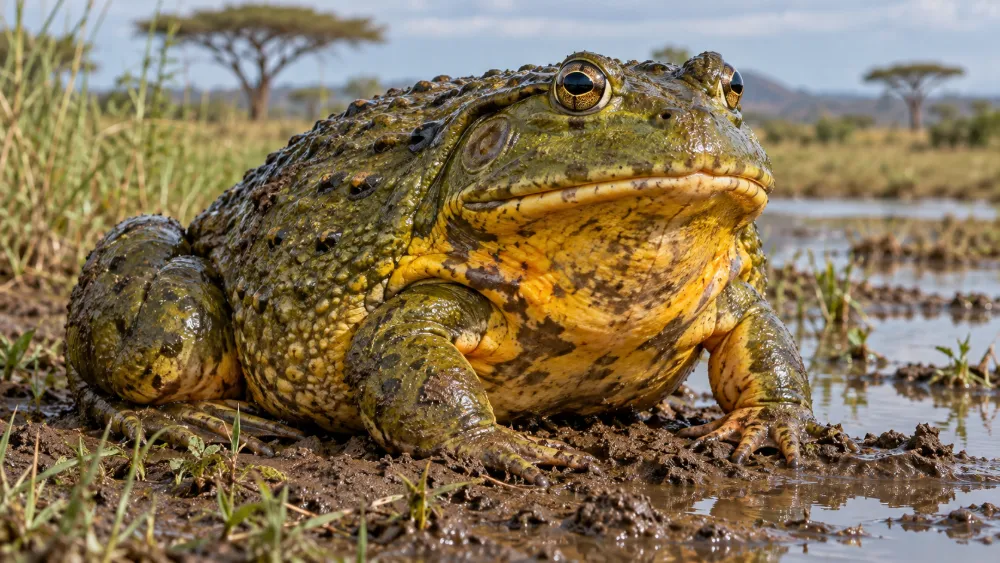
In reality, the pixie frog is one of Africa's largest frogs.
Also known as the African bullfrog or African giant bullfrog, Pyxicephalus adspersus is a powerful, heavy-bodied predator adapted to life in seasonally dry African savannas.
Large males can exceed 9 inches (23 cm) in body length and weigh more than 2 pounds (0.9 kg).
They eat almost any suitably sized animal they can overpower, spend long dry periods buried underground, and males even guard their offspring.
Pixie Frog Quick Facts
| Feature | Pixie Frog |
|---|---|
| Scientific name | Pyxicephalus adspersus |
| Other names | African bullfrog, African giant bullfrog |
| Family | Pyxicephalidae |
| Adult male size | Can exceed 9 in (23 cm) |
| Adult male weight | Can exceed 2 lb (0.9 kg) |
| Diet | Carnivorous |
| Habitat | Dry savannas, grasslands and temporary pools |
| Activity | Strongly seasonal |
| Captive longevity | Often well over 10 years |
What Is a Pixie Frog?
A pixie frog is Pyxicephalus adspersus, a large frog native to parts of southern and eastern Africa.
Despite the nickname, it is not a tiny frog.
It belongs to the family Pyxicephalidae and is closely associated with seasonally dry savanna environments.
Its range includes countries such as:
South Africa;
Namibia;
Botswana;
Zimbabwe;
Mozambique;
Zambia;
Malawi;
Tanzania;
and Kenya.
For much of the year, these landscapes may be extremely dry.
African bullfrogs survive by spending long periods underground and emerging when heavy rains create temporary pools.
How Big Do Pixie Frogs Get?
Pixie frogs are among the largest living frogs.
Adult males can grow to more than 9 inches and weigh over 2 pounds.
Females are dramatically smaller.
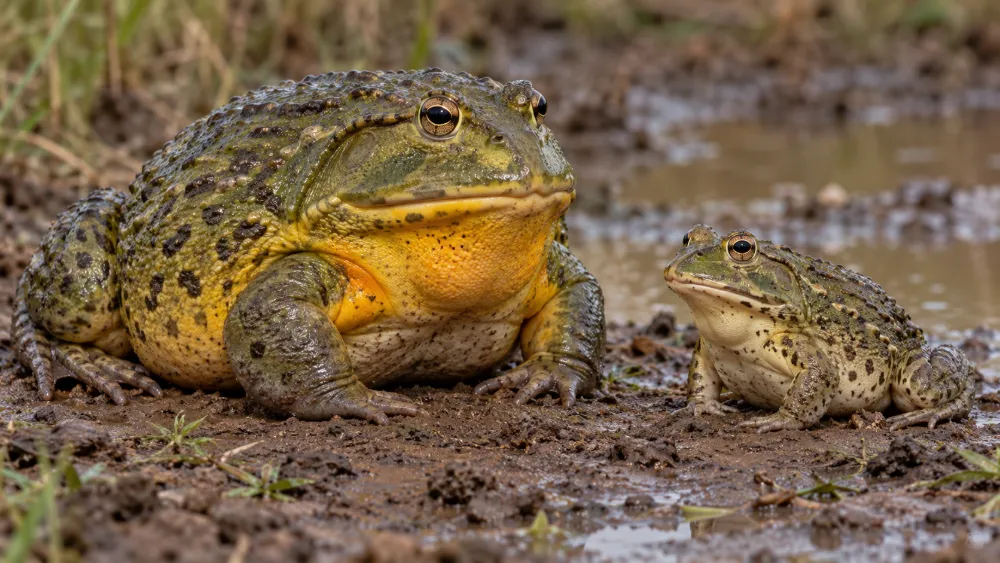
This difference between males and females is unusual because in many frog species females are the larger sex.
In African bullfrogs, the opposite is true.
Large male size is especially useful during the breeding season, when males compete aggressively with one another for access to breeding areas and females.
Why Are Male Pixie Frogs Bigger Than Females?
Male African bullfrogs compete intensely during breeding.
When seasonal rains fill temporary pools, males gather around the water and call.
Large males may:
push smaller males away;
wrestle;
bite rivals;
defend breeding territories;
and occupy favorable positions near the center of breeding groups.
This strong male-to-male competition likely helps explain the extreme size difference between the sexes.
What Do Pixie Frogs Eat?
Pixie frogs are opportunistic carnivores.
They will attempt to eat almost any animal they can overpower and swallow.
Documented prey includes:
other invertebrates;
other frogs;
small reptiles;
small mammals;
small birds;
and sometimes other African bullfrogs.
Cannibalism can occur from an early age.
Newly metamorphosed frogs may eat smaller siblings, and large adults can consume smaller frogs.
How Does a Pixie Frog Catch Food?
African bullfrogs are ambush predators.
Rather than chasing prey for long distances, they often sit partly concealed and wait for a suitable animal to move within striking distance.
The frog then opens its enormous mouth rapidly and uses its tongue to seize the prey.
The lower jaw also contains hardened tooth-like structures called odontodes.
These are not mammalian teeth, but they help the frog grip struggling prey.
Can a Pixie Frog Bite?
Yes.
A large African bullfrog has a powerful jaw and can deliver a painful defensive bite.
This is important because captive animals sometimes become accustomed to associating movement with food.
They are not animals that should be encouraged to bite fingers or be handled unnecessarily.
Their bite is not venomous, but the combination of jaw strength and tooth-like odontodes means a large individual should be treated respectfully.
Are Pixie Frogs Aggressive?
“Aggressive” needs context.
A pixie frog is not hunting people, but it is a powerful predator and can defend itself when threatened.
Male-to-male aggression can also be intense during breeding.
Adults may:
inflate the body;
open the mouth;
lunge;
bite;
or attempt to swallow smaller animals.
For this reason, keeping multiple adults together can create serious risks.
How Long Do Pixie Frogs Live?
Pixie frogs can be surprisingly long-lived amphibians.
Animal Diversity Web reports an average captive longevity figure of approximately 16.2 years.
Individuals may live longer under excellent conditions.
That means buying a young African bullfrog can represent a commitment lasting well over a decade.
Claims that every pixie frog routinely lives 30 or 40 years should be treated cautiously unless supported by documented records.
Where Do Pixie Frogs Live?
Pyxicephalus adspersus inhabits seasonally dry environments across southern and eastern Africa.
Typical habitat includes:
savanna;
grasslands;
semi-arid plains;
temporary wetlands;
and seasonal rain pools.
The frogs may experience long dry seasons followed by intense periods of rainfall.
Their entire annual lifestyle is adapted to this dramatic cycle.
How Can a Frog Survive the Dry Season?
African bullfrogs spend much of the dry season buried underground.
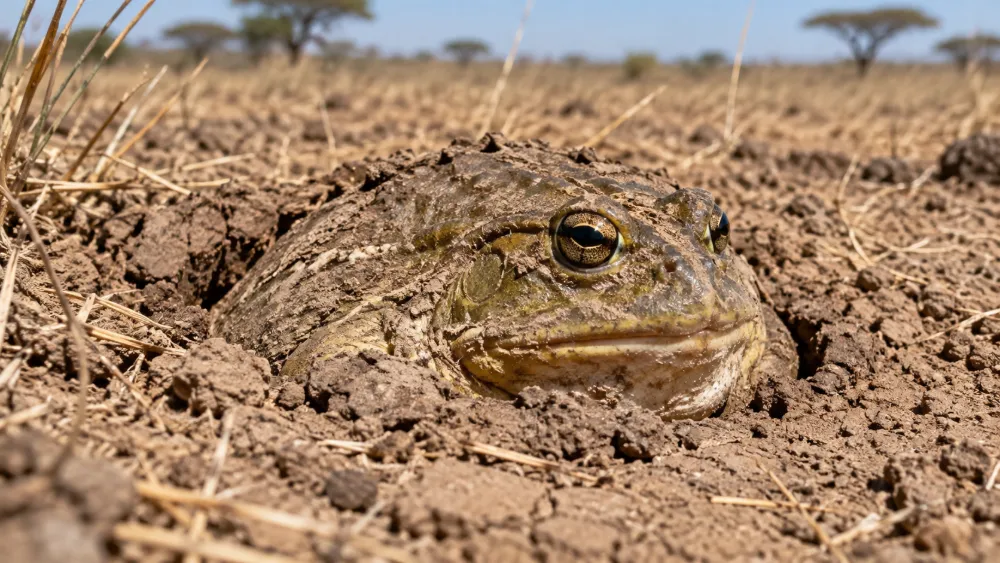
They use powerful hind feet and a hardened digging structure called a metatarsal tubercle to excavate into the soil.
Underground, the frog enters a period of dormancy called aestivation.
The outer layers of skin can form a protective cocoon around the frog.
Metabolism slows dramatically while the animal waits for wetter conditions.
This dormant period can last many months and, under severe environmental conditions, potentially a year or longer.
Aestivation vs. Hibernation
Both are forms of dormancy, but they are usually triggered by different environmental pressures.
| Aestivation | Hibernation |
|---|---|
| Associated with heat and drought | Associated primarily with winter cold |
| Helps prevent water loss | Helps conserve energy during cold periods |
| Important in African bullfrogs | Common in many temperate animals |
How Do Pixie Frogs Reproduce?
Breeding begins rapidly after heavy seasonal rains create temporary bodies of water.
Males gather around shallow pools and produce deep calls.
Large males compete for central breeding territories.
Females move toward successful males and mating takes place in shallow water.
A female may release thousands of eggs.
Animal Diversity Web reports clutches as large as approximately 4,000 eggs.
Do Male Pixie Frogs Protect Their Babies?
Yes, and this is one of the most remarkable facts about African bullfrogs.
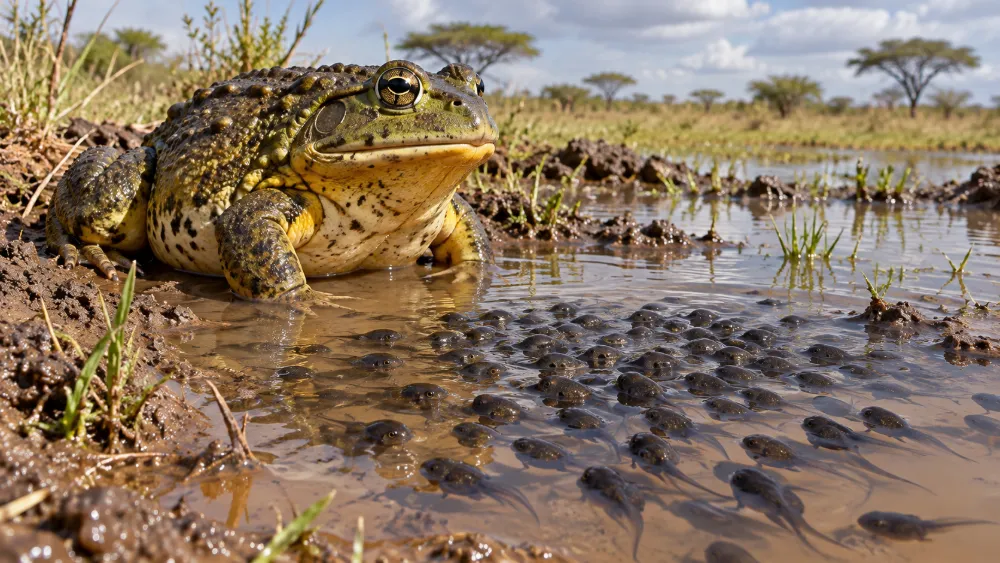
After eggs are laid, males may remain near the breeding pool and guard the developing eggs and tadpoles.
The male can aggressively defend the nursery area against threats.
Even more remarkably, when a shallow pool begins drying, males have been observed digging channels that connect stranded tadpoles to larger bodies of water.
This is an unusually active form of parental care for a frog.
But Do Male African Bullfrogs Eat Tadpoles?
They can.
This creates one of the strangest contradictions in African bullfrog biology.
The same male that defends a group of tadpoles may also consume some of them.
Parental defense and cannibalism therefore can occur in the same species—and even in the same breeding context.
How Fast Do Pixie Frog Tadpoles Grow?
Temporary African rain pools may disappear quickly.
That creates intense pressure for rapid development.
Animal Diversity Web reports that eggs can hatch in roughly two days and that tadpoles may complete metamorphosis in around three weeks under suitable conditions.
Rapid development helps the young frogs leave the aquatic stage before their pool disappears.
Are Pixie Frogs Good Pets?
Pixie frogs are popular with experienced amphibian keepers, but they are not the right pet for everyone.
Advantages include:
impressive size;
interesting feeding behavior;
long potential lifespan;
and relatively sedentary adult behavior.
Challenges include:
a powerful bite;
large adult body size;
heavy feeding requirements;
sensitivity to poor water and substrate conditions;
and a commitment that may last well over a decade.
Like most amphibians, they are better treated as observation animals than animals that need frequent handling.
Can You Hold a Pixie Frog?
Routine handling should be minimized.
Amphibians have sensitive, permeable skin that can absorb substances from human hands.
Handling can also stress the frog, and a large African bullfrog is capable of biting defensively.
If handling is necessary for health or enclosure management, proper amphibian-safe procedures should be used.
Can Pixie Frogs Live Together?
Keeping multiple pixie frogs together is risky.
They are opportunistic predators and cannibalism is a natural part of their biology.
A larger individual may attempt to eat a smaller one.
Adult males can also become highly aggressive toward each other.
Anyone maintaining these frogs in human care should plan around their natural solitary and predatory tendencies rather than assuming they will behave socially.
Pixie Frog vs. African Bullfrog: Are They Different?
No.
In the pet trade, “pixie frog” usually refers to the African bullfrog Pyxicephalus adspersus.
Other members of the genus Pyxicephalus exist, so scientific names are useful when identifying animals accurately.
The genus currently contains several recognized species, including the smaller edible bullfrog, Pyxicephalus edulis.
Is a Pixie Frog the Biggest Frog in the World?
No.
The African bullfrog is extremely large, but the title of largest living frog belongs to the Goliath frog, Conraua goliath of Central Africa.
Nevertheless, the African bullfrog ranks among the world's heaviest and most impressive frog species.
FAQ
How big does a pixie frog get?
Large adult males can exceed 9 inches in body length and weigh more than 2 pounds. Females are substantially smaller.
Is a pixie frog the same as an African bullfrog?
Yes. “Pixie frog” is a common pet-trade name for Pyxicephalus adspersus, also known as the African bullfrog or African giant bullfrog.
What do pixie frogs eat?
They are carnivorous ambush predators that eat insects, other frogs, reptiles, small mammals, small birds and almost any suitably sized prey they can overpower.
Do pixie frogs have teeth?
They have hardened tooth-like structures called odontodes on the lower jaw that help grip prey.
Can a pixie frog bite?
Yes. Large animals have strong jaws and can deliver a painful defensive bite, although they are not venomous.
How long do pixie frogs live?
They can live well over ten years in human care. Animal Diversity Web reports an average captive longevity of approximately 16.2 years.
Are pixie frogs aggressive?
They are powerful predators rather than social animals. Males may fight during breeding, and adults can defend themselves by lunging or biting.
Do pixie frogs hibernate?
They more accurately undergo aestivation during dry periods, spending long periods underground in a reduced metabolic state.
Do African bullfrogs eat other frogs?
Yes. They are opportunistic predators, and cannibalism is documented.
Do male pixie frogs take care of tadpoles?
Yes. Males can guard eggs and tadpoles and have even been observed digging channels to help tadpoles reach deeper water when pools begin drying.
Final Answer
The pixie frog is actually the African bullfrog, Pyxicephalus adspersus, one of the world's largest and most powerful frogs.
Adult males can exceed nine inches and two pounds, while females are considerably smaller.
They are aggressive ambush predators that eat almost any animal small enough to overpower, including insects, reptiles, mammals and other frogs.
Yet their most extraordinary adaptations may have little to do with their size.
Pixie frogs can spend long dry seasons buried underground in aestivation, emerge rapidly when rain returns, reproduce in temporary pools and develop from eggs to young frogs at remarkable speed.
Adult males even guard their tadpoles and may dig channels to help them escape drying pools.
For amphibian keepers, their impressive appearance and long lifespan make them fascinating animals—but their large size, powerful feeding response and specialized needs mean they are much better suited to observation than frequent handling.
Related Reading
Sources Used for Fact Checking
American Museum of Natural History — Amphibian Species of the World
Animal Diversity Web — Pyxicephalus adspersus
NCBI Taxonomy — Pyxicephalus adspersus
Channing, Du Preez & Passmore — African Bullfrog Breeding Biology