Birds can produce almost every color visible to the human eye, from scarlet red and electric blue to metallic green, violet, orange and gold.
Some species combine so many colors that they appear almost unreal. Yet these colors are not digital effects or painted feathers. They are produced by pigments, microscopic feather structures and, in some birds, combinations of both.
This list features 15 of the most colorful birds in the world. It is not an objective ranking, because beauty and colorfulness cannot be measured with a single number. Instead, each species was selected for an especially striking natural combination of colors.
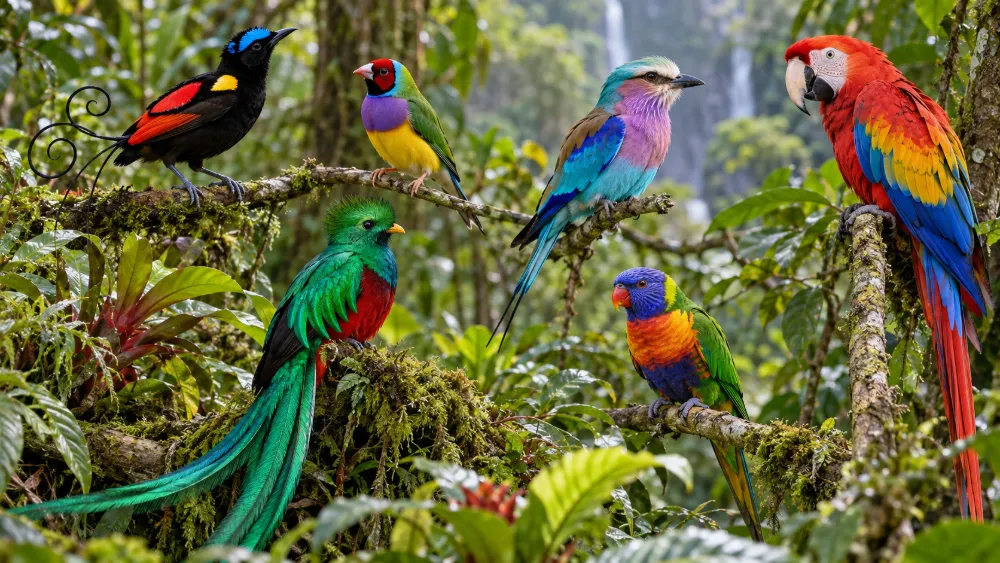
15 Colorful Birds at a Glance
| Bird | Standout Colors | Native Region |
|---|---|---|
| Wilson's Bird-of-Paradise | Blue, red, yellow, green, violet | West Papua, Indonesia |
| Gouldian Finch | Green, purple, yellow, red or black | Northern Australia |
| Lilac-Breasted Roller | Lilac, turquoise, blue, green | Eastern and southern Africa |
| Resplendent Quetzal | Iridescent green, red | Central America |
| Rainbow Lorikeet | Blue, green, orange, red, yellow | Australia |
| Painted Bunting | Blue, red, green | North America |
| Indian Peafowl | Blue, green, bronze | South Asia |
| Scarlet Macaw | Scarlet, yellow, blue | Central and South America |
| Mandarin Duck | Orange, purple, green, blue | East Asia |
| Paradise Tanager | Green, turquoise, black, red | South America |
| European Bee-Eater | Chestnut, yellow, turquoise, green | Europe, Asia and Africa |
| Golden Pheasant | Gold, red, orange, green, blue | China |
| Scarlet Ibis | Intense scarlet red | Northern South America |
| Nicobar Pigeon | Iridescent green, blue, copper | Southeast Asian islands |
| Superb Starling | Metallic blue-green, orange, white | East Africa |
1. Wilson's Bird-of-Paradise
Scientific name: Diphyllodes respublica
Few birds combine color in as many different ways as the male Wilson's Bird-of-Paradise.
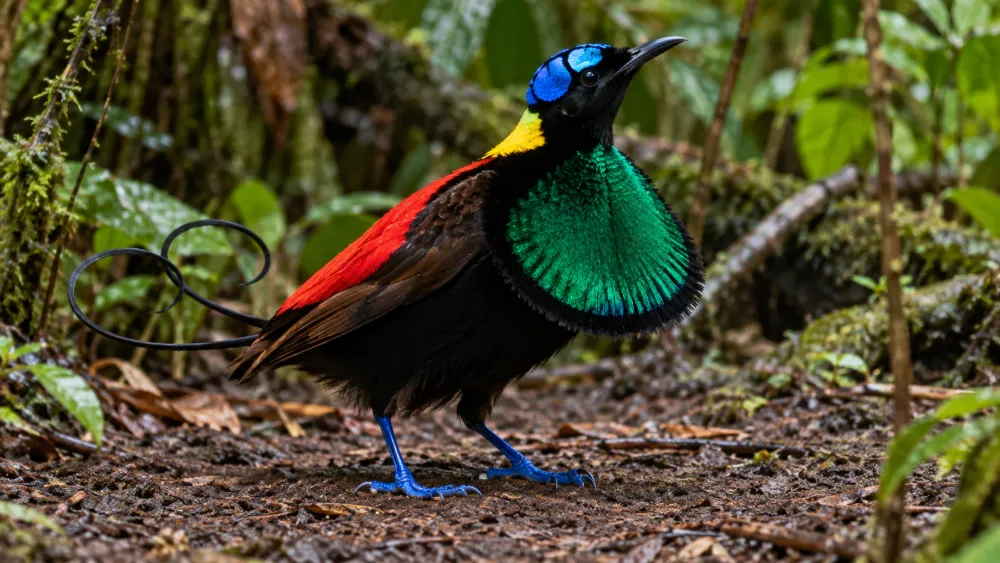
The male has a brilliant blue crown, yellow neck, crimson back, dark wings, an iridescent emerald breast shield, blue legs and a pair of curled central tail feathers.
Remarkably, the blue crown is not blue feathers at all. It is bare skin whose microscopic structure reflects blue light.
The red and yellow areas rely much more heavily on pigments, while the green breast shield is strongly iridescent.
Wilson's Bird-of-Paradise occurs only on Waigeo and Batanta in Indonesia's Raja Ampat region.
2. Gouldian Finch
Scientific name: Chloebia gouldiae
The Gouldian Finch may be Australia's most dramatically colored small bird.
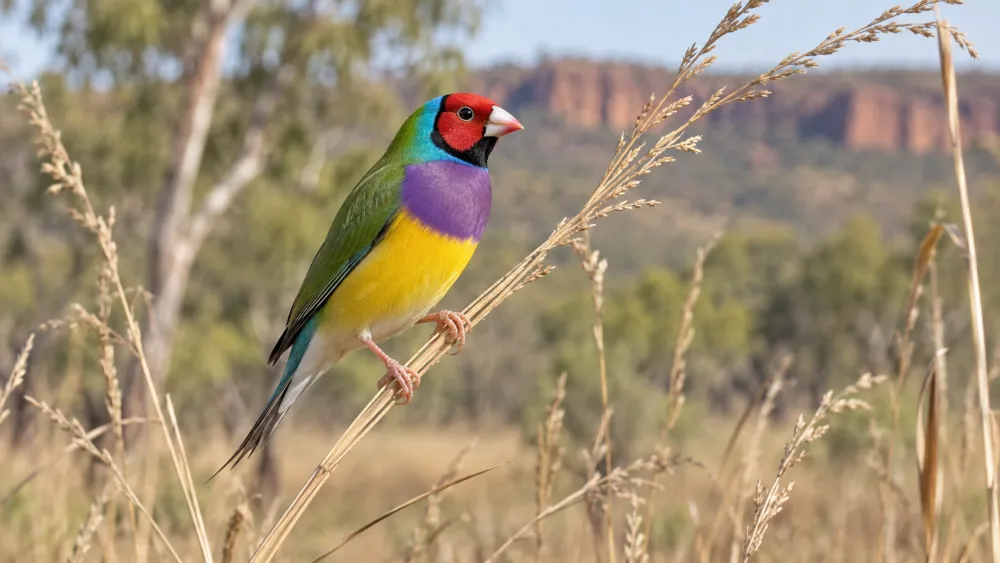
An adult male typically combines a bright green back, purple breast and yellow belly.
The head can naturally occur in different color forms.
The Australian Museum reports that roughly three-quarters of wild Gouldian Finches have black faces, about one-quarter are red-faced and rare yellow-faced individuals also occur.
Males are generally more intensely colored than females, while juveniles are much duller.
3. Lilac-Breasted Roller
Scientific name: Coracias caudatus
The Lilac-breasted Roller looks as though several different birds were combined into one.
Its feathers can include:
lilac or purple on the breast;
turquoise on the belly;
bright blue wings;
greenish-blue on the head;
and warm brown on the back.
The species inhabits open woodland and savanna across parts of eastern and southern Africa.
Unlike many highly colorful birds, males and females look broadly similar.
4. Resplendent Quetzal
Scientific name: Pharomachrus mocinno
The Resplendent Quetzal is famous for shimmering green plumage that can appear blue-green, emerald or turquoise depending on the light.
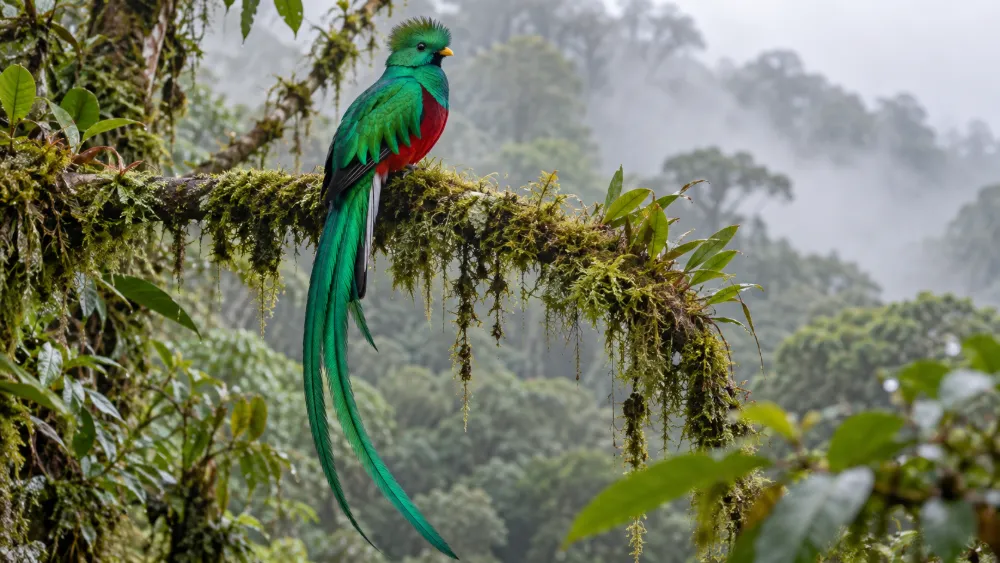
Adult males also have a brilliant red belly.
During the breeding season, their elongated green upper tail coverts extend far beyond the normal tail feathers and can create an extraordinary flowing silhouette.
Quetzals inhabit cool, humid cloud forests from southern Mexico through parts of Central America.
For more on this group, see our guide to quetzal species.
5. Rainbow Lorikeet
Scientific name: Trichoglossus moluccanus
The name “rainbow” is unusually accurate.
A Rainbow Lorikeet combines a deep blue head, orange-red chest, green back and wings, and patches of yellow and orange.
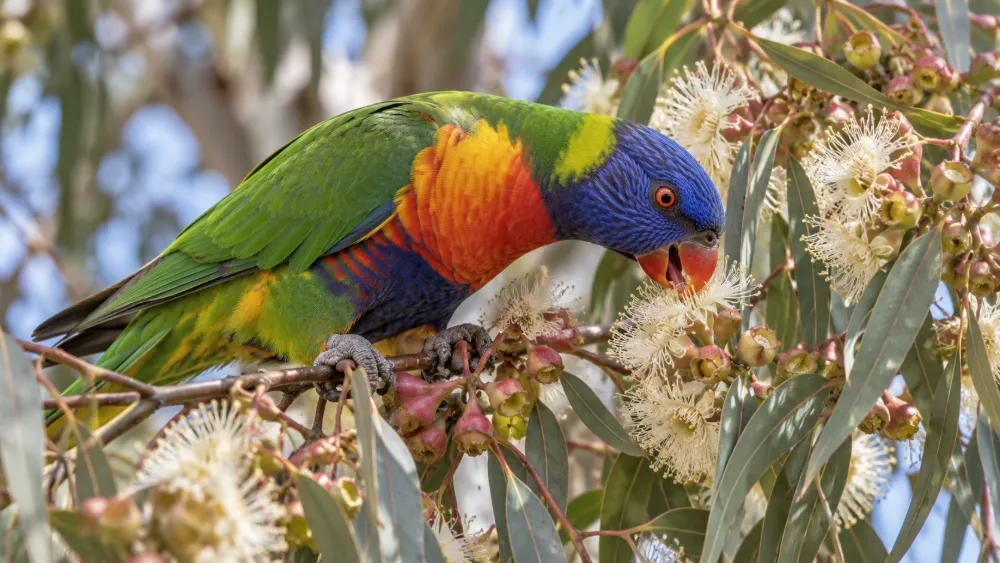
These Australian parrots feed heavily on flowers, nectar and pollen.
Lorikeets have specialized brush-like tongues that help them collect these foods.
The colors are not merely decorative. Like other parrots, lorikeets use a distinctive class of pigments called psittacofulvins for many red and yellow hues.
6. Painted Bunting
Scientific name: Passerina ciris
The male Painted Bunting is one of North America's most colorful songbirds.
Adult males combine:
a blue head;
red underparts;
and a green back.
Females and immature birds are dramatically different, appearing mostly yellow-green to bright green.
This sexual difference is so strong that an inexperienced observer might initially assume the male and female are different species.
7. Indian Peafowl
Scientific name: Pavo cristatus
The male Indian Peafowl, or peacock, is one of the best-known examples of iridescent bird coloration.
The neck and breast shimmer intense blue, while the famous display contains bronze, blue and green eye-like spots.
There is also a common anatomy misconception.
The spectacular “peacock tail” is not composed mainly of exceptionally long tail feathers. The display is formed largely by elongated upper tail coverts that sit above and extend far beyond the true tail.
During courtship, the male raises these feathers into the enormous fan familiar around the world.
8. Scarlet Macaw
Scientific name: Ara macao
The Scarlet Macaw is dominated by intense red plumage, but its wings add broad bands of yellow and blue.
The result makes the bird highly visible even in dense tropical forest.
Scarlet Macaws inhabit portions of Mexico, Central America and South America.
Their spectacular feathers have also contributed historically to human capture and trade.
For conservation context, see Why the Scarlet Macaw Is Endangered.
9. Mandarin Duck
Scientific name: Aix galericulata
Breeding male Mandarin Ducks have one of the most elaborate plumages among waterfowl.
The head contains a mixture of metallic green, purple, reddish-brown and cream.
The sides show orange feathers, including the famous upright orange “sails.”
Females are much more subdued, with gray-brown plumage and a pale eye ring.
This is another case where the most spectacular coloration is strongly associated with sexual display.
10. Paradise Tanager
Scientific name: Tangara chilensis
The Paradise Tanager is a small South American songbird with an extraordinary patchwork of colors.
Depending on the subspecies and lighting, the bird can display vivid green, turquoise blue, black, red and yellow.
Despite its scientific name chilensis, this species is not naturally a bird of Chile.
It occurs primarily in tropical forests of northern and western Amazonia and neighboring regions of South America.
11. European Bee-Eater
Scientific name: Merops apiaster
The European Bee-Eater combines a chestnut crown and back with a yellow throat, dark eye stripe and blue-green underparts.
Its pointed wings and long central tail feathers add to its distinctive appearance.
The species breeds across parts of Europe, North Africa and western Asia and many populations migrate to Africa for the nonbreeding season.
As the name suggests, flying insects such as bees and wasps form an important part of its diet.
12. Golden Pheasant
Scientific name: Chrysolophus pictus
The male Golden Pheasant looks almost ornamental.
It combines:
a golden-yellow crest;
orange and black neck feathers;
a deep red breast and belly;
green upper back;
and blue or darker wing patches.
Females are brown and heavily patterned, providing much better camouflage while nesting.
The species is native to forested mountain regions of China, although introduced populations occur elsewhere.
13. Scarlet Ibis
Scientific name: Eudocimus ruber
The Scarlet Ibis proves that a bird does not need five colors to be visually spectacular.
Adults are overwhelmingly vivid scarlet-red, with contrasting black wing tips.
The Smithsonian notes that Scarlet Ibises inhabit wetlands, mudflats, estuaries and other shallow-water habitats in northern South America and nearby regions.
As in several other red and orange birds, diet-derived carotenoid pigments contribute to the intense adult coloration.
14. Nicobar Pigeon
Scientific name: Caloenas nicobarica
The Nicobar Pigeon looks very different from the gray city pigeon familiar to most people.
Its dark body can flash metallic:
green;
turquoise;
blue;
purple;
and copper-bronze.
Long hackle-like feathers extend from the neck, while the tail is conspicuously pale or white.
The species inhabits islands and coastal forests across parts of Southeast Asia and the western Pacific.
15. Superb Starling
Scientific name: Lamprotornis superbus
The Superb Starling is one of East Africa's most recognizable colorful birds.
The head, back and upper breast shimmer metallic blue-green, while the belly is orange-rufous.
A narrow white breast band separates these color zones.
Like many starlings in the genus Lamprotornis, much of the metallic appearance comes from microscopic feather structures interacting with light rather than ordinary blue or green pigment.
Why Are Birds So Colorful?
Birds produce color using several different biological mechanisms.
Pigments
Pigments absorb some wavelengths of light and reflect others.
Important pigment groups include carotenoids and melanins.
Carotenoids contribute many yellow, orange and red colors and often come from dietary sources.
Melanins create many black, brown and gray colors and can also strengthen feathers.
Structural Color
Some colors exist because microscopic structures inside the feather control how light is reflected.
Blue feathers are a classic example.
A blue bird often does not contain blue pigment. Instead, feather structures scatter and reflect blue wavelengths toward the observer.
Iridescence
Iridescent feathers change appearance depending on lighting and viewing angle.
Peafowl, hummingbirds, starlings and many birds-of-paradise use this effect.
A feather that looks black from one angle can suddenly flash brilliant green, blue or violet from another.
Why Are Male Birds Often More Colorful Than Females?
In many species, colorful male plumage evolved partly through sexual selection.
Females choosing particular visual traits over many generations can favor increasingly elaborate male colors and ornaments.
Wilson's Bird-of-Paradise, peafowl and Painted Buntings provide obvious examples of strong sexual differences in plumage.
However, this is not a universal rule. In many parrots, rollers and other birds, both sexes may be brightly colored.
What Is the Most Colorful Bird in the World?
There is no scientifically objective winner because “most colorful” can mean number of colors, saturation, iridescence or total visible plumage area.
However, the male Wilson's Bird-of-Paradise is an especially strong candidate.
Cornell Lab notes that it displays an exceptional range of colors produced through multiple mechanisms, including pigmented red and yellow areas, structural blue skin and an iridescent green breast shield.
What Is the Most Colorful Bird in Australia?
The Gouldian Finch is one of the strongest candidates among Australian songbirds.
The Australian Museum describes it as Australia's most spectacularly colored grassfinch.
Rainbow Lorikeets are another obvious contender because blue, green, orange, red and yellow can all appear on one bird.
Are Colorful Birds More Visible to Predators?
Sometimes, but coloration has more than one function.
Bright feathers can be used for mate attraction, species recognition and social signaling.
Color can also behave unexpectedly in natural habitat. A bright green parrot may stand out against a plain background but blend surprisingly well among sunlit leaves.
Many species also combine display feathers with behavior that limits how exposed they are to predators.
FAQ
What are the most colorful birds?
Wilson's Bird-of-Paradise, Gouldian Finch, Rainbow Lorikeet, Lilac-breasted Roller, Resplendent Quetzal, Painted Bunting and Indian Peafowl are among the world's most spectacularly colorful species.
Which bird has the most colors?
There is no official record based on color count, but the male Wilson's Bird-of-Paradise combines an unusually large range of intense colors produced by pigments, structural coloration and iridescence.
Why are blue birds blue?
Blue feather coloration is usually structural rather than pigment-based. Microscopic structures inside the feather scatter blue wavelengths back toward the observer.
Why are male birds more colorful?
In many species, sexual selection favors colorful males because plumage is used in courtship. This does not apply to every species, and in many birds both sexes are brightly colored.
What colorful birds live in North America?
Examples include Painted Buntings, several hummingbirds, orioles, Western Tanagers and various brightly colored ducks and songbirds.
What colorful birds live in Australia?
Australia is home to Gouldian Finches, Rainbow Lorikeets, rosellas and many other colorful parrots and passerines.
Are bird feathers naturally blue?
They look naturally blue, but the color usually comes from feather structure rather than blue pigment.
Final Thoughts
The world's most colorful birds demonstrate that nature can create color in several completely different ways.
A Gouldian Finch combines multiple pigment-based colors on one tiny body. A quetzal and peacock produce shimmering structural effects. The blue crown of Wilson's Bird-of-Paradise is not even feather color—it comes from specialized bare skin.
That makes colorful birds more than visually spectacular animals. Their plumage is also a lesson in optics, chemistry, evolution and animal communication.
Related Reading
Sources Used for Fact Checking
Cornell Lab of Ornithology — How Birds Make Colorful Feathers
Cornell Lab Bird Academy — Wilson's Bird-of-Paradise: A Full Spectrum
Australian Museum — Wilson's Bird-of-Paradise
Australian Museum — Gouldian Finch
San Diego Zoo Wildlife Alliance — Lories and Lorikeets
Smithsonian's National Zoo — Scarlet Ibis