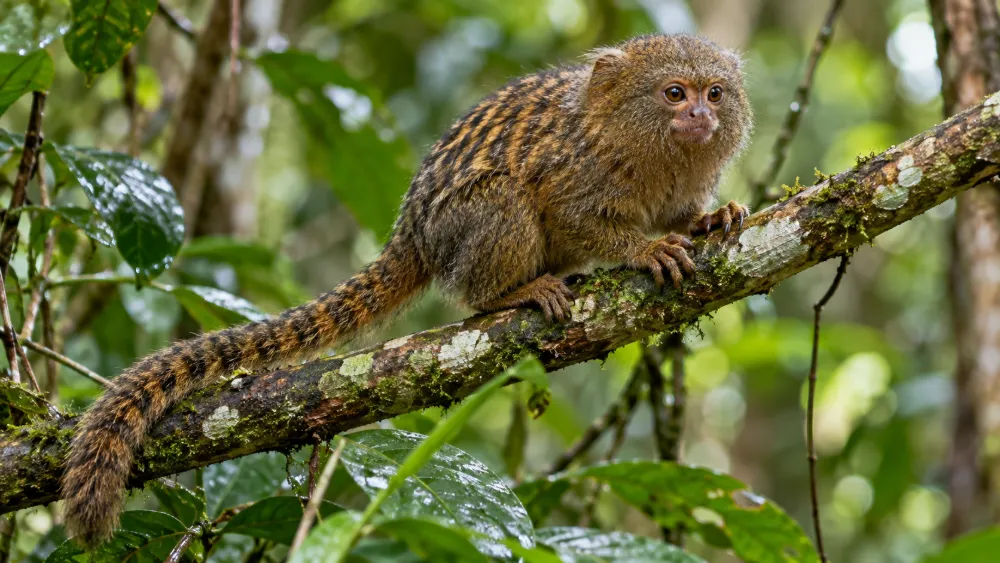
“Finger monkey” sounds like the name of a miniature monkey species small enough to live on a person's finger.
In reality, finger monkey is an informal nickname for the pygmy marmoset, one of the smallest primates on Earth and the smallest living monkey.
Adult pygmy marmosets are extraordinarily tiny, but they are not literally finger-sized. Their body is about 4.6 to 6.2 inches (12 to 16 centimeters) long, not including a tail that is longer than the body.
The finger-sized photographs commonly shared online usually show very young animals—or use camera perspective to make adults look even smaller.
Finger Monkey Facts at a Glance
| Feature | Pygmy Marmoset |
|---|---|
| Common nickname | Finger monkey |
| Genus | Cebuella |
| Adult body length | About 12–16 cm (4.6–6.2 in) |
| Tail length | About 17–23 cm (6.8–9 in) |
| Adult weight | About 85–140 g (3–5 oz) |
| Native range | Western Amazon Basin |
| Main foods | Tree gum and sap, insects, nectar and fruit |
| Wild lifespan | Up to about 12 years |
| Social structure | Family groups |
What Is a Finger Monkey?
A finger monkey is usually a pygmy marmoset, a tiny New World monkey native to South America.
The nickname is popular in social media, pet advertisements and viral photographs, but zoologists do not recognize “finger monkey” as a formal species name.
Pygmy marmosets belong to the genus Cebuella.
Modern genetic and morphological research supports recognition of two closely related species:
Northern pygmy marmoset — Cebuella pygmaea;
Southern pygmy marmoset — Cebuella niveiventris.
Older books and websites may still use the name Callithrix pygmaea or treat northern and southern populations as subspecies rather than separate species.
That explains why several different scientific names may appear when researching “finger monkeys.”
How Big Is a Finger Monkey?
An adult pygmy marmoset is only about 12 to 16 centimeters long from head to body.
It normally weighs approximately 85 to 140 grams—roughly 3 to 5 ounces.
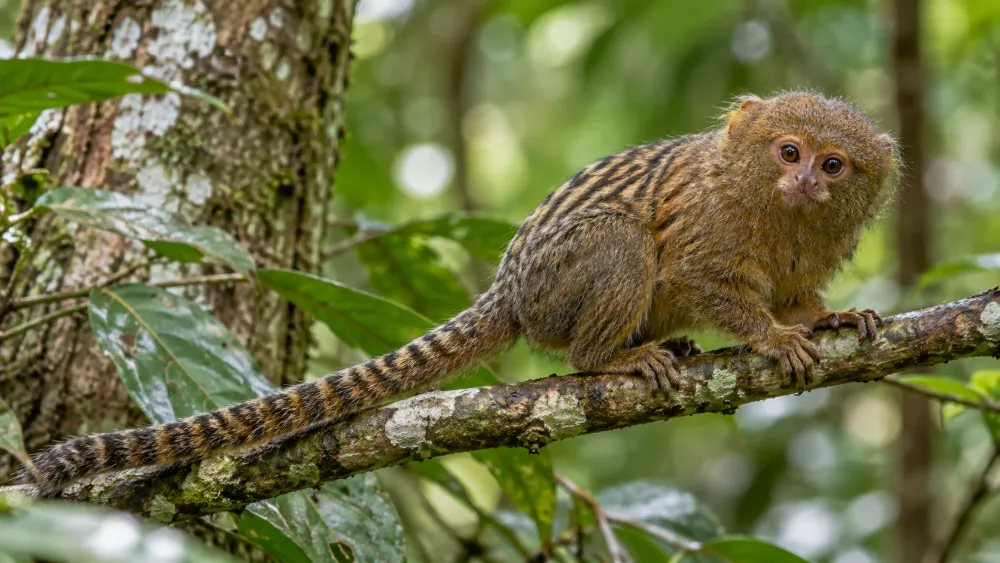
The tail adds another 17 to 23 centimeters and is therefore longer than the monkey's body.
Despite its appearance, the tail is not prehensile. The monkey does not use it like an extra hand to grip branches. Instead, it helps with balance as the animal runs and leaps through vegetation.
Are Finger Monkeys Really the Size of a Finger?
Newborn pygmy marmosets can be remarkably close to that description.
San Diego Zoo reports newborn weights of only about 3 to 15 grams and describes the babies as approximately the size of a human thumb.
Adults are much larger.
A full-grown pygmy marmoset can fit into an adult human hand, but an adult monkey is not normally small enough to sit entirely on one finger.
Images advertising adult “finger-sized monkeys” should therefore be interpreted cautiously.
Is the Finger Monkey the Smallest Monkey in the World?
Yes. Pygmy marmosets are considered the smallest living monkeys.
However, they are not the smallest primates.
That distinction is important because all monkeys are primates, but not all primates are monkeys.
The smallest living primates are mouse lemurs of Madagascar, some of which are lighter than pygmy marmosets.
Where Do Finger Monkeys Live?
Pygmy marmosets live in the western Amazon region of South America.
Their range includes portions of:
Brazil;
Colombia;
Ecuador;
Peru;
and Bolivia.
They are strongly associated with dense forests around rivers and floodplains.
Rather than moving over enormous territories, family groups can use relatively small home ranges centered on trees that provide reliable food.
What Do Finger Monkeys Eat?
Tree gum and sap are among the most important foods in the pygmy marmoset diet.
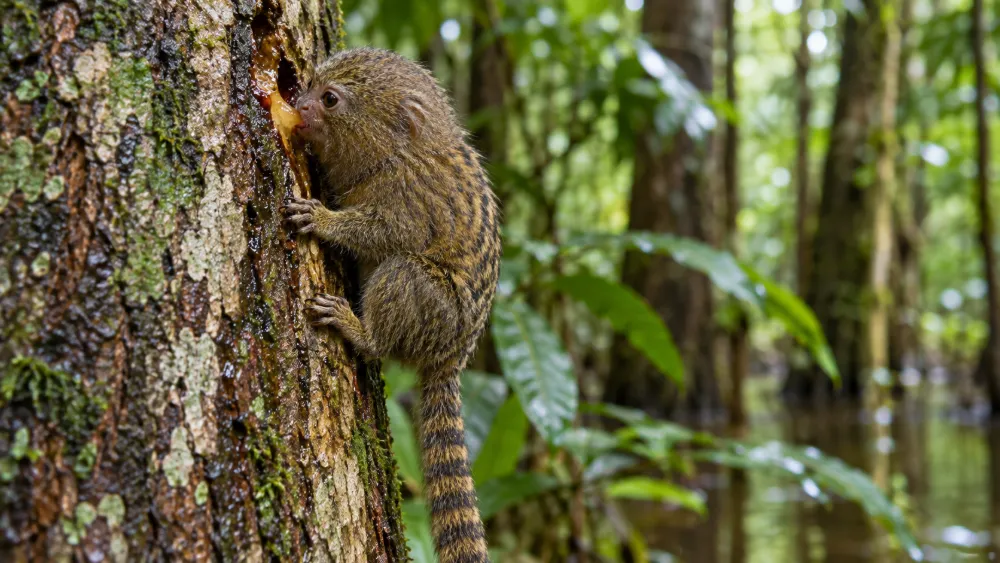
These tiny monkeys have specialized lower incisors that allow them to gouge holes into tree bark.
They repeatedly scrape the surface until gum or sap becomes available and then lick up the fluid.
A pygmy marmoset may repeatedly return to favored feeding trees and maintain large numbers of feeding holes.
The diet can also include:
insects;
nectar;
fruit;
and other small food items.
Insects attracted to sap holes can themselves become prey.
Do Finger Monkeys Have Claws?
They have claw-like nails on most digits rather than the broad, flat fingernails associated with many other primates.
These structures help pygmy marmosets cling vertically to tree trunks while feeding on gum.
They also do not have the strongly opposable thumbs that many people associate with monkeys.
Their hands and feet are specialized for rapid movement along trunks and small branches.
How Far Can a Pygmy Marmoset Jump?
Despite its tiny body, a pygmy marmoset is an agile tree-dwelling animal.
It can make rapid leaps between branches and tree trunks while escaping predators or traveling through its territory.
Small size is actually useful in this environment because it allows the monkey to use thin branches that cannot support larger primates.
Are Finger Monkeys Social?
Very.
Pygmy marmosets live in family groups rather than spending their lives alone.
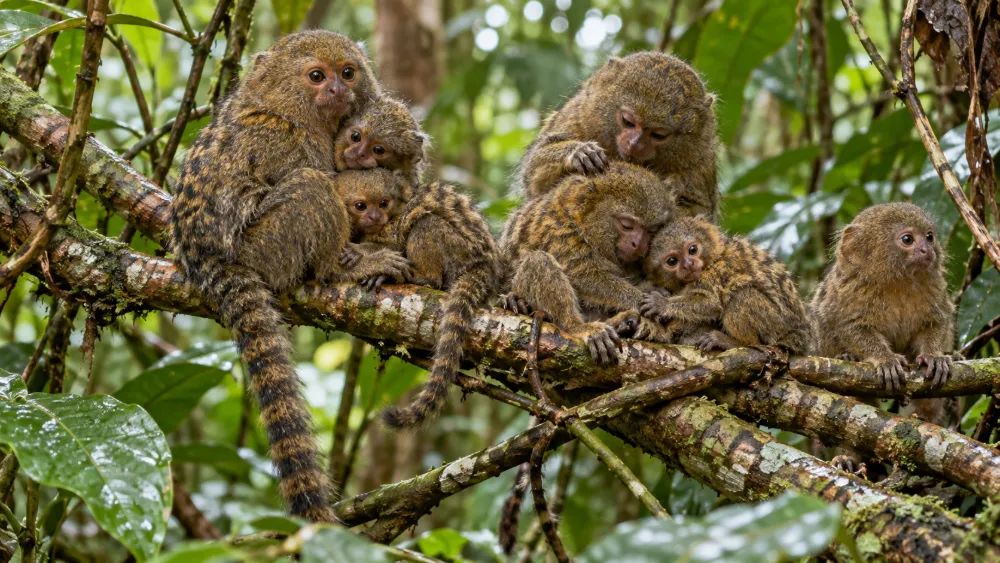
San Diego Zoo reports troops averaging around five individuals and sometimes containing up to nine.
A typical group may contain:
a breeding pair;
their young;
and older offspring that remain with the family.
Family members groom one another, communicate with calls and cooperate in caring for babies.
This social structure is one major reason a pygmy marmoset cannot simply be treated like a hamster-sized exotic pet.
Do Finger Monkeys Have Twins?
Twins are extremely common.
A mother pygmy marmoset usually gives birth to two babies after a gestation of roughly 4.5 months.
Parental care is unusually cooperative.
The father carries newborns for much of the time and returns them to the mother for nursing. Older siblings can also help care for infants.
This cooperative family system reduces the enormous energetic cost of raising two babies simultaneously.
How Long Do Finger Monkeys Live?
San Diego Zoo reports pygmy marmosets living up to approximately 12 years in the wild and as long as about 18 years in professionally managed zoological care.
That is another important consideration when people encounter advertisements presenting one as a tiny, simple pet.
A primate represents a potentially decade-plus commitment involving highly specialized behavioral, social and veterinary needs.
Do Finger Monkeys Make Good Pets?
No. Pygmy marmosets do not make appropriate conventional pets.
Their tiny size and expressive faces can make them look easy to care for, but their biology says otherwise.
They are highly social wild primates with complicated requirements involving:
constant interaction with other marmosets;
specialized diets;
large three-dimensional climbing environments;
appropriate humidity and temperature;
UV exposure and nutritional management;
behavioral enrichment;
and veterinarians experienced with nonhuman primates.
Removing a baby from its family to make it more dependent on humans can interfere with normal behavioral development.
As primates mature, their behavior can also become much harder for an inexperienced owner to manage.
Are Finger Monkeys Legal in the United States?
The answer depends on what part of the law is being discussed.
At the federal level, the United States does not allow nonhuman primates to be imported for use as pets.
CDC regulations restrict live primate imports to approved scientific, educational or exhibition purposes.
Domestic possession laws are a separate issue and vary among states and local jurisdictions. Many places prohibit or restrict private primate ownership.
Therefore, a website claiming simply that “finger monkeys are legal in the U.S.” is incomplete and potentially misleading.
Why Are Finger Monkeys Bad Pets?
The central problem is that small body size does not mean simple needs.
A pygmy marmoset is still a complex primate.
Keeping one alone removes the animal from the family structure around which much of its natural behavior evolved.
Inappropriate nutrition can cause serious health problems, while inadequate space, social isolation and lack of stimulation can damage welfare.
Primates can also carry diseases transmissible to people, and humans can transmit infections to primates.
San Diego Zoo specifically identifies the pet trade as a major threat to pygmy marmosets and states that monkeys do not make good pets.
Can Finger Monkeys Bite?
Yes.
Pygmy marmosets are tiny, but they have sharp teeth specialized for gouging tree bark.
Like any wild primate, they can bite when frightened, stressed, territorial or frustrated.
The fact that an animal is small or was raised around humans does not eliminate normal adult primate behavior.
How Much Does a Finger Monkey Cost?
Online prices are not a useful indicator of whether keeping a pygmy marmoset is legal, ethical or practical.
Advertisements using terms such as “finger monkey,” “teacup monkey” or “pocket monkey” may also misidentify young common marmosets as pygmy marmosets.
RSPCA has specifically documented young common marmosets being marketed as “pygmy marmosets” or “finger monkeys.”
Anyone considering an exotic-animal advertisement should therefore be especially skeptical of claims that the animal will remain extremely tiny or behave like a domesticated pet.
Finger Monkey vs. Common Marmoset
| Feature | Pygmy Marmoset | Common Marmoset |
|---|---|---|
| Genus | Cebuella | Callithrix |
| Typical adult weight | About 85–140 g | Roughly 300–360 g |
| Body size | Extremely small | Noticeably larger |
| Main feeding adaptation | Strongly specialized for tree gum | Also feeds heavily on plant gums |
| “Finger monkey” name | Common informal nickname | Young animals may be misleadingly sold under the name |
FAQ
What is a finger monkey?
A finger monkey is an informal name usually used for a pygmy marmoset, a tiny Amazonian monkey in the genus Cebuella.
How big does a finger monkey get?
An adult pygmy marmoset is approximately 12 to 16 centimeters long in the body and weighs around 85 to 140 grams. Its tail is longer than its body.
Is a finger monkey really finger-sized?
Newborn pygmy marmosets can be roughly thumb-sized, but adults are substantially larger and can fit in an adult human hand rather than on a single finger.
What is the smallest monkey in the world?
The pygmy marmoset is the smallest living monkey. It is not the smallest primate; mouse lemurs are even smaller.
What do finger monkeys eat?
Tree gum and sap are particularly important. They also eat insects, nectar and some fruit.
Can you keep a finger monkey as a pet?
Pygmy marmosets have extremely complex social, dietary and environmental needs and are not considered appropriate conventional pets. Laws also restrict or prohibit ownership in many jurisdictions.
Are finger monkeys legal in the U.S.?
Nonhuman primates cannot legally be imported into the United States for pet purposes. Rules concerning possession of domestically held primates vary by state and locality.
How long do finger monkeys live?
Pygmy marmosets may live up to about 12 years in the wild and as long as approximately 18 years in professionally managed zoological settings.
Do finger monkeys stay tiny forever?
They remain extraordinarily small compared with other monkeys, but adults are much larger than the thumb-sized newborns often shown in viral photographs.
Do pygmy marmosets have prehensile tails?
No. Their long tails help them balance but are not used to grasp branches like an extra hand.
Final Answer
The so-called finger monkey is usually a pygmy marmoset, the smallest living monkey.
Adults measure only around 12 to 16 centimeters in body length and weigh roughly 85 to 140 grams, while newborns can genuinely be close to the size of a human thumb.
But their tiny bodies should not be confused with simple biology.
Pygmy marmosets are highly social Amazonian primates specialized for feeding on tree gum and living in cooperative family groups. They communicate, defend territories, care for twins together and depend on a complex forest environment.
That is also why the viral image of a miniature “pocket monkey” makes a poor guide to pet ownership. A pygmy marmoset is a wild primate with demanding welfare needs—not a tiny domesticated companion.
Related Reading
Sources Used for Fact Checking
San Diego Zoo Wildlife Alliance — Pygmy Marmoset
Mammal Diversity Database — Cebuella pygmaea
Mammal Diversity Database — Cebuella niveiventris
Boubli et al. — Taxonomy of Pygmy Marmosets
U.S. Centers for Disease Control and Prevention — Nonhuman Primate Importation
RSPCA — Keeping Marmosets as Pets
World Wildlife Fund — Why Primates Do Not Make Good Pets