Crocodiles can grow to extraordinary sizes, but separating real records from legends is surprisingly difficult.
Stories exist of crocodiles more than 25 feet long, yet many of those animals were never scientifically measured, photographed with a reliable scale or preserved for later examination.
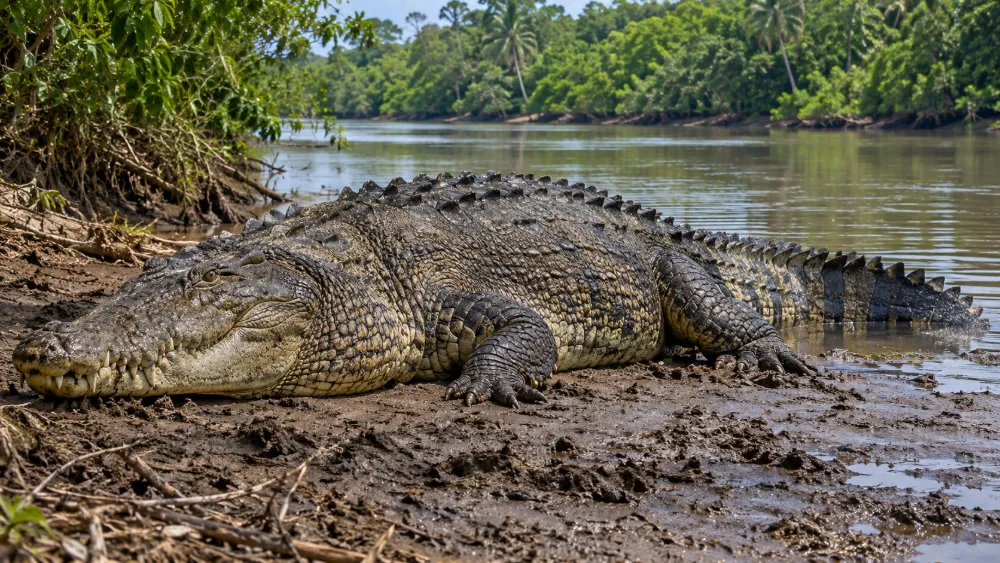
The strongest verified modern record belongs to Lolong, a giant saltwater crocodile captured alive in the Philippines.
Guinness World Records measured Lolong at 6.17 meters (20 feet 2.91 inches) long and approximately 1,075 kilograms (2,370 pounds).
That makes him the largest crocodile in captivity ever reliably recorded by Guinness.
Largest Crocodile Ever Recorded at a Glance
| Record | Crocodile | Measurement |
|---|---|---|
| Largest reliably measured captive crocodile ever | Lolong | 6.17 m (20 ft 2.91 in) |
| Weight | Lolong | Approx. 1,075 kg (2,370 lb) |
| Species | Saltwater crocodile | Crocodylus porosus |
| Captured | Bunawan, Philippines | September 2011 |
| Famous unverified claim | “Krys” | Claimed 8.6+ m (28+ ft) |
How Big Was Lolong?
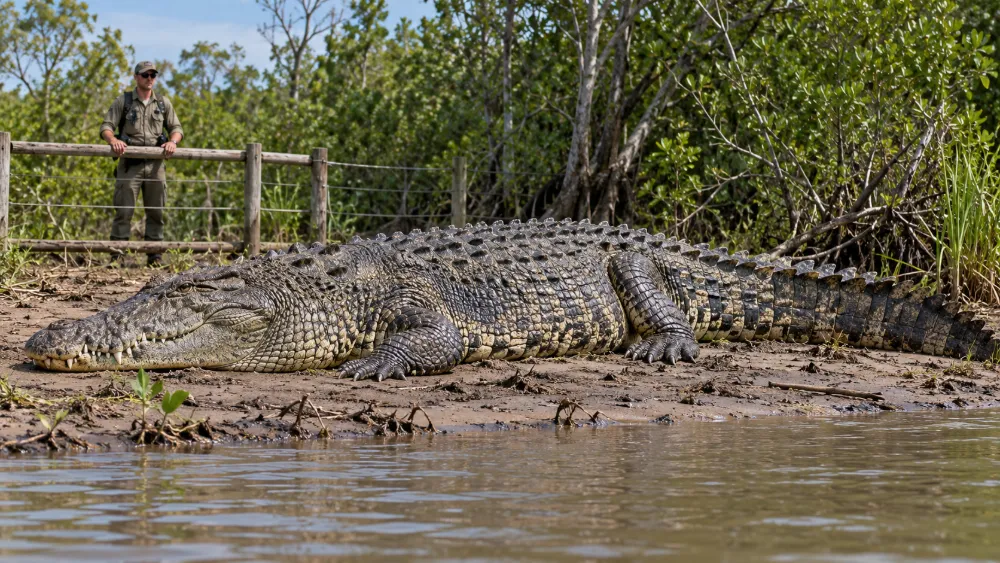
Lolong measured exactly 6.17 meters from snout to tail.
That converts to approximately:
20 feet 2.91 inches;
about the length of a small city bus;
and substantially longer than the height of a typical giraffe.
His verified weight was approximately 1,075 kilograms, or around 2,370 pounds.
Lolong was a male saltwater crocodile, Crocodylus porosus, the largest living crocodilian species.
Where Was Lolong Found?
Lolong was captured near Bunawan in Agusan del Sur on the Philippine island of Mindanao in September 2011.
The region contains extensive rivers, wetlands and marsh habitat suitable for saltwater crocodiles.
Despite the species' common name, saltwater crocodiles are not restricted to the ocean.
They can inhabit:
estuaries;
mangrove systems;
tidal rivers;
freshwater rivers;
swamps;
and coastal waters.
Large individuals may move considerable distances through interconnected waterways.
Why Was Lolong Captured?
The crocodile was captured after a prolonged effort by local authorities following serious crocodile incidents in the Bunawan area.
Guinness reports that the capture followed efforts to remove an animal suspected in connection with a girl's death and the disappearance of a fisherman.
However, suspicion surrounding individual attacks should not be interpreted as proof that every incident attributed locally to a large crocodile was caused by the same animal.
After capture, Lolong was moved to a specially constructed enclosure at the Bunawan Eco-Park and Research Centre.
How Was Lolong's Record Verified?
Initial reports suggested that the crocodile might exceed 21 feet.
That figure was not immediately accepted as a world record.
Formal measurements were later taken and evaluated before Guinness World Records recognized Lolong.
The accepted total length was 6.17 meters.
His weight was determined using a truck weighbridge and estimated at approximately 1,075 kilograms.
This verification process is important because extremely large crocodile claims are notoriously difficult to confirm.
What Happened to Lolong?
Lolong remained at the Bunawan Eco-Park after his capture.
He died on February 10, 2013.
His estimated age was around 50 years, although determining the exact age of a large wild crocodile captured as an adult is difficult.
Despite his death, his Guinness record for the largest crocodile in captivity ever remains associated with his verified 6.17-meter measurement.
What Is the Largest Crocodile Species?
The saltwater crocodile, Crocodylus porosus, is the world's largest living crocodilian species.
Large adult males commonly reach around 4.6 to 5.2 meters.
Exceptional individuals can exceed 6 meters.
Reports of individuals approaching 7 meters exist, but crocodiles of this size are extraordinarily rare and require particularly strong evidence.
Very large males can weigh more than 1,000 kilograms.
Saltwater Crocodile vs. Nile Crocodile
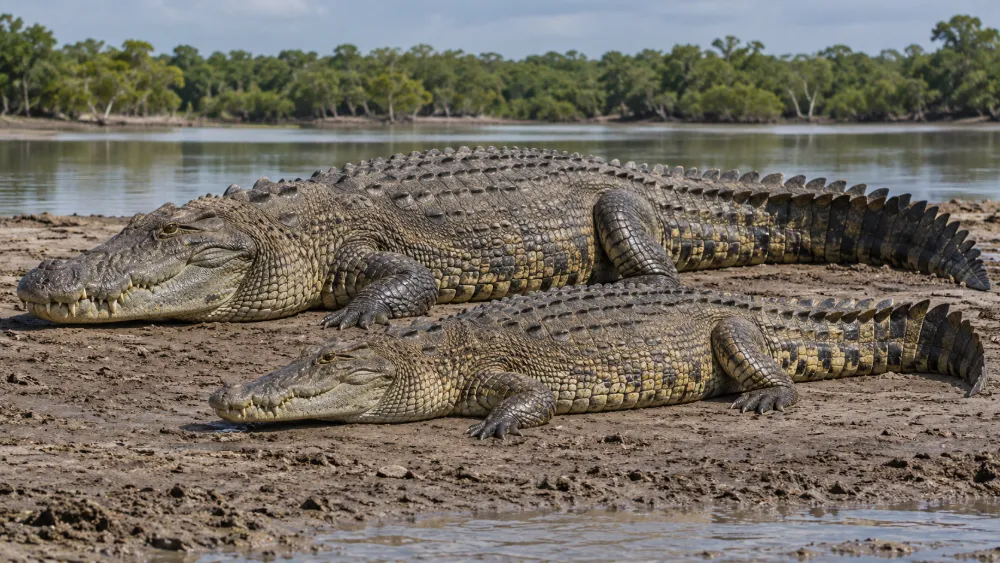
| Feature | Saltwater Crocodile | Nile Crocodile |
|---|---|---|
| Scientific name | Crocodylus porosus | Crocodylus niloticus |
| Maximum verified-size potential | Largest living crocodilian | One of the largest living crocodiles |
| Exceptional male length | 6 m+ | Can approach 6 m |
| Distribution | South and Southeast Asia to northern Australia | Much of sub-Saharan Africa |
| Typical habitat | Estuaries, rivers, mangroves, coast | Rivers, lakes, wetlands |
Nile crocodiles can become enormous, but the largest reliably documented modern individuals generally do not surpass the biggest saltwater crocodiles.
Was There Really a 28-Foot Crocodile?
This is where crocodile records become much less certain.
One of the most famous stories involves a huge crocodile reportedly shot in northern Queensland, Australia, in the 1950s.
The animal is often called Krys, after Krystina Pawlowski, who reportedly shot it.
The claimed length was approximately:
28 feet 4 inches, or about 8.6 meters.
If accurate, this would dwarf Lolong.
But the measurement was never scientifically verified, and no complete specimen remains available for modern measurement.
For that reason, the claimed 28-foot crocodile should be treated as an unverified historical claim, not as the official largest crocodile ever recorded.
Why Are Old Crocodile Size Records Unreliable?
Historical giant-crocodile stories face several problems.
Measurement Along the Curves
A tape placed along the contours of a crocodile's back can produce a longer measurement than a scientifically standardized straight-line measurement.
No Preserved Specimen
Without a skull, skeleton or skin of reliable provenance, researchers cannot independently check old measurements.
Photographic Perspective
A crocodile placed closer to a camera than a person can look enormously larger than it really is.
Estimates Instead of Measurements
A living crocodile viewed from a boat may be estimated at six or seven meters, but estimating the length of a partially submerged animal is extremely difficult.
For a world record, direct measurement is far more reliable.
What About Gustave?
Gustave is a famous large Nile crocodile associated with Burundi and Lake Tanganyika.
Popular accounts have often estimated him at roughly 5.5 to 6 meters long.
However, Gustave has never received the kind of controlled full-body measurement used to verify Lolong's Guinness record.
Stories claiming enormous numbers of human victims have also been repeated widely without reliable documentation for every alleged incident.
Gustave may have been an exceptionally large crocodile, but he should not be presented as a measured world-record holder.
What About Dominator?
Another famous giant is Dominator, a wild saltwater crocodile associated with Australia's Adelaide River.
Tourism reports often estimate Dominator at approximately 6 meters or slightly more.
But a free-ranging wild crocodile cannot simply be hauled onto a measuring platform for an exact total-length measurement.
Until a standardized measurement exists, estimates for Dominator cannot replace Lolong's verified record.
Was Cassius the Biggest Crocodile?
Cassius was an enormous Australian-caught saltwater crocodile that measured 5.48 meters (17 feet 11.75 inches).
Before Lolong's record was recognized, Cassius held the Guinness title for the largest crocodile in captivity.
After Lolong died in 2013, Cassius again became the recognized largest living crocodile in captivity.
Cassius died in November 2024.
He therefore should no longer be described as the world's largest living captive crocodile.
Lolong, however, remains larger than Cassius and retains the historical captivity record.
What Is the Largest Crocodile Alive Today?
This question is harder to answer than it appears.
Many enormous wild crocodiles have not been physically measured, while captive-record holders can change as animals die or new individuals are verified.
After the death of Cassius in 2024, Guinness' public listing for the living captive crocodile record does not currently identify a replacement holder.
That means claims naming a particular animal as the definitive world's largest living crocodile should be treated cautiously unless accompanied by a current verified measurement.
How Do Scientists Measure a Giant Crocodile?
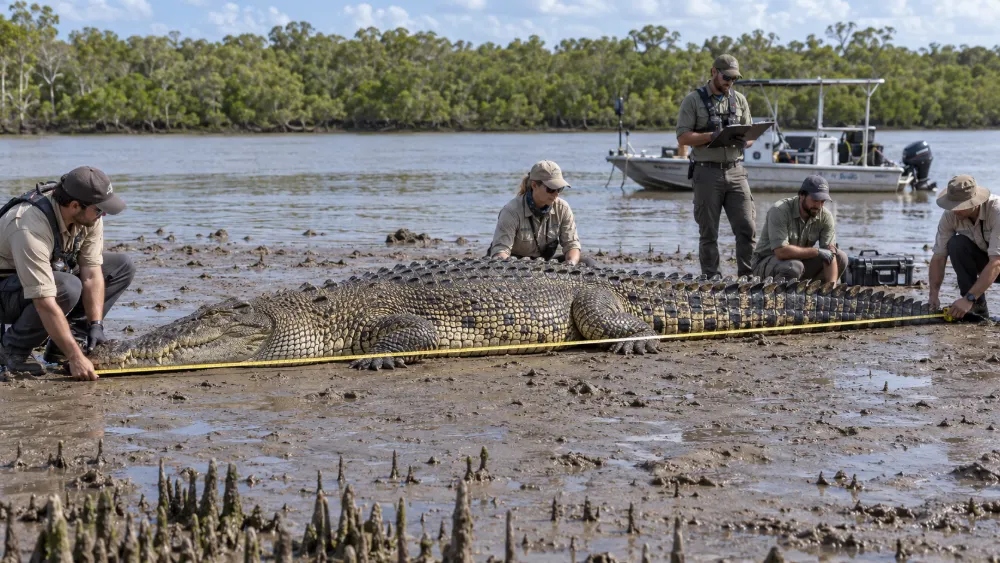
A reliable total-length measurement should extend from the tip of the snout to the tip of the tail using a standardized method.
Researchers can also record:
snout-to-vent length;
head length;
skull dimensions;
body mass;
and girth.
For living wild crocodiles, safe handling becomes increasingly difficult as size increases.
This is one reason the very largest animals may remain estimates rather than verified records.
How Heavy Can a Saltwater Crocodile Get?
Exceptional adult males can exceed a metric ton.
Lolong weighed approximately 1,075 kilograms.
Guinness states that exceptionally large saltwater crocodiles may reach approximately 1,000 to 1,200 kilograms.
Body mass rises rapidly as an animal increases in length because a longer crocodile also becomes much wider and deeper-bodied.
A 6-meter crocodile is therefore dramatically heavier than a 4-meter crocodile, not merely 50 percent heavier.
How Long Can a Saltwater Crocodile Grow?
Most adults never come close to Lolong's size.
Large males generally fall below 6 meters, while Guinness notes that outsize males may occasionally reach around 6 meters and exceptionally rare reports approach 7 meters.
Verified animals above six meters are extremely uncommon.
This is exactly why Lolong's 6.17-meter measurement is so biologically remarkable.
What Was the Biggest Prehistoric Crocodile?
Prehistoric crocodile relatives grew much larger than modern species.
One famous example is Sarcosuchus imperator, often nicknamed “SuperCroc.”
Estimates have placed large individuals at roughly 11 to 12 meters long and several tonnes in weight.
However, Sarcosuchus was an ancient crocodyliform rather than a modern species of true crocodile.
Its size is also reconstructed from fossils rather than measured from a complete living animal.
For that reason, prehistoric size estimates and modern verified records should be kept in separate categories.
Lolong vs. Sarcosuchus
| Feature | Lolong | Sarcosuchus |
|---|---|---|
| Time period | Modern | Cretaceous |
| Animal type | Saltwater crocodile | Extinct crocodyliform |
| Length | 6.17 m verified | Roughly 11–12 m estimated |
| Measurement type | Direct measurement | Fossil reconstruction |
FAQ
What is the largest crocodile ever recorded?
Lolong, a saltwater crocodile from the Philippines, measured 6.17 meters (20 feet 2.91 inches) long and weighed approximately 1,075 kilograms. Guinness recognizes him as the largest crocodile in captivity ever.
Was Lolong really 21 feet long?
Early reports suggested a length around 21 feet, but the officially accepted measurement was 6.17 meters, or approximately 20 feet 3 inches.
How much did Lolong weigh?
Approximately 1,075 kilograms, equivalent to about 2,370 pounds.
What species was Lolong?
Lolong was a saltwater crocodile, Crocodylus porosus.
Is the 28-foot crocodile real?
A crocodile known as Krys was historically claimed to measure about 28 feet 4 inches, but the measurement was never scientifically verified. It should therefore not replace Lolong as the reliable modern record holder.
Can crocodiles grow to 30 feet?
There is no reliable modern scientific record of a living crocodile reaching 30 feet. Such claims greatly exceed securely documented modern measurements.
Can saltwater crocodiles reach 7 meters?
Extremely large males have been reported near that size, and Guinness lists 7 meters as an exceptional upper extreme for the species. Reliably verified individuals above six meters are nevertheless extraordinarily rare.
Was Cassius bigger than Lolong?
No. Cassius measured 5.48 meters, while Lolong measured 6.17 meters.
Is Cassius still alive?
No. Cassius died in November 2024.
Is a saltwater crocodile bigger than a Nile crocodile?
Both can become enormous, but the saltwater crocodile is the largest living crocodilian species and has produced the largest reliably measured modern individuals.
What was the biggest prehistoric crocodile?
Several prehistoric crocodyliforms reached enormous sizes. Sarcosuchus imperator is one of the best known, with large individuals estimated at approximately 11 to 12 meters long.
Final Answer
The largest crocodile ever reliably recorded in modern times is Lolong, a male saltwater crocodile from the Philippines.
He measured 6.17 meters (20 feet 2.91 inches) from snout to tail and weighed approximately 1,075 kilograms (2,370 pounds).
Larger crocodiles have been claimed throughout history, including the famous 28-foot Australian crocodile known as Krys, but those measurements were never verified to modern scientific standards.
That distinction is crucial.
A giant crocodile estimated from a photograph, viewed from a boat or measured in an undocumented historical account is not equivalent to an animal that was physically measured and independently verified.
Until stronger evidence appears, Lolong remains the benchmark for just how enormous a modern crocodile can verifiably become.
Related Reading
Sources Used for Fact Checking
Guinness World Records — Largest Crocodile in Captivity Ever
Guinness World Records — Largest Crocodilian Species
Guinness World Records — Cassius
National Geographic — Giant Crocodile Breaks Size Record
Smithsonian Institution — Crocodylidae / Saltwater Crocodile