Some jellyfish can create their own light.
In the darkness of the ocean, a nearly invisible animal may suddenly flash blue, produce a glowing ring or send waves of light around its bell.
This ability is called bioluminescence—light produced by a chemical reaction inside a living organism.
Bioluminescence is especially common in the ocean, where many animals use light to defend themselves, communicate, attract prey or confuse predators.
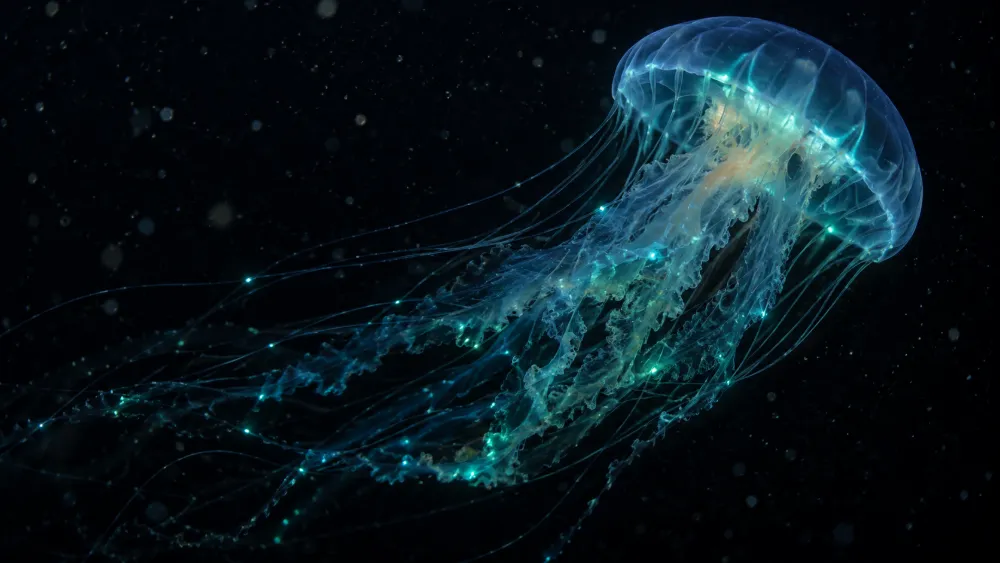
Quick Answer: Do Jellyfish Glow?
Some jellyfish do.
Many species contain light-producing proteins or chemical systems that can generate blue or green light when the animal is disturbed.
However, not every jellyfish is bioluminescent, and not every glowing-looking jellyfish photograph shows true bioluminescence.
Some apparent glow is caused by fluorescence, reflected aquarium lighting or long-exposure photography.
What Is Bioluminescence?
Bioluminescence is the production of visible light through a chemical reaction inside a living organism.
In many marine animals, a light-emitting molecule reacts with oxygen, often with the help of an enzyme or specialized light-producing protein.
The chemical reaction releases energy as light instead of producing large amounts of heat.
This is sometimes called “cold light.”
Marine bioluminescence is usually blue or blue-green because those wavelengths travel especially well through seawater.
Bioluminescence vs. Fluorescence
These terms are often confused, but they describe different processes.
| Feature | Bioluminescence | Fluorescence |
|---|---|---|
| Where does the energy come from? | Chemical reaction inside the organism | External light |
| Needs light shining on it? | No | Yes |
| Can occur in total darkness? | Yes | No |
| Typical marine colors | Blue or blue-green | Green, red, orange and others |
A fluorescent animal absorbs light of one wavelength and re-emits part of that energy at another wavelength.
A bioluminescent animal creates the original light itself.
1. Crystal Jelly — Aequorea victoria
The crystal jelly Aequorea victoria is probably the most scientifically famous bioluminescent jellyfish in the world.
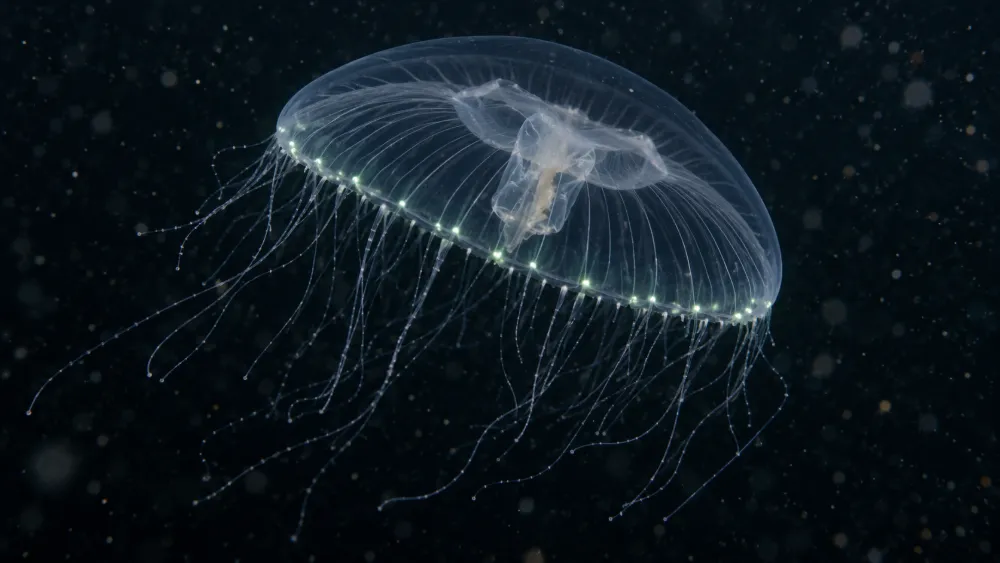
When mechanically or electrically stimulated, the jelly produces spots of bluish-green light around the edge of its umbrella.
Its light system involves two famous proteins:
aequorin, a calcium-sensitive photoprotein that produces blue light;
green fluorescent protein, or GFP, which accepts that energy and shifts much of the visible emission toward green.
This makes Aequorea victoria unusually important in modern biology.
Why Is GFP So Famous?
Scientists learned to attach the gene for GFP to other genes and proteins.
Cells containing those proteins could then be made fluorescent, allowing researchers to watch biological processes inside living cells.
GFP became one of the most important molecular imaging tools in modern biology.
Osamu Shimomura, Martin Chalfie and Roger Tsien received the 2008 Nobel Prize in Chemistry for the discovery and development of GFP.
2. Atolla Crown Jelly
Genus: Atolla
Atolla is one of the most spectacular examples of defensive bioluminescence.
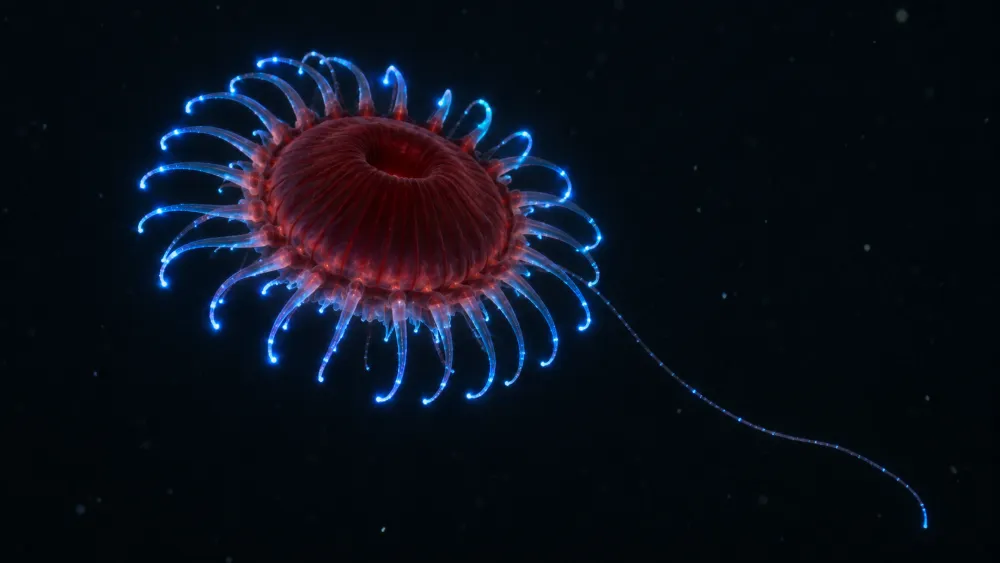
These deep-sea crown jellies often have dark red bodies.
At the depths where they live, red light from the sun is absent, so a red animal can appear almost black and become difficult for predators to see.
If camouflage fails and an Atolla jelly is attacked, it can produce a dramatic circular display of blue bioluminescence.
The light may travel around the bell like a glowing pinwheel.
The “Burglar Alarm” Jellyfish
Researchers often describe the Atolla display as a burglar alarm response.
The idea is unusual.
Instead of simply hiding from its attacker, the jelly produces enough light to advertise that something is happening.
That flash may attract a larger predator that could attack whatever is attacking the jelly.
MBARI has documented this intense blue defensive display in deep-sea Atolla.
3. Helmet Jelly — Periphylla periphylla
The helmet jelly is another large deep-sea jellyfish capable of producing light.
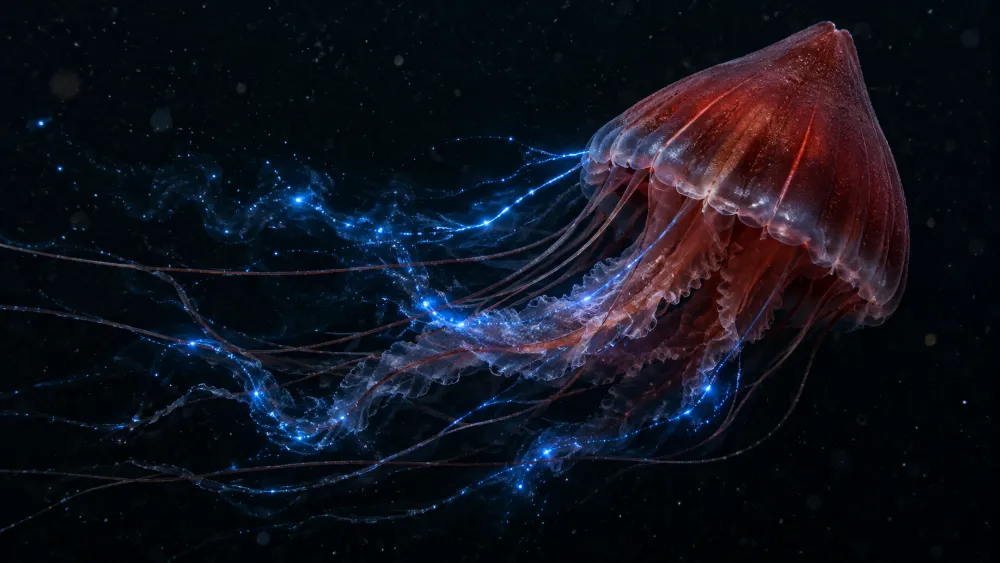
Periphylla periphylla usually has a reddish or brownish body and a distinctive high, helmet-shaped bell.
MBARI has documented helmet jellies producing brilliant blue waves of bioluminescence when defending themselves.
As with Atolla, producing a sudden burst of light in the deep sea may surprise or distract an attacker.
The deep red coloration also helps the animal remain inconspicuous because red wavelengths from sunlight do not penetrate far into deep water.
4. Mauve Stinger — Pelagia noctiluca
The Mauve Stinger is unusual because it is a bioluminescent jellyfish that can occur much closer to the surface than many famous glowing deep-sea species.
Its scientific name, Pelagia noctiluca, is closely associated with its nighttime luminosity.
Scientists have studied its light production for more than a century.
Experiments have shown that mechanical, electrical and chemical stimulation can trigger luminescence.
The light is associated particularly with tissues around the margin of the bell.
Unlike the nearly transparent crystal jelly, the Mauve Stinger can have obvious pink, mauve or purple coloration even under normal illumination.
Why Do Jellyfish Glow?
Scientists do not have one universal answer because bioluminescence can serve different functions in different species.
Defense
This appears to be one of the most important functions among jellyfish.
A sudden flash may:
startle a predator;
confuse an attacker;
make the jelly harder to track;
or attract a larger predator to the scene.
Atolla's burglar-alarm display is one of the best-known examples.
Communication
Bioluminescence is also widely used as a signaling system in the deep sea.
The exact signals produced by many jellyfish remain poorly understood.
Prey Interactions
Some marine animals use light to attract prey, although defensive functions are more commonly proposed for many glowing jellies.
Why Is Jellyfish Bioluminescence Usually Blue?
Blue light travels through seawater more efficiently than longer red wavelengths.
As a result, blue and blue-green are especially useful colors for signaling in the open ocean.
Many marine organisms also have visual systems that are particularly sensitive to these wavelengths.
This combination helps explain why blue-green light dominates marine bioluminescence.
Do Jellyfish Glow All the Time?
Usually not.
Many species produce light only after a stimulus.
Possible triggers include:
physical contact;
movement;
predator attack;
changes in chemical conditions;
or electrical stimulation in laboratory experiments.
Constantly producing light would also make an animal easier for predators to locate.
Controlled flashes therefore make more biological sense than glowing continuously.
Are Glowing Waves Caused by Jellyfish?
Usually not.
The bright blue waves photographed along coastlines are most commonly produced by enormous numbers of microscopic plankton, especially bioluminescent dinoflagellates.
Movement from waves, swimmers or boats can mechanically stimulate the cells and cause flashes of light.
A glowing beach therefore does not automatically indicate that thousands of jellyfish are present.
Do Comb Jellies Glow?
Many comb jellies are bioluminescent, but there are two important corrections.
First, comb jellies are not true jellyfish. They belong to the phylum Ctenophora rather than Cnidaria.
Second, the rainbow colors commonly photographed running along their comb rows are usually not bioluminescence.
The rainbow effect is produced when external light is diffracted by rows of beating cilia.
A comb jelly may therefore be capable of genuine bioluminescence while also producing a completely separate rainbow optical effect under normal light.
Do All Jellyfish Glow?
No.
Bioluminescence is widespread among marine gelatinous animals, especially those living in deeper water, but it is not a universal feature of jellyfish.
Even among luminous species, the brightness, pattern and chemical mechanism can differ substantially.
Can Humans See Jellyfish Bioluminescence?
Yes, but the conditions must be right.
Bioluminescence can be very faint compared with sunlight or aquarium lighting.
Researchers therefore often record it using:
darkened laboratories;
high-sensitivity cameras;
low-light remotely operated vehicles;
or specialized deep-sea imaging systems.
An animal that looks spectacularly bright in a long-exposure photograph may appear much subtler to the human eye.
How Important Are Glowing Jellyfish to Science?
Aequorea victoria alone had an enormous impact on biology.
The discovery of GFP gave researchers a way to make specific cells and proteins visible inside living organisms.
Modified versions of GFP are now used across genetics, neuroscience, cancer research, developmental biology and many other fields.
What began as research into the glow of a transparent jellyfish ultimately became one of the foundational tools of modern cell biology.
FAQ
What jellyfish glow in the dark?
Examples include the crystal jelly Aequorea victoria, Atolla crown jellies, the helmet jelly Periphylla periphylla and the Mauve Stinger Pelagia noctiluca.
What color do bioluminescent jellyfish glow?
Many produce blue or blue-green light because these wavelengths travel efficiently through seawater.
Why do jellyfish glow?
Defense appears to be a major reason. A flash can startle predators or attract larger predators that may attack the jellyfish's attacker.
What is the famous glowing green jellyfish?
Aequorea victoria, commonly called a crystal jelly, is famous for the aequorin and GFP proteins involved in its greenish bioluminescence.
Is GFP bioluminescence?
GFP itself is a fluorescent protein. In Aequorea victoria, energy generated by the bioluminescent aequorin system can be transferred to GFP, which shifts the emitted light toward green.
Are glowing ocean waves jellyfish?
Usually no. Coastal glowing waves are most commonly caused by microscopic bioluminescent dinoflagellates.
Are comb jellies bioluminescent?
Many are, but their familiar rainbow comb-row effect is usually diffraction of external light rather than bioluminescence.
Do moon jellyfish glow?
Moon jellies may look luminous under aquarium lights, but the familiar common moon jelly should not automatically be described as a strongly bioluminescent species. Apparent glow can come from transparency, reflected light or fluorescence.
Final Answer
Bioluminescent jellyfish create light through chemical reactions inside their bodies.
The phenomenon is especially useful in the dark ocean, where a sudden blue flash can confuse a predator, advertise danger or even summon a larger animal to attack the jelly's attacker.
Atolla produces one of the most dramatic displays, sending a brilliant blue pinwheel around its bell. Periphylla periphylla releases defensive blue flashes, while the Mauve Stinger Pelagia noctiluca is a well-documented luminous surface-water jelly.
But the most influential glowing jelly may be Aequorea victoria. Research into its aequorin and green fluorescent protein helped create GFP technology, which transformed modern biological imaging.
The glow of jellyfish is therefore more than an unusual deep-sea spectacle—it has also helped scientists learn how living cells work.
Related Reading
Sources Used for Fact Checking
Monterey Bay Aquarium Research Institute — Deep-Sea Crown Jelly
Monterey Bay Aquarium Research Institute — Bioluminescence and Fluorescence
MBARI — Helmet Jelly observations
Smithsonian Ocean — Jellyfish and Comb Jellies
Smithsonian Ocean — Bioluminescence
Woods Hole Oceanographic Institution — Atolla Jellyfish
Nobel Prize — Discovery and Development of GFP
NCBI / PNAS — Aequorea victoria GFP and aequorin research