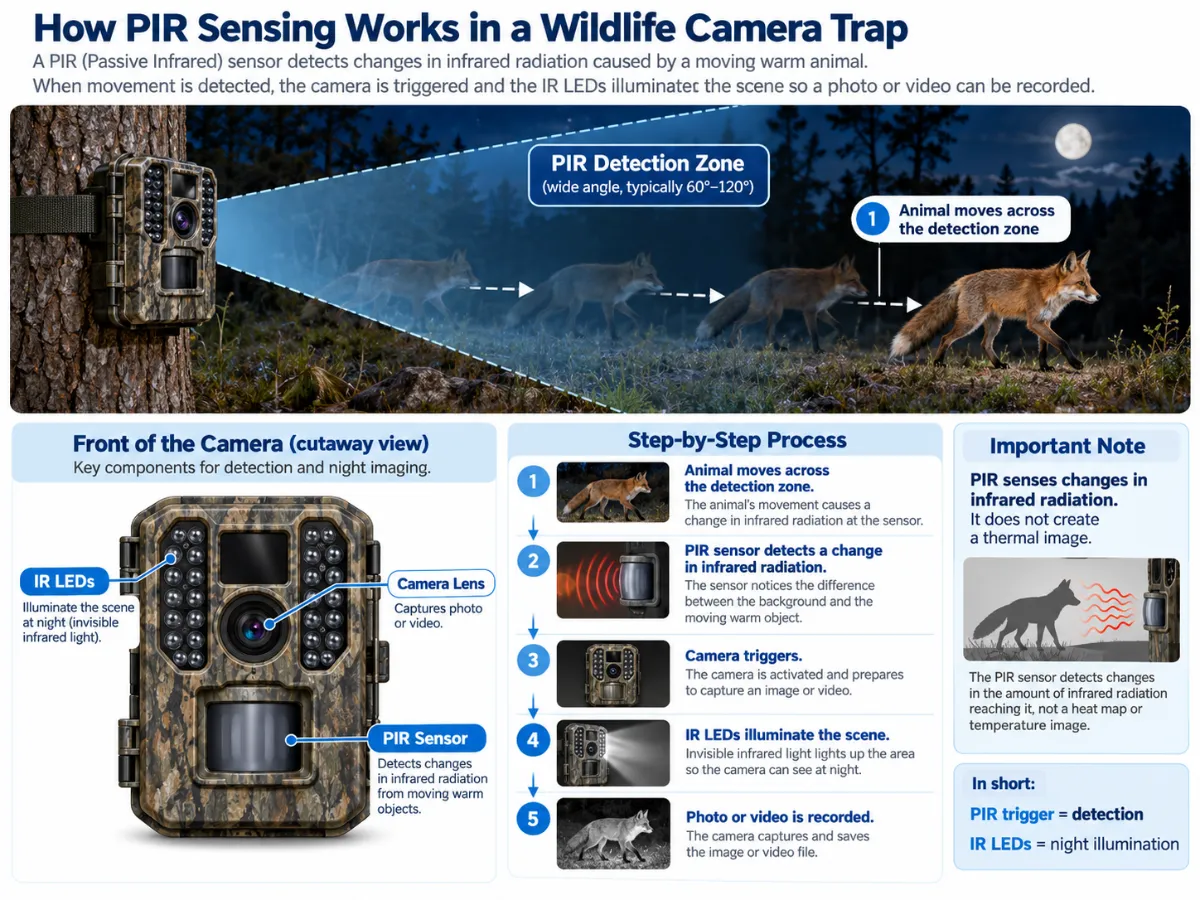
How do camera traps photograph animals at night when the forest is completely dark? Most modern wildlife camera traps use two different infrared technologies. A passive infrared (PIR) sensor detects changes in infrared radiation as an animal moves across its detection area. The camera then takes a photo or video, using infrared LEDs to illuminate the scene when there is not enough visible light.
This is why a trail camera can photograph a fox, deer or other animal at midnight without anyone standing behind the camera.
But there is an important detail: most infrared trail cameras do not produce thermal images. They usually record infrared light reflected from the animal and its surroundings, rather than displaying the animal's body temperature.
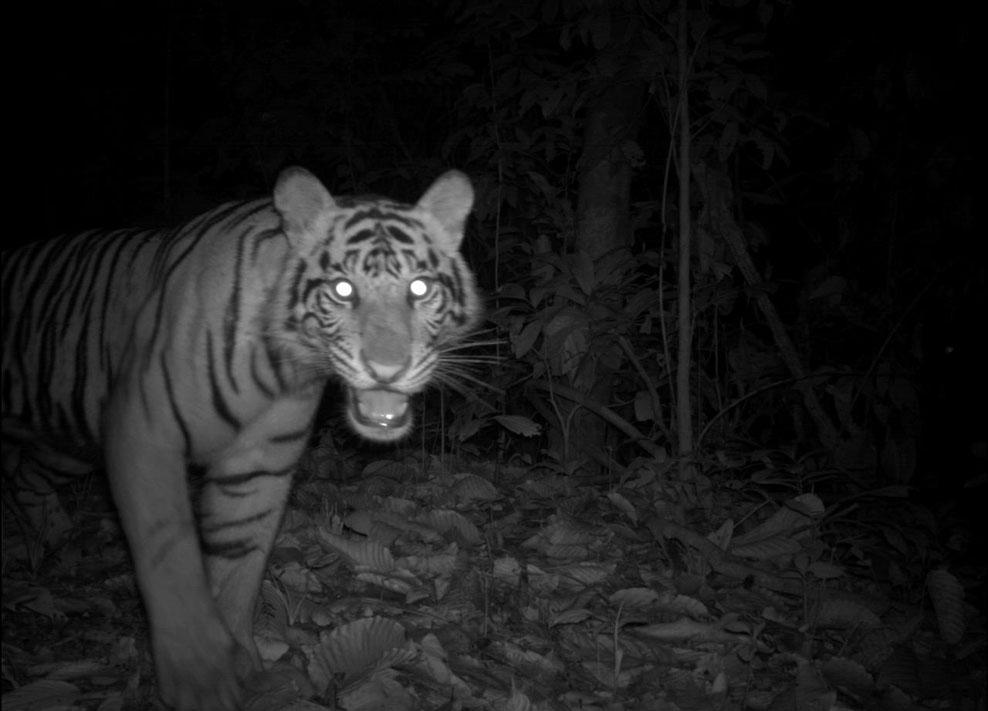
A tiger captured by a wildlife camera trap. Photo: USGS, public domain.
How a Wildlife Camera Trap Works in 5 Steps
A typical motion-triggered camera trap follows this sequence:
Standby: The camera remains ready while its sensor monitors the area in front of it.
Detection: An animal moves through the detection zone, changing the pattern of infrared radiation received by the PIR sensor.
Trigger: The camera's electronics activate a photo or video recording.
Night illumination: If the scene is dark, built-in infrared LEDs illuminate the animal for the image sensor.
Recording: The camera saves the image or video, usually with a time and date stamp.
The complete process can happen in a fraction of a second on some camera models, although actual trigger speeds vary.
Most wildlife cameras do not need to record video continuously. They can remain in standby until a sensor triggers them, conserving battery power and storage space. Some models also offer time-lapse recording or scheduled operation.
What Does a PIR Sensor Actually Detect?
PIR stands for passive infrared. A PIR sensor receives infrared radiation emitted by objects in its surroundings.
It does not work by firing a laser or visible beam toward an animal. Instead, the sensor detects a change in the infrared pattern across its field of view.
For example, imagine a deer walking in front of a forest camera. The surfaces of the deer and surrounding vegetation generally emit different amounts of infrared radiation. As the deer moves across the detection area, the sensor receives a changing infrared signal.
If the change meets the camera's triggering threshold, the camera records an image.
This process depends on more than simply detecting a warm body. Surface temperature differences, movement direction, animal size, distance and sensor sensitivity all affect whether a photograph is taken.
A camera may therefore miss a small animal or an animal that moves outside its detection zone.
How Can a Trail Camera See in Total Darkness?
The camera's night illumination system is separate from its movement detector.
When a camera takes a photograph in darkness, infrared LEDs can illuminate the scene using wavelengths outside most of the light visible to humans.
The camera's image sensor detects light reflected from the animal and the environment. This reflected infrared light helps produce the nighttime photograph.
Many trail cameras use one of two infrared illumination systems:
| Feature | Low-Glow Infrared | No-Glow Infrared |
|---|---|---|
| Typical wavelength | About 850 nm | About 940 nm |
| Visible LED glow | A faint red glow may be noticeable | Generally not visible to humans |
| Night images | Usually black and white | Usually black and white |
| Illumination range | Often stronger for comparable equipment | May be shorter under similar conditions |
| Wildlife disturbance | Less conspicuous than white flash | Generally less visually conspicuous |
Actual performance depends on the camera model, LED power, surroundings and the animal being photographed. No-glow does not guarantee that every animal will be completely unaware of the camera.
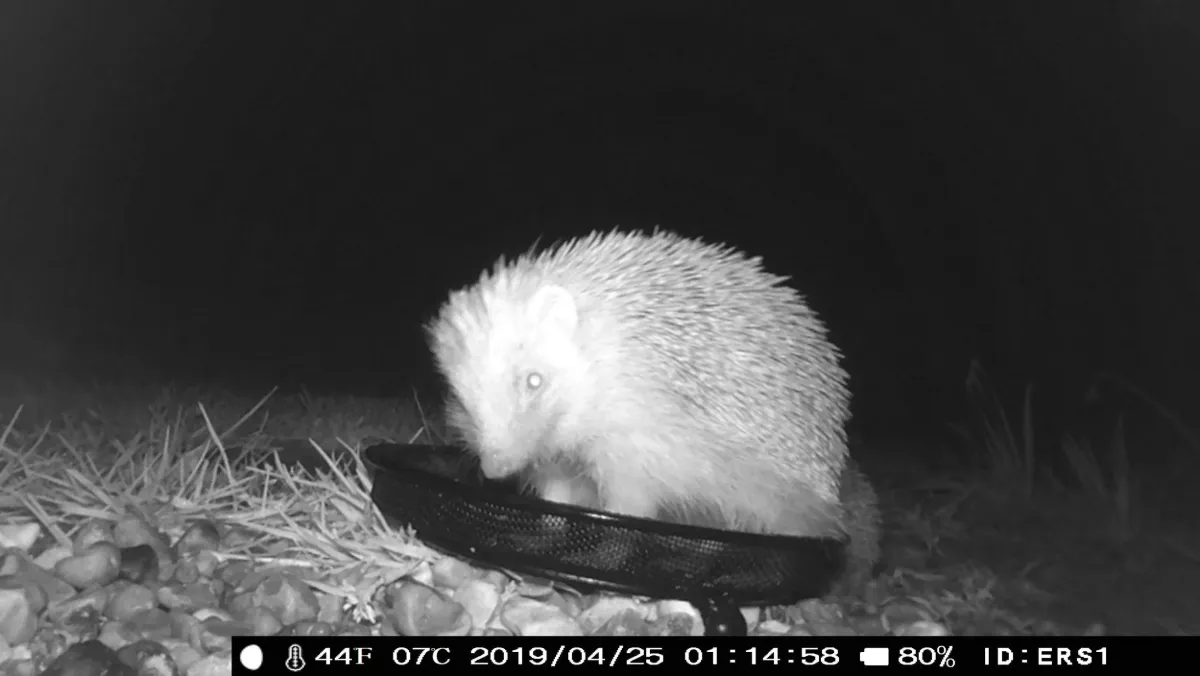
Source: Wikimedia Commons, photograph by Alex P. Kok. Image dimensions 1487 × 836, licensed under CC BY-SA 4.0.
Why Are Nighttime Camera Trap Photos Black and White?
During daylight, a digital camera records visible light and can produce color images.
At night, many trail cameras switch to infrared illumination. Because their infrared imaging mode is not recording ordinary visible colors, the resulting pictures are generally monochrome.
That explains why a brown deer may appear pale gray in a night photograph, or why a reddish fox may look almost white under infrared illumination.
A black-and-white nighttime image is not necessarily a sign that the camera is cheap or defective. It is a normal consequence of infrared photography.
Some cameras use white flashes or visible lighting to record nighttime color images. However, a bright flash can be more conspicuous and may change animal behavior.
Is an Infrared Camera Trap the Same as a Thermal Camera?
No. This is one of the most common misunderstandings about wildlife cameras.
| Technology | What It Detects | Typical Result |
|---|---|---|
| PIR trigger | Changes in infrared radiation across the detection area | Activates the camera |
| Infrared night photography | Reflected near-infrared illumination | Usually a black-and-white wildlife image |
| Thermal imaging | Infrared radiation emitted by objects, related to their surface temperatures | A thermal image showing relative temperature patterns |
A standard infrared trail camera can show the shape, fur, eyes and surroundings of a passing animal. It does not normally create a temperature map of the animal.
Thermal cameras use different imaging sensors and are useful for observing heat patterns, but they are not the same technology as most ordinary wildlife camera traps.
What Animals Can Camera Traps Photograph at Night?
Camera traps can document a wide variety of wildlife. They are especially effective for animals whose movements produce a strong enough infrared change to activate the sensor.
| Animal | Why a Camera Trap Can Be Useful | Important Limitation |
|---|---|---|
| Fox | Records movement and feeding activity at night | Fast movement can result in blurred or missed images |
| Raccoon | Reveals visits to forest paths and feeding areas | One individual may trigger many photographs |
| Deer | Shows movement through trails and habitat edges | Camera position strongly affects detection |
| Bobcat | Can document secretive wild cats without direct observation | Low detection frequency does not prove absence |
| Owl | May capture activity near a suitable perch | Fast flight and smaller body size can make detection difficult |
| Small reptiles | Sometimes records movement when conditions are suitable | PIR sensors may miss animals with weak thermal contrast |
Scientists often use multiple cameras and carefully designed survey methods to investigate species presence and behavior. A single camera's results should not automatically be interpreted as a complete record of the animals living nearby.
To understand the different activity patterns of daytime and nighttime wildlife, see our Diurnal vs. Nocturnal Animals guide.
Why Do Animals' Eyes Glow in Camera Trap Photos?
Some animals appear to have bright white or glowing eyes in nighttime photographs. This effect is known as eyeshine.
Many mammals possess a reflective structure behind the retina called the tapetum lucidum. It reflects some incoming light back through the eye and helps certain animals make better use of low-light conditions.
When infrared illumination from a camera reflects back toward the lens, the eyes may appear unusually bright.
Eyeshine does not mean an animal's eyes produce their own visible light. It is largely a reflection effect, and its appearance depends on the animal, the angle and the illumination system.
Not all species have the same eye structure, so eyeshine is not equally visible in every animal.
Why Doesn't My Trail Camera Capture Animals That Pass By?
Even when a camera works correctly, it can miss wildlife. A PIR sensor has a limited detection area, and camera placement greatly affects its ability to record an animal.
The University of Florida's wildlife camera-trapping guide recommends testing the equipment and adapting camera height and sensitivity to the animals being monitored.
Common Problems and Practical Fixes
| Problem | Possible Explanation | What to Check |
|---|---|---|
| No photos despite animal tracks | Animal moved outside the detection zone or did not trigger the sensor | Camera angle, height, sensitivity and position |
| Only part of the animal is visible | Animal was too close or camera angle was unsuitable | Field of view and camera placement |
| Night photos are almost completely black | Infrared illumination may not reach the animal | Distance, flash settings, battery and obstructions |
| Animals appear white or washed out | Infrared light may be reflecting too strongly from nearby subjects | Distance, nearby vegetation and exposure settings |
| Many empty photographs | Moving vegetation, changing sunlight on surfaces or other environmental triggers | Sensitivity and vegetation in the detection area |
| Animals appear blurry | Rapid movement or insufficient exposure performance | Camera model, trigger response and recording settings |
No camera trap detects every animal. Research has shown that detection probability can differ substantially among species, camera models and survey conditions.
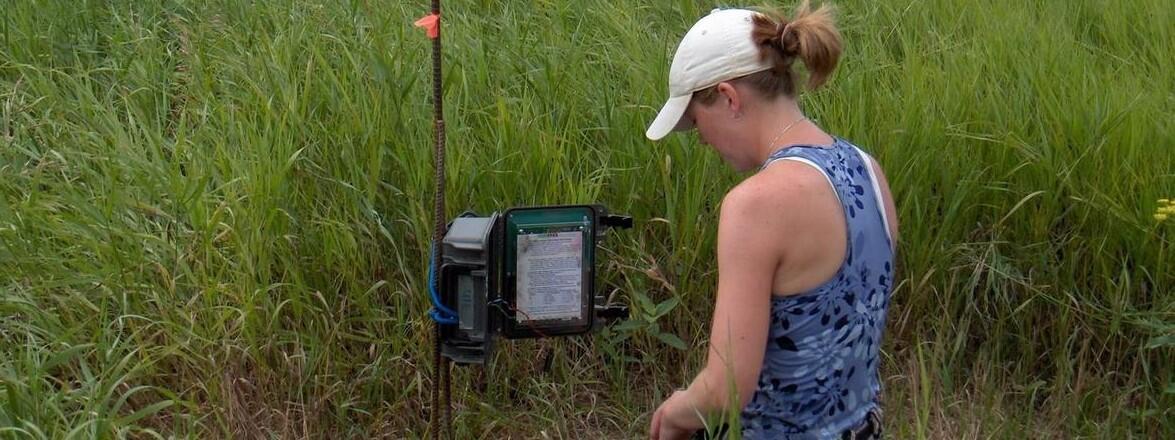
Real-world wildlife camera equipment
USGS, Public Domain
Where Should You Place a Wildlife Camera?
For general wildlife observation, choose a location where animals are likely to travel naturally, such as an established wildlife trail or habitat edge.
For medium-sized and larger animals, the University of Florida suggests that a camera around knee height, approximately 50 cm above the ground, can provide a useful starting point. The ideal height changes with the target species.
Use this basic checklist:
Choose a stable mounting surface.
Point the camera toward a clear section of habitat.
Remove nearby vegetation only where appropriate and permitted.
Keep enough space between the camera and the expected animal path.
Test the camera by walking across the detection area.
Confirm the camera is switched on and the date and time are correct.
Check battery power, storage and weather protection before leaving.
Avoid installing cameras close to sensitive nests, dens or breeding areas if doing so could disturb wildlife. Do not place bait simply to force animals into photographs, particularly in protected areas where it may be prohibited.
Always obtain landowner permission where required and follow local laws about wildlife monitoring, privacy and camera placement.
How Do Scientists Use Camera Traps to Study Wildlife?
For researchers, camera traps provide more than photographs. Their timestamps and locations can help reveal when and where animals are active.
By operating cameras over weeks or months, scientists can collect records that help them investigate habitat use, daily activity patterns and the presence of elusive species.
Camera traps are particularly useful for animals that are difficult to observe directly. For example, conservation teams studying rare forest mammals may deploy multiple cameras across suitable habitat to increase their chances of recording an encounter.
AnimalsTop's Saola conservation profile explains why indirect monitoring methods are important for an exceptionally elusive forest mammal.
What Camera Trap Data Can and Cannot Prove
| Observation | Reasonable Interpretation | What It Does Not Prove |
|---|---|---|
| One fox photo at 2:00 a.m. | A fox was present at that location at the recorded time | All foxes in the area are exclusively nocturnal |
| Several deer photos overnight | Deer used the monitored location during the night | Every image represents a different deer |
| No bobcat photos for a month | No bobcat was recorded by that camera during the period | Bobcats are absent from the surrounding habitat |
| More records in autumn than summer | Detection frequency differed between survey periods | The animal population necessarily increased |
This distinction is important in wildlife science. Camera detections depend on both animal activity and the probability that the equipment detects the animal.
Researchers use appropriate survey designs and statistical methods to account for imperfect detection. Simply counting photographs is not the same as counting individual animals.
Can Camera Traps Disturb Wildlife?
Camera traps are often less intrusive than a person actively following animals, but they are not completely without impact.
Some wildlife may notice sounds from the camera, visible flashes, human scent or changes made during installation.
Using discreet equipment, minimizing unnecessary visits and respecting protected habitats can help reduce disturbance.
Researchers must also consider the privacy of people who may pass through a camera's field of view. Images containing identifiable people should be handled according to applicable privacy laws and project policies.
Frequently Asked Questions
Do trail cameras need sunlight to work?
No. Many trail cameras use infrared illumination to photograph wildlife at night. Their motion sensors can also operate in darkness.
Do infrared trail cameras emit heat?
Infrared LEDs emit electromagnetic radiation for illumination, while PIR sensors passively detect infrared radiation. An ordinary trail camera is not designed to project a thermal image of an animal.
Why are trail camera photos black and white at night?
Most infrared trail cameras use a monochrome night-imaging mode because reflected infrared illumination does not provide the normal visible color information used in daylight photographs.
Can a camera trap record animals without movement?
A typical motion-triggered camera requires a triggering event. However, many models also support time-lapse photography that records images at scheduled intervals, regardless of detected motion.
Can an infrared camera photograph snakes or frogs?
Sometimes, but standard PIR cameras may not reliably detect them when their surface temperatures are similar to the surrounding surfaces or when they are small. Other camera configurations may be more effective.
Can wildlife see the infrared flash?
It depends on the illumination wavelength and the animal. Infrared lighting is generally less conspicuous than white flash, but it should not be assumed to be completely undetectable or harmless to every species.
Can camera traps tell scientists how many animals live in an area?
They can contribute useful information, but photo counts alone generally cannot establish population size. Researchers must consider imperfect detection, repeat visits and the survey design.
The Bottom Line
Camera traps photograph animals at night by combining motion-sensitive infrared detection with night illumination. A PIR sensor notices changes in infrared radiation as an animal moves, while infrared LEDs provide light for a photograph when the surroundings are dark.
For wildlife scientists, these cameras offer a way to record elusive species and observe activity without being physically present at every encounter.
The most important lesson is that a camera trap captures only part of what happens in the wild. Understanding how it works also helps us understand what a photograph can—and cannot—tell us about an animal.
Scientific Sources and Further Reading
University of Florida IFAS Extension — Camera Trapping for Wildlife
Wisconsin Department of Natural Resources — Snapshot Wisconsin: Nighttime Camera Trapping
Game & Wildlife Conservation Trust — Camera Traps for Game Management
Welbourne et al. — How Do Passive Infrared Triggered Camera Traps Operate?