Spiders are often imagined as brown, gray or black animals hiding in dark corners.
But some species are among the most colorful arthropods on Earth.
Colorful spiders can be bright red, green, orange, yellow, metallic silver, electric blue or even rainbow-iridescent.
Some colors come from chemical pigments. Others are structural colors created when microscopic scales, hairs or surfaces manipulate reflected light.
In certain spiders, brilliant coloration plays an important role in courtship. In others it may contribute to camouflage, species recognition or predator avoidance.
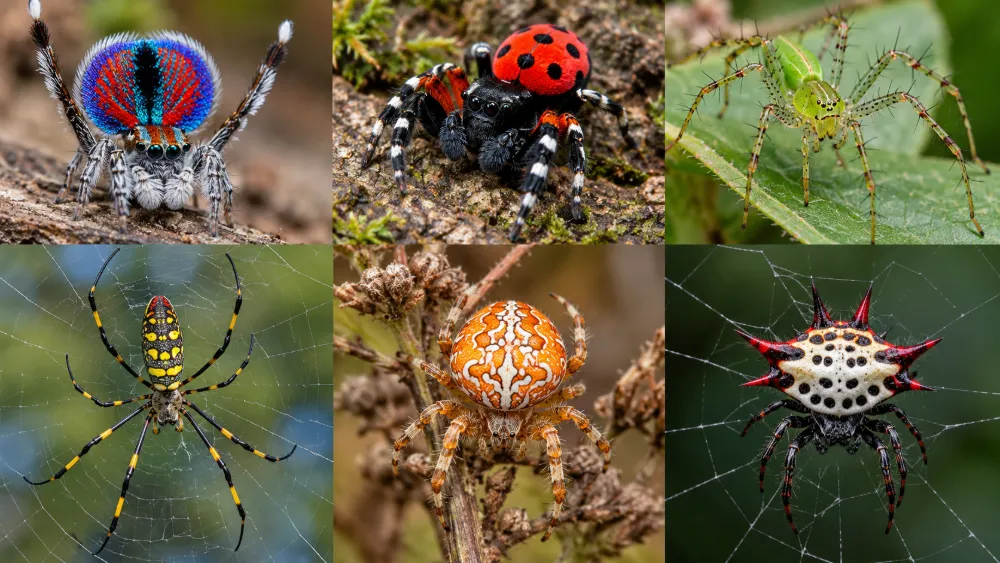
10 Colorful Spiders at a Glance
| Spider | Main Colors | Best-Known Feature |
|---|---|---|
| Peacock Spider | Red, blue, orange, yellow, black | Colorful male courtship display |
| Ladybird Spider | Red and black | Ladybird-like male abdomen |
| Orchard Orbweaver | Silver, green, yellow, orange | Metallic-looking abdomen |
| Spiny-backed Orbweaver | White, yellow, red, black | Bright spiny abdomen |
| Jorō Spider | Yellow, gray-blue, red, black | Large colorful female |
| Marbled Orbweaver | Orange, yellow, white, purple | Marbled rounded abdomen |
| Green Lynx Spider | Bright green, red, black | Green camouflage on plants |
| Hawaiian Happy-Face Spider | Yellow, red, black, white | Highly variable abdomen patterns |
| Regal Jumping Spider | Black, orange, green, blue | Iridescent chelicerae |
| Golden Silk Orbweaver | Yellow, orange, silver, black | Large body and golden-colored web silk |
1. Peacock Spider
Genus: Maratus
Peacock spiders are arguably the most spectacularly colored spiders in the world.
They are tiny jumping spiders native to Australia.
Adult males of many species display combinations of:
red;
orange;
yellow;
blue;
purple;
white;
and extremely dark black.
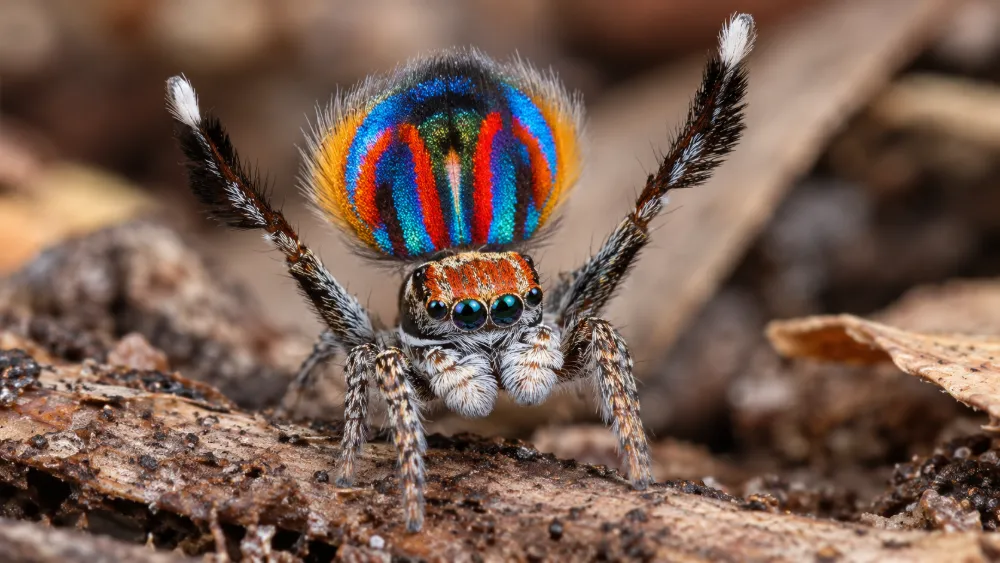
The males do not merely possess colorful abdomens.
They actively display them during courtship.
Depending on species, a male may raise his abdomen, extend colorful side flaps and wave his ornamented legs while moving in front of a female.
Why Are Peacock Spiders So Colorful?
Color is part of their complex visual courtship system.
Male Maratus spiders combine:
bright colors;
body movements;
leg displays;
and vibrations transmitted through the ground.
Females evaluate these multi-part displays during mate choice.
This strong sexual selection has contributed to the evolution of spectacular male coloration.
How Do Peacock Spiders Make Blue Color?
Some peacock-spider colors are produced by pigments, while others come from microscopic structures.
Research on Maratus splendens found that red, orange and cream-colored scales use pigments.
The brilliant blue scales are different.
They contain microscopic structures that interact with light to produce structural coloration.
Other peacock-spider species possess nanoscale gratings capable of producing intense iridescent colors that shift with viewing angle.
What Is a Super-Black Peacock Spider?
Some male peacock spiders also possess extraordinarily dark patches next to their brightest colors.
Researchers have measured parts of these surfaces reflecting less than half of one percent of incoming light under certain conditions.
Microscopic structures help trap and absorb light, producing a velvety black appearance.
The contrast may make neighboring colors appear even brighter during courtship.
2. Ladybird Spider
Scientific name: Eresus sandaliatus
The male Ladybird Spider looks remarkably like its insect namesake.
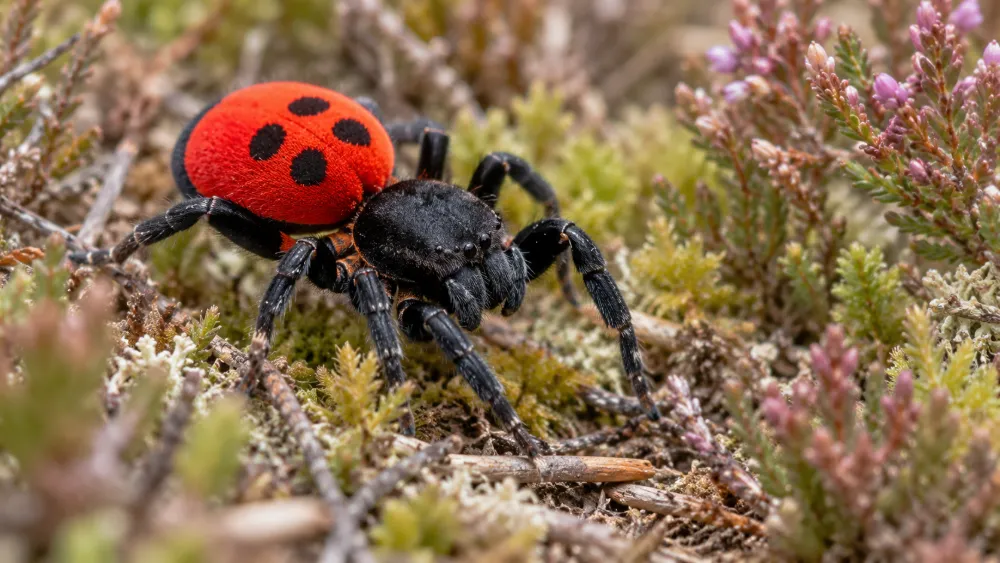
Adult males have a vivid red abdomen marked with prominent black spots.
The head and most of the legs are dark.
Females look dramatically different and are much darker overall.
This species occurs in parts of Europe.
In Britain, it became one of the country's best-known spider conservation stories after being rediscovered on Dorset heathland following decades without confirmed records.
Why Is the Ladybird Spider Red?
The coloration is most conspicuous in adult males.
Red-and-black patterning makes them visually striking as they move above ground while searching for females.
The species spends much of its life in silk-lined burrows, so the colorful wandering males are the individuals most likely to be noticed.
3. Orchard Orbweaver
Genus: Leucauge
Orchard orbweavers are small, elegant web-building spiders that can look almost metallic.
The abdomen may contain combinations of:
silver;
green;
yellow;
orange;
and reddish markings.
They build horizontal or slightly angled orb webs in vegetation.
Orchard orbweavers are common in many parts of eastern North America.
Why Does an Orchard Spider Look Metallic?
Its reflective abdominal surface interacts strongly with light.
This gives some individuals a bright silver or green sheen that can appear almost metallic in direct sunlight.
The effect is very different from the velvet-like coloration of many ground-dwelling spiders.
4. Spiny-Backed Orbweaver
Scientific name: Gasteracantha cancriformis
This small orbweaver is one of the easiest colorful spiders to recognize.
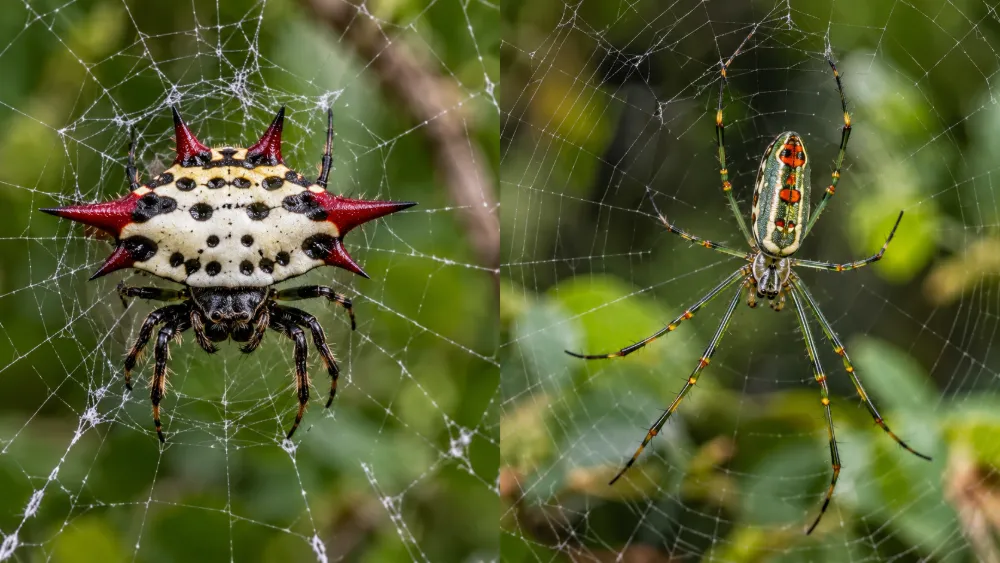
The female has a broad hardened abdomen with several projecting spines.
Color varies among individuals.
Examples include:
white abdomen with red spines;
yellow abdomen with black spines;
white and black patterns;
and other combinations.
University of Florida describes the species as having colorful spiny projections and notes that the spiders capture small insects in circular orb webs.
Is the Spiny-Backed Orbweaver Dangerous?
It may look intimidating, but its dramatic abdominal spines are not venomous stingers.
The spider primarily uses a web to capture small insects.
It is not regarded as a medically significant spider for humans.
5. Jorō Spider
Scientific name: Trichonephila clavata
Adult female Jorō spiders are large and unusually colorful.
They may show:
bright yellow bands;
gray-blue areas;
black markings;
and a conspicuous reddish marking underneath the abdomen.
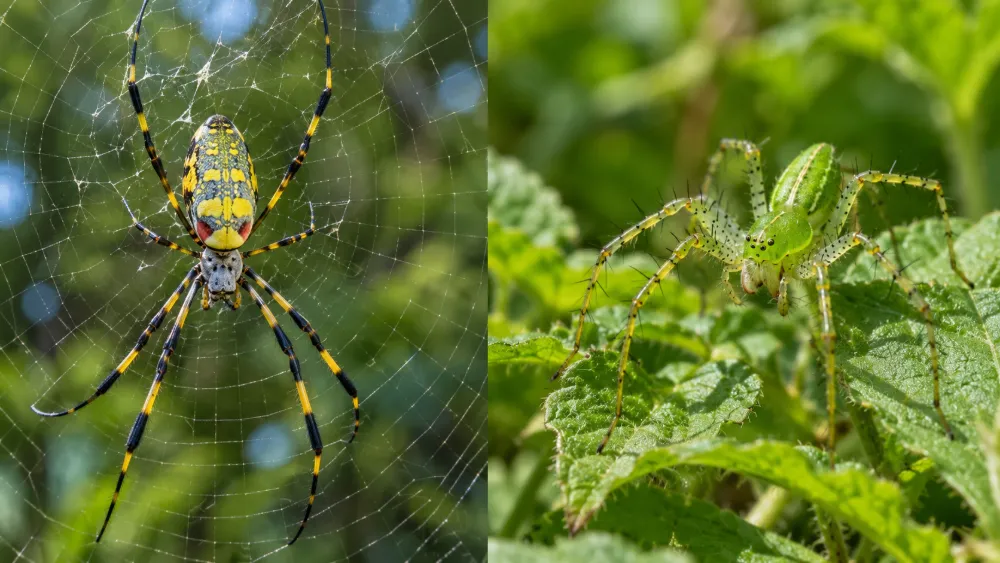
The Jorō Spider is native to Asia and has become established in parts of the United States.
Its large body, long striped legs and enormous orb web make an adult female difficult to overlook.
Are Jorō Spiders Dangerous?
Despite their size and dramatic appearance, they are not considered medically important to humans.
Penn State Extension notes that Jorō spiders are reluctant to bite and that reported bites are not considered medically significant.
6. Marbled Orbweaver
Scientific name: Araneus marmoreus
The Marbled Orbweaver can look almost like a piece of brightly colored candy.
Adult females often have very large rounded abdomens.
Common colors include:
bright orange;
yellow;
cream;
brown;
and purple-brown marbling.
Some individuals are much paler and can appear almost white.
The amount of variation within this one species demonstrates why spider identification should never depend on color alone.
7. Green Lynx Spider
Scientific name: Peucetia viridans
The Green Lynx Spider is a bright green hunting spider found on vegetation.
It does not depend on a capture web.
Instead, it hunts directly among flowers and leaves.
Typical features include:
bright green body;
long green or yellow-green legs;
prominent dark leg spines;
small red markings;
and pale hairs around the eye region.
The green coloration allows the spider to blend surprisingly well among plants despite appearing extremely bright when isolated against another background.
Can Green Lynx Spiders Change Color?
Their appearance can vary.
Individuals may develop more yellowish or reddish tones under some conditions, and changes can take days rather than occurring instantly like a chameleon.
So a Green Lynx Spider is not necessarily exactly the same shade of green throughout its entire life.
8. Hawaiian Happy-Face Spider
Scientific name: Theridion grallator
The Hawaiian Happy-Face Spider is famous for abdominal patterns that sometimes resemble a smiling face.
But not every individual has a smile.
The species is remarkably variable.
Its background can be translucent yellow, while patterns can include:
red;
black;
maroon;
white;
or combinations of these colors.
Scientific studies have documented numerous genetically influenced color morphs.
Does Every Happy-Face Spider Have a Happy Face?
No.
In fact, unpatterned yellow individuals can be very common.
The “happy face” is simply one of several possible abdominal patterns.
This species is valuable to evolutionary biologists because its dramatic color polymorphism provides a natural system for studying how color patterns are inherited and maintained.
9. Regal Jumping Spider
Scientific name: Phidippus regius
Regal Jumping Spiders combine bold body coloration with iridescent mouthparts.
Males are usually dominated by black-and-white markings.
Females can show more gray, brown or orange coloration.
The chelicerae—the structures bearing the fangs—can reflect brilliant:
green;
blue;
turquoise;
or violet.
Like other jumping spiders, they also have large forward-facing eyes and excellent vision.
10. Golden Silk Orbweaver
Scientific name: Trichonephila clavipes
The Golden Silk Orbweaver is a large web-building spider found in the Americas.
Adult females can show combinations of:
yellow;
orange;
silver;
brown;
and black.
The common name also refers to the remarkable golden appearance of its web silk in suitable light.
Large females can be conspicuous in woodland edges and gardens where their enormous webs stretch between plants.
What Is the Most Colorful Spider?
There is no scientific award for the world's most colorful spider.
However, male Peacock Spiders are among the strongest candidates because some species combine:
multiple pigment colors;
iridescent structural blue;
rainbow structural effects;
and exceptionally deep black.
They also actively display those colors during courtship rather than simply using them as static body markings.
Are There Really Rainbow Spiders?
Yes, although “rainbow spider” is not one single scientific species.
Some Peacock Spiders can reflect multiple wavelengths through microscopic nanostructures on their scales.
Researchers studying Maratus robinsoni and related species found tiny diffraction-grating structures capable of separating visible light into brilliant iridescent colors.
The effect is produced physically by light interacting with microscopic structures rather than by a literal rainbow-colored pigment.
Why Are Some Spiders Blue?
Blue is relatively difficult to produce using biological pigments alone.
In several spiders, blue appearance is created partly or primarily by structural coloration.
Microscopic hairs, scales or cuticular layers interfere with reflected light so that certain wavelengths are emphasized.
This is similar in principle to structural colors found in:
butterflies;
beetles;
birds;
and other colorful animals.
Why Are Some Spiders So Brightly Colored?
There is no single reason.
Color can serve different functions in different species.
Courtship
Male Peacock Spiders use vivid visual ornaments during elaborate mating displays.
Camouflage
A bright green Green Lynx Spider can disappear surprisingly effectively against foliage.
Species Recognition
Distinctive patterns can help animals distinguish suitable mates or competitors.
Predator Interactions
High-contrast patterns may influence how predators detect or respond to a spider, although the function must be studied separately for each species.
Does Bright Color Mean a Spider Is Venomous?
No.
Color is not a reliable way to determine whether a spider is medically dangerous.
Most spiders use venom to subdue small prey, but the effects of their venom on humans vary enormously.
Some highly colorful species are of little medical significance.
Conversely, a spider does not need to be brightly colored to possess medically important venom.
Identification should be based on species-specific anatomy and geographic range rather than a rule such as “bright colors mean dangerous.”
Are Colorful Orbweavers Dangerous?
The colorful orbweavers discussed here—including Orchard Orbweavers, Spiny-backed Orbweavers and Marbled Orbweavers—are not regarded as major medical threats to people.
They generally remain in or around their webs and prey primarily on insects.
As with any wild spider, avoid unnecessary handling.
Why Do Spider Colors Look Different in Photographs?
Structural colors can change dramatically with:
viewing angle;
sunlight direction;
flash photography;
camera exposure;
and background color.
An iridescent spider can therefore appear blue in one photograph and purple or green in another.
This is particularly important when identifying jumping spiders and other species with reflective scales.
FAQ
What is the most colorful spider?
There is no official record, but male Peacock Spiders are among the most colorful known spiders because they combine bright pigments, structural colors and elaborate courtship displays.
What spider is rainbow colored?
Several Peacock Spiders in the genus Maratus display rainbow-like iridescence produced by microscopic structures on their scales.
Are blue spiders real?
Yes. Blue coloration occurs in several spider groups and is often created through structural coloration rather than simple blue pigment.
What spider is bright green?
The Green Lynx Spider, Peucetia viridans, is a striking bright-green North American species commonly found hunting on vegetation.
What spider is red with black spots?
An adult male Ladybird Spider has a vivid red abdomen with black spots, giving it a ladybird-like appearance.
What spider has colorful spikes?
The Spiny-backed Orbweaver has a hardened abdomen with colorful spines. Individuals can be white and red, yellow and black or other combinations.
Are colorful spiders poisonous?
Bright coloration does not indicate whether a spider is dangerous. Most spiders possess venom for prey capture, but only a small subset is medically significant to humans.
Are Jorō spiders dangerous?
They are not considered medically important. They are reluctant to bite, and reported bites are generally mild.
Do spiders change color?
Some species can change appearance gradually, while others show different colors as they mature. Structural colors can also appear to change instantly when the viewing angle changes.
Why are Peacock Spiders colorful?
Male Peacock Spiders use their bright colors as part of elaborate visual and vibrational courtship displays to females.
Final Answer
Some of the world's most colorful spiders rival butterflies and birds in visual complexity.
Male Peacock Spiders combine brilliant red, blue, orange and rainbow structural colors during courtship, while Ladybird Spiders use dramatic red-and-black markings.
Orbweavers add another range of colors, from metallic silver-green Orchard Orbweavers to orange Marbled Orbweavers and spiny white, red or yellow Gasteracantha.
Other species show how color can serve very different functions: a Green Lynx Spider uses bright green to blend into foliage, while the Hawaiian Happy-Face Spider displays extraordinary inherited color variation.
Most importantly, color alone does not tell you whether a spider is dangerous.
A colorful spider is a visual trait—not a venom warning label.
Related Reading
Sources Used for Fact Checking
Royal Society / Scientific Reports — Peacock Spider Structural Coloration
Buglife — Ladybird Spider
University of Florida IFAS — Orchard Orbweaver
University of Florida IFAS — Spiny-backed Orbweaver
Penn State Extension — Jorō Spider
Penn State Extension — Marbled Orbweaver
Heredity — Hawaiian Happy-Face Spider Color Polymorphism